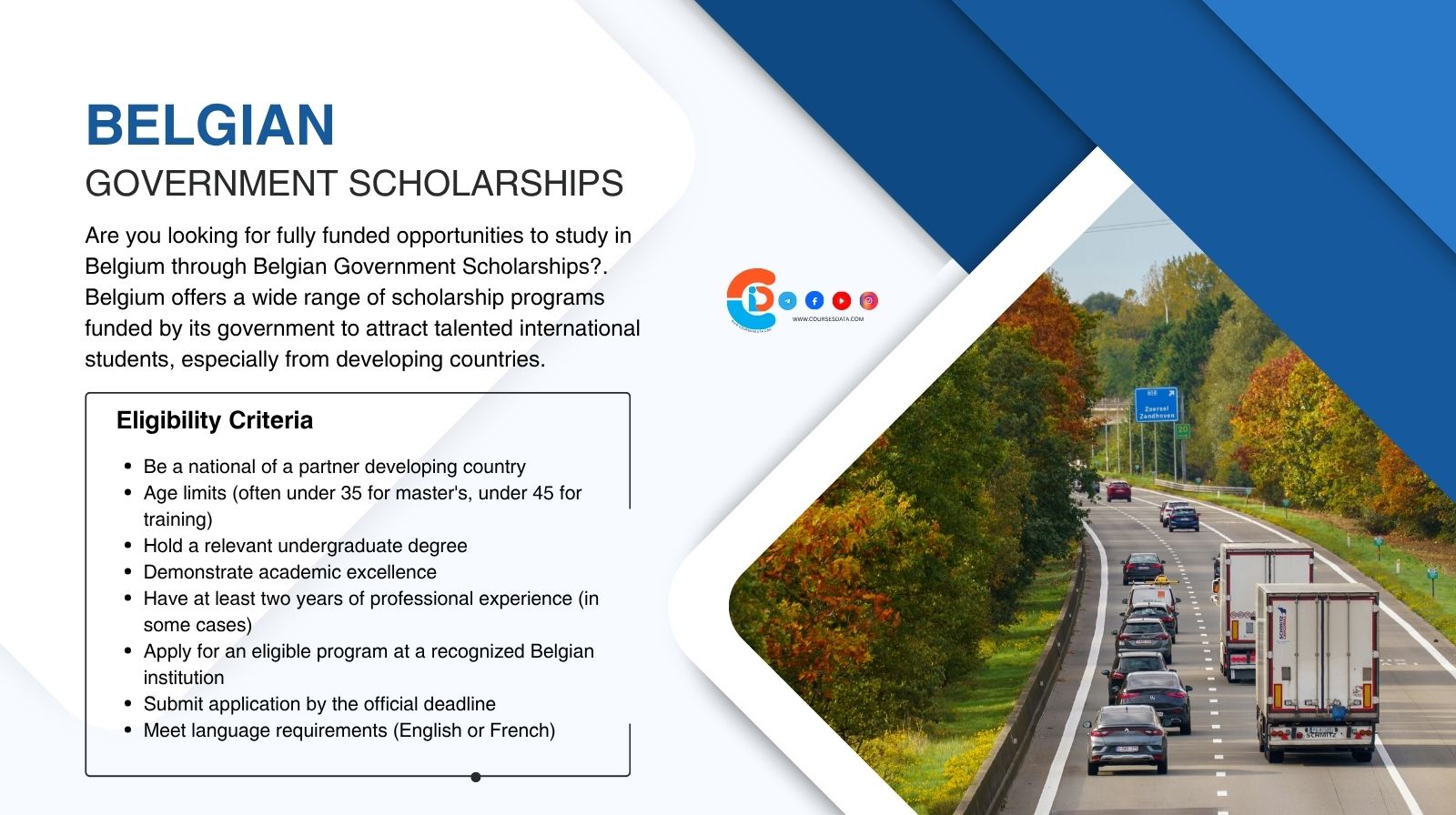
Belgian Government Scholarships can provide international students and researchers with financial support to study or conduct advanced academic work in Belgium.
However, the funding system is divided between Belgium’s language communities and different public or publicly supported organisations, so applicants need to choose the scholarship according to their study level, nationality, programme, and destination region.
What Are Belgian Government Scholarships?
The term Belgian Government Scholarships is commonly used to describe scholarship opportunities supported or administered by Belgian public institutions and government-linked organisations.
Belgium has a decentralised higher education system.
This means that scholarship opportunities can come from the Flemish Community, the Wallonia-Brussels Federation, or organisations working within Belgium’s international development cooperation framework.
For international students, the main opportunities to investigate include:
- ARES scholarships for eligible applicants studying in Wallonia-Brussels.
- Master Mind Scholarships for master’s studies in Flanders and Brussels.
- VLIR-UOS scholarships for selected programmes in Flanders.
- Erasmus Mundus scholarships delivered through Belgian universities as part of international consortia.
- Research and postdoctoral funding offered through regional organisations.
- University-specific scholarships connected with Belgian higher education institutions.
The important point is that Belgian Government Scholarships are not one universal application programme.
Each scholarship has its own eligibility conditions, participating institutions, application process, and funding structure.
Official Study in Belgium scholarship information
Main Belgian Scholarship Opportunities for International Students
The right scholarship depends heavily on your academic level and the Belgian institution you want to attend.
The following options are particularly relevant for international applicants.
ARES Scholarships
ARES scholarships are offered through the cooperation framework of the Wallonia-Brussels Federation.
They can support international students who want to follow selected advanced bachelor’s, master’s, or continuing-education programmes at higher education institutions in Wallonia-Brussels.
The programmes are specialised rather than covering every degree available in Belgium.
ARES describes its international training scholarships as covering one-year advanced bachelor’s or master’s programmes and continuing-education programmes lasting several months.
Before preparing an application, check whether your academic background and nationality correspond to the specific call and whether your intended programme is included.
Useful steps include:
- Check the official ARES scholarship programme.
- Review the eligible countries.
- Examine the participating study programmes.
- Check the academic requirements.
- Prepare your academic documents.
- Review the language requirements.
- Prepare your motivation statement.
- Follow the official application procedure.
- Submit only through the designated application system.
- Keep copies of all submitted documents.
ARES scholarship information through Study in Belgium
Master Mind Scholarship
The Master Mind Scholarship is administered by the Flemish Ministry of Education and Training for outstanding international students applying for master’s programmes at participating Flemish higher education institutions.
For the current scholarship scheme, the grant is €10,225, together with a tuition-fee arrangement.
The scholarship can cover one academic year for a 60-ECTS master’s programme or two academic years for a 120-ECTS programme, subject to the programme and scholarship conditions.
The scholarship is highly structured.
Students do not simply submit an independent scholarship application to the Flemish government; they first apply to a participating host institution, which conducts its own academic assessment and preselection.
Applicants should therefore:
- Choose an eligible master’s programme.
- Confirm that the institution participates.
- Apply to the host institution.
- Meet the institution’s admission requirements.
- Prepare a strong academic record.
- Demonstrate the required English proficiency.
- Prepare a motivation letter.
- Obtain recommendation letters.
- Submit the required documents.
- Complete the scholarship application if preselected.
- Monitor communications from the institution.
The official eligibility information specifies, among other requirements, a GPA equivalent to at least 3.5 out of 4.0 and accepted English-language evidence such as IELTS, TOEFL, or an equivalent qualification recognised by the host institution.
Official Master Mind Scholarship page
VLIR-UOS Scholarships
VLIR-UOS provides scholarships for selected international study programmes in Flanders.
Its ICP Connect scholarships are aimed at applicants from 29 eligible countries in Africa, Asia, and Latin America.
These scholarships are programme-specific.
Therefore, an applicant should not assume that any master’s programme at a Flemish university can be funded through VLIR-UOS.
The first step is to identify the eligible programmes and check whether your nationality and country of residence meet the conditions.
Applicants should check:
- Eligible countries.
- Eligible study programmes.
- Academic admission requirements.
- Age conditions.
- Nationality requirements.
- Country-of-residence requirements.
- Language requirements.
- Scholarship application instructions.
- Required supporting documents.
- The official programme information before applying.
Official VLIR-UOS study scholarships
Who Can Apply for Belgian Government Scholarships?
Eligibility varies significantly between scholarship programmes.
There is no single nationality list or academic requirement that applies to every Belgian Government Scholarship.
For example, Master Mind is open internationally subject to its stated exclusions and conditions, while VLIR-UOS restricts its scholarship to applicants from a defined group of eligible countries.
Typical eligibility factors include:
- Nationality.
- Country of residence.
- Academic qualifications.
- Grade point average.
- Previous degree.
- Intended degree level.
- Admission to a participating institution.
- English-language proficiency.
- Professional or research experience where applicable.
- Age requirements for particular programmes.
- Previous study experience in Belgium.
- Compliance with programme-specific conditions.
For example, Master Mind applicants need to be accepted by a participating Flemish institution before the scholarship can ultimately be awarded.
The applicant can be nominated by only one Flemish higher education institution.
This makes programme selection an important part of the scholarship strategy rather than something to consider after applying.
What Do Belgian Scholarships Cover?
The financial package depends on the scholarship.
A scholarship described as “fully funded” should not automatically be interpreted as covering every possible personal expense.
Applicants should read the official funding conditions carefully.
Depending on the programme, financial support may include:
- Tuition-fee support or a tuition-fee waiver.
- A living allowance.
- Travel support.
- Insurance.
- Accommodation-related support.
- Research-related costs.
- Educational expenses.
- Other approved mobility expenses.
For example, the Master Mind Scholarship provides a grant and tuition-fee arrangement, but the host institution may apply a limited tuition contribution under the programme’s rules.
For some research-focused WBI opportunities, the support structure can include return travel, a monthly scholarship, insurance, and specified educational or registration costs.
These programmes target particular research profiles rather than general undergraduate or master’s applicants.
Therefore, always separate tuition funding from living-cost funding when comparing scholarships.
What Documents Do You Need?
Preparing documents early can make the application process much easier.
Although requirements vary, competitive Belgian scholarship applications commonly involve academic, identity, language, and motivation documents.
Prepare the following where applicable:
- Passport or national identity document.
- Bachelor’s or previous degree certificate.
- Academic transcripts.
- Curriculum vitae.
- Proof of English proficiency.
- Motivation letter.
- Academic recommendation letters.
- Proof of admission or application to the host institution.
- Research proposal for research programmes.
- Publications or academic evidence where requested.
- Certified translations when required.
Master Mind’s official application instructions specifically list a profile picture, passport or national ID, CV, transcript, English-language evidence, motivation letter, two signed recommendation letters, and degree certificates among the required materials for the scholarship application.
Do not submit generic documents simply because they worked for another scholarship.
Adapt the application to the exact programme and institution.
How to Apply for Belgian Government Scholarships
The application procedure depends on the scholarship, but a practical approach is to work backwards from the programme requirements.
Start by selecting a realistic academic programme rather than searching only for the largest scholarship amount.
A practical application process is:
- Identify your desired degree level.
- Decide whether you want to study in Flanders or Wallonia-Brussels.
- Search official scholarship databases.
- Check nationality and residence requirements.
- Find an eligible programme.
- Verify university admission requirements.
- Prepare your academic documents.
- Prepare your language evidence.
- Write a programme-specific motivation letter.
- Submit the university application where required.
- Complete the scholarship procedure.
- Save confirmation of submission.
For Master Mind, the host institution performs a preselection and may nominate applicants before the scholarship application is completed through the designated system.
This means that applying to the university and applying for the scholarship can be connected stages of the same process.
How to Choose the Right Scholarship
The best starting point is not the scholarship name but your academic profile.
For example, a student seeking a master’s degree in Flanders may investigate Master Mind, while an applicant from an eligible developing country interested in a participating VLIR-UOS programme may need to examine that route instead.
Use these questions:
- What degree do I want?
- Which Belgian region offers my programme?
- Is the programme taught in English?
- Is my nationality eligible?
- Do I meet the academic requirements?
- Does my university participate?
- Is my programme specifically included?
- Does the scholarship support my study level?
- What costs are actually covered?
- What documents will I need?
A useful comparison is:
| Scholarship | Main destination | Typical target | Key feature |
|---|---|---|---|
| ARES | Wallonia-Brussels | Selected international students | Advanced bachelor’s, master’s and continuing education |
| Master Mind | Flanders and Brussels | International master’s students | Government-funded master’s scholarship |
| VLIR-UOS | Flanders | Applicants from eligible countries | Selected international study programmes |
| WBI research scholarships | Wallonia-Brussels | Researchers and postdoctoral candidates | Research and mobility support |
| Erasmus Mundus | Multiple countries, including Belgium | International master’s applicants | Joint programmes delivered by international consortia |
ARES programme information is published through Wallonia-Brussels Campus, while Master Mind and VLIR-UOS information is provided through official Flemish scholarship sources.
Common Mistakes to Avoid
Many scholarship applications fail before the selection stage because applicants misunderstand the eligibility rules.
Avoid these common problems:
- Applying for a programme that is not eligible.
- Ignoring nationality restrictions.
- Applying after the scholarship process has closed.
- Confusing university admission with scholarship selection.
- Using an unsuitable language certificate.
- Submitting incomplete transcripts.
- Sending untranslated documents when translation is required.
- Writing a generic motivation letter.
- Applying through unofficial websites.
- Assuming every Belgian scholarship covers all expenses.
One particularly important mistake is treating Belgium as though it has one national scholarship authority for international students.
The country’s scholarship opportunities are administered through different regional and institutional structures.
How to Make Your Application Stronger
Meeting the minimum eligibility criteria does not necessarily make an application competitive.
Your application should show a clear connection between your previous education, proposed programme, and future academic or professional direction.
Focus on evidence rather than general statements.
For example, instead of simply saying that you are “passionate about international development,” explain what you studied, what problem you have worked on, and why the selected programme provides the training you need.
A strong application can benefit from:
- A coherent academic trajectory.
- Relevant coursework.
- Strong academic performance.
- Relevant professional experience.
- Clearly defined academic interests.
- A focused motivation letter.
- Specific reasons for choosing the programme.
- Strong recommendation letters.
- Evidence of leadership or community engagement when relevant.
- A realistic explanation of future goals.
For research applications, the quality and relevance of the proposed research can become particularly important.
WBI’s research scholarship information, for example, lists factors such as academic record, research area, publications, recommendations, career path, and the added value of the proposed mobility among its selection considerations.
Conclusion
Belgian Government Scholarships offer several routes for international students and researchers, but applicants need to identify the correct regional or programme-specific opportunity rather than searching for one universal Belgian scholarship.
ARES is particularly relevant to selected programmes in Wallonia-Brussels, while Master Mind and VLIR-UOS are important options for eligible applicants considering participating institutions and programmes in Flanders.
The most practical approach is to begin with your degree level, nationality, academic background, and intended programme.
Then verify every requirement on the official scholarship or university website before preparing and submitting your application.
Frequently Asked Questions
Are Belgian Government Scholarships fully funded?
Some Belgian scholarship programmes provide substantial financial support, but the exact package differs.
Applicants should check whether the scholarship covers tuition, living expenses, travel, insurance, accommodation, or only specific costs before assuming that it is fully funded.
Can international students apply for Belgian Government Scholarships?
Yes, several Belgian scholarship programmes are specifically designed for international students.
However, eligibility depends on the individual scholarship, nationality, programme, academic level, and other conditions.
Is there one official Belgian Government Scholarship?
No single scholarship covers all international students and all Belgian universities.
Belgium’s higher education and scholarship structures involve different communities, public authorities, and organisations, so applicants need to identify the programme that matches their destination and academic profile.
Can I apply for the Master Mind Scholarship for a bachelor’s degree?
Master Mind is designed for master’s programmes at participating Flemish higher education institutions.
It is therefore not a general bachelor’s scholarship.
Does Master Mind require an English test?
Master Mind applicants normally need recognised evidence of English proficiency, unless an applicable exemption is accepted by the host institution.
The official eligibility page lists IELTS, TOEFL, CEFR B2, or an equivalent recognised result among the accepted options.
Can students from developing countries apply for VLIR-UOS?
VLIR-UOS scholarships are restricted to applicants from its designated eligible countries.
The current official information identifies 29 eligible countries across Africa, Asia, and Latin America, and applicants must also satisfy the programme’s other conditions.
Does ARES support bachelor’s and master’s studies?
ARES international training scholarships can support selected advanced bachelor’s and master’s programmes, as well as certain continuing-education programmes.
They are programme-specific, so applicants must check the current list rather than assuming that every Belgian degree is eligible.
Do I need university admission before applying for a Belgian scholarship?
It depends on the scholarship.
Master Mind, for example, requires the applicant to obtain acceptance from the participating Flemish institution as part of the scholarship process, while other programmes can have different procedures.
Can I apply for more than one Belgian scholarship?
Potentially, but each scholarship has its own rules concerning multiple applications and combining financial awards.
Master Mind, for example, cannot be combined with certain other scholarships, including another Flemish Government scholarship and specified international scholarship schemes.
Where should I check official Belgian scholarship information?
Start with official scholarship portals and the website of the university offering your intended programme.
Useful official sources include Study in Belgium, Study in Flanders, VLIR-UOS, Wallonie-Bruxelles International, and the relevant university’s international office.
I’ve looked into these ARES scholarships before, and I’ll admit the application process is no joke—lots of paperwork and specific country eligibility lists, so don’t assume you qualify just because you’re from a developing nation. That said, the coverage is genuinely impressive: they actually pay for your visa and round-trip airfare, which is rare. One thing I’m curious about is how competitive the advanced training programs are compared to the master’s tracks—anyone have insight into acceptance rates?
You’re spot on about the paperwork—I almost gave up halfway through my ARES application until I realized they actually cover the visa and airfare, which is a huge relief. From what I’ve seen, the advanced training programs are a bit less competitive than the master’s tracks since they’re shorter and more specialized, but you still need solid professional experience to get in. If you’re serious about applying, I’d recommend starting your documents early and double-checking that your country is on their list before diving in.
Oh, I can totally relate to that paperwork shock—I almost abandoned my application twice before I discovered they cover the visa fees and flights, which honestly saved my budget. From what I gathered while digging through forums, the advanced training programs are noticeably less competitive than the master’s tracks because they’re shorter and more targeted, but you still need solid work experience to get noticed. I’d say it’s worth focusing on those shorter courses if your country isn’t listed for the master’s or if you want a slightly better shot at actually getting in.
Honestly, I can’t give you exact acceptance rates, but after digging through forums and talking to a few past applicants, it sounds like the advanced training programs are noticeably less cutthroat than the master’s tracks—probably because they’re shorter and more niche. That said, don’t let that fool you into thinking they’re easy; you still need strong professional experience to stand out. I’d say if your country isn’t on the master’s list or you want a slightly better shot, those shorter courses are absolutely worth a serious look.
I actually applied for an ARES master’s scholarship two years ago and made it to the final round, so I can tell you the competition is brutal—I heard they accept maybe 150 out of over 2,000 applicants each year. The advanced training programs are a bit less competitive simply because they’re shorter and more niche, but you still need a rock-solid professional background to stand out. One thing that caught me off guard was how strict they are with the country list; I’d double-check that before sinking hours into the paperwork.
Ah, the ARES application process—where you get to prove your dedication to higher education by filling out more forms than you did for your actual degree. That 150-out-of-2,000 stat from Jasper Tolland is exactly the kind of cheerful reality check I needed before I start drafting my personal statement. Still, if they’re covering the visa and airfare, I suppose I can’t complain too loudly while I’m photocopying my entire academic history for the third time.
You’re not wrong about the paperwork—I swear they ask for more copies of your transcripts than your own university did. But that 150-out-of-2,000 stat is exactly why I’m side-eyeing the master’s track and giving the advanced training programs a harder look. If the competition’s that insane, I’d rather aim for a shorter, more niche program where my professional experience might actually give me an edge.
Niamh, you’ve perfectly captured the emotional rollercoaster of this application—I’m pretty sure I’ve got paper cuts just from *thinking* about photocopying my transcripts again. That 150-out-of-2,000 stat is daunting, but honestly, knowing they cover the visa and airfare is the only thing keeping me from tossing my entire folder into the bin. I’m also seriously considering the advanced training programs now, since my country only qualifies for those anyway.
Ugh, that 150 out of 2,000 stat from Jasper makes my stomach drop a little, but honestly, it helps to know what we’re up against. I’m kicking myself because I almost missed the country eligibility list—turns out my home nation isn’t on it for the master’s track, but it *is* for the advanced training programs, which I hadn’t even considered. So if you’re struggling with the competition, definitely peek at those shorter courses; they might be a smarter bet than banging your head against the master’s wall.
Honestly, that 150 out of 2,000 figure from Jasper is a bit of a gut punch, but it’s also refreshing to have a realistic target instead of vague optimism. I’m in the same boat as Chloe and Shaylene—I’ve been so fixated on the master’s track that I completely overlooked the advanced training programs, and now I’m wondering if my years of fieldwork in public health might actually make me a stronger candidate for those shorter, more specialized courses. For anyone else on the fence, have you found that the advanced programs prioritize certain professional backgrounds over academic scores?