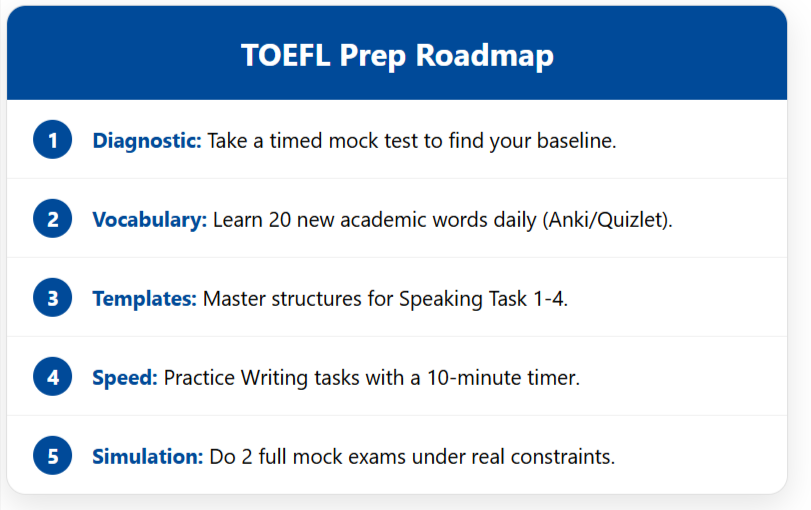
Have you ever wondered how to prepare effectively for the TOEFL exam and achieve your dream score on the first attempt? The TOEFL test is one of the most respected English proficiency exams worldwide. Whether you’re aiming for university admission, professional certification, or immigration, mastering this test requires a clear strategy and consistent effort.
What Is the TOEFL Exam and Why It Matters
The TOEFL (Test of English as a Foreign Language) evaluates your ability to use and understand English in academic settings. It measures key communication skills—reading, listening, speaking, and writing—across realistic university‑style contexts. Recognized by more than 11,000 institutions in over 150 countries, the TOEFL test is a crucial step toward your global goals.
TOEFL results not only open doors to international education but also demonstrate your readiness to thrive in an English‑speaking environment. High scores can boost scholarships, enhance job opportunities, and reflect your overall English competence. Preparation, therefore, is not just about passing—it’s about building lasting confidence.
Step 1: Understand the TOEFL Exam Structure
Knowing the format of the TOEFL test is the first and most crucial step in your preparation journey. The exam consists of four sections—Reading, Listening, Speaking, and Writing—each assessing a unique aspect of your English skills. Familiarity with this structure removes uncertainty and helps manage time effectively on test day.
- Reading: 3–4 passages from academic texts.
- Listening: 4–6 lectures and 2–3 conversations.
- Speaking: 4 tasks, including independent and integrated prompts.
- Writing: 2 tasks—Summarizing and Writing an Opinion Essay.
- Duration: About 3 hours total.
- Scores range: 0–120 overall.
- Each section: 0–30 points.
- Test type: Internet‑based (iBT).
- Grammar and vocabulary assessed indirectly.
- Universities consider both total and sectional scores.
Understanding the test pattern allows you to craft a targeted study plan. Many successful candidates begin by taking an initial diagnostic test to identify their current level and weak areas.
Step 2: Build a Solid Study Plan
Once you know the test structure, the next step is to design an organized and realistic study plan. A well‑structured schedule keeps you accountable and ensures consistent progress. Plan for at least 8–12 weeks of focused preparation depending on your current English level.
- Divide your study time across the four sections.
- Study at least 2 hours daily with short breaks.
- Set weekly goals for vocabulary, grammar, and practice tests.
- Track progress in a study journal or spreadsheet.
- Focus first on weaker sections, then strengthen the rest.
- Rotate skills to avoid fatigue or boredom.
- Schedule full mock tests every two weeks.
- Review errors carefully and note recurring mistakes.
- Include English immersion activities like podcasts or news.
- Adjust your study plan weekly based on practice results.
A strong strategy involves both active learning (writing essays, answering questions) and passive learning (reading, listening). This combination sharpens comprehension and builds natural English fluency.
Step 3: Practice Each TOEFL Section Strategically
Each part of the TOEFL exam has unique challenges. Mastering them requires targeted practice, not random study. Understanding question patterns and mastering timing can dramatically boost your score.
Reading Section
Improve comprehension by reading academic materials daily—journals, articles, or essays.
- Skim for main ideas before deep reading.
- Identify the topic sentence of each paragraph.
- Take notes on key details and transitions.
- Practice summarizing sections in one sentence.
- Watch for vocabulary in context questions.
- Manage time—don’t overthink difficult passages.
- Learn common transition signals (however, moreover).
- Use official TOEFL reading sets for practice.
- Review why wrong answers are incorrect.
- Aim for 22–26 points through consistent effort.
Listening Section
Develop your listening skills with authentic English sources like university lectures or TED Talks.
- Practice active listening by summarizing audio.
- Identify tone and intent of the speaker.
- Predict answers before seeing options.
- Take short, structured notes while listening.
- Focus on key nouns, verbs, and transitions.
- Re‑listen to check missed details.
- Use captions sparingly at first, then turn off.
- Train ears with various accents (US, UK, Canadian).
- Review transcripts for difficult sections.
- Keep improving through daily audio exposure.
Speaking Section
Fluent and coherent speech plays a vital role. Confidence and structure are more important than complex vocabulary.
- Use the SPEAK structure: Statement, Point, Example, Answer.
- Practice under real‑time limits.
- Record your responses to self‑evaluate fluency.
- Focus on intonation and pacing.
- Maintain eye contact and natural tone during mock tests.
- Listen to native speakers and mimic their rhythm.
- Avoid memorized answers; express genuine ideas.
- Time management is essential; stick to 45 seconds limits.
- Get feedback from teachers or language partners.
- Practice with TOEFL apps for realistic scenarios.
Writing Section
Writing evaluates clarity, logic, and argument strength. Improve by building essay templates and practicing summarization.
- Analyze sample essays and scoring rubrics.
- Create outlines before writing.
- Develop each paragraph with one key idea.
- Avoid repeating words; use synonyms.
- Review grammar and punctuation daily.
- Support opinions with clear examples.
- Write introductions that restate the prompt smartly.
- Conclude essays with a final insight.
- Allocate 5 minutes for proofreading.
- Focus on structured transitions for better flow.
Well‑rounded practice across all sections is the most effective way to boost your TOEFL performance steadily and confidently.
Step 4: Use Official TOEFL Materials and Tools
Official study resources give you the most accurate preview of the test experience. They replicate the real format, question style, and difficulty level—ensuring that no surprise catches you off guard on exam day.
- TOEFL iBT Official Guide (by ETS) is a must‑have.
- Use TOEFL Practice Online tests for authentic experience.
- Watch official ETS videos for section strategies.
- Read TOEFL sample essays and listening scripts.
- Rely on ETS Writing and Speaking rubrics to self‑score.
- Review questions after each practice session.
- Record your progress score by score.
- Learn from TOEFL community forums for motivation.
- Focus on accuracy before increasing speed.
- Avoid unreliable unofficial websites or apps.
Here’s a quick comparison of trusted resources:
| Resource Name | Purpose | Benefits |
|---|---|---|
| TOEFL Official Guide | Complete overview | Authentic test style and strategies |
| TOEFL Practice Online | Practice tests | Accurate scoring and timing simulation |
| ETS YouTube Channel | Listening & Speaking support | Free expert videos |
| TOEFL iBT App | On‑the‑go practice | Convenient daily revision |
| TOEFL Writing Rubrics | Essay scoring | Understand exam expectations |
Using only verified resources helps you practice smarter. This precision develops confidence and aligns your efforts with actual test standards.
Step 5: Develop Effective Exam‑Day Strategies
Preparing for test conditions is as crucial as mastering the content. Performance anxiety and timing issues can lower scores even for well‑prepared students. Your goal should be to enter the test room calm, focused, and ready to perform naturally.
- Get 7–8 hours of sleep before the exam.
- Eat a light, balanced breakfast.
- Arrive at the test center early for check‑in.
- Bring valid identification and confirmation printouts.
- Practice deep breathing to reduce stress.
- Listen carefully to all instructions.
- Manage time wisely in each section.
- Do not panic if a question feels hard.
- Focus on clarity, not perfection in speaking.
- Review written essays quickly for minor fixes.
Strong exam‑day habits can make a difference of several points in your total score. Remember that preparation isn’t only about study—it’s about smart execution, confidence, and balance.
Frequently Asked Questions
What score is considered good on the TOEFL test?
A score of 90 and above is generally considered strong for most universities. Elite institutions may require scores between 100 and 110, depending on the program and level of study.
How long should I prepare for the TOEFL exam?
Most students need 2–3 months of consistent preparation. If your English is already advanced, 4–6 weeks of targeted practice may be enough.
Is the TOEFL harder than IELTS?
Difficulty depends on your strengths. TOEFL suits students comfortable with academic English and computer‑based tests, while IELTS offers more flexibility in speaking face‑to‑face.
Can I retake the TOEFL test?
Yes. You can retake it as many times as you wish, but with a minimum gap of three days between attempts.
Do TOEFL scores expire?
Yes, TOEFL scores are valid for two years from the test date. After that, you must retake it if required by your university or employer.
How is the TOEFL graded?
Each section is scored on a scale of 0–30, and your total score is the sum of all four, giving a maximum of 120 points.
What’s the difference between TOEFL iBT and TOEFL Home Edition?
The content is identical, but the Home Edition allows you to take the test at home with strict online proctoring for convenience.
Which English skills should I improve first?
Start with your weakest skill. For most learners, Speaking and Writing need extra practice since they require structured expression and quick thinking.
Can I use a dictionary during the test?
No. You’re not allowed to use any external tools, dictionaries, or notes during the TOEFL exam.
What happens if I run out of time in a section?
Unanswered questions are automatically marked as zero. Time management practice during preparation is the best way to avoid this issue.
Conclusion
Preparing for the TOEFL exam doesn’t have to be stressful. By following these five strategic steps—understanding the test, building a plan, practicing each skill, using official tools, and mastering exam‑day strategies—you’ll build lasting confidence and achieve the score you need for your global academic or career journey.