Are you looking for fully funded scholarships to study in the UK without financial stress?
The Chevening Scholarships offer a prestigious opportunity for future leaders and influencers to pursue a one-year master’s degree at any UK university. Funded by the UK government, this program covers tuition, living expenses, and travel costs.
What Are Chevening Scholarships?
Chevening is the UK government’s international awards scheme aimed at developing global leaders. It enables outstanding professionals from around the world to gain a UK education, enhance their skills, and return to make a positive impact in their home countries.
Key facts about Chevening Scholarships:
- Fully funded master’s degree programs
- Available in over 160 countries and territories
- Covers tuition fees, travel, and living expenses
- Over 50,000 alumni globally
- Established in 1983
- Open to mid-career professionals with leadership potential
- Administered by the Foreign, Commonwealth and Development Office (FCDO)
- Over 1,500 scholarships awarded annually
- Includes networking events and leadership workshops
- Scholars study at any eligible UK university
Who Can Apply for Chevening?
The program seeks individuals with academic excellence, leadership traits, and a vision for impactful change. Eligibility criteria are strictly outlined to ensure fairness and clarity.
Eligibility requirements include:
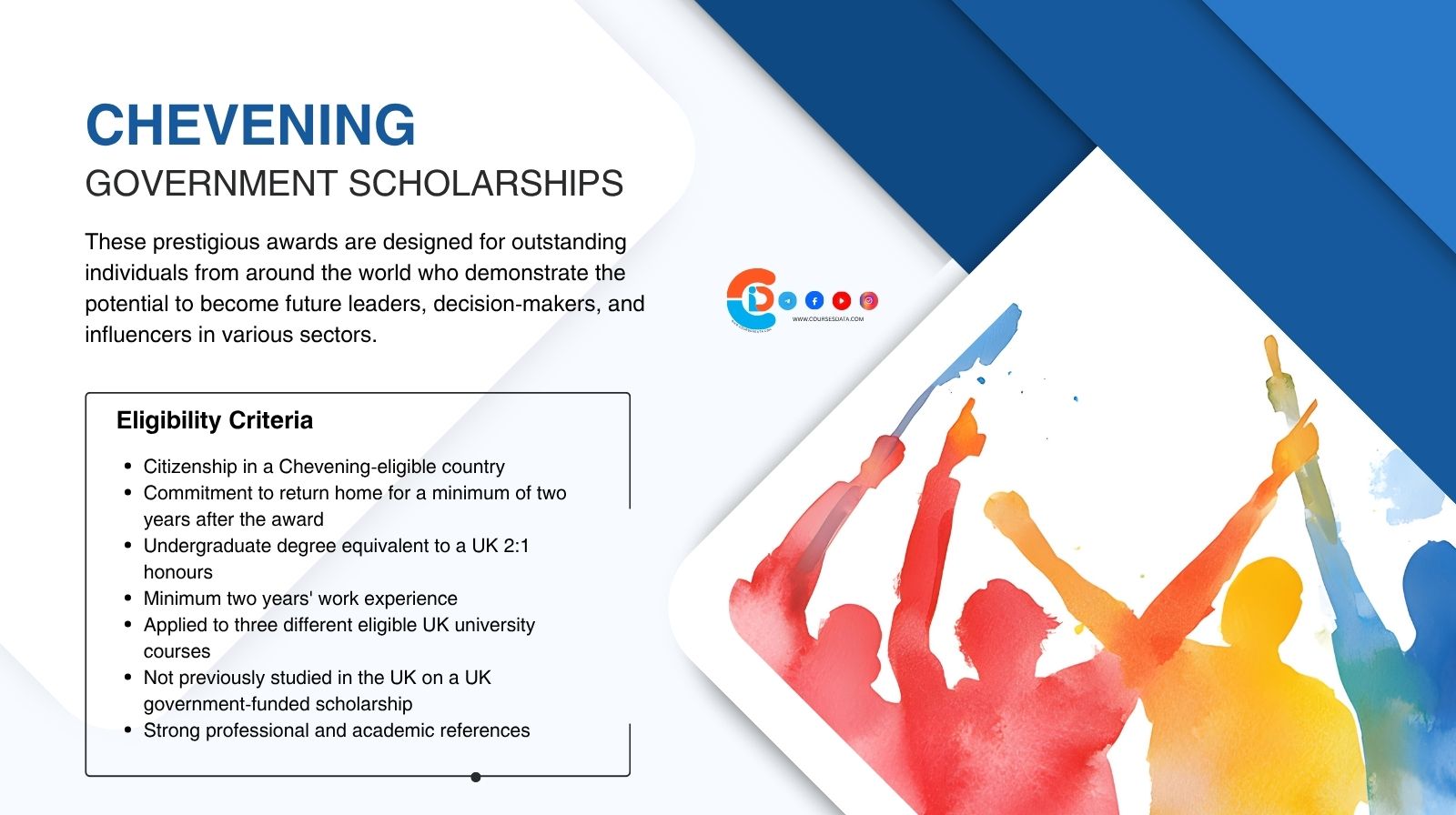
- Citizenship in a Chevening-eligible country
- Commitment to return home for a minimum of two years after the award
- Undergraduate degree equivalent to a UK 2:1 honours
- Minimum two years’ work experience
- Applied to three different eligible UK university courses
- Not previously studied in the UK on a UK government-funded scholarship
- Not hold British or dual-British citizenship
- Meet all English language requirements (if applicable)
- Strong professional and academic references
- Demonstrated leadership and networking potential
What Does the Scholarship Cover?
Chevening is a fully funded scholarship that takes care of nearly all the financial concerns associated with studying in the UK. This makes it one of the most competitive and sought-after opportunities.
The scholarship benefits include:
- Full tuition fees for one-year master’s program
- Monthly stipend to cover living costs
- Economy class return airfare to the UK
- Arrival and departure allowances
- Cost of visa application
- Travel grant to attend Chevening events in the UK
- Access to exclusive networking events
- Professional development opportunities
- Cultural exchange programs
- Membership in the global Chevening Alumni network
How to Apply for a Chevening Scholarship
The application process is comprehensive and competitive. Applicants must demonstrate leadership potential, academic excellence, and a clear plan for the future.
Steps to apply include:
- Check eligibility criteria on the official Chevening website
- Prepare required documents (passport, transcripts, references, etc.)
- Choose three eligible UK master’s courses
- Write compelling personal statement essays
- Apply through the online application portal
- Submit before the annual deadline (usually early November)
- Attend interview if shortlisted
- Receive conditional offer and complete UK university admission process
- Provide final documentation as required
- Obtain visa and travel to the UK in September
- Join the official welcome event for new scholars
What Makes Chevening Unique?
Chevening is not just about funding education. It fosters global networks, promotes cross-cultural exchange, and builds lifelong partnerships.
What sets Chevening apart:
- Focus on leadership and global impact
- Prestigious UK government backing
- Emphasis on career development
- Rich diversity of scholars and alumni
- Inclusive approach across sectors and regions
- Opportunities for internships and volunteering
- Strong support structure throughout the program
- Immersive cultural exposure
- Strategic focus on building future leaders
- Recognition and respect worldwide
Timeline and Deadlines for Chevening
The application timeline spans over a year and requires meticulous preparation. Planning ahead significantly improves the chances of success.
Typical Chevening timeline:
- August: Applications open
- November: Applications close
- November–January: Applications reviewed
- February: Shortlisted candidates invited for interviews
- March–May: Interviews conducted
- June: Final selection made
- July: Scholarship offers sent
- August: University admissions finalized
- September: Visa and travel arrangements
- October: Scholars arrive in the UK
| Stage | Month |
|---|---|
| Applications Open | August |
| Deadline to Apply | November |
| Shortlisting Period | February |
| Interviews Conducted | March–May |
| Final Decisions Announced | June |
| Course Enrolment & Travel | September–October |
FAQs About Chevening Scholarships in the UK
What GPA is required for Chevening?
Chevening doesn’t require a specific GPA, but your undergraduate degree must be equivalent to a UK 2:1 honours. Strong academic records improve your chances.
Can I apply if I haven’t secured university admission yet?
Yes, but you must apply to three eligible courses and receive at least one unconditional offer by the Chevening deadline.
Is work experience mandatory?
Yes, a minimum of two years (2,800 hours) of work experience is required, including full-time, part-time, voluntary, or paid internships.
Can I stay in the UK after my scholarship ends?
No, scholars are required to return to their home country for at least two years after the scholarship.
Do I need to take IELTS or TOEFL?
Many UK universities waive the language requirement for English-medium degree holders, but this varies by institution. Always confirm with your chosen universities.
How competitive is Chevening?
Extremely. Only 2–3% of applicants are selected each year, making it highly competitive.
Can I reapply if rejected?
Yes, as long as you meet the eligibility criteria, you can reapply in future application cycles.
Are part-time or distance learning courses eligible?
No, Chevening only funds full-time, in-person, one-year master’s programs in the UK.
Does Chevening cover dependents or family members?
No, the scholarship does not cover family or dependents. Scholars must cover those costs independently.
Which courses are most successful for Chevening?
Public policy, international relations, law, sustainable development, and business are popular, but the program supports a broad range of disciplines.
Conclusion
Chevening Scholarships open doors to academic excellence, professional growth, and a global network of change-makers.
If you’re driven to lead, Chevening is your launchpad to a life-changing UK experience.
Oh, I’ve definitely spent more time daydreaming about packing for the UK than actually checking if I’m eligible for these. The “future leader” part always makes me hesitate—do they accept people who are just really good at making tea and avoiding confrontation? My only real question is whether the essay prompts are as soul-crushingly vague as they sound, or if there’s a secret cheat code for making your “impact plan” sound less like a fever dream.
Oh, Poppy, you’ve hit on the exact reason I spent a full week staring at the eligibility page instead of filling it out. On the essay front, I found it helped to imagine I was explaining my “impact plan” to a skeptical friend at the pub—keeps the fever dream in check and the tea-making qualifications oddly relevant.
Oh, Poppy, you’ve put your finger on exactly what made me hesitate too. I actually applied a few years back and spent way too long trying to figure out if my “leadership” in organizing a community garden counted, or if they wanted someone who’d already brokered peace in the Middle East. My honest advice on the essay: don’t try to sound like a polished diplomat—they want to see genuine, messy ambition, not a perfectly scripted fever dream. The “impact plan” clicks way better when you tie it to a specific problem you’ve already tried to solve, even if you failed at first.
Matilda, your community garden example is exactly the kind of thing I wish I’d read before I applied—I spent weeks trying to frame my volunteer tutoring as some grand diplomatic mission, when I should have just owned the fact that I helped a kid who hated math actually pass an exam. That “messy ambition” advice is gold, because I think we forget Chevening wants people who’ve already gotten their hands dirty, not just those who can write a perfect essay. Thanks for sharing that—it makes the whole process feel a lot less intimidating.
Oh, Eleanor, your tutoring story is exactly the kind of thing I wish I’d led with on my own application—I spent ages trying to quantify my impact with big numbers when what really moved the needle was helping one student finally grasp a concept everyone else had given up on. That “hands dirty” part resonates so much because Chevening isn’t looking for perfect resumes; they want proof you’ve already shown up when it mattered, even if the scope felt small. If I could go back, I’d tell my past self to lean into the everyday wins and stop trying to sound like a Nobel laureate in the making.
Totally agree with this. I think people overthink the “leadership” label—it’s really about showing you can take initiative and learn from the mess-ups, not that you have a flawless resume. Tying your impact plan to a real, specific problem you’ve tackled makes it feel grounded and honest, which is what they’re actually looking for.
Yes, exactly—the leadership label almost stopped me from applying, but then I realized my biggest “win” was convincing my local council to fund a weekend literacy program after my first proposal got rejected. That failure taught me more about navigating bureaucracy than any success ever did. So I leaned into that messy story in my application, and it honestly felt more honest than pretending I’d led a national campaign.
You know, reading this actually makes me feel braver about my own application. I’ve been sitting on an essay draft that talks about my work with refugee families—just helping them navigate school admissions—and I kept thinking it wasn’t “global leader” enough. But hearing that they want real, messy ambition rather than a polished fantasy? That’s exactly the permission I needed to stop rewriting and just submit the honest version. My question is, when you tied your community garden to an impact plan, did you focus more on the local change or the bigger systemic shift you hoped to spark?
Oh, I love that the conversation is making the “future leader” label feel less like a cryptic entrance exam for sainthood. My own leadership claim to fame is successfully herding a group of hungover coworkers through a charity bake sale without any of us setting the office kitchen on fire—so this thread is giving me hope that my application won’t be laughed out of the room. For anyone who’s already submitted, did you find that the “honest, messy” approach actually helped in the interview, or did they still expect you to pivot to some grand, polished vision when pressed?
That community garden and literacy program stories hit home for me. I spent a whole year thinking my “leadership” didn’t count because I was just the person who kept our local food pantry running through sheer stubbornness after the coordinator quit—no fancy title, just a lot of early mornings and broken shelving units. Reading that Chevening actually wants people who’ve gotten their hands dirty makes me wonder if I’ve been selling myself short by trying to polish that messy reality into something it wasn’t.