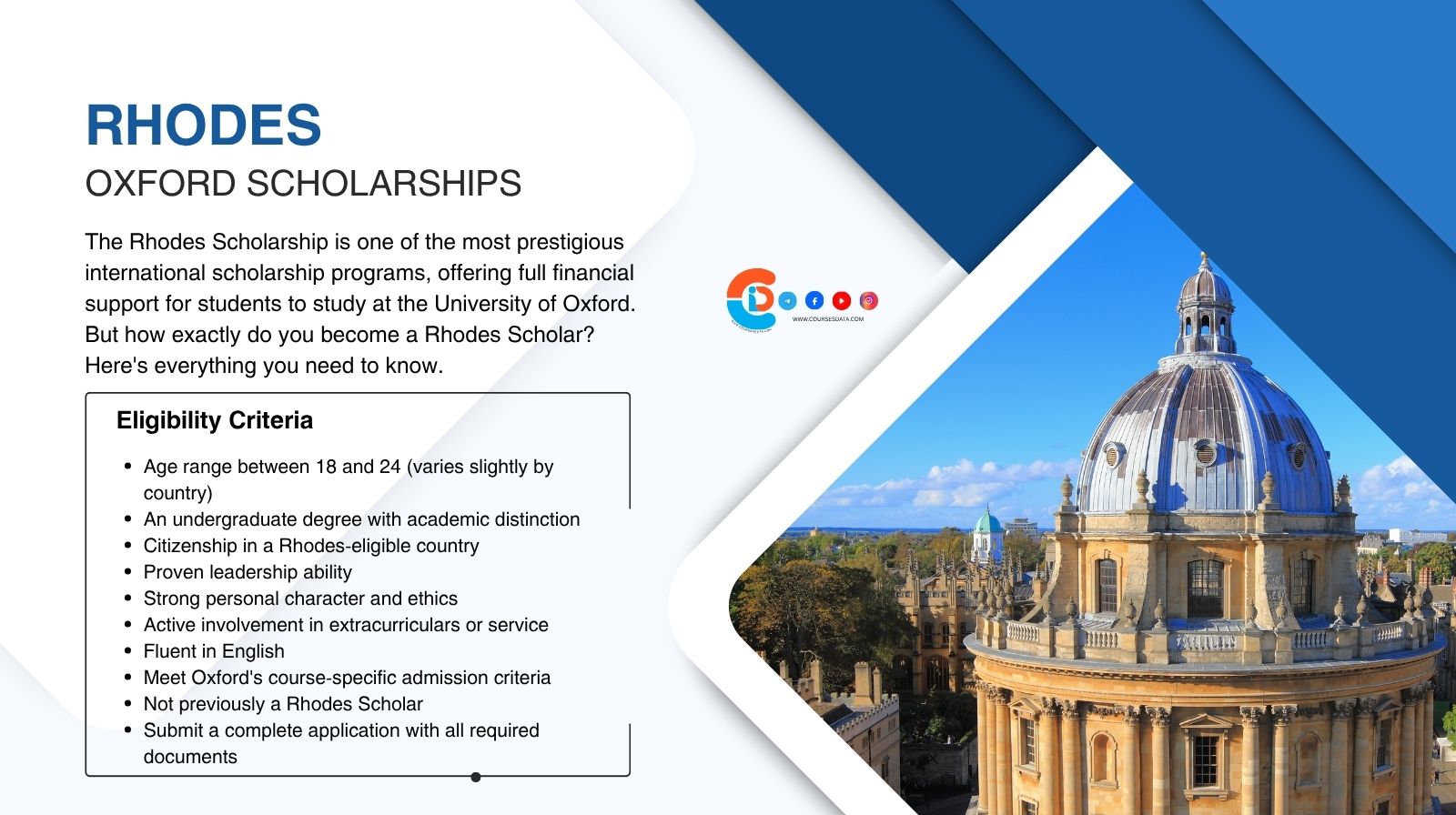
The Rhodes Scholarship funds postgraduate study at the University of Oxford for applicants selected through eligible geographic constituencies.
It covers Oxford course fees and provides a living stipend, along with specified travel and immigration costs.
This guide explains how to check eligibility, choose a course, prepare an application, and avoid common mistakes.
What Is the Rhodes Scholarship?
The Rhodes Scholarship is a fully funded award for full-time postgraduate study at Oxford.
Scholars join an international community and normally spend at least two years in the United Kingdom.
The award supports study across many fields, subject to the scholarship’s course rules and Oxford’s admission requirements.
It is intended for applicants who combine academic strength with the energy, character, and commitment to contribute beyond their own careers.
A practical starting point is to separate three questions that applicants often mix together:
- Can I apply through a Rhodes constituency? This depends on the rules for a particular country or regional grouping.
- Am I eligible within that constituency? Age, education, citizenship, and residence rules can differ.
- Can I enter my proposed Oxford course? Oxford assesses admission to the course separately.
For example, a student may meet a constituency’s Rhodes rules but lack a qualification required by a particular Oxford master’s program.
Another student may be academically ready for Oxford but fall outside the Rhodes age limit for their constituency.
The scholarship is therefore best approached as two connected applications: first, make a credible case for selection as a Rhodes Scholar; then, if selected, secure admission to an eligible Oxford course.
What Does the Scholarship Cover?
The Rhodes Trust covers Oxford course fees and pays a stipend from which scholars meet living expenses, including accommodation.
The stipend is for the scholar; applicants planning to bring a partner or children should not assume it will cover their costs.
The Trust also lists support for certain costs after selection.
Its official scholarship and funding explanation sets out the coverage and links to the detailed Conditions of Tenure.
| Cost or support | What applicants should understand |
|---|---|
| Oxford course fees | Covered for an eligible course and approved period of study |
| Living stipend | Paid to the scholar; accommodation and daily expenses come from it |
| Oxford application fee | Covered following selection for the scholarship |
| Student visa and health surcharge | Covered as specified by the Trust |
| Travel | Economy flights at the beginning and end of studies |
| Settling in | An allowance is provided on arrival |
| Additional study | Funding length depends on the approved course or degree combination |
The exact period of support matters when comparing courses.
A one-year master’s, a sequence of degrees, and a DPhil do not necessarily have the same funding arrangements.
Before committing to a course plan, check:
- Whether the proposed course is covered.
- Whether your planned combination of degrees is permitted.
- How long fees and the stipend would be paid.
- Whether the course starts at an eligible time.
- What expenses you would still pay from the stipend.
Consider a candidate hoping to take a master’s and then move into doctoral research.
That plan should be checked against the Conditions of Tenure before it becomes the central promise of an application.
Who Is Eligible to Apply?
Rhodes Scholarships are administered through constituencies: countries, territories, or regional groupings used to select scholars.
Applicants must identify the constituency through which they qualify and follow its own rules.
There is no reliable single age range, grade threshold, or nationality rule for every applicant.
A constituency may assess citizenship, residence, education, and age differently from another, and some specify additional academic conditions.
Use this sequence before drafting statements:
- Locate the constituency connected to your citizenship or background.
- Run the Rhodes eligibility checker.
- Read that constituency’s Information for Candidates.
- Check the age rule using its stated reference point.
- Confirm any education or residence requirement.
- Note its required documents and local deadline.
Do not assume that studying at a university in a country automatically makes you eligible through that country’s constituency.
Equally, holding a passport may be only one part of a constituency’s test.
The Trust states that the Global Rhodes Scholarships are suspended.
Applicants should therefore avoid older guides that present the Global route as a general fallback when they cannot qualify through a listed constituency.
The Rhodes constituency information is the place to identify the relevant route and its current instructions.
A student with ties to more than one place should assess each relevant route carefully rather than guessing which one is easiest.
The correct route depends on the Trust’s rules, not simply on where the student would prefer to compete.
What Does the Selection Committee Look For?
The Rhodes selection criteria extend beyond grades.
Academic excellence matters, but the committee also considers how applicants use their abilities, pursue meaningful interests, serve others, and show the capacity to lead.
This does not require a candidate to have founded a large organization.
A convincing record can come from sustained work in a school, research group, workplace, neighborhood, or public service project.
Evidence is more useful than broad labels:
- Academic ability: Explain demanding work you completed and what it taught you.
- Commitment: Show what you continued doing when progress was slow.
- Service: Describe whom your work helped and how you know.
- Leadership: Identify a decision you made and the responsibility you carried.
- Collaboration: Explain how others shaped the outcome.
- Character: Discuss a difficult choice with honesty and proportion.
For example, “I am passionate about education” tells a committee little.
An account of designing a tutoring program, adapting it after poor attendance, and learning from the students involved gives the reader something to assess.
Applicants can also draw on less formal experience.
Caring responsibilities, paid work alongside study, or organizing a response to a local need may reveal judgment and persistence when described accurately.
Avoid turning every activity into a claim of major impact.
It is stronger to explain a modest result clearly than to assign yourself credit for changes you cannot substantiate.
The Trust’s selection criteria provide the framework for deciding which examples belong in your application.
How Should You Choose an Oxford Course?
Choose a course because its content, training, and entry requirements fit your goals.
The Rhodes Scholarship is a means to pursue a serious academic plan; a famous course name alone is not a persuasive reason to apply.
Start with the question you want to study or the professional problem you hope to address.
Then compare Oxford courses by modules, research opportunities, teaching format, and the background expected of entrants.
A useful course review includes:
- The qualification awarded and its usual length.
- Required prior subjects or professional experience.
- The course’s written work or research expectations.
- English language requirements, where applicable.
- Whether a supervisor or research proposal is needed.
- Whether Rhodes funding permits the proposed course plan.
A public health applicant, for instance, might be interested in improving rural services.
That aim still needs an academic shape: which methods must the applicant learn, which Oxford course teaches them, and how does the applicant’s previous work prepare them?
Be specific without pretending that study guarantees a particular social outcome.
A credible explanation connects past experience, the proposed training, and the work you hope to pursue afterward.
Keep the Oxford admission decision in view.
Being selected for Rhodes does not remove a course’s academic requirements, and a course that looks attractive may require preparation you have not yet completed.
How Does the Application Process Work?
The application begins through the appropriate Rhodes constituency.
Its instructions control the local deadline, document list, reference requirements, and selection stages.
Applicants generally need to prepare a record of academic work, written statements, and recommendations.
Shortlisted candidates may face interviews, but the exact sequence should be taken from their constituency’s current guidance.
Organize the work in a practical order:
- Confirm eligibility and the constituency deadline.
- Read the full candidate instructions before writing.
- Research eligible Oxford courses and their requirements.
- List experiences that demonstrate the selection criteria.
- Ask suitable referees early and give them useful context.
- Draft statements that use concrete examples.
- Check every document against the required format.
- Submit with enough time to resolve technical problems.
Your application should make sense as a whole.
If a statement says you intend to study one subject while your academic evidence and proposed course point somewhere else, explain the connection.
Referees can help when they know your work directly.
A person who supervised a demanding project may provide more useful evidence than a prominent person who barely knows you.
If you are shortlisted, prepare to discuss both achievements and uncertainties.
You should be able to explain why you made particular choices, what you learned when something failed, and why Oxford is a sound next step.
How Can You Write Stronger Statements?
Strong statements give the reader a clear view of your thinking and actions.
They do not need dramatic openings or claims that every experience changed your life.
For the academic case, explain what you have studied, what questions now interest you, and how the proposed course helps you investigate them.
Use enough detail to show preparation while remaining understandable to readers outside your field.
For the personal case, choose experiences that reveal motivation and judgment:
- Name the problem or responsibility you faced.
- Explain your own role within the wider effort.
- Describe a choice you made and why.
- Give a verifiable result where one exists.
- Acknowledge what you would do differently.
- Connect the experience to your future direction.
Suppose you coordinated a student accessibility project.
The useful story may be how you listened to affected students, changed an initial plan, persuaded decision makers, and handled a result that was only partly successful.
Revise for accuracy as well as style.
If a project served a small group, state that scale.
If a research finding remains preliminary, do not present it as an established solution.
Ask a reader unfamiliar with your field to identify your main argument after reading.
If they can repeat your goal but cannot explain why the proposed Oxford course fits, the academic connection needs work.
What Mistakes Should Applicants Avoid?
Many avoidable problems begin before the first statement is written.
Applicants rely on a general scholarship summary, miss a constituency rule, and discover too late that a required document or endorsement takes time to obtain.
A final review should catch these issues:
- Using an age rule taken from another constituency.
- Treating an old deadline as the current one.
- Assuming every Oxford course is funded.
- Describing service without explaining the applicant’s role.
- Choosing referees solely for their titles.
- Sending generic requests for recommendations.
- Repeating the same story in every statement.
- Presenting admission to Oxford as automatic after selection.
Another mistake is to build an application around what the candidate thinks a “Rhodes leader” should sound like.
The committee needs a truthful account of sustained work, thoughtful decisions, and potential, expressed in the candidate’s own voice.
Plan for practical costs as well.
The scholarship provides substantial support, but the stipend must cover everyday living expenses, and applicants with dependents need a budget based on their own circumstances.
Finally, keep the process in proportion.
The work of clarifying an academic direction and asking for detailed feedback is valuable preparation, whether or not an applicant is selected.
Conclusion
The strongest Rhodes Scholarship application begins with an eligibility check, a suitable Oxford course, and a clear account of the applicant’s work.
Read the instructions for your constituency, gather evidence for each selection criterion, and give yourself time to prepare statements and references that are precise and honest.
Frequently Asked Questions
Is the Rhodes Scholarship fully funded?
Yes.
It covers eligible Oxford course fees and provides a living stipend, along with the specified travel, visa, health surcharge, and settling in support.
The scholar pays ordinary living costs, including accommodation, from the stipend.
Is the scholarship only for one field of study?
No.
Scholars may pursue many full-time postgraduate courses at Oxford, subject to the Conditions of Tenure and the course’s admission requirements.
Check a proposed course before making it the focus of your application.
Can I apply before finishing my undergraduate degree?
Applicants should have an undergraduate degree or be about to complete one.
Your constituency’s instructions and Oxford course requirements determine what evidence of completion is needed.
Is there one age limit for all applicants?
No.
Age rules vary by constituency and are generally strict.
Use the age rule and reference point stated in the candidate information for your own constituency.
Can I apply if my country has no Rhodes constituency?
Do not assume that a Global application is available.
That route is suspended, so review the current constituency rules to determine whether another eligible route applies to your circumstances.
Do I need an Oxford offer before applying for Rhodes?
Follow the sequence in your constituency’s application instructions.
Rhodes selection and Oxford admission are distinct processes, and a selected candidate must still meet the requirements for an eligible course.
Do I need a perfect academic record?
The selection process values academic excellence, but there is no single universal grade rule for every constituency.
Some constituencies set a specific minimum, so check yours and present your academic work accurately.
Does volunteer work guarantee an advantage?
No single activity guarantees selection.
Sustained service can provide useful evidence when you explain your contribution, the people involved, and what you learned from the work.
Can the stipend support my family?
The Rhodes Trust says the stipend is not sufficient to cover partners or dependents.
Applicants intending to bring family members should make a separate, realistic financial plan.
What should I do first if I want to apply?
Identify your constituency and read its current Information for Candidates.
Then check your eligibility, shortlist suitable Oxford courses, and map out the documents and references you will need.
I’ve seen a few friends go through the Rhodes application process, and one thing that really stood out was how much they emphasized the public service angle—it’s not just about grades or test scores. I’d be curious to know how heavily the selection committee weighs your personal story of leadership versus just academic achievements, because in my experience, people get stuck trying to polish their resume instead of showing real impact. Also, covering travel costs to and from Oxford is a small but huge relief—most people don’t realize how much that can drain your savings even before you start.
It’s really interesting you mention the personal story angle, Caroline. When I was helping a friend prep her application a few years ago, she almost didn’t include her weekend work at a local food bank because she thought it was “too small” compared to her research awards—but the mentorship coordinator told her that showing consistent, hands-on leadership in your actual community often carries more weight than a perfect GPA. Did any of your friends get specific feedback on whether a formal leadership title mattered more than a long-term commitment to a cause they were clearly passionate about?
That food bank example really hits home—my cousin applied last cycle and was told the same thing. She had a bunch of high-level internships but almost left out her three years coaching a youth soccer team in a low-income neighborhood, and the interviewer actually brought it up as the strongest part of her application. It seems like they’re looking for that quiet, consistent dedication more than a flashy title.
That’s exactly the feedback I’ve heard from former scholars too—they care more about the depth of your commitment than the prestige of the role. Your cousin’s coaching story proves that showing up week after week in a low-income neighborhood tells them more about character than any one-off internship could. It’s a good reminder to stop padding the resume and start focusing on what you actually gave to others.
It’s fascinating to see how often the “small” commitments end up being the deciding factor—my own mentor used to say that a Rhodes application should read like a story of genuine service, not a trophy case. I wonder if the selection committee ever explicitly tells applicants to leave off a prestigious but shallow role in favor of a less glamorous, long-term project. From what I’ve seen, it’s the quiet, consistent work that reveals character, and that seems to be what they’re really banking on.
You’re absolutely right about the quiet, consistent work—when I applied, I almost left out my years mentoring at a local youth center because it felt too ordinary next to my academic awards, but the committee chair later told me that commitment showed more resilience than any single achievement. I think they’re genuinely looking for a pattern of service that proves you’ll keep showing up long after the scholarship ends, not just a list of impressive titles you collected along the way.
Hannah, your experience really resonates with me—I had a similar moment where I almost didn’t include my Saturday morning tutoring at a community centre because it felt too ordinary next to my research work. But when I finally mentioned it in my interview, the panel leaned in and asked more questions about that than anything else on my CV. It made me realize they’re not hunting for a list of flashy titles; they want to see that you’ve chosen to give your time consistently, even when no one was watching.
Exactly the same thing happened to a friend of mine—she nearly scrubbed her decade of volunteering at a local hospice because it wasn’t “prestigious” enough. The interviewer actually told her that the hospice work was the only part of her application that made him believe she’d still be serving a community twenty years from now. It’s a humbling reminder that they’re reading for a lifetime habit, not a highlight reel.
It’s so reassuring to see everyone confirming that the “small” stuff matters, because when I was putting together my own application, I spent weeks agonizing over whether tutoring at the local literacy program was worth mentioning next to my research projects. What I’d love to know is how the committee handles applicants who have a clear pattern of service but who struggle to frame it into a compelling narrative—did anyone here find that the way they told their story mattered just as much as the story itself? I’ve heard that the personal statement can make or break you, but it’s hard to know where the line is between being honest and “selling” your experience.
I’ve been reading through this whole thread and nodding along, because when I applied, I almost left out the two years I spent teaching basic literacy in a rural adult education centre after work. It felt too small and too far from the “global leader” image I thought they wanted, but in the end, that story got the most traction in my interview. One thing I still wonder about, though: how do you know when you’ve found the right balance between showing real impact and not over-polishing a small commitment into something it wasn’t?