Looking for a fully funded way to study in Norway without paying tuition fees?
The Norwegian Government Scholarship offers an incredible opportunity for international students to pursue high-quality education in a progressive and inclusive environment. With tuition-free universities and generous living grants, Norway has become a top destination for global scholars.
What Is the Norwegian Government Scholarship?
This scholarship is part of Norway’s effort to promote international education and cooperation. It targets students from selected developing countries, offering full financial support for higher education at Norwegian public universities and colleges.
- Fully covers tuition fees
- Provides monthly living expenses
- Available for bachelor’s, master’s, and PhD programs
- Open to students from prioritized countries
- Covers travel costs in some cases
- Requires admission to a Norwegian institution
- Offered through various schemes like Quota Scheme, NORPART, and SIU
- Administered by the Norwegian Directorate for Higher Education and Skills
- Selection based on academic merit and motivation
- Application usually submitted via partner institutions
Who Can Apply for the Norwegian Government Scholarship?
Eligibility for the scholarship is based on nationality, academic background, and admission status. Applicants must be accepted into a relevant program at a participating Norwegian institution.
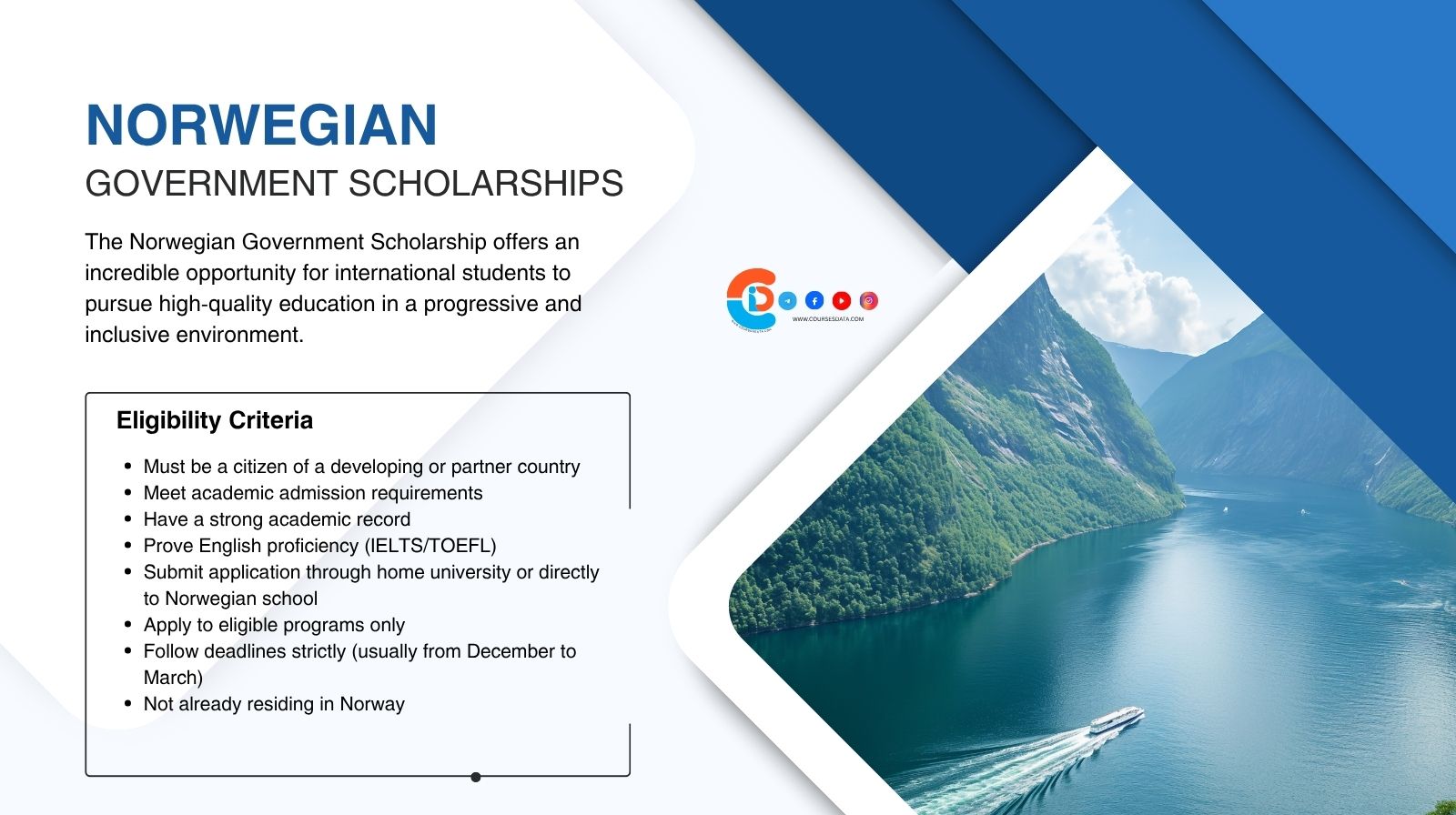
- Must be a citizen of a developing or partner country
- Meet academic admission requirements
- Have a strong academic record
- Prove English proficiency (IELTS/TOEFL)
- Submit application through home university or directly to Norwegian school
- Apply to eligible programs only
- Follow deadlines strictly (usually from December to March)
- Not already residing in Norway
- Preference given to students returning to home country after studies
- Must hold a valid passport
What Programs Are Available Under the Scholarship?
The scholarship supports a wide range of disciplines, focusing on fields relevant to development and international cooperation. English-taught programs are widely offered at both undergraduate and postgraduate levels.
- Engineering and Technology
- Environmental Sciences
- Public Health
- Education and Pedagogy
- Agriculture and Food Security
- Natural Sciences
- Business and Management
- Social Sciences
- Renewable Energy
- Peace and Conflict Studies
Top Universities That Accept the Norwegian Government Scholarship
Several prestigious public universities in Norway participate in the scholarship scheme, offering world-class education without charging tuition.
- University of Oslo
- Norwegian University of Science and Technology (NTNU)
- University of Bergen
- University of Tromsø – The Arctic University of Norway
- Norwegian School of Economics (NHH)
- Oslo Metropolitan University (OsloMet)
- University of Stavanger
- University of Agder
- BI Norwegian Business School (limited programs)
- Inland Norway University of Applied Sciences
How to Apply for the Norwegian Government Scholarship
The application process varies by program and country but typically involves securing admission first and then applying for the scholarship through that institution.
- Research eligible programs and institutions
- Check country-specific requirements
- Prepare necessary documents (CV, transcripts, recommendation letters)
- Obtain English proficiency test results
- Apply for admission online
- Indicate interest in scholarship during application
- Follow deadlines strictly (some close in early January)
- Submit scholarship-specific documents if required
- Wait for confirmation or interview request
- Acceptance is communicated by April to June
Required Documents for Application
Having the correct documentation is crucial to your application being considered. Each university may have specific requirements, so always double-check.
- Completed application form
- Statement of purpose or motivation letter
- Academic transcripts
- Degree certificates
- Proof of English proficiency (IELTS, TOEFL, or equivalent)
- Curriculum Vitae (CV)
- Passport copy
- Letters of recommendation
- Research proposal (for PhD applicants)
- Financial plan (if required)
Benefits of the Norwegian Government Scholarship
The scholarship goes beyond just free tuition. It supports international students in adapting to life in Norway and completing their education without financial burdens.
- 100% tuition waiver
- Monthly living stipend (typically NOK 11,000–13,000)
- Free or subsidized student housing
- Travel grants for some countries
- Health insurance included
- Access to student welfare organizations
- Academic support and mentoring
- Cultural integration programs
- Family allowance in some cases
- Career development resources
Timeline: Important Dates and Deadlines
Planning ahead is key. Each university sets its own deadlines, so always refer to the official website of the institution you’re applying to.
| Stage | Typical Timeline |
|---|---|
| Program Search Begins | October–November |
| Application Portal Opens | December |
| Admission Application Due | January–March |
| Document Submission Closes | March |
| Scholarship Review Period | March–May |
| Results Notification | April–June |
| Visa Application Process | June–July |
| Departure to Norway | August |
Life in Norway as a Scholarship Student
Norway offers a high quality of life, progressive values, and a safe environment for international students. The scholarship includes resources to help students transition smoothly.
- Free healthcare for students
- Excellent public transport system
- Multicultural campuses
- High English fluency nationwide
- Affordable student dining options
- Breathtaking natural scenery
- Student discounts and welfare services
- Active student organizations
- Opportunities to learn Norwegian
- Internships and part-time work rights
Frequently Asked Questions
Is the Norwegian Government Scholarship fully funded?
Yes, it typically covers full tuition and living costs, allowing students to study without financial stress.
Can I work while studying in Norway on this scholarship?
Yes, international students can work up to 20 hours per week during studies.
Is Norwegian language required for scholarship programs?
No, many programs are fully taught in English, especially at the master’s and PhD level.
Do I apply for the scholarship before or after university admission?
Usually, you apply for admission first and indicate interest in the scholarship during the process.
What GPA do I need for the Norwegian Government Scholarship?
A strong academic record is essential, usually equivalent to a 3.0 GPA or above on a 4.0 scale.
Are there age limits for applicants?
No strict age limit, but recent graduates are typically favored.
Can I bring my family with me to Norway?
Yes, and in some cases, family allowance is included in the scholarship.
How competitive is the scholarship?
Very competitive. Thousands apply yearly, and selection is based on merit and motivation.
Is health insurance included in the scholarship?
Yes, students are covered under the Norwegian National Health Scheme.
Can I stay in Norway after graduation?
Yes, Norway offers post-study work visas for international graduates.
Conclusion
The Norwegian Government Scholarship opens the door to world-class education in a forward-thinking, inclusive country. It’s a chance to study for free while gaining global exposure.
I actually applied for the Norwegian Government Scholarship a few years back, and while the tuition-free aspect is amazing, the real challenge was getting admitted to a program first—you need that acceptance letter before you can even apply for the funding. One thing that caught me off guard was how competitive it is for master’s programs, especially in engineering and social sciences, so I’d recommend having a strong research proposal or work experience ready. Did anyone else find the country prioritization list a bit restrictive, or was it just me?
God, yes—the country priority list felt like a cruel joke when I realized my home country wasn’t even on it, so I had to scramble to see if I qualified through any other bilateral agreements. And you’re absolutely right about the admission letter being the real gatekeeper; I spent months perfecting my motivation letter just to get that first foot in the door. The competition for social sciences was brutal in my year too, so I ended up leaning heavily on my previous NGO fieldwork to stand out—definitely worth highlighting any practical experience you have.
Yes, the country prioritization list definitely felt restrictive to me too—I remember checking it obsessively just to make sure my home country was still eligible that year. And you’re so right about the admission letter being the real hurdle; I spent months emailing professors and tweaking my research proposal before I even felt ready to apply. What helped me was focusing on a niche program where I had direct field experience, which seemed to balance out the competition a bit.
That’s a smart angle with the niche program—I’ve seen locals here in Cork get tripped up by trying to apply to broad degrees that flood with applicants, while something like Arctic engineering or Sami studies barely fills its slots. Did you find your field experience actually shifted the conversation with professors, or was it more about fitting their published research? I’m always skeptical of advice that sounds too neat, but if it worked for you, I’d say it’s worth a shot.
Yeah, you hit the nail on the head with the admission letter catch—that step took me way longer than I expected. I also remember being surprised that the living grant only covers the basics if you’re in Oslo, where rent is brutal, so definitely budget extra. Did you ever feel like the priority list made it harder to plan around backup options, or did you just commit fully to the Norwegian route?
Oh, the Oslo rent thing is so real—I remember looking at housing prices and wondering if I’d have to live on instant noodles for two years just to make ends meet. As for the priority list, I actually committed fully to the Norwegian route, but only because my country was listed that year; I can see how it’d make planning backup options feel nearly impossible if you’re not sure you’ll qualify. It’s a gamble that forces you to put all your eggs in one basket, and that part definitely kept me up at night.
The part about the country priority list and the admission letter being the real gatekeeper really resonates with me. I spent nearly six months just getting my documentation and research proposal polished enough to even be considered for a master’s spot, and even then, the competition felt overwhelming. For anyone thinking of applying, I’d highly recommend reaching out to a professor in your field at the Norwegian university before you submit anything—having that informal support can make a huge difference when the selection committee reviews your file. Did anyone else find that building a connection with a faculty member ahead of time helped with the scholarship odds?
That’s solid advice—I actually emailed a professor before applying and it made a big difference in shaping my research proposal to fit their department’s focus. The informal support didn’t guarantee the scholarship, but it definitely helped my application stand out when the committee reviewed it. If you’re serious about this, don’t skip that step.
The admission letter hurdle really is the make-or-break moment—I spent a full year just getting my documents together for a master’s in public health, only to realize my country wasn’t on the priority list the following cycle. That constant uncertainty made it hard to commit fully, especially when the living grant barely covers rent in Oslo unless you’re willing to share a tiny flat. For anyone starting now, I’d suggest applying to a few Norwegian programs early and having a backup plan in another country, just so you’re not left scrambling if the list changes.
It’s wild to me how much the country priority list dictates everything—I spent a solid six months getting my application together for a master’s in environmental policy, only to find my home country had been dropped the cycle I was ready to apply. That constant shift made me wonder if it’s even worth banking on the scholarship alone, or if it’s smarter to treat Norway as a long-shot option while locking in a more predictable backup. Did anyone else find that the list changed between the time you started preparing and when you actually submitted?