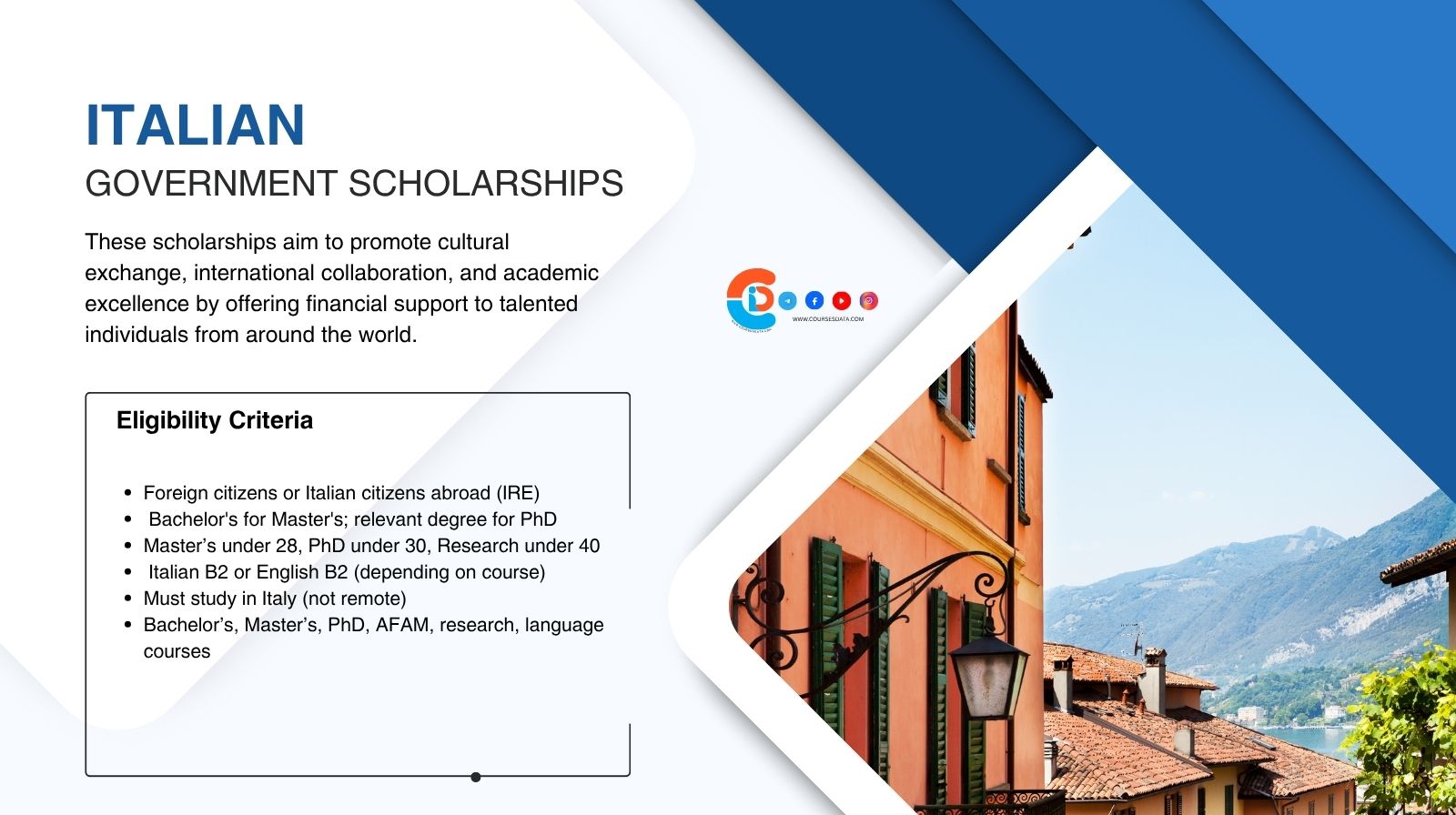
Are you looking to study in Italy and wondering how to secure a scholarship through the Italian government’s funding programme?
What are the Italian Government Scholarships?
This funding initiative by the Ministry of Foreign Affairs and International Cooperation (MAECI) promotes study, research and cultural exchange in Italy.
- Scholarships awarded to foreign citizens residing abroad and Italian citizens living abroad (IRE)
- Available for Bachelor’s, Master’s, single-cycle degrees, PhDs, research projects, and Italian language/culture courses
- Applications for 2025-26 closed on 16 May 2025 at 14:00 CET
- Covers study on Italian territory only (on-site attendance required)
- Promotes international cooperation and Italian language/culture
- Supports Italy’s global academic and economic influence
- Financial coverage for tuition and living expenses (in part)
- Accessible via the Study in Italy portal
- Health and accident insurance included during study period
- Selections based on merit, proposal quality, and language proficiency
Why study with an Italian Government Scholarship?
This scholarship offers more than financial aid—it opens doors to Italy’s academic and cultural life.
- Access to 60+ public universities and prestigious institutions
- Opportunity to study in English or Italian
- Scholarships reduce or eliminate tuition costs
- Cultural immersion in Italy’s rich heritage
- Study in globally recognized Italian institutions
- Improve employability with a European degree
- Funded academic and language courses
- Short-term and long-term programme flexibility
- Insurance coverage during stay
- International academic network opportunities
Key Features of the Scholarship
Understand the essential benefits and coverage before applying.
- Financial grant up to €9,000 for 9 months
- Possible tuition fee waivers depending on institution
- Health and accident insurance included
- Study duration varies by course (3 to 9 months)
- Age limits: under 28 for Master’s, under 30 for PhD, under 40 for research
- Language requirements: Italian B2 or English B2
- Study must be physically in Italy
- Requires academic merit and proposal relevance
- Annual call issued via Study in Italy portal
- Specific country eligibility applies each year
Eligibility Checklist
Make sure you meet these criteria before applying.
| Criteria | Requirements |
|---|---|
| Nationality | Foreign citizens or Italian citizens abroad (IRE) |
| Academic background | Bachelor’s for Master’s; relevant degree for PhD |
| Age limit | Master’s: <28, PhD: <30, Research: <40 |
| Language proficiency | Italian B2 or English B2 (depending on course) |
| Study location | Must study in Italy (not remote) |
| Course types | Bachelor’s, Master’s, PhD, AFAM, research, language courses |
| Application method | Online via Study in Italy portal |
| Application deadline | Varies annually (e.g., 16 May 2025) |
| Document readiness | ID, transcripts, CV, motivation, language proof |
| Country eligibility | Must be on the annual eligible countries list |
What Does the Scholarship Cover?
Know exactly what expenses are supported.
- €9,000 grant for a typical 9-month programme
- Some tuition exemptions by institutions
- Health/accident insurance (excluding pre-existing conditions)
- Living costs partially covered (not full support)
- Accommodation not guaranteed or covered
- Travel expenses not included
- No tuition fee exemption for language/culture courses
- Proportional funding for shorter stays
- University policies vary by location
- Renewal possible for longer programmes with good progress
Application Process
Follow this structured process to apply successfully.
- Choose an eligible programme and Italian institution
- Verify eligibility by age, nationality, and academic level
- Register and apply via Study in Italy portal
- Prepare and upload necessary documents:
- Passport or valid ID
- Academic transcripts and certificates
- CV and motivation letter
- Language certification (Italian or English)
- Research proposal and supervisor letter (if applicable)
- Submit application before the deadline
- Wait for selection and admission confirmation
- Enrol in the institution and activate scholarship
- Maintain progress for scholarship continuation
- Open Italian bank account if required
- Stay updated via institution and MAECI notifications
Common Pitfalls to Avoid
Be mindful of these frequent mistakes.
- Missing application deadlines
- Ignoring age and programme-specific eligibility
- Not understanding language requirements
- Choosing ineligible courses or institutions
- Assuming automatic tuition waivers
- Failing to submit complete documents
- Underestimating living and travel costs
- Not securing accommodation early
- Overlooking country eligibility lists
- Submitting applications via unofficial portals
Selection and Ranking Criteria
Improve your chances by knowing how you’re evaluated.
- Academic excellence and prior achievements
- Quality and clarity of motivation letter
- Alignment of study proposal with Italian priorities
- Language skill proficiency
- Admission to an Italian institution
- Completeness of application
- Relevance and innovation in research (if applicable)
- Supervisor endorsement for research grants
- Study feasibility and candidate preparedness
- Country representation goals in selection process
Key Dates and Timeline (Example: 2025-26)
Track these important milestones.
- Call announced: April 2025
- Application deadline: 16 May 2025, 14:00 CET
- Review and selection: May to July 2025
- Results published: Summer 2025
- Scholarship activation: September/October 2025
- Course start: Varies by institution
- Duration: 3-9 months depending on programme
- Renewal application (if applicable): Early 2026
Frequently Asked Questions
Can I apply for an English-taught programme?
Yes, provided you meet the English proficiency requirement (minimum B2 level).
Does the scholarship cover all living expenses?
No. The grant helps with expenses but doesn’t fully cover all costs.
Can I apply if I already live in Italy?
No. Applicants must be foreign citizens living outside Italy or Italian citizens abroad.
Is the scholarship renewable?
Yes, depending on your academic progress and course duration.
Do I need admission before applying?
Admission may strengthen your application but isn’t always required initially.
How do I know if my country is eligible?
The eligible country list is published annually with the call.
What language proof do I need?
B2 for Italian or English, depending on course language. Italian A2 for culture courses.
Is the application online?
Yes, all applications go through the Study in Italy portal.
Can I work while studying?
You must check with your visa terms and institution guidelines.
What happens after selection?
You follow your university’s enrolment steps, activate your grant, and start your programme.
Conclusion
The Italian Government Scholarships provide a valuable opportunity to study in Italy with financial and academic support. They enable students to pursue higher education in one of Europe’s most vibrant cultural environments.
Yeah, I remember looking into these a couple of years back for a mate who wanted to study design in Milan. The on-site attendance thing is a biggie—you can’t just do it remotely, which caught a few people off guard. Question for anyone who’s applied before: how did the financial coverage actually work out for you in terms of covering rent and daily costs, especially in pricier cities like Rome or Florence? Feels like it’s a solid foot in the door, but you’d still need a backup plan for the bills.
Honestly, that’s the exact question I had when I applied two years ago for a Master’s in Bologna. The monthly stipend was decent, but it barely covered my rent in a shared flat near the city center, so I ended up taking a part-time job at a local café to make ends meet. It’s a fantastic opportunity to get your foot in the door, but I’d warn anyone heading to Rome or Milan to have a solid savings buffer—the scholarship covers tuition and a chunk of living costs, but not all of them.
Totally agree with you on the savings buffer—I learned that the hard way when I did my year in Florence. My stipend covered about 60% of my rent in a shared flat near Santa Croce, and I had to pick up freelance writing gigs just to afford groceries and the occasional train ticket. If you’re heading to a pricey city, definitely plan to have at least three months of expenses saved up before you arrive.
Oh, this brings back memories—I applied for this exact scholarship back in 2022 for a Master’s in art history in Florence, and the on-site requirement was honestly a blessing in disguise because it forced me to fully immerse myself in the language and culture. That said, I agree with Thandi about the costs; my stipend covered about two-thirds of my rent in a shared apartment, and I had to dip into savings for groceries and transport. One thing I’d add for anyone considering it: make sure you have a local bank account set up early, because the disbursements can be a bit slow for the first month and you’ll need cash upfront for deposits and utility bills.
Oh, the local bank account tip is gold—I learned that one the hard way when my stipend took six weeks to land and I was living on espresso and sheer hope. The on-site immersion really does pay off, though; I still dream about the panini I ate while staring at Botticellis during my own Master’s in Florence. Just brace for the first month’s financial juggling act, and you’ll be fine.
Oh, living on espresso and sheer hope—I think that’s the unofficial Italian scholarship motto. I second the bank account nightmare, but I’d add that if you can wrangle a letter from MAECI confirming your award early, some Italian banks will let you open an account before the stipend lands, which at least stops the panic spiral. Also, the panini envy is real; I’m still chasing that exact vibe from my own Master’s in Bologna.
I was so close to applying for this scholarship a few years back, but the on-site requirement actually stopped me because I was trying to balance a remote job at the time. Now looking back, I think I missed out on the best part of the experience—being forced to live there and soak up the language daily. For anyone who actually got in, did the bureaucracy for the residence permit and housing feel overwhelming, or did the scholarship office help you through those first chaotic weeks?
Oh, Marlene, I totally get that hesitation—I almost backed out for the same reason, but honestly, living there changed everything. The first few weeks were a blur of paperwork and confusion, but the scholarship office gave me a solid checklist and even connected me with a local student buddy who walked me through the residence permit office. Housing was a bit of a scramble since I had to find a place before my stipend kicked in, but the university’s housing office had a list of verified landlords that saved me from getting scammed.
That’s reassuring to hear the scholarship office actually helps with the bureaucracy—I’ve seen too many funding schemes leave students to figure out permits and housing on their own. The verified landlord list is a smart move too, especially for avoiding scams when you’re not there in person yet. Good to know the support goes beyond just writing the cheque.
Oh, the bank account delay is so real—I had the same panic when my stipend took five weeks to hit and I was scrambling to pay my first month’s deposit in Rome. One thing I’d add for anyone considering this: double-check whether your university offers emergency bridging loans or a small advance from the scholarship office, because mine did and it saved me from eating plain pasta for a month. Did anyone else find that the MAECI office was helpful when you needed to prove your income for the residence permit, or did you have to fight for that paperwork on your own?