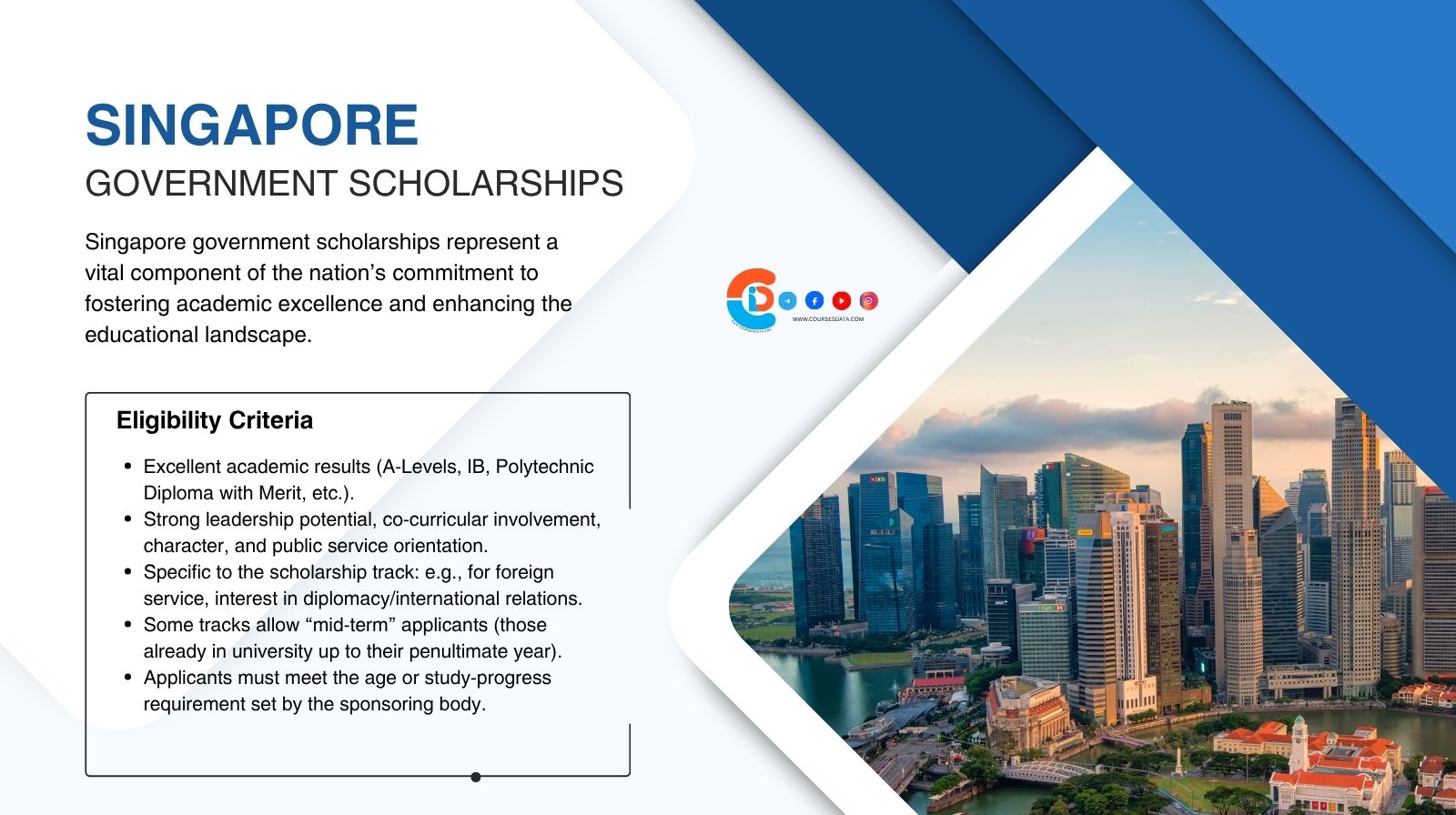
Are you looking for a fully‑funded opportunity to study and serve that’s backed by the Singapore government?
Introduction
The Public Service Commission (PSC) and other Singapore government agencies offer the Singapore Government Scholarship scheme to recruit high‑potential students for undergraduate and postgraduate study. This article unpacks the key scholarship tracks, eligibility criteria, benefits, application process and career prospects in one place.
What is the Singapore Government Scholarship?
This government scholarship programme is essentially a way for Singapore to invest in talent who will contribute to Singapore’s public service or affiliated institutions. Key features include:
- Government‑sponsored funding for study locally or overseas.
- A study‑bond service obligation on return.
- Tailored to different roles: e.g., public service, foreign service, defence.
- Allows Singapore citizens (in many cases) to study abroad or locally under sponsorship.
- Varies significantly depending on the sponsoring agency (e.g., Ministry of Foreign Affairs, Ministry of Social and Family Development).
Who can apply – Eligibility criteria
Here’s a breakdown of typical eligibility criteria for the Singapore Government Scholarship:
- Excellent academic results (A‑Levels, IB, Polytechnic Diploma with Merit, etc.).
- Strong leadership potential, co‑curricular involvement, character, and public service orientation.
- Specific to the scholarship track: e.g., for foreign service, interest in diplomacy/international relations.
- Some tracks allow “mid‑term” applicants (those already in university up to their penultimate year).
- Applicants must meet the age or study‑progress requirement set by the sponsoring body.
What types of scholarship tracks are available?
Below is a table summarising major tracks within the Singapore Government Scholarship ecosystem.
| Scholarship Track | Administering Agency | Typical Study Level & Focus |
|---|---|---|
| PSC Undergraduate Scholarship | Public Service Commission | Bachelor’s degree (various disciplines) for Singapore citizens. |
| PSC Foreign Service / Professional Service | PSC | Undergraduate + possible Master’s, overseas/local, for careers in foreign service/legal/public finance. |
| Foreign Service Scholarships | Ministry of Foreign Affairs | Young Singaporeans for overseas undergraduate or postgraduate study in non‑English‑speaking countries sometimes. |
| Ministry‑specific Scholarships (e.g., MSF) | Ministry of Social & Family Development | Targeted scholarships for fields like social work, economics, data analytics etc. |
Each track has its own bond length, study country/language conditions and development programmes.
What does the scholarship cover?
The scope of funding and benefits varies by track, but commonly includes:
- Tuition fees for the approved degree programme.
- Maintenance allowance or stipend (varies by country of study).
- Return airfare (particularly for overseas study).
- Development programmes (e.g., leadership training, internships) integrated with the scholarship.
- In some cases, overseas living costs allowances.
What are the bond and service obligations?
Scholarship holders commit to serving the public service or sponsoring agency after graduation. Key points:
- Bond period typically ranges from 4 to 6 years depending on country of study and scholarship track.
- If you study locally (Singapore), the bond tends to be shorter than if you study overseas in a non‑English speaking country.
- Service is typically in the agency that sponsored the scholarship, or in a linked public service role.
How to apply – process and timeline
Here’s a typical application process for the Singapore Government Scholarship:
- Monitor the sponsoring agency’s website for opening window (often Sept–March for PSC tracks).
- Submit online application form with academic transcripts, co‑curricular records, statement of intent, recommendations.
- Undergo selection phases such as aptitude tests, interviews, maybe video interviews.
- Shortlisted candidates are offered conditional awards pending final exam results.
- Accept the scholarship, enrol in university, and join the development programme.
Tips:
- Ensure you meet the academic + leadership criteria well ahead of deadlines.
- Prepare a strong personal statement focused on public service and commitment.
- Be ready for selection interviews and/or psychological assessment.
Why choose the Singapore Government Scholarship?
This government‑backed scholarship offers several key advantages:
- Access to high‑quality study and leadership development linked to Singapore’s public service.
- Financial support so you can pursue your university education without typical tuition burden.
- A structured pathway to a meaningful career with public impact.
- Exposure to overseas study (in many cases) and global perspectives (especially in foreign service tracks).
- Strong network: alumni, mentors, and public sector professionals support you.
What are the career prospects after scholarship?
After completion of your studies and tied service, you can expect:
- Placement in the sponsoring ministry, statutory board or public agency in an officer or leadership track.
- Opportunities to further specialise, maybe pursue Master’s study or secondment.
- Accelerated exposure to public sector work, policy‑making, international relations (for foreign service).
- A foundational role in Singapore’s public service system including potential for senior leadership.
Frequently Asked Questions
Q: Can international students apply for the Singapore Government Scholarship?
A: Most tracks are designed for Singapore citizens. However, there are scholarships in Singapore for international students (such as the Singapore International Graduate Award) that are separate from PSC‑administered government service scholarships.
Q: What academic qualifications do I need?
A: You generally need strong results: for example, GCE A‑Levels, International Baccalaureate, or Polytechnic Diploma with Merit. For mid‑term applications you may already be in university.
Q: How long is the bond after study?
A: Bond durations vary: for studying in Singapore it can be 4 years, for English‑speaking country overseas maybe 6 years, for non‑Englishspeaking country overseas maybe 5 years.
Q: Can I choose any university overseas?
A: It depends on the track. Some allow study at approved overseas institutions under the scholarship terms (especially foreign service). The sponsoring agency will list eligible universities.
Q: Is the scholarship only for undergraduate study?
A: No. Some government‑linked scholarships cover postgraduate study, for example the SINGA award covers PhD study in Singapore.
Q: What happens if I fail to complete my studies or break the bond?
A: You will likely be required to reimburse the scholarship benefits and may face additional obligations. It is crucial to understand the bond terms before accepting the scholarship.
Q: When do applications open?
A: For the PSC undergraduate scholarships, application windows are often from 1 September through mid‑March.
Q: Can I apply if I’m in the middle of my university studies (“mid‑term”)?
A: Yes, some scholarship streams allow mid‑term applicants who are up to their penultimate year of undergraduate studies.
Q: Does the scholarship cover living costs overseas?
A: In many cases yes, it covers tuition, living allowance, airfare, and may include settling‑in allowance. The exact benefits depend on the track.
Q: How competitive is it?
A: Very competitive. Applicants are judged not only on academic excellence but leadership, potential, character and commitment to public service.
Key tips for a winning application
- Highlight your leadership, team experiences and interest in public service.
- Demonstrate strong academic performance and co‑curricular involvement.
- Articulate how you plan to contribute to Singapore’s public sector after your studies.
- Prepare for interview scenarios: personal motivation, public service orientation, overseas readiness.
- Meet deadlines, ensure all documents (transcripts, references, essays) are submitted on time.
- Research the sponsoring ministry or agency to tailor your application accordingly.
Conclusion
The Singapore Government Scholarship is a powerful pathway to world‑class education and public service leadership. If you’re committed to serving Singapore and ready for rigorous academic and professional challenge, this opportunity delivers major value.
Ah, the bond—there’s the rub, isn’t it? I’ve always wondered how many bright-eyed students really sit down and calculate what six years in the civil service looks like after a four-year degree abroad, especially when your mates are hopping between tech startups. Still, if you’ve got the stomach for it, the PSC scholarship is probably the most secure launchpad you’ll find this side of a tenure track, provided you don’t mind your future boss being a permanent secretary.
Ciarán, you’ve nailed the tension exactly. I took the PSC scholarship myself, and while I never regretted the security or the experience abroad, I definitely underestimated how suffocating that bond feels when your peers are pivoting careers every two years. The permanent secretary boss part is real—but honestly, the bigger shock was realizing how few of us actually ask if we’ll still want that stability by year four.
Jenna, your point about not asking if you’ll still want that stability by year four is the part that sticks with me. It’s one thing to sign up for a known quantity at twenty-one, but quite another to wake up at twenty-six and realize the safety net you chose is actually a gilded cage. I suspect most of us just assume we’ll grow into the decision, rather than out of it.
You’ve put your finger on the exact thing that makes me hesitate every time I look at the application form. It’s one thing to trust your twenty-year-old self to pick a degree, but quite another to ask that same person to lock in a whole career trajectory while you’re still figuring out how to cook pasta without setting off the fire alarm. The “year four” question is the one I think most of us avoid because we’re scared the answer might be “no.”
Oh, the bond—Ciarán’s got it exactly right. I remember a friend who took a PSC scholarship, spent three years in London, and then spent the next six counting down the days until her posting in a ministry basement ended. It’s a fantastic safety net, but I’d love to know how many applicants actually map out what their 30-year-old self will want, versus what the bond demands. Anyone here ever tried to negotiate a career break or switch tracks mid-bond, or is that just a fantasy?
Pippa, your friend’s story hits close to home—I know a PSC scholar who spent her bond years in a procurement office, counting Excel rows instead of days abroad. As for negotiating mid-bond, I’ve heard of one or two people who managed a lateral move within the civil service, but a career break? That’s a pipe dream unless you’re willing to buy out your bond, which most can’t afford. It’s why I decided to sit the scholarship out; I just couldn’t trust my 22-year-old self to lock in a life my 30-year-old self wouldn’t resent.
Maeve, the procurement office example gave me chills—that’s exactly the kind of quiet mismatch I think a lot of us ignore until it’s too late. I’ve got a cousin who did a mid-bond lateral move from policy to something more operational, and she said it felt less like a negotiation and more like pleading for mercy from HR. Your decision to sit it out honestly sounds more self-aware than most people’s leap in.
The bond is the part that keeps me up at night, honestly. I’m weighing a PSC application now, but I keep circling back to the same question: how do you even know if you’ll still be the same person by year four of that obligation? Jenna’s point about the suffocation is exactly what I’m scared of—no one talks about the quiet panic of watching your freedom shrink while your peers seem to expand theirs.
The bond conversation really resonates with me, especially Maeve’s point about not trusting your 22-year-old self to lock in a life your 30-year-old self won’t resent. I almost applied for the PSC scholarship back in college, but what stopped me wasn’t the obligation itself—it was the creeping feeling that I was being asked to commit to a version of “service” before I even knew what service meant to me. Has anyone here actually gone through the application process and found that the interviews or assessments helped clarify whether the civil service was a genuine fit, or did they just reinforce the pressure to say the right thing?
Niamh, you’ve hit on something I think a lot of people skim over—those interviews are basically a masterclass in learning how to sound like the perfect civil servant, not figuring out if you actually want to be one. I went through the process a few years back and came out with a lot of practice in saying the “right” thing about serving the nation, but zero clarity on whether I’d still feel that way when the bond started pressing down. It’s almost like the system is designed to select for conviction at twenty-one, not to help you discover if that conviction will hold.