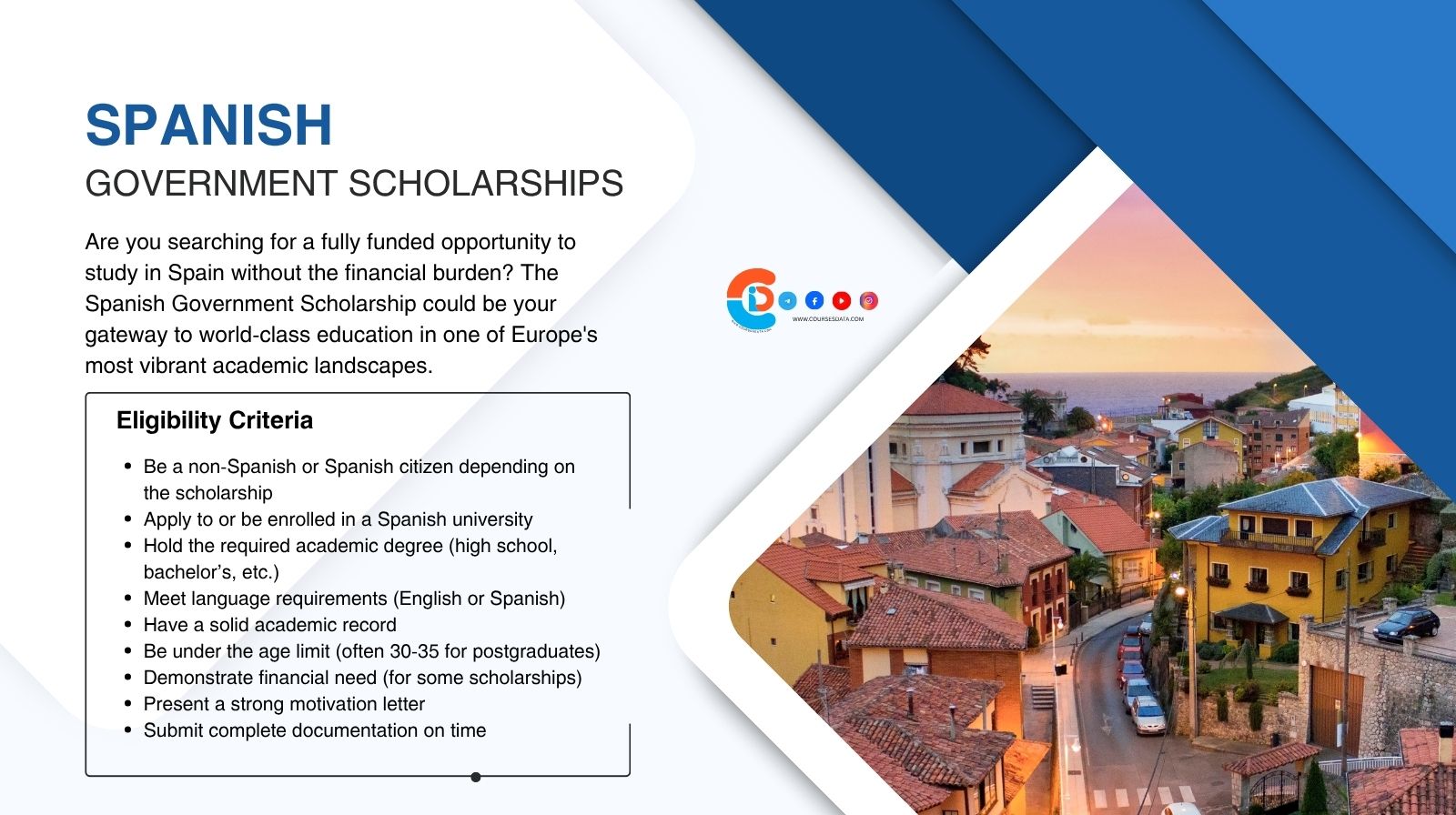
The Spanish Government Scholarship can provide access to postgraduate study, specialist training, diplomacy programs, academic mobility, and other educational opportunities in Spain.
However, applicants should understand that Spain does not operate one universal scholarship for every international student; government funding is offered through several programs with different nationality, academic, residence, and study requirements.
What Is the Spanish Government Scholarship?
The term Spanish Government Scholarship commonly refers to scholarships and study grants financed or administered by Spanish public institutions.
For international applicants, one of the most important government institutions is the Spanish Agency for International Development Cooperation, commonly known as AECID.
Its MAEC-AECID scholarship programs are particularly relevant to applicants from selected countries in Africa, the Middle East, Latin America, and Asia.
Spain’s Ministry responsible for education also operates a general scholarship system.
However, international students should not assume that admission to a Spanish university automatically makes them eligible for this funding because nationality and legal residence conditions apply.
The main government-backed routes students may encounter include:
- MAEC-AECID scholarships for international applicants.
- Master’s scholarship programs for selected regions.
- Scholarships connected with Spain’s Diplomatic School.
- Government grants for eligible university students residing in Spain.
- Specialized training programs administered by public institutions.
- Academic and professional cooperation programs.
- Scholarships for particular countries or geographic regions.
- Programs linked to international development cooperation.
Applicants should therefore identify the exact scholarship program before preparing documents.
The official AECID scholarship and active procedures portal is the most important starting point for current MAEC-AECID opportunities.
Main Spanish Government Scholarship Programs for International Students
International applicants are most likely to encounter government scholarships through MAEC-AECID.
The available programs can change between calls, and each program has its own target group.
Applicants should never use the eligibility requirements of one MAEC-AECID program to determine eligibility for another.
MAEC-AECID Africa-Med Master’s Program
The Africa-Med Master’s scholarship is aimed at citizens from eligible countries in Africa and the Middle East who want to undertake qualifying master’s-level study.
The official call defines which countries, master’s programs, institutions, documentation, and candidate profiles are accepted.
This route can be relevant for students who:
- Hold citizenship from an eligible country.
- Have completed the academic qualification required for master’s admission.
- Meet the conditions specified in the scholarship call.
- Apply for an eligible master’s program.
- Satisfy language requirements where applicable.
- Complete the AECID online application correctly.
- Submit all compulsory supporting documents.
- Meet any academic or professional criteria in the specific call.
It is important to distinguish eligibility for university admission from eligibility for the scholarship.
A student may qualify academically for a master’s degree in Spain but still be ineligible for an AECID scholarship because of nationality, program, documentation, or other scholarship-specific conditions.
MAEC-AECID Diplomatic School Program
AECID also operates a scholarship route connected with Spain’s Diplomatic School for eligible applicants from countries in Latin America, Africa, and Asia.
This is a specialized opportunity rather than a general master’s scholarship.
It is especially relevant to applicants interested in areas such as:
- International relations.
- Diplomacy.
- Foreign affairs.
- International cooperation.
- Public administration.
- International organizations.
- International policy.
Applicants should review the corresponding call carefully because being from Latin America, Africa, or Asia by itself does not establish eligibility.
Country coverage and additional conditions are determined by the individual scholarship announcement.
Spanish Government Scholarship Benefits
Scholarship benefits are not identical across all Spanish government programs.
This is one of the most important points for prospective students because websites sometimes describe the Spanish Government Scholarship as though every recipient receives the same financial package.
The actual award may include some combination of:
- A monthly financial allowance.
- Support toward living expenses.
- Tuition-related assistance.
- Medical or health-related coverage where specified.
- Academic support associated with the funded program.
- Funding for the approved scholarship period.
- Other benefits explicitly listed in the scholarship call.
Applicants should rely on the financial conditions written in the individual announcement.
Do not assume that a scholarship automatically provides:
- Free university accommodation.
- Unlimited tuition coverage.
- International airfare.
- Family allowances.
- Visa fees.
- Funding for dependents.
- Funding beyond the approved scholarship period.
If a benefit is important to your study plan, confirm that it appears explicitly in the official call.
Spanish Government Scholarship Overview
| Scholarship Route | Main Target Group | Typical Study Level | Important Eligibility Issue |
|---|---|---|---|
| MAEC-AECID Africa-Med | Eligible citizens of specified African and Middle Eastern countries | Master’s | Country and program restrictions apply |
| MAEC-AECID Diplomatic School | Eligible applicants from specified countries in Latin America, Africa, and Asia | Specialized postgraduate training | Applicants must meet the conditions of the specific call |
| Ministry General Scholarship | Students meeting Spanish nationality/residence and other requirements | Mainly eligible university and post-compulsory studies | International student status alone is insufficient |
| Other AECID Programs | Depends on the individual call | Training, postgraduate or specialist programs | Eligibility can change significantly between programs |
The table should be used as an orientation tool rather than a replacement for the official scholarship announcement.
Who Can Apply for a Spanish Government Scholarship?
There is no single set of eligibility requirements covering every Spanish government scholarship.
Eligibility depends primarily on the institution administering the scholarship and the program selected.
Common requirements can include:
- Citizenship of an eligible country.
- A recognized academic qualification.
- Admission or eligibility for the relevant study program.
- Compliance with academic requirements.
- Language proficiency where required.
- Submission of a complete application.
- Valid identification or passport documentation.
- Academic transcripts or certificates.
- Compliance with any professional experience requirement.
- Compliance with the conditions stated in the official call.
Some programs target citizens of specific partner countries.
Others depend heavily on a student’s legal residence in Spain.
This difference is particularly important for applicants already studying or living in Spain.
Ministry General Scholarship Eligibility
Spain’s general Ministry scholarship is different from a MAEC-AECID international scholarship.
Spanish citizens can apply subject to the applicable academic and financial requirements.
Citizens of European Union countries can also qualify under specified conditions relating to residence or employment in Spain.
For non-EU citizens, the rules are more restrictive.
The Ministry explains that eligible non-EU applicants may need qualifying residence status in Spain; having only authorization to stay in Spain for studies is not necessarily sufficient.
Therefore, an international student arriving in Spain exclusively with a study authorization should not automatically expect to receive the national general scholarship.
Students considering this route should review the official Spanish Ministry scholarship requirements before relying on the grant when calculating their study budget.
Academic and Language Requirements
Academic requirements depend on both the scholarship and the university program.
A government scholarship does not normally replace the university’s admission requirements.
Applicants may therefore have to complete two related but distinct processes.
For example, a candidate applying for master’s funding may need to satisfy:
- The scholarship’s nationality requirement.
- The scholarship’s academic conditions.
- The master’s admission requirements.
- Degree equivalency or recognition requirements where applicable.
- Language requirements set by the university.
- Documentation requirements set by AECID.
- Application deadlines for both procedures.
Spanish proficiency is not automatically required for every program.
Some Spanish universities offer postgraduate degrees completely or partly in English, while other programs are taught primarily in Spanish.
Applicants should determine the actual teaching language of the selected degree rather than assuming that an English-language certificate or Spanish-language certificate will always be required.
Depending on the program, evidence could include:
- Spanish proficiency certification.
- English proficiency certification.
- Previous education completed in the teaching language.
- Alternative evidence accepted by the university.
- No separate language certificate where the program does not require one.
The university’s admission rules remain the authoritative source for program-specific language requirements.
Documents Commonly Required
Students should create their document file before the scholarship portal opens.
Exact requirements differ by program, but international scholarship applications commonly involve academic, identification, admission, and supporting documents.
Potential documents include:
- Valid passport or accepted identification.
- University degree certificate.
- Academic transcript.
- Curriculum vitae.
- Proof of admission where required.
- Language certificate where required.
- Statements or declarations specified in the application.
- Professional experience evidence where applicable.
- Additional certificates requested by the scholarship program.
- Official translations when specifically required.
Never upload substitute documents unless the scholarship rules allow them.
A transcript, graduation certificate, university admission letter, and degree-recognition document serve different purposes.
Applicants should also check:
- Accepted file formats.
- Maximum document sizes.
- Whether documents must be signed.
- Whether certified copies are necessary.
- Whether official translation is required.
- Whether documents must be legalized or apostilled.
- Whether originals may be requested later.
Preparing these items early can prevent an otherwise competitive application from becoming administratively incomplete.
How to Apply for the Spanish Government Scholarship
The application process depends on the scholarship route.
For MAEC-AECID programs, applications and related procedures are handled electronically according to the instructions attached to the particular call.
AECID specifically instructs applicants to consult the individual procedure because its scholarship applications use designated electronic systems.
A practical application sequence is:
- Identify the exact scholarship program.
- Confirm that your nationality is eligible.
- Check the permitted study level or program.
- Review academic requirements.
- Check university admission requirements separately.
- Prepare all compulsory documents.
- Create or access the required electronic account.
- Complete every application field.
- Upload the requested documentation.
- Submit the application electronically.
- Save proof of submission.
- Monitor the electronic portal for notifications.
Applicants using AECID should follow the official AECID application registration guidance.
After submission, do not assume that the process has finished.
AECID procedures may include stages such as:
- Administrative review.
- Lists of admitted applications.
- Lists requiring correction.
- A correction or document-submission stage.
- Eligibility review.
- Evaluation.
- Provisional decisions.
- Acceptance procedures.
- Final scholarship decisions.
Applicants should therefore continue checking their online account and official scholarship notices.
How Applicants Are Evaluated
Selection criteria vary considerably between Spanish government scholarship programs.
Meeting minimum requirements generally means that an application can be considered.
It does not mean that funding is guaranteed.
Depending on the program, evaluation may consider factors such as:
- Academic record.
- Relevance of previous studies.
- Professional experience.
- Suitability for the selected program.
- Quality of submitted documentation.
- Connection between the applicant’s background and proposed studies.
- Requirements connected with international cooperation objectives.
- Program-specific evaluation criteria.
A strong application should therefore be coherent.
For example, an applicant with a bachelor’s degree in environmental engineering applying for a relevant master’s should clearly demonstrate how the proposed studies connect with previous education, professional goals, and the subject of the funded program.
Avoid submitting generic statements that could be used for any university or scholarship.
When a motivation statement is required, it should answer practical questions:
- Why this field?
- Why this particular program?
- How does your previous education prepare you?
- What skills do you intend to develop?
- How will the training relate to your professional direction?
Every statement must remain truthful and supported by the applicant’s actual background.
Important Differences Between Scholarship and University Admission
A common mistake is treating the scholarship application and university application as one process.
They may be connected, but they are not automatically the same.
Students should distinguish between:
- Scholarship eligibility.
- University admission eligibility.
- Degree recognition requirements.
- Language requirements.
- Immigration requirements.
- Enrollment procedures.
Consider a student who qualifies for a scholarship based on nationality and academic background.
The university may still require:
- A specific undergraduate degree.
- Particular prerequisite subjects.
- Proof of language proficiency.
- Certified academic documents.
- Recognition of a foreign qualification.
- Separate online registration.
Likewise, receiving university admission does not automatically guarantee government funding.
Students should maintain two checklists: one for the university and one for the scholarship.
A Practical Application Checklist
Before submitting, confirm that:
- Your country is explicitly eligible.
- Your chosen study program is eligible.
- Your academic degree satisfies the requirements.
- Your passport information matches your application.
- Your name is consistent across documents.
- Required translations are complete.
- Required certificates are uploaded.
- Your application is formally submitted.
- You saved the submission confirmation.
- You know how official notifications will be delivered.
- You understand any correction procedure.
- You can provide original documents if later requested.
This simple review can identify administrative problems before submission.
Common Mistakes to Avoid
The biggest mistake is applying based on the phrase “Spanish Government Scholarship” without identifying the exact program.
Government scholarships are highly specific legal and administrative calls.
Avoid these common problems:
- Assuming every nationality is eligible.
- Confusing university scholarships with government scholarships.
- Assuming admission guarantees funding.
- Applying to a program not covered by the scholarship.
- Relying on unofficial lists of eligible countries.
- Uploading incomplete academic records.
- Ignoring document correction notifications.
- Assuming all scholarships cover accommodation.
- Assuming every scholarship pays travel expenses.
- Using outdated requirements from an earlier call.
- Missing university admission requirements.
- Treating a student stay permit as equivalent to qualifying residence for the Ministry’s general grant.
Applicants should make decisions from the current official call rather than social media summaries or old scholarship articles.
Is the Spanish Government Scholarship Fully Funded?
There is no correct universal answer.
Some Spanish government scholarship programs provide substantial financial support, but the benefits depend on the specific award.
The phrase “fully funded” should therefore be used carefully.
Before considering an award financially sufficient, compare its stated benefits against:
- University tuition.
- Accommodation.
- Food.
- Local transportation.
- Health coverage.
- Study materials.
- Residence or visa-related costs.
- Travel to Spain.
- Personal expenses.
Only count a cost as covered when the official scholarship conditions explicitly say so.
This is particularly important when choosing between cities.
Living expenses can differ considerably depending on the destination and type of accommodation.
Students should prepare a personal budget even when applying for substantial government support.
Conclusion
The Spanish Government Scholarship can be a valuable route for international students, particularly through the MAEC-AECID programs available to eligible candidates from designated partner countries.
The key is to identify the exact scholarship first, verify nationality and academic eligibility, distinguish scholarship requirements from university admission, and submit every required document through the official system.
Frequently Asked Questions
1. What is the Spanish Government Scholarship?
It is a general term used for scholarships and study grants financed or administered by Spanish public institutions.
For many international applicants, MAEC-AECID scholarships are among the most relevant government-funded opportunities.
2. Can international students apply for Spanish Government Scholarships?
Yes, international students can apply to programs that specifically accept their citizenship or applicant category.
Eligibility varies significantly between scholarships, so there is no universal international-student application.
3. Is the Spanish Government Scholarship fully funded?
Funding depends on the specific program.
Applicants should check the official call for the exact allowance, tuition support, insurance, travel support, or other benefits rather than assuming every award covers all study and living costs.
4. Do I need admission to a Spanish university before applying?
It depends on the scholarship.
Some programs may require admission or evidence connected with the selected course, while others follow a different procedure.
Scholarship and university requirements should always be reviewed separately.
5. Can I apply for a bachelor’s degree?
Not every government scholarship is available for bachelor’s study.
Major international MAEC-AECID opportunities may target postgraduate or specialized programs, so undergraduate applicants should verify the education level covered by each individual call.
6. Can I apply for a master’s degree?
Yes.
Master’s-level opportunities are available under certain government scholarship programs, including targeted MAEC-AECID initiatives.
Applicants must meet the nationality, academic, program, and other conditions stated in the relevant call.
7. Do I need to speak Spanish?
Not necessarily for every scholarship or academic program.
The required language depends mainly on the language of instruction and the university’s admission rules.
Some postgraduate programs are taught in English, Spanish, or a combination of languages.
8. Can a non-EU international student receive Spain’s general Ministry scholarship?
Possibly, but specific legal residence rules apply.
Simply entering Spain with authorization to stay for study purposes does not automatically establish eligibility for the Ministry’s general scholarship.
9. Where do I apply for MAEC-AECID scholarships?
Applications are submitted electronically using the procedure specified by AECID for the individual scholarship call.
Applicants should use the official AECID electronic system rather than unofficial scholarship websites.
10. What should I do before the next scholarship application opens?
Prepare your passport, academic certificates, transcripts, curriculum vitae, possible translations, language evidence, and other commonly requested documentation.
Then monitor the official AECID scholarship portal and check the requirements of the specific program immediately when the new call is published.
Solid overview. One thing I’d add is that the application deadlines vary a lot between the AECID scholarships and the ministry-funded ones, so you really need to check specific program pages instead of relying on a single date. Also, don’t sleep on the language requirement—while some master’s programs are in English, many still expect at least a B2 in Spanish, so factor in prep time if you’re not fluent. Have you looked into whether the stipend actually covers cost of living in cities like Madrid or Barcelona, or is it tighter outside the big hubs?
The “fully funded” label really is doing a lot of heavy lifting here, isn’t it? You’re right to question whether the stipend actually works in Madrid or Barcelona, because from what I’ve seen, it’s a flat amount that assumes you’re splitting rent three ways in a smaller city. Also, that B2 requirement is a bigger hurdle than most people admit—if you’re not already conversational, cramming for a DELE exam on top of applications is a recipe for burnout.
Honestly, the point about the stipend stretching further outside Madrid or Barcelona is spot-on. I had a friend on a similar scholarship in Granada, and she lived pretty comfortably, but when I visited her in Madrid for a week, I could see how the same amount would disappear fast on rent alone. Did you find that the scholarship covers housing directly, or do they just give you the cash and let you figure it out?
You’re spot-on about the housing situation—from everything I’ve dug into, they just drop the cash in your account and wish you luck. I’ve seen a few people say they managed to find a decent room in a shared piso by joining local Facebook groups before they arrived, but it still feels like a gamble when you’re flying in blind. Honestly, I’d be way less stressed if there was a university housing option baked into the scholarship, but it really seems like we’re on our own.
Yeah, this is a decent summary, but it glosses over the real headache: the application paperwork. I’ve seen people get disqualified just because their transcripts weren’t officially translated and notarized by the Spanish consulate. So before you get too excited about the monthly stipend, maybe ask if they actually reimburse you for that costly bureaucratic nightmare, or if you’re eating the fees yourself.
Ah, yes, the “fully funded” dream—until you realize “fully funded” sometimes means “we’ll give you just enough cash to subsist on tapas and existential dread in a city where the rent is four times your stipend.” I’m curious if anyone has cracked the code on whether the AECID scholarship’s monthly allowance actually adjusts for the cost of living in places like Seville versus, say, a tiny village in Extremadura, or if we’re all just expected to become expert bargain-hunters at the local mercado. Also, Brendan’s point about the paperwork-induced migraine has me wondering: is the translation and notarization fee reimbursable, or is that a quiet “you’re on your own, sucker” situation?
Oh, you’ve nailed the “tapas and existential dread” part—that hit a little too close to home. I was on a different Spanish grant a few years back in Valencia, and the flat rate absolutely did not budge when I showed them my rent contract; they basically shrugged and wished me luck at the mercadona. As for the notarization fees, I ate that €180 myself because the scholarship guidelines said “administrative costs are the responsibility of the applicant,” which is bureaucrat-speak for “you’re on your own, sucker.”
I’ll be honest, I almost gave up on my application because the notarized translation requirement caught me off guard—cost me nearly €200 out of pocket with no reimbursement in sight. Also, Maddy’s right about the stipend not stretching far in Madrid; I landed in a shared piso and still had to pick up a part-time gig to cover groceries. If anyone’s figured out whether AECID actually factors city cost-of-living into the monthly allowance, I’d love to hear, because right now it feels like a flat rate that assumes we’re all living in Almería.
I’ve been looking into the AECID scholarship myself, and the point about the paperwork is what’s really holding me back—€200 for notarized translations is no joke when you’re already pinching pennies as a student. On the housing question from Maddy, from what I’ve seen on other forums, most programs just deposit the cash into your account and expect you to hunt down a place yourself, which feels pretty risky in a city you’ve never lived in. Has anyone here actually had luck negotiating a higher stipend by showing proof of Madrid rent prices, or is the flat rate set in stone?
Honestly, this whole thread is validating my anxiety about applying. I’ve been eyeing the AECID scholarship for a master’s in Barcelona, but hearing that the stipend is a flat rate that doesn’t budge for rent costs is making me second-guess whether I’d just be setting myself up for a side hustle struggle. Also, the €200 notarization fee being non-reimbursable feels like a hidden tax on people who are already scraping by—has anyone found a cheaper workaround for the translation requirement, or is it just a painful rite of passage?