Are you looking for a fully funded scholarship to study in Switzerland at the postgraduate level?
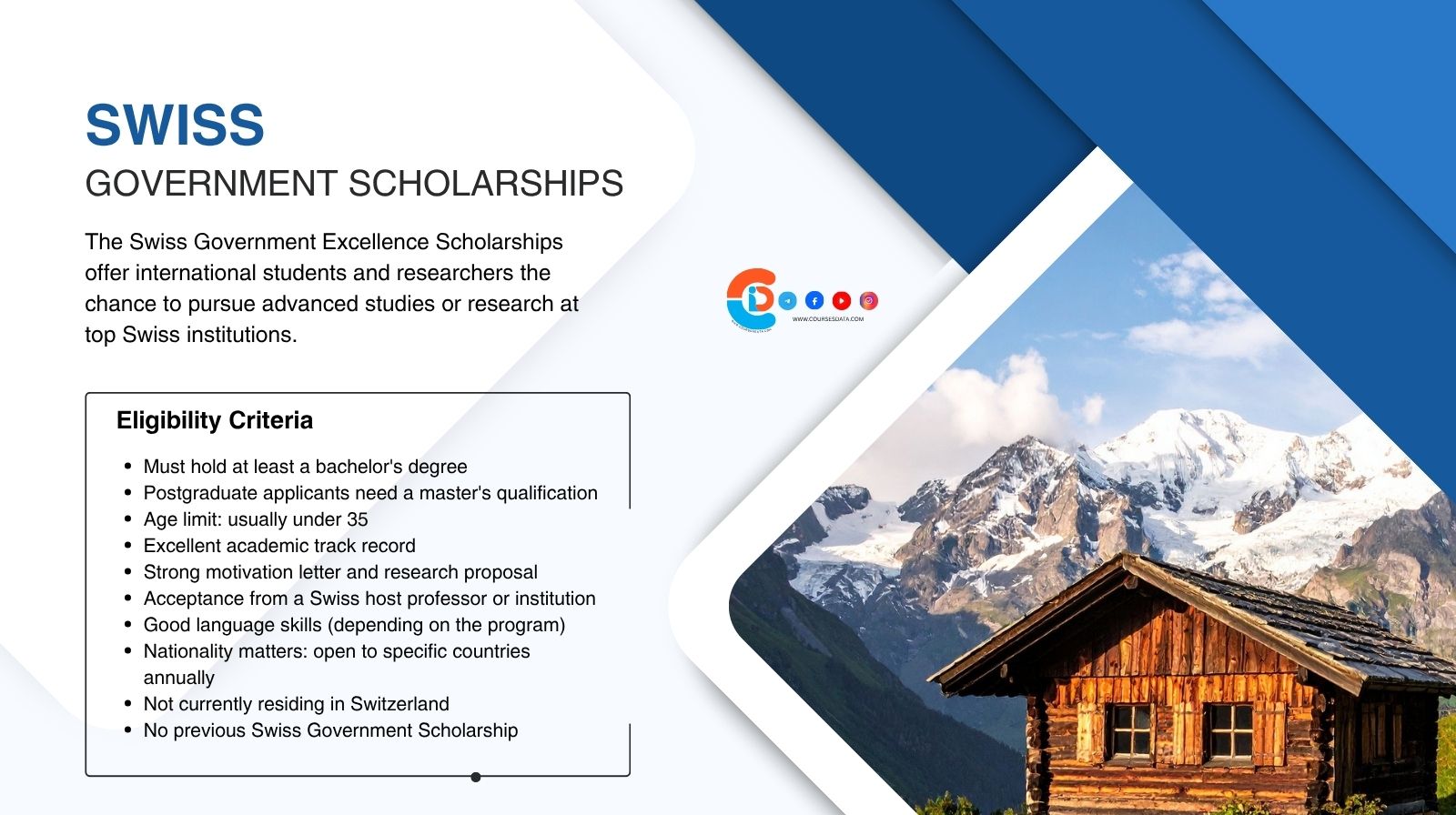
The Swiss Government Excellence Scholarships offer international students and researchers the chance to pursue advanced studies or research at top Swiss institutions. These competitive awards support academic excellence and cross-cultural collaboration.
What Is the Swiss Government Scholarship?
This prestigious scholarship program is funded by the Swiss Confederation. It supports international postgraduate students, researchers, and artists across more than 180 countries.
- Covers master’s, PhD, and postdoctoral levels
- Open to all academic fields and research disciplines
- Offers full tuition coverage
- Provides a monthly stipend
- Includes health insurance (for non-EU scholars)
- Offers travel allowance
- Enables access to world-class Swiss institutions
- Requires a host professor at a Swiss university
- Highly competitive and merit-based
- Promotes international academic exchange
Who Can Apply for the Swiss Government Scholarship?
Eligibility criteria vary depending on the scholarship type but generally target high-achieving graduates.
- Must hold at least a bachelor’s degree
- Postgraduate applicants need a master’s qualification
- Age limit: usually under 35
- Excellent academic track record
- Strong motivation letter and research proposal
- Acceptance from a Swiss host professor or institution
- Good language skills (depending on the program)
- Nationality matters: open to specific countries annually
- Not currently residing in Switzerland
- No previous Swiss Government Scholarship
Types of Swiss Government Scholarships
There are two main scholarship categories, tailored to various academic levels and goals.
Research Scholarships
Ideal for doctoral or postdoctoral researchers affiliated with Swiss institutions.
- Doctoral candidates or postdoctoral fellows
- Must submit a detailed research plan
- Requires Swiss university support
- 12-month funding, renewable up to 36 months
- Access to research labs and mentors
- Includes monthly stipend
- Encourages publication and innovation
- Must contribute to academic community
- Acceptance by a professor is mandatory
- Supports global academic collaboration
Art Scholarships
Designed for international artists pursuing master’s degrees at Swiss arts universities.
- Open to students in music, fine arts, and design
- For master’s level study only
- One-year duration, non-renewable
- Must show outstanding artistic portfolio
- Requires acceptance into a Swiss arts school
- Highly selective
- Covers tuition and living costs
- Fosters artistic growth in Swiss environment
- Only for specific countries
- Limited number of slots per year
How to Apply for the Swiss Government Scholarship
Applicants must follow a strict and detailed application process through official channels.
- Check country-specific eligibility and deadlines
- Identify the right scholarship type
- Secure a host professor or institution
- Prepare academic CV and certificates
- Submit a detailed research or study proposal
- Obtain letters of recommendation
- Provide a copy of passport
- Proof of language proficiency if required
- Use official application documents only
- Submit through the Swiss Embassy or Consulate
Required Documents for the Application
Providing complete and accurate documents is essential for consideration.
- Signed FCS application form
- Full CV with academic and professional background
- Motivational letter
- Research plan (2 pages max)
- Two academic recommendation letters
- Copies of diplomas and grades
- Medical certificate
- Copy of passport
- Letter of invitation or support from Swiss host
- Language proficiency certificates (if applicable)
Selection Criteria and Process
The selection process is highly competitive and merit-based, involving several Swiss authorities.
- Academic and research excellence
- Innovation and feasibility of research plan
- Quality and impact of artistic work
- Motivation and clarity of objectives
- Relevance to Swiss academic landscape
- Endorsement by a Swiss institution
- Contribution to future academic development
- Personal and professional alignment
- Balanced representation of countries
- Final decision by Federal Commission for Scholarships (FCS)
Scholarship Benefits and Coverage
The scholarship provides generous financial and academic support throughout your stay in Switzerland.
- Monthly stipend (approx. CHF 1,920)
- Full tuition fee waiver
- Swiss health insurance coverage
- One-time airfare support (in some cases)
- Public transport allowance
- Research and thesis expenses support
- Access to Swiss Federal Institute network
- Cultural integration programs
- Networking with international scholars
- Alumni opportunities after graduation
Swiss Universities Participating in the Program
Scholarship holders can study or conduct research at leading Swiss institutions.
| University Name | Area of Excellence |
|---|---|
| ETH Zurich | Science, Engineering, Technology |
| EPFL Lausanne | Engineering, Natural Sciences |
| University of Zurich | Law, Economics, Arts |
| University of Geneva | International Relations, Sciences |
| University of Lausanne | Biology, Business, Humanities |
| University of Bern | Medicine, Law, Environment |
| University of Basel | Life Sciences, Chemistry, History |
| University of Fribourg | Theology, Multilingual Studies |
| University of St. Gallen | Business, Economics, Law |
| Lucerne University of Applied Sciences | Design, Music, Applied Sciences |
Deadlines and Application Timeline
Timely preparation is critical, as deadlines vary by country.
- Application opening: August-September annually
- Country-specific deadlines: September–December
- Review phase: January–March
- Results announcement: April
- Scholarship starts: Following September
- One-year renewal (if applicable)
- Ensure early contact with Swiss host professor
- Follow official deadlines strictly
- Late applications not accepted
- Allow time for embassy processing
Frequently Asked Questions (FAQs)
Who funds the Swiss Government Scholarships?
The Swiss Federal Commission for Scholarships (FCS), under the Swiss Confederation, funds and manages the program.
Can I apply if I’m already studying in Switzerland?
No, applicants must not be residing in Switzerland at the time of application.
Is there an age limit for applicants?
Yes, applicants must generally be under 35 years old at the time of application.
Do I need to know a Swiss national language?
Not necessarily. Most research programs are in English, but language requirements vary by university and field.
Can I bring my family during the scholarship period?
The scholarship does not include family allowances. Bringing family is possible but must be self-funded.
Is work allowed during the scholarship?
Part-time work is restricted and must be approved by the host institution and immigration authorities.
What are my chances of getting selected?
The selection rate is low due to high competition. Only the most qualified applicants with strong proposals are chosen.
Can I reapply if rejected once?
Yes, reapplication is allowed, but a significantly improved application is expected.
Can I choose any Swiss university?
Yes, but the university must be recognized and the host professor must endorse your project.
How long does the scholarship last?
Scholarships typically last one academic year, with extensions available depending on the program type.
Conclusion
The Swiss Government Scholarship opens doors to world-class research and cultural exchange. It’s a life-changing opportunity for talented minds worldwide.
It sounds like a great opportunity, but I’d be curious to know how competitive it actually is for specific fields like engineering or social sciences. The requirement to already have a host professor lined up is a big hurdle—does the scholarship offer any support or networking to help applicants find one? Also, the mention of health insurance only for non-EU scholars makes me wonder if there are separate health coverage rules for EU residents.
You’re spot on about the host professor being the biggest hurdle—I went through the same grind myself, sending out dozens of emails before one took a chance on me. As for competition, engineering is brutal because Swiss ETH and EPFL labs get flooded with applicants, but social sciences can be slightly less saturated if you tailor your proposal to a niche the professor is actively researching. No, the scholarship doesn’t offer any matchmaking, so you really have to rely on cold outreach. On health insurance, EU residents typically use their European Health Insurance Card, though it’s worth double-checking if your home country’s coverage extends to the full duration of your stay.
I applied for this a few years back, and honestly, finding a host professor was the toughest part—I spent weeks cold-emailing labs before one finally responded. It would be really helpful if the program included a database or matchmaking service for applicants, because not everyone has those academic connections. As for the health insurance, I think EU residents just use their European Health Insurance Card, but it’s a detail that could trip people up if they’re not careful.
Megan, you’ve nailed the biggest pain point—cold-emailing professors is basically a part-time job nobody asked for, and a database or matchmaking service would save so many talented people from burning out before they even apply. And you’re right about the European Health Insurance Card, but it’s one of those fine-print details that could screw someone over if they assume the scholarship covers everything automatically. Honestly, if the program wants to attract the best applicants, they need to make that host professor hurdle less of a shot in the dark.
Ah, the cold-emailing gauntlet—brings back fond memories of refreshing my inbox like a gambler watching a slot machine. You’re dead right about needing a matchmaking service, because the current system basically filters for people who either have a thick skin or a pre-existing network, which seems to defeat the purpose of “excellence.” And on the health insurance bit, I’d add that even with the European Health Insurance Card, some Swiss cantons have their own registration quirks, so it’s worth checking if your home country covers the full duration or if you’ll need a supplementary plan.
Yeah, that host professor hurdle sounds like a proper mission, especially if you’re coming from a country without strong links to Swiss universities. I reckon it could be a dealbreaker for a lot of talented folks who don’t have the time or the network to spam emails for weeks on end. It’d be mint if the scholarship threw in some sort of introduction program or at least a list of departments actively looking for international students.
An introduction program would be a game-changer, but I suspect the Swiss figure if you can’t survive the email grinder, you’re not ready for their academic rigor. Still, it does feel like the scholarship is accidentally filtering for persistence over pure talent—which is a shame when they’re supposedly after “excellence.” A simple list of departments with a history of hosting foreign scholars wouldn’t exactly break the federal budget.
I went through this process a couple of years ago, and I have to agree that finding a host professor is the real gatekeeper—I sent out nearly forty emails before I got a single positive reply. One thing that doesn’t get mentioned enough is that Swiss professors often expect you to already have a solid research proposal tailored to their specific work, not just a generic interest in their lab. Looking back, I wish the scholarship had offered even a simple list of departments that have historically accepted foreign scholars, because guessing which labs are open to cold applications wasted a huge chunk of my time.
Oh, forty emails sounds painfully familiar—I think I hit around fifty before I got my first “maybe.” You’re absolutely right about the research proposal, too; I spent days reworking mine to match a professor’s recent publication, and it still felt like a shot in the dark. A list of historically welcoming departments would have saved me from wasting weeks on labs that never even open their emails.
Right, reading through the comments, the host professor hurdle sounds less like a scholarship requirement and more like a part-time cold-calling job on top of the actual application. It’s a bit rich that a program meant to foster international collaboration doesn’t at least provide a directory of labs currently open to hosting foreign scholars. You’d think the Swiss Confederation could spare a budget for a simple matchmaking database, given the talent they’re supposedly trying to attract.