Are you looking for a fully funded opportunity to study in Colombia without worrying about tuition or living expenses?
The Colombian Government Scholarship offers international students a chance to study at top universities in Colombia with all major costs covered. This competitive scholarship is part of Colombia’s global education strategy to attract talent and promote international cooperation.
What Is the Colombian Government Scholarship?
The Colombian Government Scholarship is a prestigious program managed by ICETEX (Instituto Colombiano de Crédito Educativo y Estudios Técnicos en el Exterior). It is open to foreign students wishing to pursue master’s or doctoral degrees in Colombia.
- Fully funded by the Colombian Ministry of Foreign Affairs
- Covers tuition, living costs, visa, and health insurance
- Open to students from over 100 countries
- Courses available in Spanish and some in English
- Priority given to countries with diplomatic ties to Colombia
- Requires prior undergraduate degree (bachelor’s or equivalent)
- Students must commit to returning to their home country post-study
- Accepted at over 50 Colombian universities
- Annual application period, usually between February and June
- Includes a Spanish language course if required
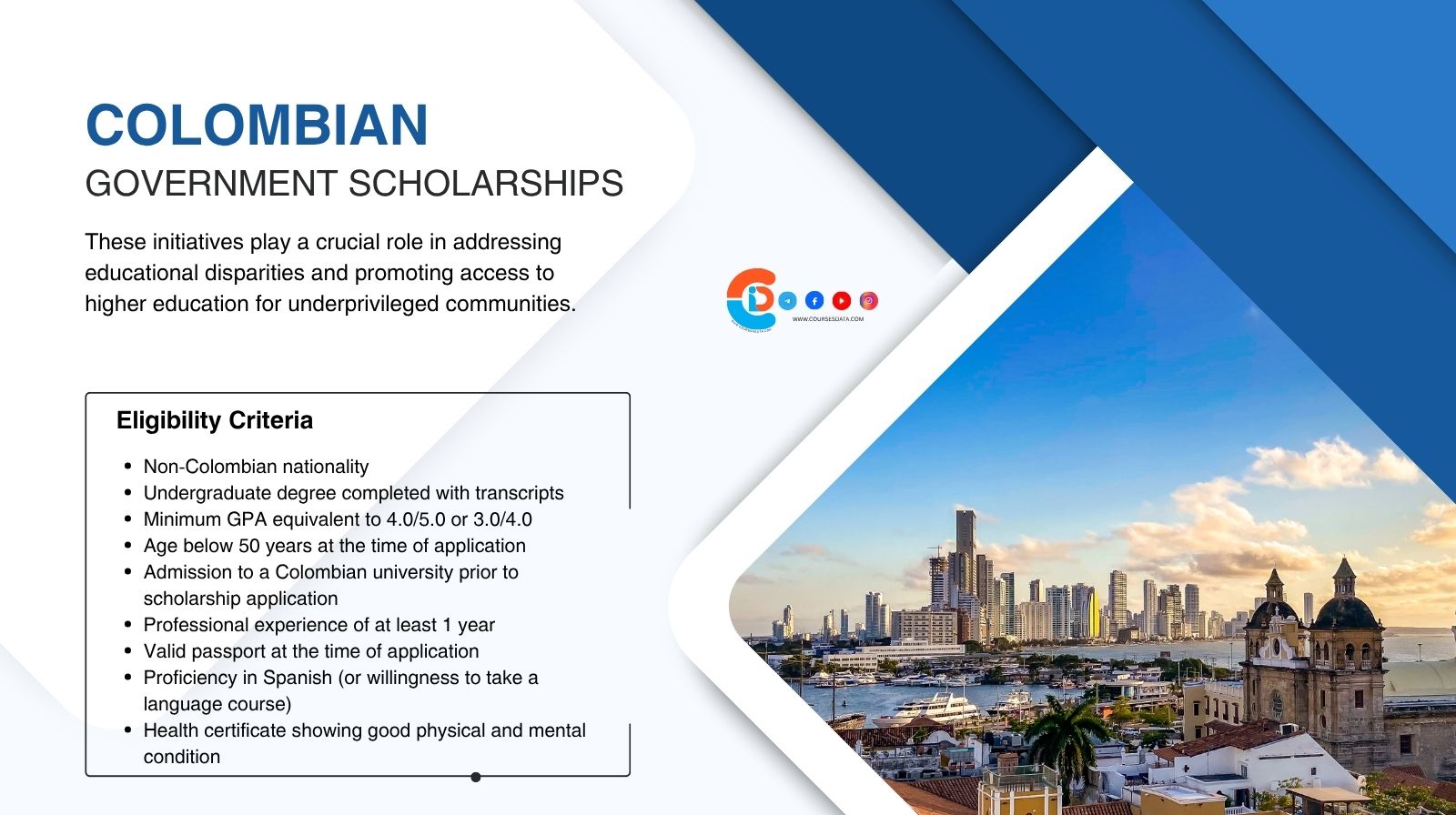
Eligibility Criteria for Applicants
To apply for the Colombian Government Scholarship, candidates must meet a range of academic and administrative requirements.
- Non-Colombian nationality
- Undergraduate degree completed with transcripts
- Minimum GPA equivalent to 4.0/5.0 or 3.0/4.0
- Age below 50 years at the time of application
- Admission to a Colombian university prior to scholarship application
- Professional experience of at least 1 year
- Valid passport at the time of application
- Proficiency in Spanish (or willingness to take a language course)
- Health certificate showing good physical and mental condition
- Written motivation letter explaining study goals
What Expenses Are Covered?
One of the most attractive aspects of the Colombian Government Scholarship is the comprehensive financial support it provides.
| Expense | Coverage |
|---|---|
| Tuition Fees | Full coverage at any participating university |
| Monthly Stipend | 2,484,348 COP (approx. $650 USD) for living expenses |
| Installation Grant | One-time payment for settling in Colombia |
| Health Insurance | Full medical insurance during stay |
| Visa Costs | Covered entirely by the program |
| Spanish Course | Fully paid for if needed before academic program |
- No application fee required
- Includes transportation allowance within Colombia
- Return airfare not always covered
- Some universities offer additional academic support
- Housing often arranged through host universities
- Opportunities for internships or research roles
- Personal expenses not included
- Covers up to 24 months of study
- Funds disbursed monthly
- Includes support for thesis development
Application Process Step-by-Step
Applying to the Colombian Government Scholarship involves careful planning and timely submission of documents.
- Research available universities and eligible programs
- Secure admission to a Colombian institution
- Prepare required documents (transcripts, passport, etc.)
- Write a strong motivation letter
- Obtain a health certificate
- Complete the ICETEX online application form
- Attach scanned documents to the portal
- Submit application before the official deadline
- Wait for shortlisting and possible interview
- Await final scholarship decision via email
Required Documents Checklist
Applicants need to gather and submit all required documents in digital format through the ICETEX portal.
- Passport-sized photo
- Academic transcripts with official seal
- Undergraduate diploma or degree certificate
- Curriculum Vitae (CV)
- Copy of valid passport
- Medical certificate (issued within last 6 months)
- Admission letter from Colombian university
- Spanish proficiency certificate (if applicable)
- Two letters of recommendation
- Signed application form with declaration
Best Universities Accepting Scholarship Recipients
Over 50 universities in Colombia participate in the scholarship program, many of which are renowned for academic excellence.
- Universidad Nacional de Colombia
- Pontificia Universidad Javeriana
- Universidad de los Andes
- Universidad del Rosario
- Universidad EAFIT
- Universidad del Valle
- Universidad de Antioquia
- Universidad Industrial de Santander
- Universidad Externado de Colombia
- Universidad del Norte
Popular Fields of Study
Colombia offers a wide range of master’s and PhD programs under the scholarship scheme.
- Environmental Sciences
- Engineering and Technology
- Public Health
- Political Science
- International Relations
- Education and Pedagogy
- Renewable Energy
- Social Development
- Agriculture and Food Security
- Cultural Studies
Benefits Beyond Financial Support
The Colombian Government Scholarship provides more than just funding; it offers a full academic and cultural immersion.
- Exposure to Colombia’s rich culture and language
- Opportunity to build international academic networks
- Access to cutting-edge research and labs
- Enhanced career prospects in international sectors
- Spanish language skills for global employability
- Opportunities for regional travel and exploration
- Participation in academic seminars and workshops
- Community service and volunteering options
- Strong alumni support and networking
- Recognition from government and global institutions
Common Reasons for Rejection
Understanding common pitfalls can help applicants avoid disqualification.
- Incomplete or missing documentation
- Submitting after the deadline
- Lack of Spanish proficiency with no plan for improvement
- Weak or generic motivation letter
- No admission letter from a Colombian university
- Poor academic performance or low GPA
- Over age limit (above 50 years)
- Medical issues affecting long-term study
- Failure to meet professional experience requirement
- Unclear study or return plans
Key Dates and Timeline
Timing is crucial when applying for the scholarship. Below is a typical annual schedule.
- February: Application portal opens
- March to May: Document preparation and submission
- June: Application deadline closes
- July: Review and evaluation by ICETEX
- August: Interview invitations (if needed)
- September: Final decision and award letters
- October: Visa processing and Spanish course (if required)
- January: Academic programs begin
Frequently Asked Questions (FAQs)
Can I apply without being admitted to a Colombian university yet?
No, admission is a mandatory requirement before applying for the scholarship.
Do I need to know Spanish before applying?
Not necessarily, but non-Spanish speakers must take a mandatory Spanish course.
Is the scholarship available for undergraduate programs?
No, it is only for graduate-level studies (master’s and PhD).
Can I stay in Colombia after graduation?
The scholarship requires scholars to return home post-graduation.
What are my chances of getting selected?
It depends on your academic merit, documentation, and motivation.
Does the scholarship cover family or dependents?
No, it only covers individual students.
Can I apply more than once if rejected?
Yes, reapplication is allowed in future cycles.
Do I need to translate my documents?
Yes, all documents must be officially translated into Spanish.
What if my program is in English?
You may still need basic Spanish skills for daily life in Colombia.
Who can I contact for help?
Reach out to ICETEX directly or consult your local Colombian embassy.
Conclusion
The Colombian Government Scholarship opens doors to high-quality education and cultural enrichment in South America. For motivated students worldwide, it’s a chance to study with full support in a dynamic, emerging global hub.
I’ve been looking into this scholarship for a while now, and what really stands out to me is how they cover the visa and health insurance on top of tuition and living costs—that’s a huge relief compared to some programs that leave you sorting out those details yourself. I’m curious, though: does anyone know how competitive the selection process actually is for master’s applicants, especially if you’re coming from outside Latin America? I’d love to hear from someone who’s gone through it, because the language barrier with Spanish has me a bit nervous about the application essays.
The selection is extremely competitive, especially for non-Latin American applicants—think single-digit acceptance rates. Your Spanish doesn’t need to be flawless for the essays, but it does need to show genuine effort and clarity; I’d recommend having a native speaker review your work. Focus on how your research aligns with Colombia’s priorities, and you’ll have a better shot than most.
Let’s be real—covering visa and health insurance is nice, but it’s the bare minimum for a “fully funded” claim. What actually worries me is the language requirement: if the application materials and coursework are in Spanish, and you’re not fluent, are they really setting you up for success, or just checking a diversity box? Also, I’d want to see the actual acceptance rate for master’s programs, not just the marketing spin, because “competitive” can mean anything from 10% to 1%.
You’ve hit on exactly what made me hesitate too, Brett. I applied last year and the Spanish requirement is definitely the real filter—they’re not just checking a box, they expect you to engage with the material and culture, which means fluency matters far more than the visa coverage. As for the acceptance rate, it’s brutal for master’s applicants from outside Latin America—think well below 5%—so it’s not marketing spin, but if your research aligns with Colombia’s needs and you can prove you’ve worked on the language, it’s not impossible.
I actually went through the application process for the master’s track last year, and I’ll be honest—the Spanish requirement is the real gatekeeper. I’m from Canada and I’m not fluent, so I spent months on the essays with a tutor, and even then, I barely made the shortlist. The competition is fierce, but if you can prove your academic fit and show you’ve made an effort with the language, it’s not impossible—just don’t expect them to hand it to you for being an outsider.
It’s reassuring to hear from Kiri that showing genuine effort with the language can make a difference, because I’d be lying if I said the Spanish requirement didn’t intimidate me too. That said, I’m still wondering if there’s any flexibility for programs taught in English, or if you’re expected to be fully bilingual from day one. Has anyone here found a way to balance language prep with the rest of the application without burning out?
Great question, Niamh. From what I’ve seen and heard, a few Colombian universities do offer master’s programs taught in English, especially in STEM fields, so it’s worth checking each program’s language of instruction before you apply. Balancing language prep with the rest of the application comes down to carving out 20–30 minutes daily for Spanish practice and treating your essays as a two-step process: get the content right first, then polish the language with a tutor or native speaker. It’s a grind, but focusing on small, consistent steps keeps you from burning out while still making real progress.
Oh great, another “fully funded” scholarship that conveniently forgets to mention the real cost is three years of your life wrestling with bureaucratic Spanish and a 2% acceptance rate. But hey, at least they throw in the visa fee so you can feel fancy while you’re stressing over the language requirement. Kiri’s story about barely making the shortlist after months with a tutor is exactly the kind of reality check that should scare off anyone who thinks this is a casual application.
I really appreciate hearing from Kiri and Megan about the language prep—it’s the part that keeps me up at night too. I’m a native English speaker from the US, and I’ve been wondering if the selection committee values a polished but imperfect essay more than a perfect one that feels stiff. Has anyone here found that emphasizing a personal connection to Colombia or a specific research interest outweighed a less-than-fluent application?
Honestly, reading this thread makes me feel a bit better about my own nerves around the Spanish requirement—I’m from South Africa and my Spanish is shaky at best, so hearing Kiri’s story about barely making the shortlist after months with a tutor is both terrifying and oddly motivating. What I’m still unsure about is whether they look more kindly on applicants from non-Spanish-speaking countries if we can clearly show we’ve tried, or if they just expect fluency from the get-go. For anyone who’s been accepted, did you feel the application essays were judged more on language perfection or on the strength of your research proposal?