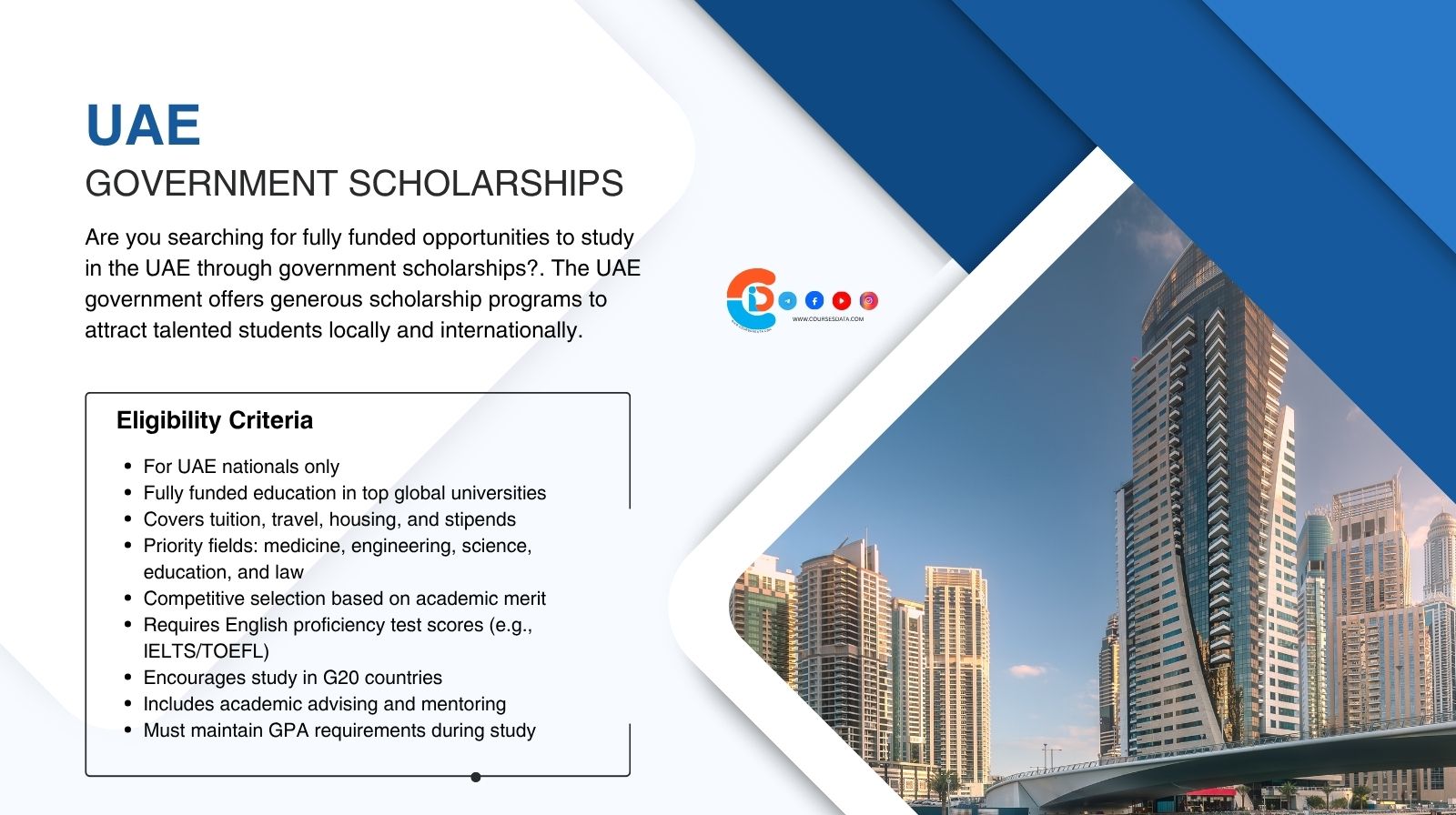
UAE Government Scholarships include several funding routes for higher education, ranging from government-sponsored study opportunities for Emirati citizens to tuition scholarships and funded graduate programs at public universities.
International students can also access selected university-based scholarships, but eligibility, coverage, and application procedures vary considerably between programs.
What Are UAE Government Scholarships?
UAE Government Scholarships are financial support programs connected to federal authorities, government entities, public universities, and government-backed higher education institutions.
There is no single scholarship called the “UAE Government Scholarship” that automatically provides the same benefits to every applicant.
Students need to identify the specific program that matches their nationality, degree level, academic record, and intended university.
The main scholarship routes include:
- Government scholarships for UAE nationals studying abroad.
- Scholarships at federal and public universities.
- Full or partial tuition scholarships.
- Graduate research funding.
- University fellowships and assistantships.
- Merit-based scholarships for high-performing students.
- Specialized scholarships in strategic academic fields.
- Scholarships connected to government and industry partners.
According to the official UAE Government education portal, the Ministry of Education and other government entities provide scholarship opportunities for UAE nationals pursuing undergraduate and postgraduate education at recognized universities abroad.
International applicants should therefore avoid assuming that every scholarship advertised as a UAE government scholarship is available to foreign students.
Who Can Apply for UAE Government Scholarships?
Eligibility depends heavily on the scholarship provider.
Some federal scholarship schemes are specifically designed for UAE citizens.
Government universities, however, may operate separate merit scholarships for international students.
Typical applicant groups include:
- UAE nationals finishing secondary school.
- Emirati undergraduate students.
- Emirati graduate students.
- International students applying to UAE universities.
- High-achieving secondary-school graduates.
- Master’s applicants.
- Doctoral researchers.
- Students in strategic academic disciplines.
- Applicants with exceptional talents.
- Students applying for research or teaching funding.
Nationality is therefore one of the first eligibility requirements students should check.
A student who is not a UAE citizen may still have excellent funding opportunities, but these are more likely to come directly from a government university than through a federal scholarship for overseas study.
Main Types of UAE Government Scholarships
Scholarship funding in the UAE can be divided into several practical categories.
Government Scholarships for UAE Nationals
The UAE government supports eligible citizens who pursue higher education, including approved programs outside the country.
Depending on the specific sponsorship scheme, support may include:
- University tuition.
- Monthly financial allowances.
- Travel-related support.
- Academic expenses.
- Support associated with studying abroad.
- Other benefits determined by the sponsoring authority.
These schemes generally require applicants to meet citizenship, academic, university-recognition, and program requirements.
Students should not assume that admission to a university automatically creates entitlement to government sponsorship.
Scholarships at Government Universities
Public and government-backed universities operate their own scholarship systems.
These may be available to:
- UAE nationals.
- International students.
- High-achieving applicants.
- Students with exceptional talents.
- Graduate researchers.
- Teaching or research assistants.
University scholarships are especially important for foreign applicants because some are explicitly open to international students.
Graduate Research Funding
Graduate funding can work differently from undergraduate scholarships.
A master’s or doctoral student may receive financial support through:
- University fellowships.
- Research assistantships.
- Teaching assistantships.
- Faculty-funded research projects.
- Government sponsorship.
- Strategic research grants.
Funding availability can depend on the university’s budget, research priorities, supervising faculty, and the student’s academic progress.
UAE University Scholarships for International Students
United Arab Emirates University is one of the most important institutions to examine when searching for UAE Government Scholarships.
Its undergraduate scholarship structure includes scholarships and tuition discounts for eligible international students.
For example, UAEU currently lists a Chancellor’s Scholarship for Elite Students providing a 100% tuition discount for qualifying applicants.
It also offers other scholarship levels and a talent-based scholarship route.
Applicants can review the current criteria through the official UAEU undergraduate scholarship page.
Typical factors considered include:
- Secondary-school academic performance.
- University admission requirements.
- English-language proficiency.
- Mathematics proficiency for applicable programs.
- Program-specific requirements.
- Continued academic performance after enrollment.
- Minimum study-load requirements.
- Availability of scholarship places.
A particularly important point is that the full undergraduate UAEU scholarship covers tuition rather than automatically covering every cost.
UAEU explicitly states that its 100% Chancellor’s Scholarship for Elite Students covers tuition fees but does not cover housing or the admission application fee.
This distinction matters when comparing UAE scholarships.
| Funding Route | Typical Applicants | Possible Coverage | International Students |
|---|---|---|---|
| Federal overseas scholarship | UAE nationals | Tuition and approved allowances | Generally no |
| UAEU undergraduate scholarships | High-achieving students | Partial or full tuition | Yes |
| University talent scholarships | Applicants with exceptional abilities | Often tuition support | May be available |
| Graduate fellowships | Master’s and PhD students | Tuition and/or financial support | Depends on program |
| Research assistantships | Graduate researchers | Funding linked to research work | Often possible |
| MBZUAI undergraduate scholarships | Strong AI applicants | Up to full tuition and cost of attendance | Yes |
| MBZUAI doctoral funding | PhD applicants | Tuition, stipend and other benefits | Yes |
The table illustrates why applicants should compare the actual scholarship package instead of relying only on the words “fully funded.”
MBZUAI Scholarships and Graduate Funding
Mohamed bin Zayed University of Artificial Intelligence is another government-backed institution with significant scholarship opportunities for both UAE and international applicants.
The university accepts international students and offers programs in fields such as:
- Artificial intelligence.
- Machine learning.
- Computer vision.
- Natural language processing.
- Robotics.
- Computer science.
- Human-computer interaction.
- Statistics and data science.
Undergraduate applicants can be considered for merit-based scholarships covering up to 100% of tuition and the cost of attendance.
The university also operates the Tahnoon bin Zayed Scholarship in AI Excellence for prospective students from the UAE and other countries.
Graduate funding varies by degree and funding arrangement.
For doctoral students, available funded packages can include:
- Free tuition.
- Monthly stipend.
- Health insurance.
- Residence visa support where eligible.
- Annual return airfare to the student’s home country.
- Research-related support.
Funding remains subject to the applicable university requirements and satisfactory academic progress.
Applicants should check the official MBZUAI admissions and funding information because funding conditions differ between undergraduate, master’s, doctoral, and professional programs.
This is especially important for master’s applicants, because admission does not necessarily mean that every master’s student receives full funding.
What Do UAE Government Scholarships Cover?
Scholarship coverage varies significantly.
A student should never interpret “scholarship” as automatically meaning tuition, accommodation, flights, insurance, and a monthly stipend.
A scholarship may cover only:
- 100% of tuition.
- A percentage of tuition.
- Research expenses.
- Academic fees.
- A monthly stipend.
- Housing or housing support.
- Medical insurance.
- Travel allowances.
- Student visa costs.
- A combination of these benefits.
For example, the full UAEU undergraduate merit scholarship is primarily a tuition waiver, while funded doctoral study at MBZUAI can include tuition and additional living-related benefits.
Applicants should therefore separate scholarship benefits into four categories:
- Tuition: What percentage is waived?
- Living costs: Is there a monthly stipend?
- Housing: Is accommodation included?
- Additional expenses: Are flights, insurance, visas, or books covered?
This simple comparison prevents students from choosing a scholarship that looks generous but leaves substantial living expenses unpaid.
Academic and Language Requirements
Academic merit is central to many UAE scholarships.
Competitive programs commonly prioritize applicants who have a strong previous academic record rather than applicants who simply meet the minimum admission requirement.
Scholarship committees may consider:
- Secondary-school grades.
- Bachelor’s or master’s grades.
- GPA.
- English proficiency.
- Mathematics ability.
- Research experience.
- Academic recommendations.
- Personal statements.
- Publications.
- Relevant professional experience.
English-language requirements depend on the institution and program.
Commonly accepted tests may include:
- IELTS Academic.
- TOEFL iBT.
- Other university-approved proficiency assessments.
Applicants should use the score required for the particular scholarship rather than relying only on the university’s general admission minimum.
A scholarship can impose a stronger academic or English standard than ordinary admission.
Documents Usually Required
The exact document list differs between universities, but students can prepare most core documents before beginning an application.
Common documents include:
- Valid passport copy.
- National identification documents when applicable.
- Secondary-school certificate.
- Academic transcripts.
- Bachelor’s certificate for graduate applicants.
- Master’s certificate for relevant doctoral applicants.
- English-language test results.
- Personal statement.
- Curriculum vitae.
- Recommendation letters.
- Research proposal when required.
- Evidence of achievements or awards.
- Passport-style photograph.
International qualifications may also require official recognition, attestation, or equivalency procedures.
Students educated outside the UAE should pay particular attention to document-recognition requirements because these can affect final enrollment even after receiving an initial admission decision.
For research programs, applicants should prepare additional evidence such as:
- Research interests.
- Previous projects.
- Publications.
- Technical skills.
- Thesis experience.
- Academic references.
Documents should be clear, consistent, and submitted in the requested format.
How to Apply for UAE Government Scholarships
The application method depends on whether the scholarship is government-sponsored or university-based.
A practical application process looks like this:
- Determine whether the scholarship accepts your nationality.
- Choose the correct degree level.
- Check whether your intended university and program are eligible.
- Review admission requirements.
- Review separate scholarship requirements.
- Prepare academic documents.
- Complete any required language tests.
- Submit the admission application.
- Complete the scholarship application if it is separate.
- Monitor the applicant portal for additional requests.
Some university scholarships do not require an entirely separate application because applicants may be evaluated during the admission process.
Others require students to submit a dedicated scholarship form.
Before submitting, check:
- Whether admission must come first.
- Whether scholarship consideration is automatic.
- Whether a separate application exists.
- Whether supporting documents must be uploaded twice.
- Whether recommendations are submitted directly by referees.
- Whether interviews or assessments are required.
Never send documents to an unofficial agent simply because the advertisement uses government logos or scholarship terminology.
How to Improve Your Scholarship Application
Strong scholarship applications are usually specific rather than generic.
Your application should demonstrate why your academic preparation fits the program you selected.
Useful ways to strengthen your application include:
- Apply to programs that match your academic background.
- Prepare language-test results early.
- Use a focused academic CV.
- Select recommenders who know your academic work.
- Explain relevant research or projects.
- Highlight measurable academic achievements.
- Follow document-format instructions carefully.
- Submit complete transcripts.
- Avoid generic personal statements.
- Review every uploaded document before submission.
For example, an applicant seeking an artificial intelligence scholarship should highlight mathematics, programming, data science, research, competitions, technical projects, or related professional experience.
A student seeking a research doctorate should focus more heavily on research preparation, methodology, publications, previous thesis work, and alignment with potential research areas.
Do not fill a scholarship application with unrelated achievements simply to make it longer.
Important Conditions After Receiving a Scholarship
Winning a scholarship is usually not the final requirement.
Most scholarships include continuation conditions that students must satisfy throughout their studies.
These may include:
- Maintaining a required GPA.
- Remaining in good academic standing.
- Completing the required credit load.
- Following university conduct rules.
- Making satisfactory research progress.
- Avoiding unauthorized withdrawals.
- Completing the degree within the permitted study period.
- Meeting assistantship responsibilities.
- Reporting changes in academic status.
- Avoiding prohibited combinations of scholarships.
At UAEU, for example, scholarship continuation can depend on GPA and study-load requirements, and students normally cannot combine multiple scholarships.
Graduate funding can also depend on research progress, faculty supervision, or assistantship arrangements.
Students should therefore read the scholarship agreement before accepting the award.
Common Mistakes Applicants Should Avoid
Many scholarship applications fail because applicants misunderstand eligibility or funding rather than because their academic record is weak.
Common mistakes include:
- Applying to scholarships restricted to UAE nationals.
- Assuming every UAE scholarship is fully funded.
- Confusing admission with scholarship approval.
- Ignoring program-specific requirements.
- Submitting incomplete transcripts.
- Missing language requirements.
- Using unofficial application websites.
- Applying to an unrecognized program.
- Failing to prepare recommendation letters early.
- Assuming housing is included without checking.
- Ignoring scholarship continuation requirements.
- Providing inconsistent information across documents.
Another frequent problem is relying on third-party scholarship articles without checking the university’s current rules.
Use informational websites to discover opportunities, but make the final application decision from the official university or government source.
Conclusion
UAE Government Scholarships can provide substantial support for higher education, but applicants need to distinguish between federal scholarships for UAE nationals and university-based scholarships that accept international students.
UAEU offers merit-based undergraduate tuition scholarships, while institutions such as MBZUAI provide additional merit and research funding opportunities in specialized fields.
The most effective approach is to choose the university and degree first, verify nationality eligibility, examine exactly what the scholarship covers, and prepare the academic and language requirements carefully.
A scholarship described as “full” should always be checked for tuition, housing, stipend, insurance, travel, and continuation conditions separately.
Frequently Asked Questions About UAE Government Scholarships
Can international students apply for UAE Government Scholarships?
Yes, international students can apply for selected scholarships offered by government and government-backed universities.
However, federal overseas scholarship programs intended for UAE citizens should not be confused with university scholarships available to foreign applicants.
Are UAE Government Scholarships fully funded?
Some are, but not all.
Certain scholarships cover only tuition, while some funded graduate programs may additionally provide stipends, health insurance, travel support, or other benefits.
Does UAEU offer scholarships for international students?
Yes.
UAEU has undergraduate scholarship categories for eligible international students, including merit-based tuition scholarships.
Scholarship places are competitive and meeting the minimum criteria does not guarantee an award.
Can I receive a 100% tuition scholarship in the UAE?
Yes.
Selected universities offer scholarships that can cover the full tuition amount for applicants who satisfy the relevant academic and scholarship requirements.
Does a full tuition scholarship include accommodation?
Not necessarily.
Full tuition means the tuition charge is covered.
Housing, food, transportation, insurance, visa expenses, and other costs must be checked separately.
Can international students receive funding at MBZUAI?
Yes.
International applicants can be eligible for scholarships and funding at MBZUAI.
The exact funding arrangement depends on the degree program, merit, research funding, and applicable university conditions.
Do I need IELTS to obtain a UAE scholarship?
It depends on the university and program.
Many English-taught programs require approved evidence of English proficiency, but accepted tests and minimum scores differ.
Can I apply for a scholarship before receiving university admission?
This depends on the program.
Some scholarships are assessed together with the admission application, while others require a separate application or require admission first.
Is receiving university admission enough to guarantee a scholarship?
No.
Admission and scholarship decisions are often separate.
A student can satisfy university admission requirements without being selected for financial support.
What is the best way to find legitimate UAE Government Scholarships?
Start with official UAE government portals and the scholarship or admissions pages of government universities.
Verify nationality requirements, funding coverage, academic conditions, and the official application procedure before submitting personal documents.
How can I apply
Hey Nabel, I’d start by bookmarking the ADEK and Ministry of Education portals—they’re the main hubs for application cycles and deadlines. When I applied, I made sure my statement of purpose tied directly to UAE’s Vision 2031 goals, which honestly made my application stand out way more than just listing grades. Also, double-check if your program accepts international students early on; I found a few engineering tracks were restricted to Emirati nationals when I looked. And prepare for a long wait—I submitted in October and didn’t hear back until March, so patience and a strong GPA are your best friends here.
Kia ora Nabel, I went through the ADEK portal myself last year, so I’d start by bookmarking their official site and the Ministry of Education one—deadlines pop up a few months before the cycle opens, usually around August. When I applied, the key was tailoring my statement of purpose to UAE’s Vision 2031 goals, not just my own career plans, and making sure my program had spots for international students since some engineering tracks were limited to Emirati nationals. Be ready for a long wait—I submitted in October and didn’t hear back until March—but keep your GPA high, because losing funding for a slip is a real risk.
It’s great to see the UAE investing so heavily in education, especially with full tuition coverage for fields like AI and engineering. I remember when I was researching scholarships, I found that getting a strong recommendation letter and a clear statement of purpose was just as important as the grades. For anyone wondering how to apply like Nabel, I’d suggest checking the ADEK or Ministry of Education portals directly, as they usually post detailed deadlines and requirements a few months before the cycle opens. Just be patient with the process—it can take a while, but it’s worth it.
Right, because waiting months for a portal to update is everyone’s idea of a good time. Glad you found the secret sauce with the recommendation letters, but maybe warn people that “patient” means refreshing the same page until your eyes bleed. Brilliant advice on the statement of purpose though—let’s hope Nabel likes writing essays more than applying.
Ha, Brett, you’re not wrong about the portal refresh marathon—I think I wore out my F5 key just waiting on ADEK to post their dates. The statement of purpose nearly did me in, but honestly, tying it to their vision goals wasn’t just a box to check; it actually helped me land a research project that tied in with my career. Hope Nabel’s got a good stash of coffee and a thick skin for the waiting game—totally worth it once that acceptance email hits.
Thanks for sharing this, Thandi—your point about the recommendation letters really hit home for me. I went through the ADEK application a couple of years ago, and I honestly underestimated how specific their prompt for the statement of purpose was; they wanted it directly tied to UAE’s Vision 2031 goals, not just my personal career ambitions. For anyone starting the process, I’d recommend looking at whether the scholarship ties you to a job placement after graduation, because I’ve seen a few friends struggle with that obligation when they wanted to switch fields later.
That’s a great point about the job placement clause—I’d never even thought to check that until a friend of mine got stuck in a role she hated for two years after her ADEK scholarship ended. Definitely something I’ll be digging into the fine print for before I hit submit.
Gabrielle, you’re spot on about the job placement clause—I almost missed that in my own ADEK application, and it’s a huge commitment if you’re not sure about your long-term path. The Vision 2031 angle was brutal for me too; I rewrote my statement three times before it felt like I was actually connecting my research to their goals rather than just listing them. Definitely worth checking the fine print before you hit submit, because I’ve heard stories of people feeling trapped in roles they didn’t expect.
I applied for the Khalifa University scholarship last year, and honestly, the timeline was the hardest part—I submitted everything in October and didn’t hear back until March. One thing I wish someone had told me upfront is that some of these government scholarships require you to maintain a very high GPA each semester, or you risk losing the funding entirely. For anyone like Nabel just starting out, I’d double-check whether your intended program actually has slots for international students, because a few of the engineering tracks were only open to Emirati nationals when I looked.
You’re so right about the GPA requirement—I lost a friend who thought she could relax after getting the scholarship, and they pulled her funding halfway through. The timeline is brutal too; I submitted my ADEK application in September and didn’t sleep through that whole wait until February. Definitely check the international slots early, because I almost wasted a cycle on a master’s program that turned out to be Emirati-only.