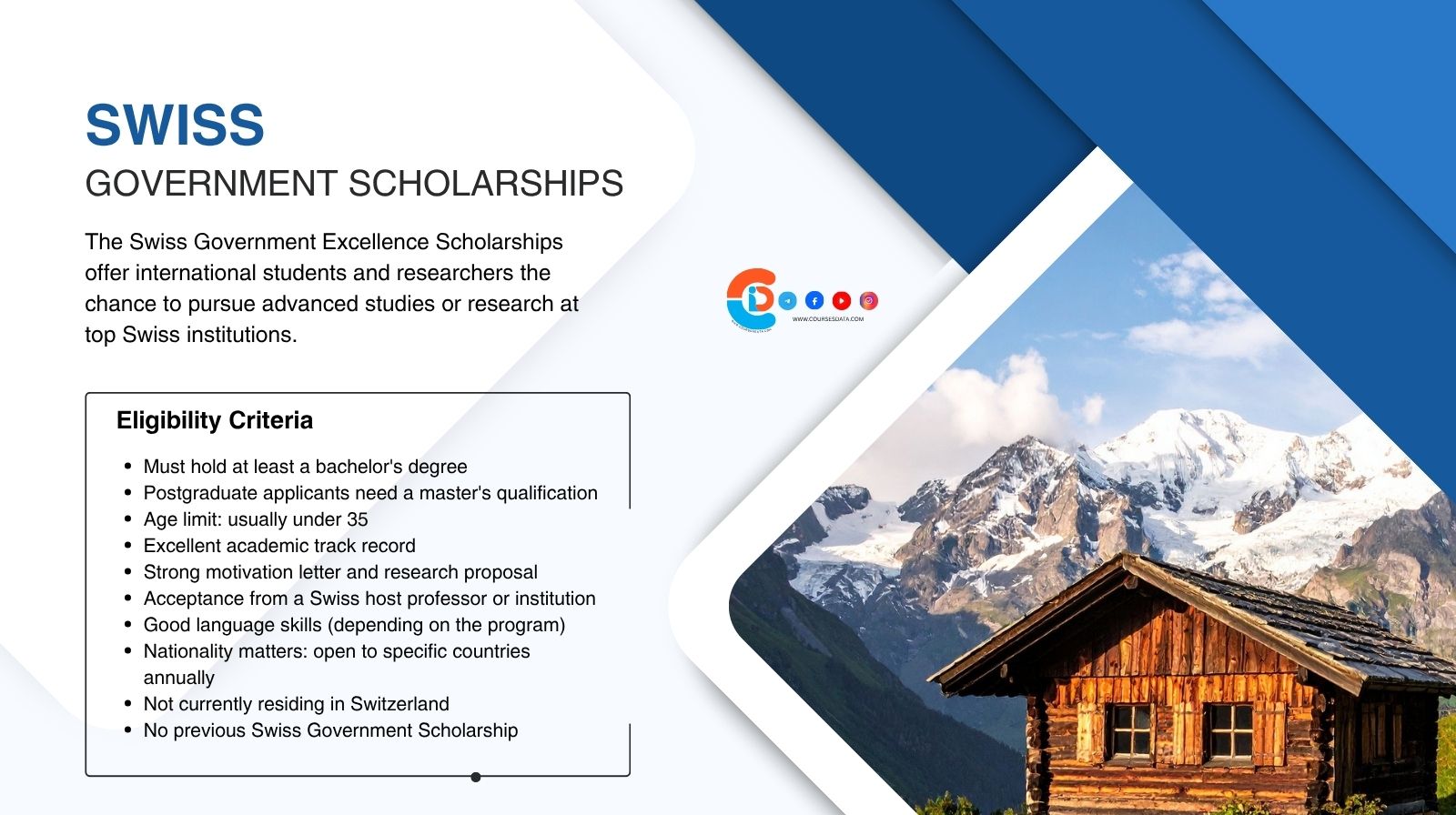
The Swiss Government Scholarship supports international researchers undertaking doctoral research in Switzerland and, for applicants from selected countries, artists pursuing their first master’s degree.
The official name is the Swiss Government Excellence Scholarship.
Your first steps are to identify the scholarship type offered to your country, confirm that you meet its conditions, and prepare the required academic or artistic support.
What Is the Swiss Government Scholarship?
The Swiss Confederation awards these scholarships to encourage research cooperation and artistic exchange.
The Federal Commission for Scholarships for Foreign Students selects recipients.
The programme is mainly aimed at early career researchers who have completed a master’s degree.
It also offers a separate route for artists seeking their first master’s degree at a Swiss art school or conservatory.
This distinction matters because the Swiss Government Scholarship is not a general scholarship for every bachelor’s or master’s programme.
A graduate seeking a taught master’s degree in business, for example, should not assume that the research scholarship will fund that course.
The Swiss government’s scholarship overview explains the available routes and the selection process.
Before preparing an application, identify which of these describes your goal:
- A research stay that forms part of a doctorate outside Switzerland.
- A full doctorate at a Swiss institution.
- A first master’s degree in an artistic field.
- A different degree or study goal that falls outside these routes.
Which Scholarship Type Fits Your Plans?
The research stay and PhD scholarship both require a Swiss academic supervisor who supports the proposed project.
The art scholarship follows a different process involving an eligible arts institution and a portfolio or other evidence of artistic work.
| Scholarship type | Intended applicant | Main purpose | Standard initial duration |
|---|---|---|---|
| Research stay | Doctoral researcher enrolled outside Switzerland | Conduct part of an existing doctoral project in Switzerland | Six to twelve months |
| PhD scholarship | Researcher seeking a doctorate in Switzerland | Pursue a doctoral project at an eligible Swiss institution | Twelve months, with possible renewals |
| Art scholarship | Artist seeking a first master’s degree | Study at a Swiss art school or conservatory | Twelve months, with a possible extension |
A research stay can suit a doctoral candidate whose home university remains responsible for their degree.
For example, a researcher studying water quality could propose a defined project with a Swiss laboratory and return to their home institution to complete the doctorate.
A PhD scholarship can suit a master’s graduate whose proposed doctorate will be based at a Swiss university.
Admission to a doctoral programme and selection for the scholarship are separate matters, so applicants must understand the requirements of both.
An art scholarship can suit a musician, visual artist, or other eligible artist applying to a Swiss master’s programme.
It is available only to applicants from selected countries.
The current scheme does not offer a postdoctoral scholarship.
Applicants who already hold a doctorate should therefore check the available categories before investing time in a proposal.
To choose a route, ask yourself:
- Where will my doctorate be registered?
- Am I seeking a research visit or a complete PhD?
- If I am an artist, would this be my first master’s degree?
- Is my country offered this specific scholarship type?
Who Can Apply?
Eligibility depends on the scholarship type and the country of origin.
The official country list specifies the routes available to applicants from each country and their application deadlines.
Research applicants need a qualifying master’s degree or equivalent, a detailed project plan, and support from an academic supervisor in Switzerland.
Art applicants need a qualifying bachelor’s degree or equivalent and must not already hold a master’s degree when the scholarship begins.
The scheme also applies an age condition and rules concerning prior residence in Switzerland.
Because these conditions use exact cutoff dates for each intake, read the current official criteria rather than relying on an approximate age or residence summary.
An applicant’s academic record alone is insufficient.
The proposed work, host arrangement, and complete application must also meet the relevant requirements.
Use this initial eligibility check:
- Find your country in the official country list.
- Confirm that your intended scholarship type appears.
- Read its deadline and any country-specific instructions.
- Compare your degree with the stated qualification requirement.
- Check the exact age and residence conditions.
- Confirm that you can obtain the required host support or arts admission evidence.
Applicants who previously received a Swiss Government Excellence Scholarship are excluded.
The official rules also exclude a further application after three unsuccessful attempts, as well as simultaneous applications by one person for multiple host institutions or scholarship types.
If you already study or work in Switzerland, examine the residence condition particularly closely.
It can affect eligibility even when your project and qualifications are otherwise suitable.
What Does the Scholarship Cover?
The research, PhD, and art scholarships provide CHF 2,450 per month toward one person’s basic living expenses.
This payment is a scholarship, not a salary.
Additional benefits vary by circumstance.
The Federal Commission covers compulsory health insurance premiums for scholarship holders from outside the EU and EFTA, while holders from EU and EFTA countries pay those premiums themselves.
Other stated benefits include a one-time CHF 600 grant for a rental deposit and a Half-Fare Travelcard for public transport.
Eligible holders from outside the EU and EFTA also receive a return flight allowance determined by country of origin.
The scholarship has important cost limits:
- It does not automatically cover tuition or semester fees.
- It does not fund conference participation.
- It does not provide extra funding for field research.
- It covers the basic living expenses of one person.
- It does not provide family allowances.
- EU and EFTA scholarship holders pay their own travel expenses.
Some institutions charge fees to scholarship holders, and some may require additional funding from a supervisor.
Ask the proposed host institution what costs apply to your specific programme before making a budget.
For example, a researcher planning interviews outside Switzerland should not build a budget on the assumption that the scholarship will pay for those trips.
Research stays also require full-time research in Switzerland and do not permit field research abroad.
The official scholarship conditions and benefits set out the funding, costs, and obligations in detail.
How Do You Find a Swiss Academic Supervisor?
Every research stay and PhD scholarship application needs the support of an academic supervisor at an eligible Swiss institution.
Finding that person is the applicant’s responsibility.
Start with the research question, then look for groups whose current work genuinely connects with it.
A professor’s broad subject label is less useful than a clear match between your methods, project, and their expertise.
A productive supervisor search might look like this:
- Write a short description of your research question.
- Identify Swiss groups working on the same problem.
- Read recent work from potential supervisors.
- Check the institution’s degree and supervision rules.
- Prepare a focused message for each suitable person.
- Allow time for discussion and revisions.
Suppose you want to study rehabilitation technology.
A message that identifies a particular lab method and explains how your proposed work uses it gives the recipient a concrete reason to respond.
A generic request sent to many unrelated professors does not establish that fit.
Introduce your training, describe the project briefly, explain why you approached that supervisor, and state that you intend to apply for the Swiss Government Excellence Scholarship.
Include the materials needed for an informed initial discussion, such as a concise CV and research plan.
The supervisor’s support is a substantive commitment.
They should know the project, be able to guide it, and provide the required letter; a brief expression of interest is not a substitute for that letter.
At a university of applied sciences, doctoral arrangements can involve two supervisors, including one authorised to confer doctorates at a traditional university.
Confirm the arrangement with the prospective host before applying.
How Do You Build a Strong Research Proposal?
The proposal should show what you intend to investigate, why the question matters, and how the work can be completed during the funded period.
It should also explain why the Swiss host is suited to the project.
The application requires a detailed research plan with milestones and activities.
Its official form allows a maximum of five pages, including a summary understandable to readers outside your specialty.
A useful proposal covers these points:
- The specific question or problem.
- The knowledge or evidence already available.
- The work you will carry out in Switzerland.
- The methods, materials, or data you will use.
- A realistic sequence of milestones.
- The expected research output.
- The role of the Swiss supervisor and host.
- The potential for continued research cooperation.
Keep the scope consistent with the scholarship type.
A short research stay needs a project that can produce a meaningful result within its limited period; a PhD proposal can present a broader doctoral plan while identifying achievable early milestones.
For example, “improve public health” is too broad to guide a research stay.
A proposal to test a defined method on an available dataset, with a clear analysis plan and host expertise, gives reviewers something they can assess.
The commission considers the candidate’s profile, the quality of the project, supervision, and potential for future cooperation.
A clear project cannot compensate for missing eligibility, but it helps reviewers understand what the award would make possible.
What Should Art Applicants Prepare?
Art applicants follow a separate route designed for study toward a first artistic master’s degree.
They need evidence that they have been admitted to a Swiss arts institution or have applied there; the official conditions also describe what to provide if that institution’s admissions process has not opened.
The portfolio requirements depend on the artistic field.
Musicians, visual artists, and applicants in other disciplines present different kinds of work, so use the instructions for your own category.
Prepare the artistic application around:
- The master’s programme you intend to enter.
- Your existing artistic training and practice.
- A portfolio that meets the field-specific format.
- A concise explanation of your artistic direction.
- Evidence of admission or an active application.
- The required academic recommendations.
A visual artist, for example, should select work that shows development and decisions, alongside the sketches and identifying information requested in the official instructions.
A musician should pay close attention to the recording requirements rather than submitting an unrestricted collection of performances.
The scholarship decision does not replace the institution’s admission process.
Admission availability is part of the art scholarship assessment, so pursue both applications in time.
Which Documents and Application Steps Matter Most?
The exact package differs between research and art applicants.
Both should allow time for recommendations, degree records, and any certified translations required for documents outside the accepted languages.
For research applicants, the key documents include a CV, motivation letter, proposal, Swiss supervisor’s support letter and short CV, degree records, and passport copy.
The online system also requests the email addresses of two professors who will be asked to provide recommendations.
Some situations require additional evidence.
A research stay calls for a short CV from the supervisor at the home university, while an application to certain doctoral schools requires confirmation of admission.
A practical preparation sequence is:
- Confirm the route and deadline assigned to your country.
- Check the full eligibility criteria.
- Arrange Swiss host support or arts admission evidence.
- Draft and review the proposal or portfolio.
- Request recommendations early.
- Collect certificates, transcripts, and translations.
- Register in the official online application system.
- Review every field and attachment before submission.
Applications are submitted through GO ESKAS, the official online system.
The scholarship authority instructs applicants not to submit by email or on paper.
For an individually supervised doctorate, a supervisor’s support letter is required at scholarship application stage, while a PhD admission letter is not necessarily required then.
A doctoral school with no assigned supervisor in its first stage has different rules: applicants need both the required school admission evidence and supervisor support.
A missing document or formal error can result in exclusion.
Give yourself time to check that the uploaded material meets the application instructions, rather than treating submission as the final proofreading stage.
How Are Applications Assessed?
The Federal Commission for Scholarships for Foreign Students makes the award decisions.
For research applicants, it assesses the candidate, the project, the quality of supervision, and the potential for research cooperation.
For artists, the assessment includes the artistic profile, qualifications, motivation, portfolio, and availability of a place at the intended institution.
Strong work must be presented in the format requested for the relevant artistic field.
Before submitting, read your application as a reviewer would:
- Is the intended scholarship type unmistakable?
- Does the project have a defined aim?
- Is the timeline credible?
- Does the host’s expertise match the work?
- Are required letters and admission documents present?
- Do the CV, motivation letter, and proposal tell a consistent story?
Ask a knowledgeable reader to identify passages they cannot understand without specialist background.
The proposal’s summary should make the purpose and value of the work clear beyond your immediate field.
Selection remains competitive.
Meeting the formal criteria makes an application eligible for consideration; it does not guarantee an award.
What Should You Do Next?
Begin with the official country list and the conditions for your scholarship type.
If you are a researcher, invest early effort in a credible proposal and a suitable Swiss supervisor; if you are an artist, align your scholarship preparation with the arts institution’s admission process.
Use the Swiss government’s applicant FAQ when questions arise about supervisors, doctoral admission, or repeat applications.
Apply only through the official system: the application is free, and the scholarship authority warns applicants against fraudulent offers requesting money.
Frequently Asked Questions
Is the Swiss Government Scholarship open to bachelor’s students?
The Swiss Government Excellence Scholarship routes described here do not fund a general bachelor’s degree.
Research applicants need advanced academic qualifications, while the art route is intended for a first artistic master’s degree.
Can I use it for any master’s degree?
No.
The master’s route is specifically for eligible applicants seeking their first master’s degree in an artistic field.
It is not a general award for taught master’s programmes in other subjects.
Do I need a Swiss supervisor before applying?
Yes, for a research stay or PhD scholarship.
The Swiss supervisor must support the proposed project and provide the required letter, including the accompanying short CV.
Does a supervisor’s agreement guarantee admission to a PhD?
No.
Scholarship application and doctoral admission are separate processes.
The documents needed at scholarship application stage depend on whether you are pursuing an individually supervised doctorate or applying through a doctoral school.
How much is the monthly scholarship payment?
The stated payment for research, PhD, and art scholarship holders is CHF 2,450 per month toward one person’s basic living expenses.
It is a scholarship rather than an employment salary.
Are tuition and semester fees covered?
No.
The scholarship does not cover tuition or semester fees, and a host institution may charge them.
Check the charges for your intended programme when preparing your budget.
Can I apply without already living in Switzerland?
Yes.
These scholarships are designed for eligible international applicants undertaking the funded research or study in Switzerland.
Applicants who already reside there must pay particular attention to the scheme’s residence conditions.
Can I apply to several Swiss hosts at once?
The official exclusion rules prohibit simultaneous scholarship applications by the same person for multiple host institutions or scholarship types.
Choose the route and host that best fit your proposed work.
Are postdoctoral scholarships available?
The current Swiss Government Excellence Scholarship scheme does not award postdoctoral scholarships.
Researchers who already hold a doctorate should look for funding designed for their career stage.
Is there a fee to apply?
No.
The Swiss scholarship authority states that applying is free.
Use its official application system and disregard messages that demand payment in exchange for a scholarship offer.
It sounds like a great opportunity, but I’d be curious to know how competitive it actually is for specific fields like engineering or social sciences. The requirement to already have a host professor lined up is a big hurdle—does the scholarship offer any support or networking to help applicants find one? Also, the mention of health insurance only for non-EU scholars makes me wonder if there are separate health coverage rules for EU residents.
You’re spot on about the host professor being the biggest hurdle—I went through the same grind myself, sending out dozens of emails before one took a chance on me. As for competition, engineering is brutal because Swiss ETH and EPFL labs get flooded with applicants, but social sciences can be slightly less saturated if you tailor your proposal to a niche the professor is actively researching. No, the scholarship doesn’t offer any matchmaking, so you really have to rely on cold outreach. On health insurance, EU residents typically use their European Health Insurance Card, though it’s worth double-checking if your home country’s coverage extends to the full duration of your stay.
I applied for this a few years back, and honestly, finding a host professor was the toughest part—I spent weeks cold-emailing labs before one finally responded. It would be really helpful if the program included a database or matchmaking service for applicants, because not everyone has those academic connections. As for the health insurance, I think EU residents just use their European Health Insurance Card, but it’s a detail that could trip people up if they’re not careful.
Megan, you’ve nailed the biggest pain point—cold-emailing professors is basically a part-time job nobody asked for, and a database or matchmaking service would save so many talented people from burning out before they even apply. And you’re right about the European Health Insurance Card, but it’s one of those fine-print details that could screw someone over if they assume the scholarship covers everything automatically. Honestly, if the program wants to attract the best applicants, they need to make that host professor hurdle less of a shot in the dark.
Ah, the cold-emailing gauntlet—brings back fond memories of refreshing my inbox like a gambler watching a slot machine. You’re dead right about needing a matchmaking service, because the current system basically filters for people who either have a thick skin or a pre-existing network, which seems to defeat the purpose of “excellence.” And on the health insurance bit, I’d add that even with the European Health Insurance Card, some Swiss cantons have their own registration quirks, so it’s worth checking if your home country covers the full duration or if you’ll need a supplementary plan.
Yeah, that host professor hurdle sounds like a proper mission, especially if you’re coming from a country without strong links to Swiss universities. I reckon it could be a dealbreaker for a lot of talented folks who don’t have the time or the network to spam emails for weeks on end. It’d be mint if the scholarship threw in some sort of introduction program or at least a list of departments actively looking for international students.
An introduction program would be a game-changer, but I suspect the Swiss figure if you can’t survive the email grinder, you’re not ready for their academic rigor. Still, it does feel like the scholarship is accidentally filtering for persistence over pure talent—which is a shame when they’re supposedly after “excellence.” A simple list of departments with a history of hosting foreign scholars wouldn’t exactly break the federal budget.
I went through this process a couple of years ago, and I have to agree that finding a host professor is the real gatekeeper—I sent out nearly forty emails before I got a single positive reply. One thing that doesn’t get mentioned enough is that Swiss professors often expect you to already have a solid research proposal tailored to their specific work, not just a generic interest in their lab. Looking back, I wish the scholarship had offered even a simple list of departments that have historically accepted foreign scholars, because guessing which labs are open to cold applications wasted a huge chunk of my time.
Oh, forty emails sounds painfully familiar—I think I hit around fifty before I got my first “maybe.” You’re absolutely right about the research proposal, too; I spent days reworking mine to match a professor’s recent publication, and it still felt like a shot in the dark. A list of historically welcoming departments would have saved me from wasting weeks on labs that never even open their emails.
Right, reading through the comments, the host professor hurdle sounds less like a scholarship requirement and more like a part-time cold-calling job on top of the actual application. It’s a bit rich that a program meant to foster international collaboration doesn’t at least provide a directory of labs currently open to hosting foreign scholars. You’d think the Swiss Confederation could spare a budget for a simple matchmaking database, given the talent they’re supposedly trying to attract.