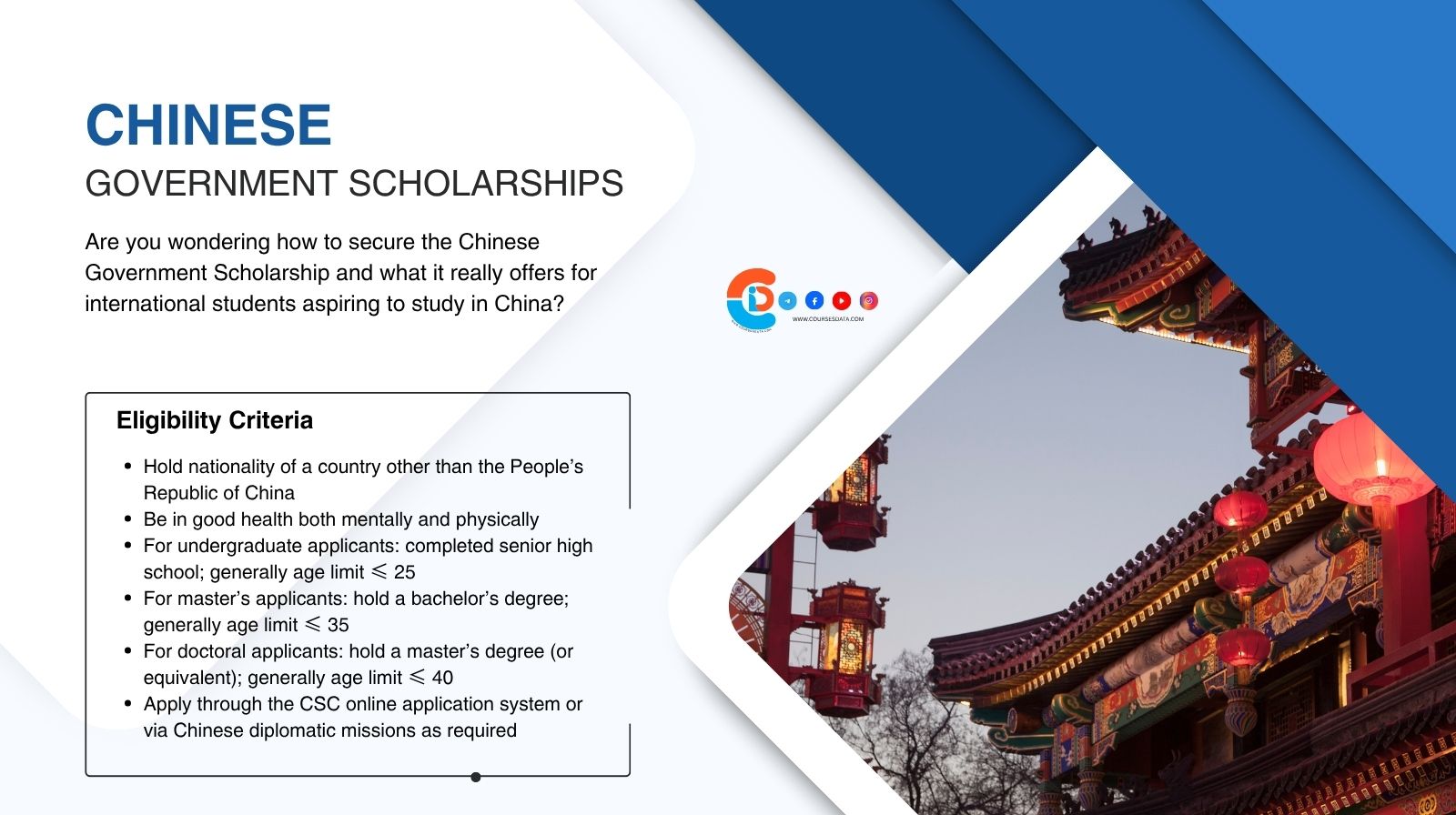
The Chinese Government Scholarship supports international students and scholars at designated universities in China.
It can cover tuition, accommodation, medical insurance, and a monthly stipend, but eligibility, documents, and application steps depend on the program and the organization receiving your application.
What the China Scholarship Covers
The Chinese Government Scholarship, often called the CSC Scholarship, supports undergraduate and graduate degrees as well as nondegree study for general and senior scholars.
The China Scholarship Council administers the award, while universities and application receiving organizations take part in reviewing candidates.
For a full scholarship, the standard package described in the Chinese embassy’s scholarship guidance includes tuition, a university dormitory place or accommodation subsidy, a monthly stipend, and comprehensive medical insurance.
The stated monthly stipends are CNY 2,500 for undergraduates, CNY 3,000 for master’s students and general scholars, and CNY 3,500 for doctoral students and senior scholars.
That package gives you a starting point for a budget, not a promise that every expense will disappear.
A dormitory place differs from a cash housing subsidy, and living costs vary by city and personal needs.
Before accepting an offer, identify expenses you may need to pay yourself:
- Travel to and from China.
- Visa and document preparation costs.
- Deposits or charges required on arrival.
- Meals, local transport, and personal spending.
- Any housing cost above the available subsidy.
Read the award letter alongside the university’s instructions.
Those documents tell you what your particular offer provides and what you must arrange before enrollment.
Choose the Right Application Route
Applicants commonly encounter Type A and Type B routes.
Type A applications go through an authorized receiving organization, such as a Chinese embassy or another designated body; Type B applications go through a participating Chinese university.
The route determines whose instructions you must follow.
A university may ask for an application in its own admission system as well as a submission in the scholarship system, while an embassy route may require a recommendation from its receiving organization.
| Route | Where to begin | Detail to verify |
|---|---|---|
| Type A | The authorized receiving organization for your application | Its eligibility rules, agency number, documents, and deadline |
| Type B | The participating university’s scholarship notice | Its eligible programs, admission steps, agency number, and deadline |
For example, a prospective master’s student considering a university program should read that university’s Type B notice before entering a code into the scholarship form.
A student applying through an embassy should use the instructions issued for that embassy’s route.
A university’s Type B application guide illustrates why the distinction matters: the university assesses candidates, issues pre-admission documents to those it recommends, and forwards nominations for scholarship review.
A university recommendation is a step in the process, not a final scholarship award.
Use this route check before creating your application:
- Identify the exact scholarship program.
- Confirm whether it uses Type A or Type B.
- Find the organization receiving applications.
- Copy its agency number from its own instructions.
- Check whether a separate university application is required.
Check Eligibility Before Selecting a Degree
The scholarship is intended for eligible applicants who are not citizens of the People’s Republic of China.
Applicants must also meet the academic, health, language, and other admission requirements that apply to their chosen program.
The published age and qualification rules differ by study level.
Undergraduate applicants generally need a high school qualification and must be under 25; master’s applicants need a bachelor’s degree and must be under 35; doctoral applicants need a master’s degree and must be under 40.
Separate limits apply to general and senior scholars.
Meeting those baseline rules does not secure admission.
A university may set additional requirements for a particular course, department, or language of instruction.
Check the fit in this order:
- Your citizenship and the receiving organization’s rules.
- Your completed degree or expected graduation status.
- The age rule for your study category.
- The university’s subject requirements.
- The teaching language and proof of proficiency.
- Any examination or portfolio requirement.
A bachelor’s degree in a related subject may qualify you to apply for a master’s course, but the department still evaluates whether your preparation matches its curriculum.
Likewise, a strong scholarship application cannot replace a required university admission document.
If you have not graduated yet, read the document rules for prospective graduates.
Some routes accept official proof of current enrollment or expected graduation at application stage, with the final qualification required later.
Find a Suitable University and Program
Start with the subject you want to study, then narrow the list to universities offering that subject through an eligible scholarship route.
A university’s participation in the scholarship does not mean every course it teaches is available under every route.
Look beyond the broad degree title.
Two programs called “public health,” for example, can differ in research focus, teaching language, entry requirements, and the documents requested from applicants.
For each potential program, record:
- The university and exact program name.
- Degree level and teaching language.
- Department entry requirements.
- Scholarship route and available places, if stated.
- Whether pre-admission is required.
- Application systems and submission steps.
The official Study in China scholarship portal is the starting point for scholarship information and the online application.
Then use the university’s own program notice to confirm the course details and admission process.
Consider academic fit alongside cost.
A research applicant should look for relevant supervisors or research groups; a coursework applicant should review the actual modules and assessment format.
These checks will also help you write a more convincing study plan.
Understand Language and Entrance Requirements
Programs may be taught in Chinese or English, and the evidence required depends on the program.
Do not infer the teaching language from the university’s general website or from another degree at the same institution.
Published scholarship rules specify HSK levels for several Chinese-taught study categories.
Universities also assess whether applicants meet their own language and academic admission criteria, so follow the requirement for the exact program you select.
Undergraduate applicants must pay particular attention to the China Scholastic Competency Assessment, or CSCA.
Current scholarship guidance requires a valid score report for bachelor’s applications; applicants should identify the subjects required for their intended major before taking the assessment.
Make a short requirements checklist for each course:
- Confirm its language of instruction.
- Check accepted language certificates.
- Check minimum scores or levels.
- Identify any entrance assessment.
- Verify whether a preparatory language period applies.
- Allow time for scores to reach you before submission.
A Chinese language preparatory period can be part of an eligible award, but it should not be assumed for every applicant or used as a substitute for an entry requirement.
Follow the program notice and your eventual admission documents.
Prepare Documents That Match Your Application
Document lists vary by route and study level.
Typically, applicants should expect to provide the scholarship application form, passport identification page, academic records, proof of qualifications, and evidence of language ability where required.
Graduate applicants may also need a study or research plan, recommendation letters, and a pre-admission document.
Additional documents can apply to particular subjects or applicant circumstances.
Assemble a working folder with:
- A clear passport scan.
- Diploma or official expected-graduation evidence.
- Academic transcripts.
- Required language or assessment results.
- Study plan or research proposal.
- Recommendation letters, if requested.
- Any university admission or pre-admission document.
Check whether documents issued in another language need certified or notarized Chinese or English translations.
The receiving organization’s instructions govern what format and authentication it accepts.
Your study plan should connect your background to the chosen course.
For example, an engineering graduate applying for an energy systems master’s program can explain a relevant final project, the skills still needed, and how specific parts of the curriculum address that gap.
Keep the claims verifiable.
A concise account of completed work and a realistic academic goal is more useful than broad statements about passion or guaranteed future impact.
Submit the Application Carefully
Once you know your route, follow its instructions in order.
Do not assume that completing the scholarship portal automatically completes a separate university admission application.
The scholarship form asks for a program category and an agency number.
Entering an unrelated organization’s number can send an application down the wrong route, so obtain both details from the receiving organization or university handling your application.
Use this submission sequence:
- Read the current notice for your route.
- Confirm the eligible university and program.
- Complete any required university application.
- Create or update your scholarship portal account.
- Select the correct program category and agency number.
- Upload the required files and review each field.
- Submit, then save the confirmation and application form.
Review names, passport details, qualifications, and program choices before submission.
File names should make documents easy to identify, and scans should be complete and legible.
Deadlines vary among embassies and universities.
Follow the deadline attached to your route, including any earlier date for a university admission application or pre-admission request.
Avoid relying on a deadline copied from another country’s notice.
Plan for Selection and Arrival
After submission, the receiving organization or university may screen documents, assess academic fit, and recommend candidates.
Scholarship review and final admission follow the applicable process; the precise sequence can vary by route.
During the waiting period, keep access to the email address used in your applications.
Respond promptly if an official office asks for a corrected file or further information, and retain copies of everything submitted.
Prepare for the next steps without assuming an award:
- Monitor the application systems and email.
- Keep original academic documents accessible.
- Check passport validity.
- Review possible housing arrangements.
- Make a realistic arrival budget.
- Wait for formal admission instructions before booking travel.
A pre-admission letter can strengthen or advance an application where the route calls for one, but it should not be treated as a final scholarship decision.
The formal scholarship and admission documents establish the actual offer.
Apply through official channels.
The China Scholarship Council warns applicants against individuals or intermediaries claiming to process scholarship applications on its behalf.
Conclusion
The strongest Chinese Government Scholarship application begins with the correct route and a program that fits your qualifications.
Verify its requirements, prepare documents that answer them directly, and use the instructions from your receiving organization and chosen university for every submission step.
Frequently Asked Questions
Is the Chinese Government Scholarship fully funded?
A full award covers tuition, university accommodation or an accommodation subsidy, a monthly stipend, and comprehensive medical insurance.
Read the specific offer to understand your housing arrangement and budget separately for expenses the award does not list.
Can I apply for an undergraduate degree?
Yes, the scholarship includes undergraduate study at eligible universities.
Applicants must meet the relevant age, academic, language, and admission requirements, and bachelor’s applicants need the required CSCA score report.
Can I apply for a master’s or doctoral degree?
Yes.
Master’s and doctoral study are supported categories, subject to the applicable qualification and age rules and the chosen university’s admission requirements.
What is the difference between Type A and Type B?
Type A uses an authorized application receiving organization, while Type B is handled through a participating university.
Each route has its own instructions, agency number, and selection steps, so choose the route before completing the scholarship form.
Do I need an admission letter before applying?
It depends on the program and route.
Some procedures ask applicants to contact universities for admission or pre-admission documents, while a university Type B process may issue pre-admission after its own assessment; follow the notice that applies to you.
Can I study in English?
English-taught options exist, but availability and entry requirements are specific to each university program.
Confirm the teaching language and accepted proof of proficiency on the chosen program’s admission page.
Must every applicant take the CSCA?
The published requirement applies to applicants seeking bachelor’s degree study.
Check the assessment subjects required for your intended major and the receiving organization’s instructions for submitting the score report.
Is Chinese language study included?
Scholarship guidance allows for Chinese language preparatory study where applicable.
Whether you receive it depends on your admission route, program, and offer; do not assume it removes a stated language requirement.
Is there one application deadline for everyone?
No.
Embassies and universities publish deadlines for their respective routes, and a separate university application may close at a different time.
Use the current notice from the organization receiving your application.
Where should I apply?
Begin at the official Study in China scholarship portal, then follow the application instructions issued by your authorized receiving organization or participating university.
Check the route and agency number there before you submit.
I applied for the Chinese Government Scholarship two years ago, and honestly, the timeline was the trickiest part—I almost missed the window because different universities have their own internal deadlines before the CSC cutoff. One thing I wish the post emphasized more is that the “fully funded” label really means everything: tuition, accommodation, a monthly stipend, and even comprehensive medical insurance, which saved me a huge headache when I got sick in Beijing. For anyone considering this, I’d suggest reaching out to your target university’s international office early—they often have tips on how to strengthen your application for the specific programs they prioritize.
That’s a solid point about the internal deadlines—most people fixate on the CSC cutoff and miss the real key date. The insurance part is underrated too; I had a friend who needed emergency dental work in Shanghai and the bill would’ve been brutal without it. Best advice is to email the international office before you even start the application, not after.
You’re absolutely right about the insurance—I remember a classmate who needed an emergency root canal in Nanjing, and she walked out with zero out-of-pocket costs thanks to that CSC coverage. And yes, contacting the international office early is a game-changer; they let me know they preferred applicants with research proposals aligned to their current faculty projects, which gave my application a real edge.
Lindiwe, your point about aligning research proposals with faculty projects really resonates—that’s exactly how I got my edge too. I spent two weeks combing through my target university’s website to find a professor whose work matched my background, and when I mentioned his name in my statement, the international office fast-tracked my file. That hospital story is wild, but it proves how the insurance is a silent game-changer for anyone nervous about health costs abroad.
Oh, brilliant—so the secret sauce to getting a government scholarship is just stalking faculty pages until you find a professor who’s willing to be name-dropped. Who knew academic stalking could be so lucrative? But honestly, that insurance bit is the real hero here; nothing says “fully funded” like walking out of a root canal without checking your bank account.
Ah, the “academic stalking” approach—hard to argue with results, even if it feels a bit like crafting a Tinder bio to impress someone you’ve never met. And you’re dead right about the insurance; nothing says “fully funded” like getting a cavity filled without wondering if you’ll have to sell a kidney to pay for it.
That bit about name-dropping a specific professor is clever—I did something similar, and it felt a bit like academic stalking until my application got flagged for priority review. The insurance really is the unsung hero of the whole package; nothing makes you appreciate “fully funded” quite like a trip to the hospital that costs you nothing but time.
That’s a great point about the internal deadlines—I’ve seen a few people miss out just because they assumed the CSC cutoff was the only date to watch. I’m curious, did you find that the monthly stipend actually covers living costs comfortably in a city like Beijing, or did you have to supplement it? Also, practical tip for anyone reading: get your documents notarized and translated well in advance, because last-minute rushing with the health check forms can throw off your whole application.
Honestly, the stipend in Beijing was tight but doable—I had to budget carefully for eating out and metro fares, but rent and utilities were covered, so I never went into my own savings. That tip about notarized documents is spot-on; I saw a guy in my orientation group get disqualified because his health check wasn’t stamped by the right hospital. Start gathering those papers at least two months before the internal deadline, not the CSC one.
Yeah, the stipend in Beijing was tight but manageable—I never had to dip into savings, but I definitely skipped pricier restaurants and stuck to the campus cafeterias most days. The real lifesaver was that accommodation and utilities were fully covered, so my monthly money went straight to food, transit, and a bit of fun. And I can’t second that document advice enough; I nearly lost my spot because my health form wasn’t stamped by the right hospital, so get that sorted way before the internal deadline.