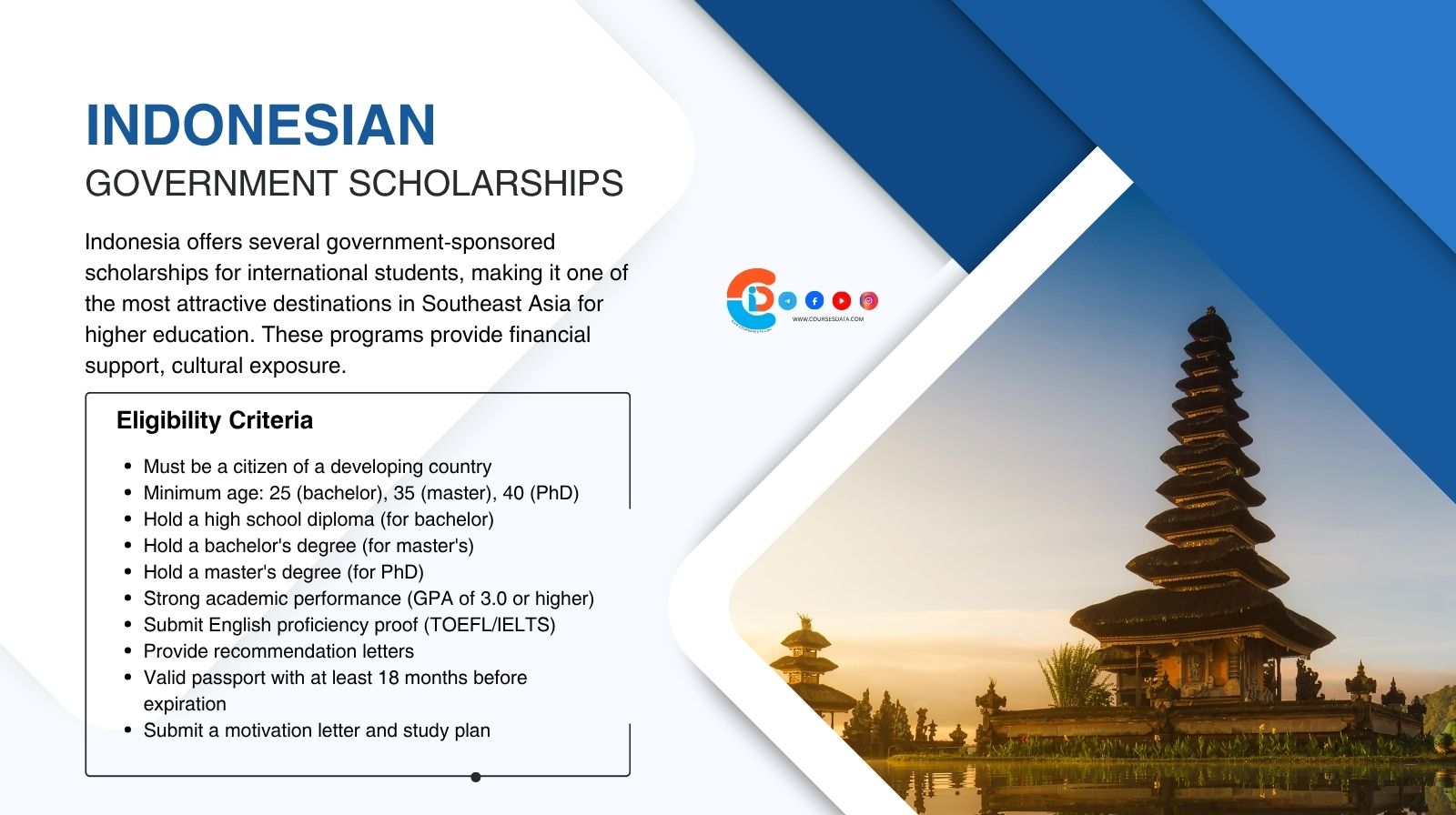
The Indonesian Government Scholarship, officially known as the KNB Scholarship (Kemitraan Negara Berkembang), offers international students from eligible developing countries the opportunity to study at Indonesian universities with substantial financial support.
The program covers bachelor’s, master’s, and doctoral study and can include tuition, living support, health insurance, travel, and other allowances, depending on the scholarship terms.
What Is the Indonesian Government Scholarship?
The Indonesian Government Scholarship is a scholarship program funded by the Government of Indonesia for international students from developing countries.
It is administered through Indonesia’s higher education authorities and is intended to strengthen educational cooperation and international relations while supporting students who want to pursue higher education in Indonesia.
The official name of the program is the Kemitraan Negara Berkembang Scholarship, commonly shortened to KNB Scholarship.
It is available for selected bachelor’s, master’s, and doctoral programs at participating Indonesian universities.
The scholarship is particularly relevant to students who want to experience Indonesian higher education while studying in a multicultural environment.
The current KNB program works with a network of participating universities and provides applicants with a range of study programs from which to choose.
Applicants should understand that the scholarship is not simply a general financial grant that can be used at any university.
The applicant must select an eligible university and study program included in the official KNB offering.
Important points about the program include:
- It is funded by the Government of Indonesia.
- It is intended for eligible international applicants.
- It supports bachelor’s, master’s, and doctoral study.
- Study takes place at participating Indonesian universities.
- Applicants must satisfy the requirements for their selected degree level.
- An Indonesian Embassy or Consulate recommendation is required.
- Academic documents are an important part of the application.
- English proficiency may be required.
- A valid passport is required.
- Medical documentation is required.
- The scholarship includes several forms of financial support.
- Applicants must follow the official selection procedure.
What Does the KNB Scholarship Cover?
The Indonesian Government Scholarship provides several forms of financial support.
The exact conditions and allowances are determined by the official scholarship regulations and the applicable program terms.
According to the official KNB information, the scholarship can cover:
| Scholarship support | What it generally provides |
|---|---|
| Tuition fees | Financial support for tuition according to the scholarship terms |
| Living allowance | Regular financial support during the scholarship period |
| Arrival allowance | Support provided when the student arrives in Indonesia |
| Research and book allowance | Support related to academic materials and research |
| Publication assistance | Support available under the applicable scholarship provisions |
| Health insurance | Monthly health coverage subject to the scholarship conditions |
| International airfare | Arrival and return travel support under the scholarship rules |
| Indonesian language preparation | Indonesian language and preparatory study before the academic program where required |
The official KNB website confirms that the scholarship includes tuition support, monthly living expenses, arrival support, book and research allowances, publication assistance, transportation for arrival and return, and health insurance, subject to the applicable terms and conditions.
Students should not assume that every personal expense will automatically be paid.
Before accepting an award, applicants should carefully read the official scholarship guidelines and understand which expenses are covered, which are subject to limits, and which must be paid personally.
For example, accommodation arrangements can differ between universities.
The official KNB FAQ explains that dormitory availability depends on the individual university and its facilities.
Who Can Apply for the Indonesian Government Scholarship?
The KNB Scholarship is designed for foreign nationals from eligible developing countries or countries that have the relevant relationship with Indonesia.
Indonesian citizens are not eligible for the KNB Scholarship.
Eligibility also depends on the degree level.
A student applying for a bachelor’s program must satisfy the bachelor’s requirements, while master’s and doctoral applicants have different academic requirements.
For example, a bachelor’s applicant must normally hold a high school qualification, while an applicant for a master’s program needs the appropriate previous university degree.
Applicants should therefore select the scholarship level that corresponds to their existing qualification.
Key eligibility considerations include:
- Citizenship and eligibility of the applicant’s country.
- Appropriate previous educational qualification.
- Age requirement for the selected degree level.
- Required academic performance.
- English proficiency where applicable.
- Valid passport.
- Recommendation from an Indonesian diplomatic mission.
- Academic recommendation.
- Employer or supervisor recommendation where required.
- Medical documentation.
- Compliance with the scholarship’s personal and administrative conditions.
The official KNB FAQ states that the minimum GPA is 2.75 for bachelor’s applicants and 3.00 for master’s and doctoral applicants.
Applicants should still check the requirements for their specific program because individual universities or study programs may have additional expectations.
Requirements for Bachelor’s Applicants
Bachelor’s applicants must meet specific requirements before submitting an application.
The official requirements include an appropriate high school qualification and documentation demonstrating previous academic performance.
The applicant must also meet the applicable age condition.
The KNB system automatically checks the age requirement, so applicants should not assume that being only slightly over the limit will be accepted.
Typical bachelor’s application documents include:
- Valid official passport.
- High school certificate.
- High school academic transcript.
- Curriculum vitae.
- Academic recommendation letter.
- Employer or immediate supervisor recommendation, or an appropriate statement if unemployed.
- Indonesian Embassy or Consulate recommendation.
- English proficiency evidence where required.
- Medical report.
- Required video presentation.
- Other documents specified by the official application system.
The academic certificate and transcript must meet the official requirements concerning language and legalization.
Applicants should prepare these documents well before the application window because legalization and diplomatic verification can take time.
The official KNB requirements also request a short video in English or Bahasa Indonesia explaining the applicant’s profile, reasons for choosing Indonesia and the KNB Scholarship, and reasons for choosing the selected university and study program.
Requirements for Master’s and Doctoral Applicants
Master’s and doctoral applicants need to demonstrate stronger academic preparation because they are applying for advanced study.
A master’s applicant should have a relevant previous university degree and academic records that satisfy the scholarship requirements.
The selected master’s program should also be compatible with the applicant’s previous academic background.
Doctoral applicants face additional requirements because the application involves research preparation.
The official KNB procedure includes a recommendation from a potential research supervisor at a participating university and a statement of purpose for doctoral applicants.
Doctoral applicants should therefore prepare:
- Previous university degree certificate.
- Academic transcripts.
- Academic recommendation.
- Curriculum vitae.
- Passport.
- English proficiency evidence where applicable.
- Employer or supervisor recommendation where required.
- Indonesian Embassy or Consulate recommendation.
- Medical report.
- Potential research supervisor recommendation.
- Statement of purpose.
- Any additional documents requested by the selected university or program.
A practical approach is to identify the research area first and then investigate participating universities and potential supervisors.
This is much more effective than selecting a university only because its name is familiar.
English Language Requirements
English proficiency is an important part of the KNB application for applicants from non-English-speaking countries.
The official requirements list accepted English tests and minimum scores for bachelor’s applicants, including TOEFL ITP, TOEFL iBT, IELTS, TOEIC, or equivalent evidence.
The certificate must satisfy the validity conditions specified by the scholarship.
The official FAQ also indicates that equivalent English tests can be considered when they assess relevant language skills.
Applicants should nevertheless check the current application instructions before relying on a particular test.
Applicants may not need to submit an English proficiency certificate if they come from an English-speaking country or have studied in an English-medium university program and can provide official evidence supporting that exemption.
Before applying, check:
- Which English tests are accepted.
- The minimum score for your degree level.
- Whether your certificate is still valid.
- Whether your previous university used English as the language of instruction.
- Whether official proof is required for an exemption.
- Whether your selected university has additional language requirements.
Do not wait until the application period begins to take the language test.
A delayed test result can make an otherwise eligible application difficult to complete.
Indonesian Embassy Recommendation
One of the most important parts of the KNB application is the recommendation from the Indonesian Embassy or Consulate General in the applicant’s country of origin.
The official KNB procedure instructs applicants to contact the Indonesian diplomatic representative and submit the required academic and personal documents to obtain the recommendation.
The recommendation must come from the relevant Indonesian Embassy or Consulate General rather than an honorary consul.
The official FAQ specifically states that honorary consuls cannot issue the required recommendation.
Applicants should therefore contact the diplomatic mission early and ask about its local procedure.
Requirements, appointment arrangements, document submission methods, and verification procedures may vary by country.
A useful preparation checklist is:
- Find the Indonesian Embassy in your country.
- Confirm which office handles scholarship recommendations.
- Ask for the current document checklist.
- Prepare your passport copy.
- Prepare academic certificates.
- Prepare transcripts.
- Prepare your curriculum vitae.
- Prepare your language certificate if required.
- Prepare recommendation letters.
- Follow the Embassy’s instructions for verification or interview.
- Keep copies of every submitted document.
The official Indonesian diplomatic mission directory is available through Indonesia’s Ministry of Foreign Affairs website.
How to Apply for the KNB Scholarship
The application is completed through the official KNB Scholarship platform.
Applicants should rely on the official website rather than third-party scholarship pages for the final application procedure.
The general process involves several stages:
- Review the official KNB requirements.
- Download and review the relevant scholarship guidelines.
- Identify eligible universities and study programs.
- Prepare academic and personal documents.
- Contact the Indonesian Embassy or Consulate in your country of origin.
- Obtain the required recommendation.
- Create or complete your KNB application account.
- Upload the required documents.
- Submit the online application.
- Complete the required selection stages.
- Monitor the official KNB platform for results and instructions.
The official KNB website explains that eligible applicants may go through administrative and academic selection, including interviews and psychological tests conducted by selected universities.
The latest official application cycle shown on the KNB platform has already completed its main application period, and the website is publishing selection and awardee announcements.
Students preparing for a future intake should therefore use the current official requirements as a preparation guide and monitor the KNB website for the next opening.
Choosing a University and Study Program
Choosing the right program is one of the most important decisions in the application.
The KNB Scholarship does not make every degree available at every participating university.
The official website provides information about partner universities and their available programs.
Applicants should consult the relevant study program information before submitting their preferences.
When comparing programs, consider:
- The degree level.
- Your previous academic qualification.
- The academic field.
- The curriculum.
- Research opportunities.
- Faculty or supervisor availability.
- Language of instruction.
- University location.
- Accommodation options.
- Academic facilities.
- The requirements of the specific program.
The official FAQ states that programs should be aligned with the applicant’s previous degree.
Applicants should not assume that the scholarship will provide a preparatory pathway for an unrelated academic field.
For a doctoral applicant, supervisor compatibility is especially important.
A strong research match can make the application more coherent because the proposed research, academic background, university, and supervisor should form a logical academic profile.
Indonesian Language and Studying in Indonesia
International KNB students should also prepare for the language and cultural environment in Indonesia.
The official KNB information states that scholarship recipients undertake Indonesian language preparation, and regular academic classes are conducted in Indonesian rather than automatically being taught entirely in English.
This is an important consideration for students who are applying because they expect an English-only degree.
Applicants should check the specific program and understand the language expectations before selecting a university.
Learning basic Indonesian before arrival can also make everyday life easier.
Even simple skills such as introducing yourself, asking for directions, communicating with university staff, and handling daily purchases can be valuable during the transition.
Students should also be prepared for:
- A new academic system.
- Different classroom practices.
- Indonesian language study.
- Cultural differences.
- New administrative procedures.
- Living away from home.
- University-specific accommodation arrangements.
- Adapting to local food and daily routines.
- Building relationships with students from different countries.
- Managing academic work alongside cultural adjustment.
The KNB Scholarship is therefore not only a financial opportunity.
It also involves adapting to Indonesia’s academic and social environment.
How to Prepare a Strong Application
Meeting the minimum requirements does not guarantee selection.
A practical application should present a consistent academic story from the applicant’s previous education to the proposed study program.
Start by choosing a program that genuinely matches your background.
Then make sure your CV, academic recommendations, statement, interview answers, and selected university all support the same direction.
For example, a student with a bachelor’s degree in environmental engineering applying for a related master’s program can clearly explain how the proposed study builds on previous academic training and future professional objectives.
Before submitting, check:
- Your name matches your passport exactly.
- Your date of birth matches your passport.
- Your nationality information is correct.
- Your passport is valid for the required period.
- Academic certificates are complete.
- Academic transcripts are complete.
- Required documents are properly legalized.
- Recommendation letters meet the requirements.
- Language evidence is valid.
- Medical documentation satisfies the official conditions.
- The selected program matches your academic background.
- Uploaded files are readable.
- All required fields have been completed.
- Your video follows the specified instructions.
The KNB FAQ emphasizes that personal information must match the passport and warns that discrepancies can lead to problems with an application or selection.
Common Mistakes to Avoid
Many scholarship applications become difficult because applicants begin preparing too late.
The most time-consuming documents are often those requiring another institution, government authority, university, or diplomatic mission.
Avoid these common mistakes:
- Waiting until the application opens before contacting the Embassy.
- Choosing a study program unrelated to your previous degree.
- Uploading incomplete academic documents.
- Using a passport with insufficient validity.
- Ignoring document legalization requirements.
- Submitting an invalid language certificate.
- Assuming every university offers the same programs.
- Assuming accommodation is automatically guaranteed.
- Preparing a generic doctoral research proposal.
- Giving inconsistent information across documents.
- Entering personal information differently from the passport.
- Ignoring official announcements after submitting the application.
Applicants should also avoid relying entirely on unofficial scholarship blogs for requirements.
Third-party websites can be useful for discovering opportunities, but the final eligibility, documents, program list, and application procedure should always be verified through the official KNB platform.
Conclusion
The Indonesian Government Scholarship, through the KNB Scholarship, provides international students from eligible countries with an opportunity to pursue bachelor’s, master’s, or doctoral study at participating Indonesian universities with significant financial support.
The program can cover tuition and several living, travel, health, and academic expenses under its scholarship conditions.
For prospective applicants, preparation is as important as eligibility.
Selecting a compatible program, preparing academic documents, obtaining the Indonesian Embassy recommendation, checking language requirements, and understanding the study environment can make the application process much more manageable.
The most reliable source for future application openings, participating universities, requirements, and official announcements is the KNB Scholarship website rather than unofficial scholarship databases.
Frequently Asked Questions
Is the Indonesian Government Scholarship fully funded?
The KNB Scholarship is presented by the Indonesian government as a fully funded scholarship program, with support that includes tuition and several allowances and services.
The exact coverage is subject to the official scholarship terms and conditions.
Can international students apply for the KNB Scholarship?
Yes.
The program is specifically intended for eligible foreign nationals from developing countries or countries that meet the applicable eligibility conditions.
Indonesian citizens cannot apply for the KNB Scholarship.
Can I apply for a bachelor’s degree through the KNB Scholarship?
Yes.
The KNB Scholarship supports bachelor’s-level study in addition to master’s and doctoral programs.
Bachelor’s applicants must meet the specific age, academic, language, documentation, and other eligibility requirements.
Can I apply for a master’s degree?
Yes.
Master’s study is one of the degree levels supported by the KNB Scholarship.
Applicants need the appropriate previous degree and must satisfy the academic, language, recommendation, documentation, and other requirements established by the scholarship.
Can I apply for a PhD through the Indonesian Government Scholarship?
Yes.
Doctoral study is supported by the KNB Scholarship.
Doctoral applicants have additional requirements, including a potential research supervisor recommendation and a statement of purpose according to the official application procedure.
Do I need an English language certificate?
Applicants from non-English-speaking countries generally need to provide acceptable English proficiency evidence unless they qualify for an applicable exemption.
The official KNB requirements specify accepted tests and minimum scores, while the FAQ also discusses equivalent language tests.
Do I need a recommendation from an Indonesian Embassy?
Yes.
The official KNB procedure requires applicants to obtain a recommendation from the Indonesian Embassy or Consulate General in their country of origin.
The recommendation cannot be replaced by one from an honorary consul.
Can I choose any Indonesian university?
No.
Applicants must choose from participating universities and eligible study programs offered through the KNB Scholarship.
The available degree levels and programs differ between universities, so applicants should consult the official program information before making their selection.
Is the KNB Scholarship taught in English?
Applicants should not assume that the academic program will be entirely in English.
The official KNB information states that recipients undertake Indonesian language preparation and that regular academic classes are conducted in Indonesian.
Applicants should verify the language arrangements for their specific program.
Where can I apply for the Indonesian Government Scholarship?
The official KNB application is handled through the Indonesian Government’s KNB Scholarship platform.
Applicants should use the official website for the application system, current requirements, participating universities, guidelines, and announcements.
Official KNB Scholarship: knb.kemdiktisaintek.go.id
Official Indonesian Ministry of Foreign Affairs – Indonesian Missions: Indonesian diplomatic missions directory
I actually looked into the KNB scholarship last year, and while the benefits are amazing, I found the application timeline to be really tight—especially if you need to get your documents translated and legalized in time. One thing that surprised me was how competitive it is for certain programs like engineering compared to cultural studies. Did you find the health insurance covered everything, or were there gaps for things like dental or pre-existing conditions?
You’re spot on about the timeline—I nearly missed the deadline because my university took weeks to legalize my transcripts, and then the embassy had its own delays. As for the insurance, I found it covered emergencies and basic checkups, but dental and pre-existing conditions were definitely gaps I had to cover myself. Packing a little extra cash for those unexpected costs is a must, especially if you end up in a city like Bandung where rent eats into the allowance fast.
Ah, yes, another fully funded dream package that requires the organizational stamina of a minor diplomat to even apply. I suppose the real question is whether the monthly living allowance is calibrated to Jakarta prices or to some optimistically frugal fantasy of student life. Brianna’s point about dental coverage is a good one—I’ve never met a government scholarship that didn’t treat a root canal as an optional luxury.
Oh, Eleanor, you’ve hit the nail right on the head about that “optimistically frugal fantasy.” When I was on the KNB scholarship in Yogyakarta, the allowance was actually decent for the city, but I heard horror stories from friends in Jakarta who had to supplement their rent from savings. And as for the health insurance, I learned the hard way that it covers a standard check-up but not a single filling at the dentist—definitely pack some painkillers and hope for the best.
You’re confirming exactly what I suspected—the living allowance seems to be a coin toss depending on which city you end up in, which makes budgeting a gamble. And the dental thing is absurd; it’s like they assume teeth don’t exist in developing countries. Honestly, for a “fully funded” program, having to pack painkillers as a backup plan feels a bit like they’re daring you to get sick abroad.
Oh, you’ve put it perfectly—packing painkillers as a backup plan really does feel like a passive-aggressive dare from the scholarship board. I remember staring at my “comprehensive” insurance booklet in Yogyakarta, wondering if they thought dental emergencies were a myth invented by dentists. It’s such a shame, because the academic side is genuinely wonderful, but the fine print turns “fully funded” into a scavenger hunt for your own savings.
Eleanor, you’ve absolutely nailed it with the “optimistically frugal fantasy” line—that’s exactly how I felt when my living allowance barely covered my rent in Surabaya. I ended up tutoring English on weekends just to afford groceries, and when I needed a filling, the insurance said “sorry, not covered” and I had to pay out of pocket. It’s a brilliant opportunity on paper, but the fine print definitely expects you to be part-financier and part-detective just to survive comfortably.
Eleanor, you’ve perfectly described the “optimistically frugal fantasy” – I was in Jakarta and my allowance barely covered a shared room in a kos, let alone the actual cost of eating more than instant noodles. And you’re spot on about the dental coverage; I had to wire my parents for cash when I needed a crown, because the scholarship insurance basically said “good luck.” It’s a fantastic academic opportunity, but the budget part definitely expects you to be a financial detective.
I went through the KNB application process last year, and I’d add that the timeline isn’t just tight—it’s almost punishing if your university requires physical document legalization at the embassy. The health insurance does cover emergency hospital visits, but don’t expect a penny back for any routine dental work or even a prescription for common infections. For anyone considering this, I’d budget an extra $50–$100 a month out of pocket, especially if you end up in a pricier city like Bandung.
It’s wild how consistent the stories are about the living allowance being a total crapshoot depending on the city. I was seriously considering applying, but reading about people having to tutor just to afford groceries makes me wonder if the “fully funded” label is more of a marketing hook than a guarantee. For anyone who made it work without side gigs, what was your secret—did you negotiate housing beforehand or just get lucky with a cheaper campus location?