Everything you need to know about Cambridge Proficiency Exams | Free Infos
Are you wondering if you have what it takes to master the English language at the highest professional level?.
Understanding everything you need to know about Cambridge Proficiency Exams is essential for students and professionals aiming for the C2 level, which proves you have reached an exceptional level of English.
Achieving a C2 Proficiency qualification is the ultimate hallmark of English language excellence for non-native speakers worldwide. It demonstrates to employers and universities that you possess the fluency and sophistication of a highly competent English speaker in any professional or academic setting imaginable.
Global recognition by thousands of prestigious universities
Permanent validity with no expiration date for the certificate
Proof of ability to study at postgraduate or PhD levels
Enhanced career opportunities in international corporate environments
Evidence of mastering complex textual nuances and irony
Validation of spontaneous and fluent communication skills
Acceptance for high-level government and visa applications
Development of lifelong academic research and writing skills
Increase in personal confidence and linguistic authority
Strategic advantage in competitive global job markets
Understanding the CPE Exam Structure and Format
The exam is divided into four distinct papers designed to test every facet of your linguistic ability. Each section requires a unique set of strategies, ranging from rapid reading comprehension to the production of high-level creative and analytical writing for various audiences.
Reading and Use of English paper lasting ninety minutes
Writing paper consisting of two distinct tasks
Listening paper featuring various accents and speeds
Speaking test conducted face-to-face with an examiner
Total exam duration of approximately four hours
Seven parts within the Reading and Use of English paper
Two compulsory sections in the Writing component
Thirty questions in the Listening section for candidates
Four phases in the collaborative Speaking assessment
Mixture of multiple-choice and open-ended question formats
Paper
Duration
Percentage of Total Mark
Reading and Use of English
1 hour 30 minutes
40%
Writing
1 hour 30 minutes
20%
Listening
40 minutes
20%
Speaking
16 minutes
20%
Mastering Reading and Use of English Section
This paper is often considered the most challenging because it tests your grasp of grammar, vocabulary, and cohesion simultaneously. You must demonstrate an ability to understand implicit meanings and complex structures while managing your time effectively across seven demanding parts.
Multiple-choice cloze tasks focusing on precise vocabulary
Open cloze questions testing grammatical structural knowledge
Word formation exercises requiring suffix and prefix changes
Keyword transformations involving specific grammatical shifts
Multiple-choice reading passages with complex abstract themes
Gapped text tasks focusing on paragraph logical flow
Multiple matching exercises involving various short texts
Focus on collocations and idiomatic English expressions
Assessment of subtle differences in word meanings
Evaluation of the ability to follow a complex argument
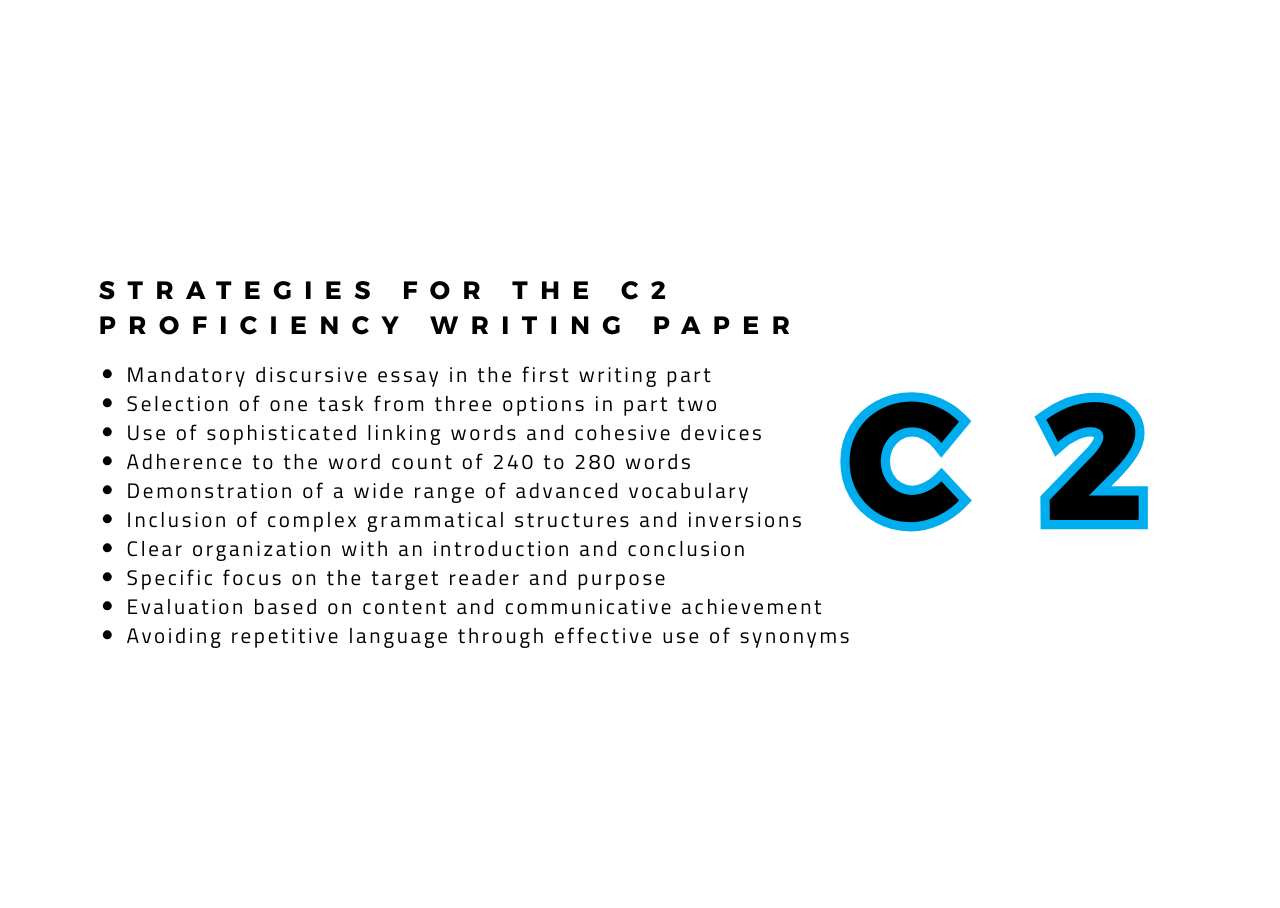
Strategies for the C2 Proficiency Writing Paper
The writing section demands more than just correct grammar; it requires stylistic flair and the ability to organize complex ideas. Candidates must choose between various formats such as reports, reviews, or letters, ensuring the tone is appropriate for the intended reader.
Mandatory discursive essay in the first writing part
Selection of one task from three options in part two
Use of sophisticated linking words and cohesive devices
Adherence to the word count of 240 to 280 words
Demonstration of a wide range of advanced vocabulary
Inclusion of complex grammatical structures and inversions
Clear organization with an introduction and conclusion
Specific focus on the target reader and purpose
Evaluation based on content and communicative achievement
Avoiding repetitive language through effective use of synonyms
Navigating the Listening and Speaking Components
The oral and auditory parts of the exam focus on real-world interaction and the ability to process information at a natural pace. Success here depends on your ability to pick up on speaker attitudes and participate in a balanced conversation.
Identification of speaker opinion and emotional attitude
Ability to follow complex discussions and arguments
Completion of sentences based on heard information
Recognition of gist and detail in short monologues
Collaborative task involving a decision-making process
Individual long turn based on a prompt card
Use of functional language to agree or disagree
Maintenance of a natural and flowing conversation pace
Correct use of intonation and word stress patterns
Ability to speculate and evaluate abstract concepts
Grade
Cambridge English Scale Score
CEFR Level
Grade A
220–230
C2
Grade B
213–219
C2
Grade C
200–212
C2
Level C1
180–199
C1
Effective Preparation Tips for High Scores
Preparation for the C2 level is a marathon, not a sprint, requiring immersion in high-level English media and literature. You should move beyond textbooks and engage with academic journals, quality journalism, and sophisticated podcasts to expand your mental lexicon.
Daily reading of quality newspapers like The Guardian
Consistent practice with authentic past exam papers
Use of English-to-English dictionaries for definitions
Recording yourself speaking to improve fluency and clarity
Joining advanced discussion groups or debate clubs
Learning vocabulary in context rather than isolated lists
Focus on prepositions and fixed phrasal verb patterns
Time management drills for the reading components
Peer review of writing tasks for objective feedback
Understanding the specific assessment criteria of examiners
Scoring and Results Interpretation
The Cambridge English Scale provides a detailed view of your performance across the four skills, ensuring transparency in how your final grade is calculated. A high score not only grants the certificate but provides a profile of your linguistic strengths.
Scores reported for each of the four skills
Separate score for the Use of English component
Overall score derived from the average of five scores
Certificate awarded for scores above two hundred
Grade A awarded for exceptional performance in tasks
Statement of results available before the physical certificate
Verification service for universities and employers
Alignment with the Common European Framework of Reference
Indication of performance relative to the C2 standard
Option to share results securely via the online portal
Frequently Asked Questions
How difficult is the C2 Proficiency compared to C1 Advanced?
The jump from C1 to C2 is significant because it requires a move from u0022effectiveu0022 communication to u0022exceptionalu0022 mastery. At the C2 level, you must understand subtle nuances, irony, and very abstract concepts that even native speakers might find complex.
Is the Cambridge Proficiency certificate valid forever?
Yes, unlike exams such as IELTS which expire after two years, the Cambridge Proficiency certificate has no expiry date. However, some institutions may require that you took the exam within the last few years to ensure your skills are current.
Can I take the exam on a computer or only on paper?
Most centers offer both computer-based and paper-based versions of the exam. The content and the difficulty levels are identical, but the computer-based version often provides faster results and a built-in word counter for the writing section.
What happens if I fail to reach the C2 score?
If your performance is below the C2 level but falls within the C1 range (180–199), you will receive a Cambridge English certificate stating that you demonstrated ability at Level C1. This ensures your effort is still recognized even if you miss the top mark.
How long should I study before attempting the CPE?
Most experts suggest at least 100 to 200 hours of targeted study if you are already at a strong C1 level. This time should be spent on specific exam techniques and expanding your vocabulary to include more formal and academic terms.
Conclusion
Mastering everything you need to know about Cambridge Proficiency Exams empowers you to reach the pinnacle of English language certification.
This journey ensures you possess the elite communication skills required to excel in any professional or academic environment across the globe.