Are you wondering what the required TOEFL scores in US universities are for your 2025 application? Navigating the admission landscape requires understanding these specific benchmarks to secure your spot at a top American institution.
Understanding Required TOEFL Scores in US Universities
Knowing the required TOEFL scores in US colleges is the first step toward a successful international education journey. Most American institutions use the internet-based test (iBT) to evaluate if students can handle complex academic English in a classroom setting.
Minimum composite scores usually range from 60 to 110
Ivy League schools typically demand a minimum of 100
Top tier public universities often require 80 to 90
Community colleges may accept scores as low as 61
Graduate programs often have higher requirements than undergraduate ones
Sectional minimums frequently require 20 plus in each skill
Competitive MBA programs often look for 105 or higher
Teaching assistantships usually require high speaking scores
Score requirements can vary between different campus departments
Some schools offer conditional admission for lower scores
TOEFL Requirements for Top Tier US Institutions
High ranking universities have the most stringent required TOEFL scores in US history due to their rigorous academic standards. Institutions like MIT, Stanford, and Harvard set the bar high to ensure all enrolled international students can contribute effectively to research and discussion.
Harvard University recommends a total score of 100
Stanford University generally expects 100 for most programs
MIT requires a minimum of 90 for undergraduate entry
Columbia University often sets a threshold of 105
Yale University typically requires a 100 on the iBT
Princeton University looks for 28 plus in speaking
University of Pennsylvania requires a 100 for admission
Cornell University recommends a score of 100 or better
Brown University maintains a minimum requirement of 100
University of Chicago expects 104 for competitive applicants
Average TOEFL Scores for Public State Universities
If you are looking for more flexible required TOEFL scores in US public schools, state universities offer a wide range of options. These institutions provide world class education while maintaining entry bars that are accessible to a broader range of international English learners.
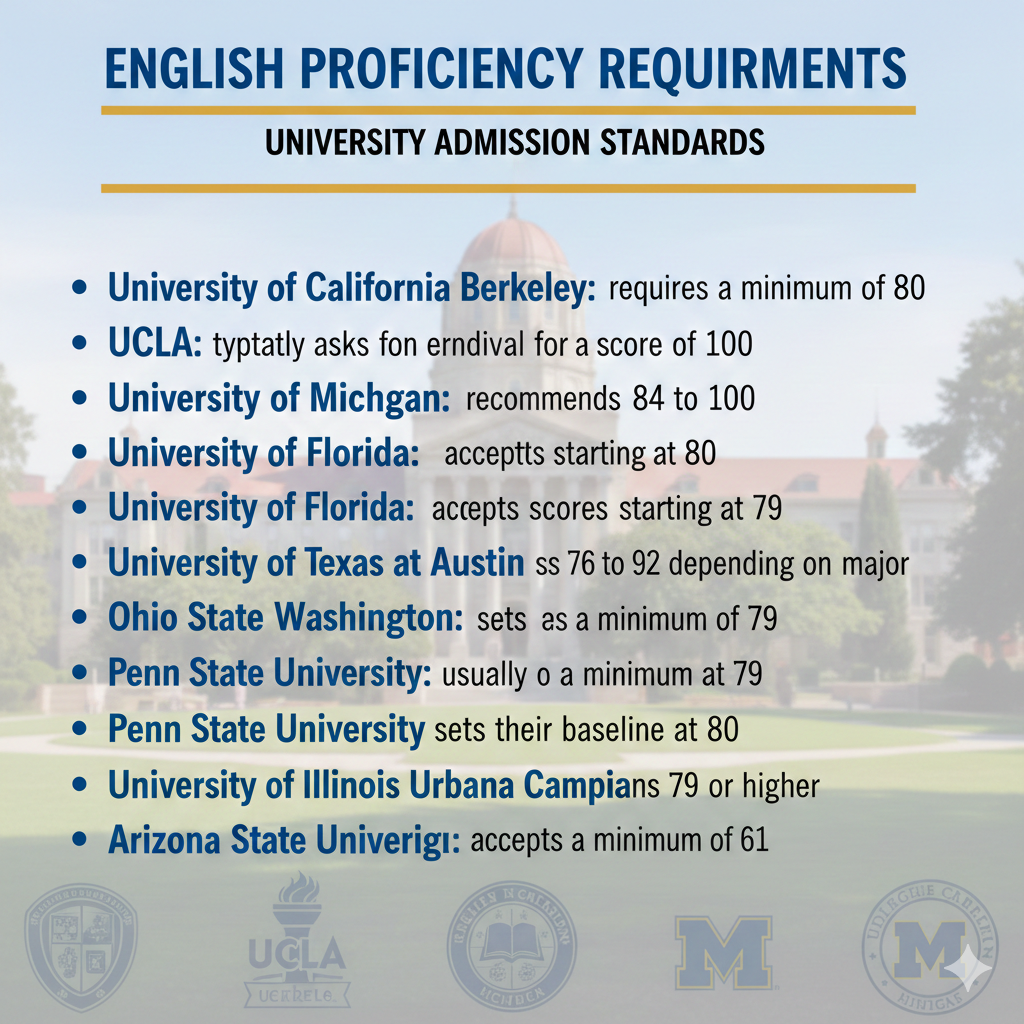
University of California Berkeley requires a minimum of 80
UCLA typically asks for a score of 100
University of Michigan recommends 84 to 100
University of Florida accepts scores starting at 80
University of Texas at Austin sets a minimum of 79
University of Washington requires 76 to 92 depending on major
Ohio State University usually requires a minimum of 79
Penn State University sets their baseline at 80
University of Illinois Urbana Champaign requires 79 or higher
Arizona State University accepts a minimum of 61
Minimum TOEFL Scores for US Graduate Programs
Graduate students often face specialized required TOEFL scores in US master’s and PhD programs that differ from general university rules. Technical fields may focus more on reading, while humanities and law programs prioritize high scores in writing and speaking sections.
Most MS programs require between 80 and 90
PhD candidates should aim for 100 to be safe
Law schools often require 100 plus for LLM degrees
Medical residencies usually look for very high speaking scores
Engineering departments sometimes accept lower scores like 79
Education degrees prioritize high writing and speaking marks
Journalism programs rarely accept anything below a 105
MBA programs at top schools demand 100 to 110
Fine arts programs may accept scores between 70 and 80
Research fellowships often require a minimum of 100
University Type
Typical TOEFL iBT Range
Competitive Target
Ivy League
100 – 105
110+
Top 50 National
90 – 100
105+
Large State Schools
79 – 90
95+
Liberal Arts Colleges
80 – 100
100+
Community Colleges
61 – 70
80+
Factors Affecting Required TOEFL Scores in US Admissions
The required TOEFL scores in US admissions are not always set in stone and can be influenced by several external factors. Admissions officers often take a holistic view of your profile, though meeting the minimum English proficiency remains a non-negotiable legal requirement for most.
Your choice of major can raise or lower requirements
Previous education in an English speaking country matters
High SAT or ACT verbal scores may waive TOEFL
Some schools offer their own internal English tests
Conditional admission programs allow for lower initial scores
Individual section scores are often as important as totals
Competitive scholarship programs require much higher scores
The university ranking significantly influences the score bar
State laws in some regions mandate specific score levels
Yearly application volume can lead to score inflation
Impact of TOEFL Scores on US Student Visas
Meeting the required TOEFL scores in US universities is also linked to your ability to obtain an F-1 student visa. While the US government does not set a universal score for the visa itself, the university must verify your proficiency before issuing your I-20 document.
Consular officers check English skills during the interview
High TOEFL scores demonstrate academic readiness to officers
The I-20 form confirms the school has vetted your English
Low scores may lead to extra questioning at the embassy
Pathway programs are acceptable for visa issuance
Consistency between your score and interview performance is key
TOEFL scores are valid for two years for visa purposes
Official score reports must be sent directly to institutions
Exemptions apply if you have a degree from the US
Financial aid packages often depend on hitting score targets
Frequently Asked Questions
What is the minimum TOEFL score for most US universities?
Most mid-range universities require a minimum score of 79 or 80 on the TOEFL iBT. However, more competitive schools and specific programs like engineering or business often set their minimums at 90 or 100.
Can I get into a US university with a TOEFL score of 60?
Yes, some community colleges and specific u0022pathwayu0022 programs at larger universities accept scores as low as 60. These programs usually require you to take additional English as a Second Language (ESL) classes alongside your degree.
Do Ivy League schools have higher TOEFL requirements?
Yes, Ivy League institutions like Yale, Columbia, and Harvard generally require a minimum score of 100. To be truly competitive among thousands of international applicants, a score of 105 or higher is often recommended.
Is the TOEFL Essentials test accepted in the US?
While the TOEFL iBT remains the gold standard, an increasing number of US universities now accept the TOEFL Essentials test. You should always check the specific admissions page of your target school to confirm their current policy.
How do I send my TOEFL scores to US colleges?
You can send your scores through your ETS account by selecting the specific institution codes for your chosen universities. Most schools require official reports sent directly from ETS rather than student-provided copies.
Conclusion
Meeting the required TOEFL scores in US universities is the vital bridge between your current location and your dream of studying in America.
By targeting the right score for your specific institution, you ensure that your academic journey starts with a solid foundation in the English language.