Are you aiming for a fully funded scholarship to study at the University of Cambridge?
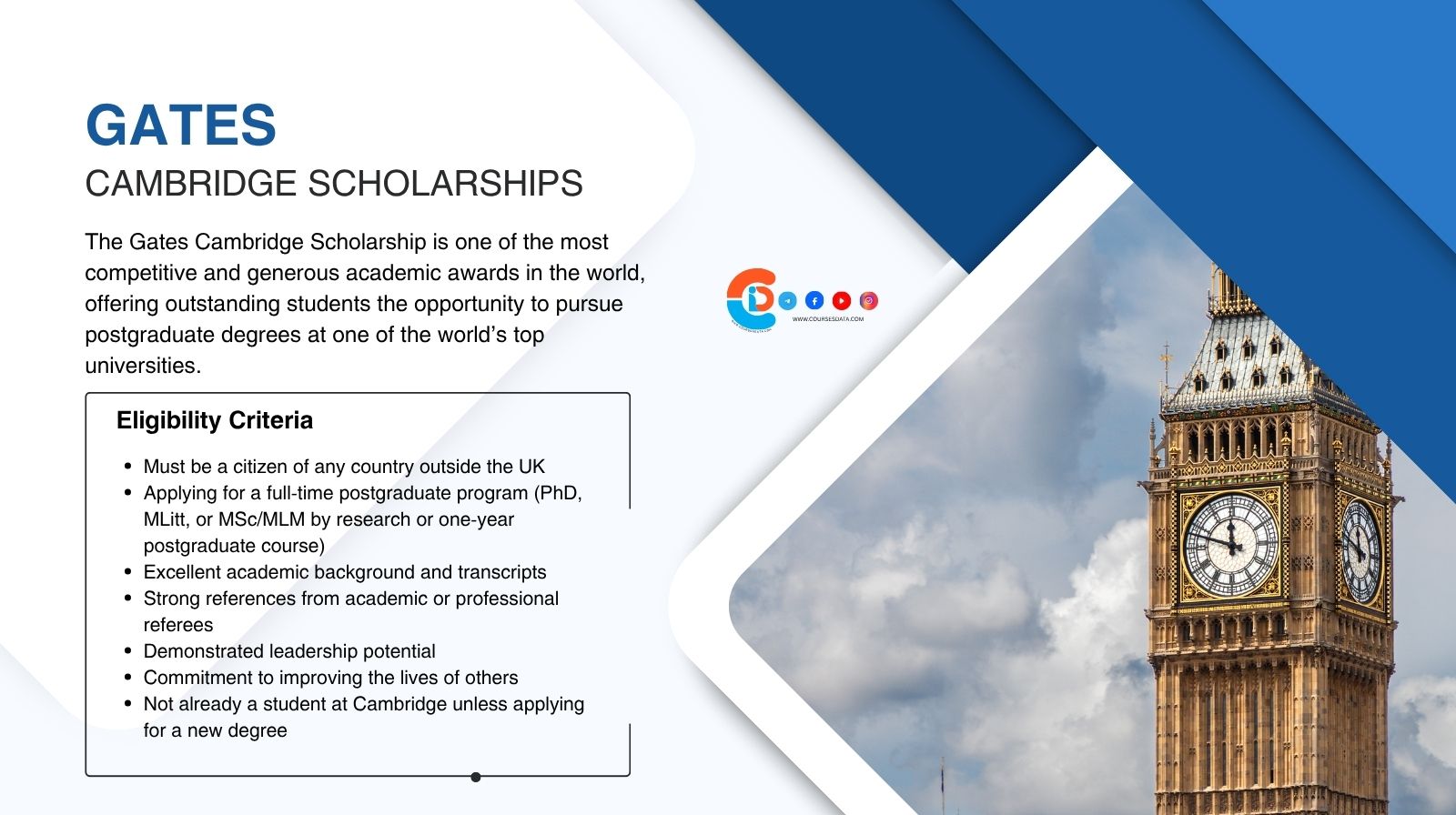
The Gates Cambridge Scholarship is one of the most competitive and generous academic awards in the world, offering outstanding students the opportunity to pursue postgraduate degrees at one of the world’s top universities.
What is the Gates Cambridge Scholarship?
This scholarship program was established in 2000 by a donation from the Bill and Melinda Gates Foundation. It supports international students who demonstrate academic excellence, leadership potential, and a commitment to improving the lives of others.
Key features of the Gates Cambridge Scholarship:
- Fully funds postgraduate study at the University of Cambridge
- Open to non-UK citizens from around the world
- Covers tuition fees, maintenance allowance, travel, and visa costs
- Over 1,700 scholarships awarded since inception
- Focuses on academic excellence and social impact
- Available for full-time master’s or PhD degrees
- Separate application process from general Cambridge admission
- Supports scholars in all subjects except certain professional degrees
- Offers access to a vibrant scholar community
- Provides additional funding for academic development
Who is Eligible for the Gates Cambridge Scholarship?
Eligibility for the Gates Cambridge Scholarship is based on nationality, academic merit, and the type of degree pursued. Only non-UK applicants planning to study full-time in Cambridge are considered.
Eligibility requirements include:
- Must be a citizen of any country outside the United Kingdom
- Applying for a full-time postgraduate program (PhD, MLitt, or MSc/MLM by research or one-year postgraduate course)
- Excellent academic background and transcripts
- Strong references from academic or professional referees
- Demonstrated leadership potential
- Commitment to improving the lives of others
- Not already a student at Cambridge unless applying for a new degree
- Meeting English language requirements of the university
- Applying within the correct application window
- Specific course must be eligible for funding
What Does the Scholarship Cover?
The Gates Cambridge Scholarship is known for its generous and comprehensive financial support. It ensures that students can focus fully on their studies and research.
The scholarship covers the following:
- University composition fee at the appropriate rate
- Maintenance allowance (approx. £20,000 per year)
- One economy single airfare at the beginning and end of the course
- Inbound visa and Immigration Health Surcharge costs
- Academic development funding (up to £2,000)
- Family allowance if applicable
- Fieldwork and research costs for PhD scholars
- Maternity/paternity funding if needed
- Hardship funding for unforeseen difficulties
- Access to professional development events
How to Apply for the Gates Cambridge Scholarship
The application process is rigorous and highly competitive. It requires careful preparation and submission of detailed documents via the University of Cambridge’s online portal.
Steps to apply:
- Apply for admission to a Cambridge postgraduate course
- Indicate interest in the Gates Cambridge Scholarship during the application
- Submit a personal statement (up to 500 words)
- Provide academic transcripts
- Submit a CV/resume
- Include references, including one specifically for Gates Cambridge
- Upload research proposal (for PhD applicants)
- Ensure application is submitted by the scholarship deadline
- Review interview invitation (if shortlisted)
- Attend interview (in person or online)
What Makes a Strong Application?
To stand out in the competitive pool, applicants must go beyond excellent grades. The Gates Cambridge panel looks for candidates who align with the program’s core values.
Key components of a strong application:
- Exceptional academic record
- A clearly defined study or research plan
- Personal statement that conveys vision and passion
- Evidence of leadership in academic or community settings
- Specific examples of commitment to social change
- Well-structured and realistic research proposal (PhD only)
- Tailored and supportive references
- Authenticity in personal and academic goals
- Awareness of global challenges and solutions
- Strong interview performance with clear communication
Timeline and Deadlines for Gates Cambridge Scholarship
The Gates Cambridge Scholarship operates on strict deadlines, which vary depending on the applicant’s citizenship and program.
Typical timeline includes:
- Application portal opens: Early September
- US citizens deadline: Mid-October
- All other international applicants: Early December to early January (varies by course)
- Shortlisting for interview: Late January
- Interviews conducted: March
- Final offers sent: Late March
- University offers confirmed: April to June
- Scholars begin studies: October
| Stage | US Applicants | International Applicants |
|---|---|---|
| Application Opens | Early September | Early September |
| Deadline | Mid October | Early December to January |
| Interview Invitations | January | January |
| Interviews | February | March |
| Final Decisions | March | March |
Life as a Gates Cambridge Scholar
Becoming a Gates Cambridge Scholar means joining a dynamic and diverse community of students dedicated to leadership and social transformation.
Benefits of scholar life include:
- Membership in a global network of over 1,700 scholars and alumni
- Access to regular events, conferences, and academic workshops
- Opportunities for interdisciplinary collaboration
- Leadership development programs
- Cultural and social events in Cambridge
- Support for personal and professional growth
- Access to mentoring and peer support networks
- Living in one of Cambridge’s historic colleges
- Rich academic and intellectual environment
- Lifelong connections through the Gates Cambridge Alumni Association
Frequently Asked Questions (FAQs)
Is the Gates Cambridge Scholarship open to all countries?
Yes, applicants from any country outside the United Kingdom are eligible.
Can I apply for any postgraduate course at Cambridge?
Most full-time master’s and PhD programs are eligible, except for certain professional degrees like MBA, MFin, and clinical medicine.
Is the scholarship available for undergraduate studies?
No, it is strictly for postgraduate programs.
Do I need to have an offer from Cambridge before applying?
You apply to the university and the scholarship simultaneously via the same application portal.
How competitive is the Gates Cambridge Scholarship?
Extremely competitive. Only around 80 scholarships are awarded annually out of thousands of applications.
Can current Cambridge students apply?
Only if they are applying for a new postgraduate degree.
What should I write in the personal statement?
Explain your motivations, leadership experience, academic goals, and how your work will improve the lives of others.
Are there interviews for all applicants?
No, only shortlisted candidates are invited to interview.
Does the scholarship cover families?
Yes, family allowances are provided for scholars with dependents.
Is there any age limit for applicants?
No, there is no specific age restriction, but applicants must meet academic and program-specific criteria.
Conclusion
The Gates Cambridge Scholarship offers a life-changing opportunity to pursue graduate studies in one of the world’s most inspiring academic environments. It combines full funding with leadership and community support.
I’ve looked into this scholarship before, and while it sounds amazing on paper, the application process is intense—especially the part about demonstrating a commitment to improving others’ lives, which isn’t always easy to prove if you’re coming from a pure science background. Has anyone here actually gone through the interview stage? I’d love to know how they balanced talking about their research with the leadership and community service angle.
Katie, you’ve hit on the real challenge of this scholarship. I went through it as an engineering student, and I found the key was to stop seeing leadership and community service as a separate box to tick, and start treating it as a practical extension of your research—like how you mentor undergrads or solve a local technical problem. The panel didn’t need a global savior story; they just wanted a clear, honest link between your work and a real person it could help.
I actually applied for the Gates Cambridge Scholarship a few years back, and I can tell you the interview was the most humbling experience of my life—they really pressed me on how my chemistry research could tangibly serve communities beyond the lab. Katie, you’re right that the “improving lives” angle feels forced if you’re in a pure science, but I found that even framing my work’s potential for future medical applications or science education outreach helped bridge that gap. Did anyone else struggle to articulate that part without feeling like you were stretching the truth?
Brenda, I completely understand that struggle—I’m an astrophysics student, and during my Gates interview, they kept asking how studying distant galaxies “helps anyone.” I ended up talking about my work with local schools teaching coding through telescope data, and that seemed to click with them. It felt a bit forced at first, but honestly, the more I thought about it, the more genuine that connection became.
Brenda, I really appreciate you sharing that—I’ve been wrestling with the same thing as a molecular biology student. My research feels so far from an obvious community benefit that I’ve worried I’d come across as insincere trying to force a connection. What you said about framing potential future applications or outreach makes me think I just need to get honest about the *process* of impact, not a finished product. It’s reassuring to know the panel might value that kind of thoughtful honesty over a polished but hollow story.
Brenda, your honesty is such a relief—I’m a molecular biology student, and I’ve been dreading that exact pressure to justify my lab work. Hearing you say the panel responded well to framing future medical applications or outreach gives me hope that I can be genuine about the *process* of impact, not just the end result. I think I’ll try focusing on how my research on cellular mechanisms could one day inform disease treatments, and pair it with my volunteer work teaching biology to high schoolers in underfunded schools.
I went through the Gates interview process two years ago as a materials science applicant, and I felt the same pressure to justify my work’s “real-world impact.” What helped me was stopping the search for grand, world-changing applications and instead getting specific about small, tangible benefits—like how my research on cheaper solar cell materials could lower energy costs in off-grid communities I’d actually visited. Did any of you find that the panel responded better to concrete local examples versus broad global promises?
Great point, Ciarán. That shift from vague global promises to specific local examples seems like the key difference between sounding idealistic and showing real, grounded leadership. For anyone else prepping for the interview, did the panel ever push back on the scale of your impact—like asking if helping one small community is enough to meet their “improving lives” standard?
That’s such a good question, Shane. In my own interview for a different scholarship, I felt the panel was less concerned about the size of the impact and more about whether you could clearly explain the *why* behind your choice—why that one community, why that specific problem. They seemed to value authenticity over scale, as long as you could show genuine, thoughtful engagement.
You’ve put your finger on exactly what I wrestled with when I applied—I kept thinking my impact had to be huge to be worth mentioning. But once I stopped trying to save the world and just talked honestly about why I cared about a small, messy problem I’d actually seen, everything clicked with the panel. That shift from scale to sincerity made all the difference for me, too.