Are you looking for a fully funded opportunity to study in Indonesia through an Indonesian Government Scholarship?
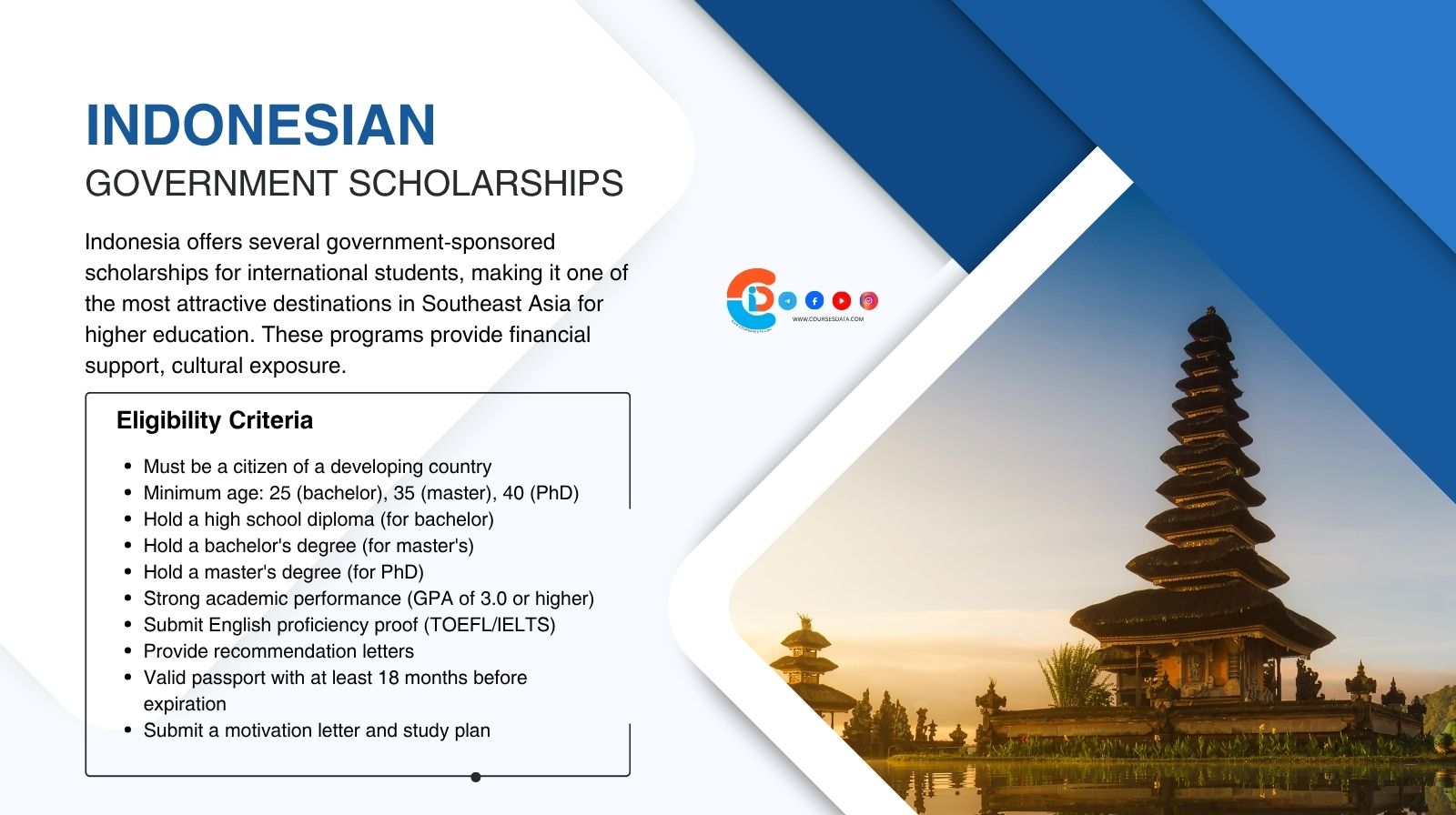
Indonesia offers several government-sponsored scholarships for international students, making it one of the most attractive destinations in Southeast Asia for higher education. These programs provide financial support, cultural exposure, and academic development in top Indonesian universities.
What Is the Indonesian Government Scholarship?
The Indonesian Government Scholarship, commonly known as KNB (Kemitraan Negara Berkembang), is designed to support students from developing countries to pursue undergraduate, master’s, or doctoral degrees in Indonesia.
- Offers full tuition coverage
- Includes monthly living allowance
- Covers settlement and book allowances
- Provides health insurance
- Covers round-trip international airfare
- Open to students from more than 90 countries
- Hosted at leading Indonesian public universities
- Courses available in both English and Bahasa Indonesia
- Includes one-year Bahasa language training
- Promotes international diplomacy and cultural exchange
- Fully managed by the Ministry of Education, Culture, Research, and Technology
Types of Indonesian Government Scholarships
Indonesia offers several scholarship programs through its ministries and educational institutions. Each targets a specific audience and study level.
- KNB Scholarship for developing countries
- Darmasiswa Scholarship for non-degree cultural learning
- BIPA Program (Bahasa Indonesia for Foreign Speakers)
- LPDP Scholarship (Indonesian Endowment Fund for Education)
- University-specific scholarships (UGM, UI, ITB)
- Ministry of Religious Affairs Scholarships
- Research and innovation-focused grants
- Short-term exchange programs
- Vocational and technical education scholarships
- Postdoctoral and fellowship programs
Eligibility Criteria for Indonesian Government Scholarships
To apply for most Indonesian scholarships, candidates must meet specific academic, language, and documentation requirements.
- Must be a citizen of a developing country
- Minimum age: 25 (bachelor), 35 (master), 40 (PhD)
- Hold a high school diploma (for bachelor)
- Hold a bachelor’s degree (for master’s)
- Hold a master’s degree (for PhD)
- Strong academic performance (GPA of 3.0 or higher)
- Submit English proficiency proof (TOEFL/IELTS)
- Provide recommendation letters
- Valid passport with at least 18 months before expiration
- Submit a motivation letter and study plan
How to Apply for an Indonesian Government Scholarship
The application process is handled online and includes multiple stages. Candidates should carefully follow deadlines and instructions.
- Visit the official scholarship portal (e.g., knb.kemdikbud.go.id)
- Register and create a user profile
- Upload academic transcripts and certificates
- Submit English test scores (IELTS, TOEFL, or Duolingo)
- Upload recommendation and motivation letters
- Choose a university and academic program
- Complete online application form
- Wait for pre-selection and interview invitation
- Attend online interview with panel
- Await final results and acceptance letter
Top Universities Offering Indonesian Government Scholarships
Several high-ranking Indonesian universities host scholarship recipients. These institutions are known for academic excellence and cultural diversity.
- Universitas Gadjah Mada (UGM)
- Universitas Indonesia (UI)
- Institut Teknologi Bandung (ITB)
- Universitas Airlangga (UNAIR)
- Universitas Diponegoro (UNDIP)
- Universitas Padjadjaran (UNPAD)
- Universitas Hasanuddin (UNHAS)
- Universitas Brawijaya (UB)
- Universitas Negeri Malang (UM)
- Universitas Sebelas Maret (UNS)
Benefits of Studying in Indonesia with a Government Scholarship
Scholarship recipients enjoy comprehensive support throughout their academic journey in Indonesia.
- No tuition fees during study period
- Monthly stipend covers living expenses
- Access to on-campus housing
- Free Bahasa Indonesia course
- Supportive international student community
- Cultural trips and educational excursions
- Mentorship from experienced faculty
- High academic standards
- Opportunities for internships and research
- Gateway to ASEAN regional networks
Required Documents for Scholarship Application
Applicants must prepare and upload all documents in digital format. Missing documents can lead to disqualification.
- Passport-size photo
- Passport biodata page copy
- Curriculum Vitae (CV)
- High school or university diploma
- Academic transcripts with GPA
- English language test result
- Recommendation letter (from university or employer)
- Statement of purpose or study plan
- Medical certificate
- Declaration of willingness to follow rules
Scholarship Timeline and Deadlines
Scholarship application cycles generally follow the Indonesian academic calendar. Key dates may vary by program.
| Phase | Timeline |
|---|---|
| Announcement | January – February |
| Application Submission | February – May |
| Document Review | May – June |
| Interview Stage | June – July |
| Final Selection | July – August |
| Result Announcement | August – September |
| Visa Processing | September – October |
| Arrival and Orientation | October – November |
Life in Indonesia for International Students
Living in Indonesia offers a unique mix of cultural immersion, affordability, and scenic beauty.
- Low cost of living in most cities
- Rich cultural and religious diversity
- Warm climate year-round
- Delicious local cuisine
- Safe and friendly communities
- Availability of student housing
- Efficient public transportation
- Access to beaches, mountains, and rainforests
- Vibrant student organizations
- Strong English-speaking academic environment
Frequently Asked Questions
Q: Can I study in English in Indonesia under a government scholarship?
Yes, many programs offer courses in English, especially at the master’s and PhD levels.
Q: Do I need to learn Bahasa Indonesia?
Yes, most programs include a one-year Bahasa Indonesia language course.
Q: Is the scholarship really fully funded?
Yes, the KNB and other scholarships cover tuition, living costs, airfare, and insurance.
Q: What GPA is required to qualify?
Generally, a GPA of 3.0 or higher is expected.
Q: Can I bring my family while studying in Indonesia?
This depends on your visa and scholarship type. Some programs allow it.
Q: Are there age restrictions?
Yes. Typically 25 for bachelor’s, 35 for master’s, and 40 for doctoral programs.
Q: Do I need an English proficiency test?
Yes. TOEFL, IELTS, or Duolingo scores are required.
Q: How competitive is the selection?
Very. Thousands apply yearly. Strong academics and motivation help.
Q: Can I work part-time as a student in Indonesia?
Part-time work is not usually allowed under a student visa.
Q: How long is the study duration?
Bachelor: 4 years, Master: 2 years, PhD: 3–4 years, plus 1 year for language training.
Conclusion
The Indonesian Government Scholarship opens academic and cultural doors for students worldwide. It’s more than funding—it’s a life-changing journey in a vibrant country.
I actually looked into the KNB scholarship last year, and while the benefits are amazing, I found the application timeline to be really tight—especially if you need to get your documents translated and legalized in time. One thing that surprised me was how competitive it is for certain programs like engineering compared to cultural studies. Did you find the health insurance covered everything, or were there gaps for things like dental or pre-existing conditions?
You’re spot on about the timeline—I nearly missed the deadline because my university took weeks to legalize my transcripts, and then the embassy had its own delays. As for the insurance, I found it covered emergencies and basic checkups, but dental and pre-existing conditions were definitely gaps I had to cover myself. Packing a little extra cash for those unexpected costs is a must, especially if you end up in a city like Bandung where rent eats into the allowance fast.
Ah, yes, another fully funded dream package that requires the organizational stamina of a minor diplomat to even apply. I suppose the real question is whether the monthly living allowance is calibrated to Jakarta prices or to some optimistically frugal fantasy of student life. Brianna’s point about dental coverage is a good one—I’ve never met a government scholarship that didn’t treat a root canal as an optional luxury.
Oh, Eleanor, you’ve hit the nail right on the head about that “optimistically frugal fantasy.” When I was on the KNB scholarship in Yogyakarta, the allowance was actually decent for the city, but I heard horror stories from friends in Jakarta who had to supplement their rent from savings. And as for the health insurance, I learned the hard way that it covers a standard check-up but not a single filling at the dentist—definitely pack some painkillers and hope for the best.
You’re confirming exactly what I suspected—the living allowance seems to be a coin toss depending on which city you end up in, which makes budgeting a gamble. And the dental thing is absurd; it’s like they assume teeth don’t exist in developing countries. Honestly, for a “fully funded” program, having to pack painkillers as a backup plan feels a bit like they’re daring you to get sick abroad.
Oh, you’ve put it perfectly—packing painkillers as a backup plan really does feel like a passive-aggressive dare from the scholarship board. I remember staring at my “comprehensive” insurance booklet in Yogyakarta, wondering if they thought dental emergencies were a myth invented by dentists. It’s such a shame, because the academic side is genuinely wonderful, but the fine print turns “fully funded” into a scavenger hunt for your own savings.
Eleanor, you’ve absolutely nailed it with the “optimistically frugal fantasy” line—that’s exactly how I felt when my living allowance barely covered my rent in Surabaya. I ended up tutoring English on weekends just to afford groceries, and when I needed a filling, the insurance said “sorry, not covered” and I had to pay out of pocket. It’s a brilliant opportunity on paper, but the fine print definitely expects you to be part-financier and part-detective just to survive comfortably.
Eleanor, you’ve perfectly described the “optimistically frugal fantasy” – I was in Jakarta and my allowance barely covered a shared room in a kos, let alone the actual cost of eating more than instant noodles. And you’re spot on about the dental coverage; I had to wire my parents for cash when I needed a crown, because the scholarship insurance basically said “good luck.” It’s a fantastic academic opportunity, but the budget part definitely expects you to be a financial detective.
I went through the KNB application process last year, and I’d add that the timeline isn’t just tight—it’s almost punishing if your university requires physical document legalization at the embassy. The health insurance does cover emergency hospital visits, but don’t expect a penny back for any routine dental work or even a prescription for common infections. For anyone considering this, I’d budget an extra $50–$100 a month out of pocket, especially if you end up in a pricier city like Bandung.
It’s wild how consistent the stories are about the living allowance being a total crapshoot depending on the city. I was seriously considering applying, but reading about people having to tutor just to afford groceries makes me wonder if the “fully funded” label is more of a marketing hook than a guarantee. For anyone who made it work without side gigs, what was your secret—did you negotiate housing beforehand or just get lucky with a cheaper campus location?