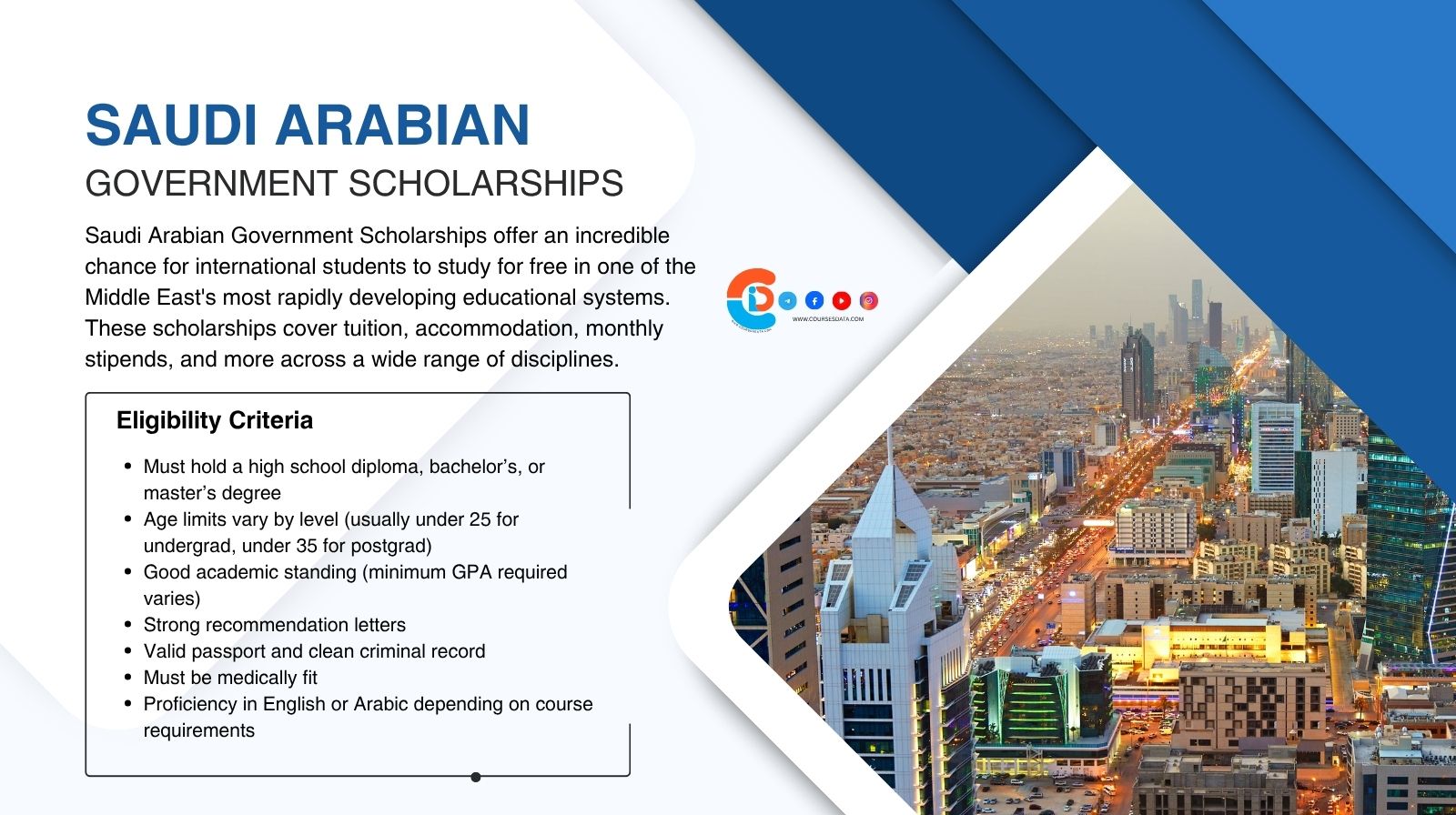
Saudi Government Scholarships provide study opportunities for international students through Saudi public universities, with options that can include full or partial financial support.
The main route for international applicants is through Saudi universities and the official Study in Saudi system, while scholarship benefits, eligible programs, and admission requirements can vary by institution and scholarship type.
What Are Saudi Arabian Government Scholarships?
Saudi Arabian Government Scholarships are opportunities offered through Saudi public higher-education institutions for eligible non-Saudi students.
They are available to international applicants both outside Saudi Arabia and, under separate arrangements, to eligible non-Saudis legally residing inside the Kingdom.
For students applying from abroad, the relevant category is generally an external scholarship.
Students who are already legally resident in Saudi Arabia may fall under the internal scholarship category, subject to the applicable rules.
Depending on the university and award, applicants may encounter:
- Full scholarships
- Partial scholarships
- Paid-study opportunities
- Undergraduate programs
- Master’s programs
- Doctoral programs
- Arabic-language programs for non-native speakers
- Academic and research programs
- University-specific scholarship opportunities
The Saudi Ministry of Education explains that public-university scholarships can differ in their benefits and that the university’s own regulations determine the applicable conditions and benefits.
Types of Saudi Scholarships for International Students
One important point is that not every Saudi scholarship has identical funding.
The official Study in Saudi platform distinguishes between full scholarships, partial scholarships, and paid study.
Full Scholarships
A full scholarship can cover tuition and university-provided services and may also include financial assistance for international students.
The exact package should be checked against the specific university and scholarship offer rather than assumed from the word “full.”
Potential benefits may include:
- Tuition coverage
- Financial assistance
- University services
- Housing, where provided under the applicable scholarship regulations
- Health-care benefits under applicable rules
- Travel benefits where applicable
- Arrival-related financial assistance in qualifying cases
The Ministry of Education lists housing, health care in qualifying circumstances, an arrival allowance, and annual travel tickets among possible benefits associated with external scholarships, subject to the governing regulations.
Partial Scholarships
Partial scholarships provide some benefits rather than the complete package.
The university determines which benefits are included.
For example, an institution may provide a study place and housing without providing every benefit associated with a full scholarship.
Paid Study
The Study in Saudi platform also identifies paid-study opportunities for international students.
These are not the same as fully funded scholarships because the student may be responsible for study-related costs according to the applicable program.
Who Can Apply for Saudi Government Scholarships?
Eligibility depends on the university, degree level, program, and scholarship category.
The Ministry of Education publishes general controls for international scholarship students, but applicants should always verify the specific requirements of their chosen university.
General requirements can include:
- Meeting the university’s academic admission requirements
- Holding the required previous qualification
- Providing authenticated educational documents where required
- Meeting applicable age requirements
- Passing required medical examinations
- Providing required identification and passport documents
- Meeting any country-specific requirements
- Not already holding another scholarship from a Saudi educational institution
- Providing additional documents requested by the university
For the general international scholarship framework published by the Ministry, stated age limits include up to 25 for undergraduate-level study, 30 for master’s study, and 35 for doctoral study.
These are general published controls and should not replace checking the requirements of the specific program.
Some programs can also have additional academic, language, professional, or institutional requirements.
Which Degrees Can Students Study?
Saudi public universities offer scholarship opportunities across a wide range of academic fields, although availability depends on the institution and current admissions cycle.
The Ministry states that international applicants can apply for available specializations at participating universities, with important restrictions applying to certain health and medical specialties under the general scholarship framework.
Possible fields may include:
- Computer science
- Information technology
- Artificial intelligence
- Engineering
- Business administration
- Economics
- Accounting
- Law
- Education
- Islamic studies
- Arabic language
- Natural sciences
- Social sciences
- Humanities
- Research-based disciplines
For example, a student interested in artificial intelligence should not simply search for “Saudi government scholarship.” The better approach is to identify Saudi universities offering an AI-related degree, check whether international admission is available, and then examine the scholarship attached to that admission route.
Saudi Universities and Scholarship Opportunities
Saudi government scholarships are closely connected with individual public universities.
The Ministry of Education states that international students can apply through public universities according to their admission schedules and that applicants should consult each university for its specific conditions and requirements.
The Ministry’s scholarship information identifies 27 public universities within its information for international students.
When researching universities, compare:
| What to check | Why it matters |
|---|---|
| Degree level | Scholarship availability can differ by level |
| Major | Not every university offers every discipline |
| Scholarship type | Full, partial, or paid study |
| Tuition coverage | Determines your main education cost |
| Housing | Check whether accommodation is included |
| Financial support | Benefits differ by scholarship |
| Language of instruction | Determines whether language preparation is needed |
| Admission requirements | Academic and document requirements vary |
| Application route | Applications may use official government or university systems |
| Application deadline | Missing the deadline can prevent consideration |
The safest approach is to treat the university’s official admissions information and the official Saudi scholarship platform as the primary sources when preparing an application.
How to Apply for Saudi Arabian Government Scholarships
The application process depends on the scholarship and university, but international students should begin with official Saudi government channels rather than third-party scholarship websites.
A practical process is:
- Identify your intended degree level.
- Choose a suitable academic field.
- Research Saudi public universities offering that field.
- Check whether international students are eligible.
- Review the scholarship type.
- Check the university’s admission requirements.
- Prepare your academic documents.
- Check document-attestation requirements.
- Submit the application through the applicable official route.
- Monitor your application and respond to university requests.
The Ministry of Education explains that international scholarship applications can be submitted through public universities according to their admission periods.
It also identifies Saudi diplomatic missions as another channel in circumstances where applicable.
The official Study in Saudi platform is another important government source for information about scholarship categories and study opportunities for international students.
Documents You Should Prepare
Preparing documents early can make the application process considerably easier, particularly when certificates need authentication or translation.
A typical preparation checklist includes:
- Valid passport
- Previous academic certificate
- Academic transcript
- Certified translations when required
- Academic recommendation letters when requested
- Personal statement when requested
- Language-test certificate when required
- Passport-size photographs if requested
- Medical documentation when required
- Police or good-conduct documentation where required
- Additional university-specific forms
- Documents required for visa procedures after admission
Do not assume that every applicant needs every document on this list.
The exact requirements are determined by the university, program, and scholarship category.
The Ministry’s published controls specifically mention attestation of certificates and supporting documents by the competent authorities designated by the educational institution.
What Does the Scholarship Usually Cover?
The financial package is one of the most important points to verify before accepting a scholarship.
A student should distinguish between tuition coverage and the wider living-support package.
Depending on the scholarship, benefits can include:
- Tuition or study costs
- Accommodation
- Financial allowance
- Arrival allowance
- Health-care coverage under applicable rules
- Annual travel tickets under applicable regulations
- University services
- Benefits comparable to those available to scholarship students at the institution
The Ministry of Education notes that these benefits are governed by regulations and can therefore vary according to the scholarship and educational institution.
This means applicants should not describe every Saudi government scholarship as automatically covering flights, accommodation, monthly payments, and all living expenses.
The official scholarship offer is the document that determines what the individual student actually receives.
How to Improve Your Application
A strong application starts with eligibility rather than simply submitting applications to as many universities as possible.
Before applying, focus on these areas:
- Choose a program matching your academic background.
- Check the university’s international-student requirements.
- Confirm that your qualification is accepted.
- Prepare clear scans of official documents.
- Complete required authentication procedures.
- Use consistent personal information across documents.
- Check language requirements carefully.
- Write a focused personal statement if required.
- Apply through official channels.
- Keep copies of every submitted document.
- Monitor your email and application account.
- Respond quickly if the university requests additional information.
For example, if you are applying for a master’s degree in business administration, your application should clearly demonstrate the connection between your previous qualification, professional or academic experience where relevant, and the MBA program you have selected.
Avoid relying on generic claims such as “Saudi Arabia offers fully funded scholarships for everyone.” Scholarship availability and benefits depend on the specific program and institution.
What Happens After Admission?
Receiving admission and completing scholarship procedures are related but should not be treated as exactly the same step.
For international students, the Ministry explains that a scholarship from a Saudi university is required for the relevant study-visa process.
After arrival, scholarship recipients may obtain a residence permit for the duration of their study through procedures involving their university.
After receiving an admission or scholarship decision, check:
- Scholarship status
- Funding conditions
- Tuition coverage
- Housing arrangements
- Visa requirements
- Required medical procedures
- Travel instructions
- Registration requirements
- Arrival procedures
- University orientation
- Residence-permit procedures
Keep the official admission and scholarship documents accessible because they may be required during subsequent procedures.
Important Mistakes to Avoid
Many scholarship applicants lose time by relying on incomplete information rather than checking the official university requirements.
Avoid these common mistakes:
- Assuming every scholarship is fully funded
- Applying without checking degree eligibility
- Ignoring university-specific requirements
- Using unofficial application websites
- Submitting inconsistent personal information
- Waiting until the last moment to authenticate certificates
- Assuming language requirements are identical across universities
- Applying for a program that does not match your previous qualification when a matching requirement applies
- Ignoring scholarship-specific age conditions
- Paying an unofficial person or agency to “guarantee” admission
- Failing to monitor the application after submission
- Treating an admission offer as confirmation of every scholarship benefit
The Ministry states that scholarship applicants must meet applicable admission requirements and that educational institutions can establish rules governing scholarship admission.
The most reliable starting point is the official university or government scholarship platform, not a social-media post or an agency promising guaranteed funding.
Official Sources for Saudi Scholarships
Applicants should use official sources when checking scholarship availability, requirements, and application procedures.
The most relevant sources include:
- Saudi Ministry of Education
- Study in Saudi platform
- Official website of the selected Saudi university
- Saudi diplomatic missions where applicable
- Official university admissions portals
- Official scholarship instructions associated with the selected program
The Saudi Ministry of Education’s scholarship information confirms that international students should consult the university for its specific admission conditions and available programs.
Always verify the scholarship benefits, eligibility rules, and application route from the official source before making financial or travel arrangements.
Conclusion
Saudi Arabian Government Scholarships can provide international students with opportunities to study at Saudi public universities under full, partial, or other scholarship arrangements.
The most important step is to identify a suitable university and program, verify the scholarship category and benefits, prepare the required documents, and apply through the official route.
Because scholarship conditions can differ between institutions, applicants should avoid assuming that one scholarship’s benefits apply to every Saudi university.
Checking the official Study in Saudi platform, Ministry of Education information, and the selected university’s admissions requirements is the most practical way to build an accurate application.
Frequently Asked Questions
1. Are Saudi Arabian Government Scholarships available to international students?
Yes.
Saudi public universities offer scholarship opportunities to non-Saudi students, including applicants from outside the Kingdom.
The Ministry of Education identifies external scholarships for international students and provides information about internal scholarships for eligible non-Saudis residing in Saudi Arabia.
2. Are Saudi scholarships fully funded?
Some scholarships are classified as full scholarships, but not every scholarship has the same benefits.
Saudi scholarship opportunities can also be partial or paid-study arrangements, so applicants should verify the exact funding package attached to their university and program.
3. Can I apply for a bachelor’s degree?
International students can apply for bachelor’s-level study where the university and program offer an eligible international scholarship route.
The applicable admission requirements and scholarship conditions should be checked with the selected university.
4. Can I study for a master’s degree through a Saudi scholarship?
Yes, master’s study is included within the levels covered by the general international scholarship information published by the Ministry.
However, admission depends on the university, program, academic qualification, and applicable scholarship conditions.
5. Can I apply for a PhD scholarship in Saudi Arabia?
Doctoral opportunities are available within the international scholarship framework, subject to program availability and university admission requirements.
Applicants should review the research, academic, and document requirements of the particular doctoral program.
6. Do Saudi scholarships cover accommodation?
Accommodation can be among the benefits associated with external scholarships, but applicants should confirm whether housing is included in their specific scholarship offer.
Housing arrangements can vary according to the scholarship and university regulations.
7. Do Saudi scholarships provide a monthly allowance?
Financial assistance may be provided under qualifying scholarship arrangements, but the exact amount and conditions should not be assumed before receiving the official scholarship information.
Applicants should check the financial benefits stated for their particular scholarship.
8. Do I need IELTS for a Saudi government scholarship?
There is no single IELTS rule that applies identically to every Saudi scholarship.
Language requirements can depend on the university and program, so applicants should check the official admission requirements for their chosen course.
9. Can students already living in Saudi Arabia apply?
Potentially, yes.
Saudi Arabia has an internal scholarship category for eligible non-Saudi students who are legally residing in the Kingdom.
The Ministry of Education provides specific information concerning internal scholarships for non-Saudis.
10. Where should I apply for a Saudi government scholarship?
International applicants should begin with the official Study in Saudi platform and the official admissions information of the Saudi university they want to attend.
The Ministry of Education also explains that applications can be handled through public universities according to their admission periods.
I actually applied for a Saudi government scholarship back in 2019, and the whole process was surprisingly straightforward, though getting the visa took a bit longer than expected. One thing I wish I’d known earlier is that some universities require a separate application for specific programs even after you get the initial scholarship approval, so double-checking with the admissions office early on can save a lot of headaches. Did anyone else find the language requirement for Arabic-taught courses tricky to meet?
That’s a really helpful tip about the separate program applications, Mason—I hadn’t considered that extra layer. For the Arabic-language requirement, I’ve heard that some foundations offer a preparatory year, but I’m curious if that actually helps enough to meet university-level demands. It’s encouraging to know the process was straightforward overall, though the visa delay sounds stressful.
Oh, the preparatory year is a bit like being handed a swimsuit and thrown into the deep end—you’ll learn to paddle, but the first time you hit medical terminology or engineering jargon, you’ll wonder if you accidentally signed up for a different language entirely. From what I’ve gathered from friends who’ve been through it, the foundation is decent for day-to-day chatter, but university-level demands have a way of humbling you fast. That visa delay, though, sounds like the real endurance test before you even crack a textbook.
That’s interesting, Mason—I’ve been cautiously looking into these scholarships for a master’s program, but the Arabic-language requirement gives me pause. I’ve seen some universities claim you can study in English, yet the promotional materials blur the lines on what’s actually available. Kelsey, do you know if the preparatory year is genuinely sufficient for courses taught in Arabic, or do students still struggle with technical vocabulary afterward?
I remember when I first looked into these scholarships a few years ago, the biggest surprise for me was how much the application timeline varies by university—I almost missed a deadline because I assumed all schools followed the same calendar. For anyone worried about the Arabic requirement, I found that even in English-taught programs, having a basic grasp of the language helped immensely with daily life outside the classroom. Has anyone here successfully navigated the shift to a fully Arabic-taught program after that preparatory year, or did you end up switching to an English track?
That’s a really good point about the application timelines varying by university—I almost missed a deadline for my master’s application because I trusted one school’s calendar for another. On the Arabic requirement, I actually did the preparatory year before starting a fully Arabic-taught program, and while it helped with basic conversation, the technical vocabulary in my engineering classes was still a steep climb for the first semester. For anyone considering that route, I’d recommend brushing up on subject-specific terms beforehand or asking the university if they offer a glossary or support sessions.
Thandiwe, your point about the technical vocabulary being a steep climb even after the preparatory year really resonates—I’ve been eyeing a public health program taught in Arabic, but I’m worried the medical terminology would throw me off completely. Has anyone found that universities provide any subject-specific language support once you’re actually in the program, or are you mostly on your own after that first semester?
That’s a fair concern, Maddie—medical terminology in a second language is no joke. From what I’ve seen, some universities offer optional language workshops or subject-specific glossaries during the first semester, but after that, it’s mostly sink-or-swim unless you actively seek out tutoring. I’d suggest emailing the program coordinator directly to ask if they have any ongoing support or if they recommend bridging resources before you arrive.
That’s a really good point about the language support, Brenda—I’ve been looking into these scholarships for a nursing program, and I’m nervous about how much medical terminology you’d need even in an English-taught track, since clinical placements might still involve Arabic-speaking patients. For those who’ve done a preparatory year, did you find that the university assigned a mentor or buddy to help with subject-specific language, or was it all self-directed study? I’d love to know if there’s any structure beyond the first semester for that kind of support.
Ah yes, nothing says “streamlined application process” like having to chase down separate program deadlines after you’ve already been approved. I’m sure that’s a fun surprise for anyone who assumed “fully funded” meant they could focus on packing instead of playing detective with admissions offices. On the Arabic requirement, I’d love to know if those preparatory years actually cover legal or business terminology, or if it’s just a crash course in ordering coffee and small talk.