
The Lakehead University Scholarship route covered here is the International Undergraduate Entrance Scholarship. It recognizes admission grades and can reduce the cost of an eligible bachelor’s degree in Canada.
International applicants receive automatic consideration through admission. This guide focuses on undergraduate entrance funding; graduate assistantships and research awards follow separate arrangements.
Brief description
- Provider: Lakehead University.
- Country: Canada.
- Main campuses: Thunder Bay and Orillia.
- Level: undergraduate.
- Audience: non-Canadian entrants.
- Selection basis: academic merit.
- Application: automatic consideration.
- Minimum scholarship average: 75% Canadian equivalent.
- Currency: Canadian dollars.
- Award confirmation: admission letter.
About Lakehead University
Lakehead University has campuses in Thunder Bay and Orillia, Ontario. Campus availability differs across programs, so applicants should choose both the course and location carefully.
Its academic range includes arts, sciences and professional subjects such as business, engineering, education, nursing and kinesiology. The undergraduate directory identifies campus and program availability.
Lakehead also offers graduate study and an English Language Centre. Applicants should use the admissions route for their qualification rather than treating all university funding as one scheme.
About the Lakehead University Scholarship
- It is an academic entrance award.
- High-school entrants are considered.
- International college or university transfers are considered.
- Canadian-equivalent grades determine the tier.
- IB averages have a published equivalent grid.
- All three published tiers show unlimited availability.
- Fee-status changes trigger reassessment.
- Academic English tuition is excluded.
Fields of study
The official award rule specifies eligible undergraduate degrees of at least four years, with entry into years one, two or three. It does not publish a separate scholarship-major list. Use the undergraduate program directory to check the exact degree, length, campus and entry route.
The university’s listed fields include the following. A field name alone does not establish scholarship eligibility; shorter degrees, access programs and professional routes must be assessed against the award rule.
- Anthropology, criminology, sociology and psychology.
- English, history, philosophy, languages and Indigenous learning.
- Gender and women’s studies, political science and interdisciplinary studies.
- Business and economics.
- Applied life sciences, biology, chemistry and natural science.
- Computer science, mathematics and physics.
- Geography, geology, geoarchaeology and water science.
- Environmental management, environmental studies and environmental sustainability.
- Forestry and resource and environmental economics.
- Chemical, civil, electrical, mechanical, mechatronics and software engineering.
- Education, kinesiology, nursing and social work.
- Media, film and communications; music; and visual arts.
- Outdoor recreation, parks and tourism.
- General arts and general science.
Target group
- Non-Canadian students entering from secondary school.
- Students transferring from an international college or university.
- Applicants whose assessed grades and degree meet the entrance-award conditions.
Scholarship benefits
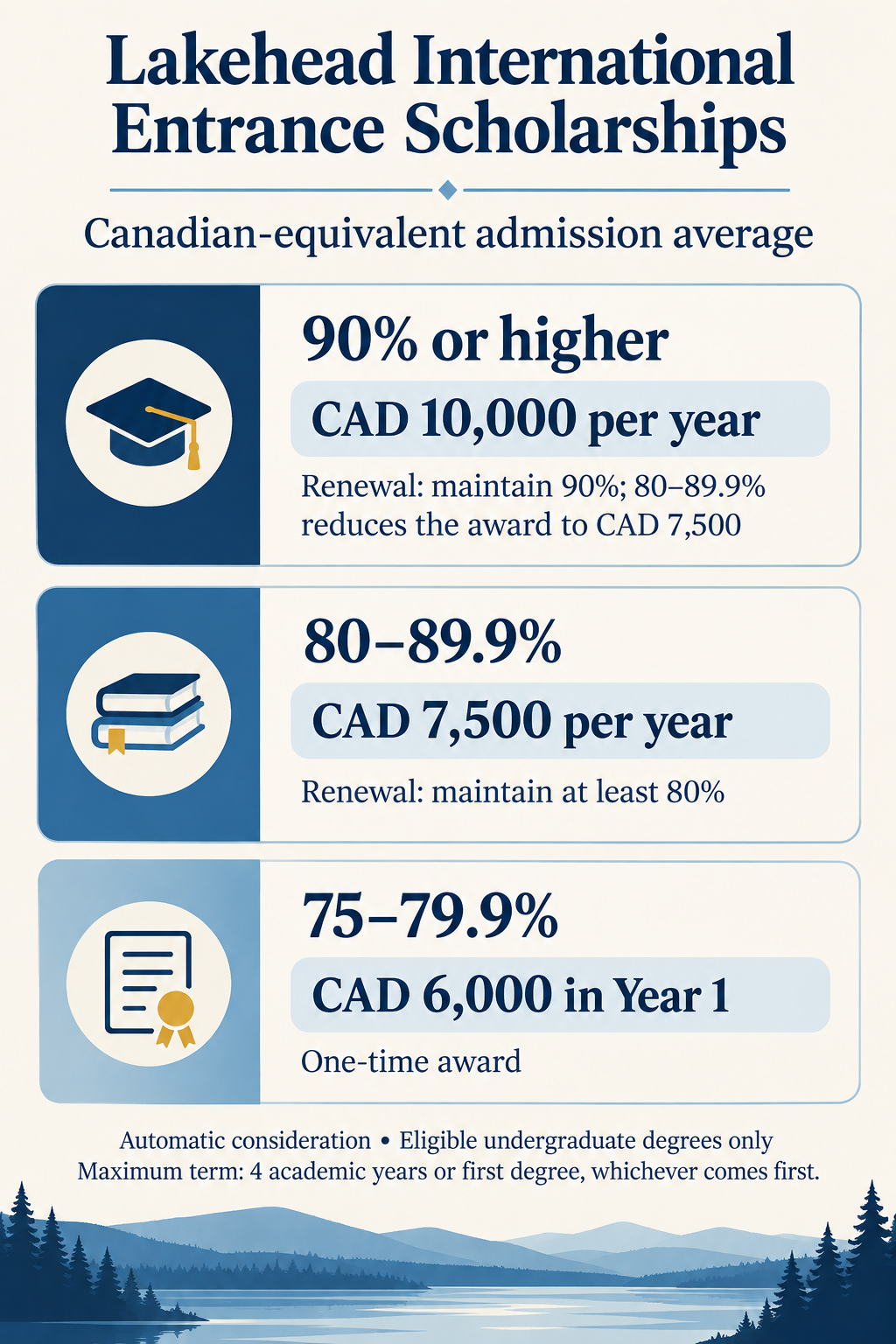
The official international scholarship grid publishes three tiers:
- 90% or above: CAD 10,000 annually, up to CAD 40,000.
- 80–89.9%: CAD 7,500 annually, up to CAD 30,000.
- 75–79.9%: CAD 6,000 once.
This is tuition assistance, not a promise to cover your full study budget. Plan separately for accommodation, food, insurance, transport and any preparatory English study.
Scholarship duration
- Eligible bachelor’s degrees: maximum four academic years or completion of the first degree, whichever comes first.
- The top tier renews at 90%; an 80–89.9% university average reduces subsequent annual awards to CAD 7,500.
- The middle tier renews at 80%.
- The CAD 6,000 tier does not renew.
Check the conditions attached to your own award for course-load and payment rules. Transfer credit can change your remaining study plan; do not assume the headline maximum equals your personal entitlement.
Scholarship requirements
Scholarship consideration uses your admission assessment. Complete the academic record so the university can establish your qualification and grades correctly.
- Meet the published citizenship, entry-route and degree conditions.
- Reach the relevant Canadian-equivalent admission average.
- Satisfy admission conditions and any applicable English requirement.
- Maintain the academic conditions for renewal.
Admission requirements by degree
Bachelor’s degrees
- Complete an academic secondary-school qualification or recognized equivalent.
- Meet the chosen program’s prerequisite subjects.
- Lakehead’s general international undergraduate admission guidance specifies at least a 70% Canadian-equivalent overall final average; competitive programs may require more.
- Transfer applicants must provide their postsecondary records for assessment.
The English-language requirements generally accept Academic IELTS 6.5 with no component below 6.0. Nursing has higher requirements, including IELTS 7.0 overall, with listening and reading at least 6.5 and speaking and writing at least 7.0.
Other accepted tests and approved education-based exemptions are available. If you qualify academically but need English preparation, Lakehead may consider conditional admission through its Academic English Program; the entrance award cannot pay that program’s tuition.
Application instructions
Step 1: Compare programs and entry routes
- Check the curriculum, campus and credential length.
- Review country-specific academic requirements and prerequisite subjects.
- Transfer applicants should ask how previous credits affect their entry year.
Step 2: Submit your admission application
- Use the undergraduate application route linked from Lakehead’s official application instructions.
- Create the required applicant account, enter your education history and pay the applicable application fee.
- Retain your application reference and confirmation.
Step 3: Complete the document record
- Provide academic and language records requested for your application.
- Arrange final official transcripts through the issuing institution.
- Supply additional assessments or creative materials where the program requires them.
Step 4: Review the decision and award
- Monitor your Lakehead applicant account and email.
- Read the offer, outstanding conditions and scholarship assessment together.
- Ask admissions to resolve any mismatch in your academic record before accepting a funding assumption.
Step 5: Accept and prepare to enroll
- Follow the acceptance instructions in your admission package.
- Complete the applicable attestation-letter, study authorization, registration and orientation steps supplied by the university.
- Build a budget using the confirmed award and remaining costs.
Documents required for registration
- Official academic transcripts.
- English-language evidence, where applicable.
- Course descriptions for transfer applicants.
- Nursing-transfer consent form and reference letter, where applicable.
- Program-specific supplementary materials, where requested.
Important tips
The following are application and study-planning suggestions:
- Choose a program for its curriculum and career fit.
- Compare campus living costs before committing.
- Check how Lakehead converts your grading system.
- Confirm the exact credential length.
- Keep your name consistent across records.
- Arrange official documents with your school early.
- Use a personal checklist for outstanding conditions.
- Ask about transfer credit before planning your course load.
- Set an academic plan that supports renewal.
- Keep an emergency budget beyond the scholarship.
Use the admission letter as the starting point for your funding plan. A suitable degree, complete records and a realistic budget will help you make a confident decision about studying at Lakehead.
Frequently asked questions
Do I need to submit a separate scholarship form?
No. Eligible international undergraduate applicants are considered automatically.
Can an admission offer still have conditions?
Yes. Unofficial transcripts may support a conditional decision, but final official records are required before studies begin.
Is the standard IELTS score enough for every program?
No. Nursing and certain other professional programs have higher language requirements. Use the rule for your exact program.
Does this guide describe master’s or doctoral funding?
No. Lakehead publishes separate graduate funding arrangements, including assistantships and supervisor-awarded research support. Those are not the undergraduate entrance award.