The Sogang University Scholarship name covers several tuition awards rather than one universal package. International undergraduate, graduate, and Graduate School of International Studies applicants encounter different benefits, selection standards, language rules, and renewal conditions.
Applicants should use the admission guide for their exact degree and intake because Sogang assigns many awards during admission review. Funding can range from a partial first-semester tuition reduction to multi-semester full tuition, subject to the stated academic conditions.
Key Facts
- Institution: Sogang University in Seoul, Republic of Korea.
- Main undergraduate routes: Admission, Global Emerging, Language Excellence, and KLEC scholarships.
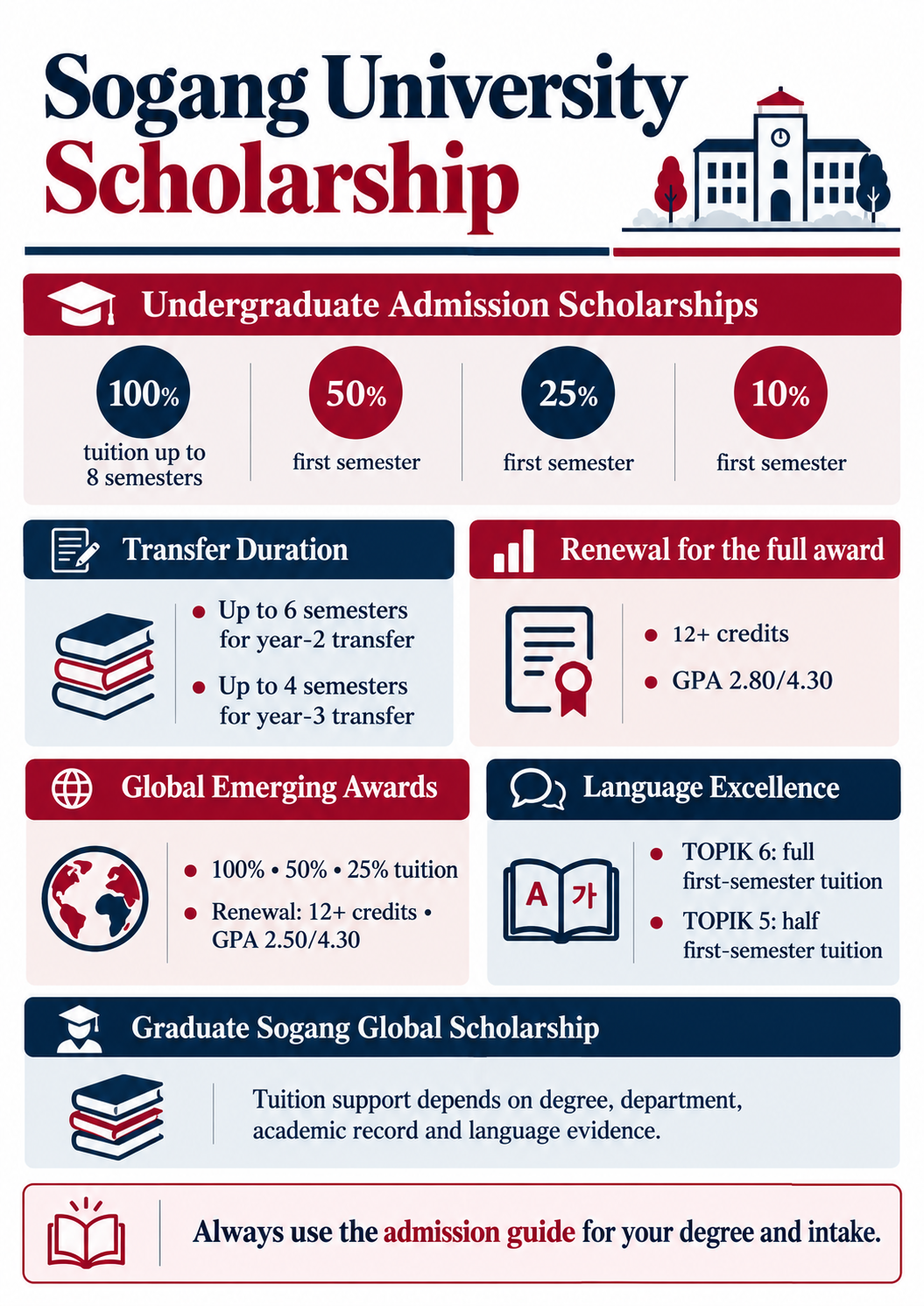
- Undergraduate Admission Scholarship I: full tuition for up to eight semesters.
- Other undergraduate admission levels: 50%, 25%, or 10% of first-semester tuition.
- Global Emerging levels: full, half, or 25% tuition for the standard scholarship period.
- Language Excellence awards: full or half tuition for the first semester based on verified Korean proficiency.
- Graduate route: Sogang Global Fellowship and school-specific awards.
- GSIS route: 100%, 75%, 50%, or 25% tuition reduction.
- Selection: academic record, admission evaluation, language evidence, financial circumstances, department recommendation, or school-specific review.
- Renewal: only the awards described as continuing can extend beyond the first semester, subject to credits and GPA.
University Overview
Sogang University is a private university in Seoul with undergraduate and graduate education across humanities, social sciences, business, communication, economics, natural sciences, engineering, integrated knowledge, and interdisciplinary fields. Its international admission system separates undergraduate, general graduate, and specialist graduate-school routes.
The undergraduate programme normally lasts four years, with transfer entry available at later stages when applicants meet the academic conditions. Instruction can involve Korean and English, but the language profile varies by track and major.
Graduate applicants apply to the relevant graduate school or department. Scholarship percentages and continuation rules can differ between the General Graduate School, the Graduate School of International Studies, and professional programmes, so applicants should not transfer one school’s benefit to another.
Scholarship Overview
- Admission Scholarship I targets the strongest international undergraduate admission results and can cover full tuition for the standard scholarship period.
- Admission Scholarships II, III, and IV provide 50%, 25%, and 10% tuition reductions for the first semester.
- Global Emerging Scholarships consider financial circumstances and academic performance, with full, half, or quarter tuition support.
- Language Excellence Scholarships reward qualifying TOPIK or Sogang Korean Language Education Center achievement.
- Continuing international undergraduate scholarships can provide full, two-thirds, one-third, or one-sixth tuition support.
- The General Graduate School publishes Sogang Global Fellowship categories based on field, language evidence, recommendation, and academic standing.
- Sogang GSIS assigns A, B, C, or D tuition reductions through admission review and later academic performance.
- Scholarship selection remains competitive and may depend on the available budget even when an applicant meets minimum conditions.
The university’s official graduate scholarship directory lists the fellowship levels for the General Graduate School, GSIS, and selected professional schools.
Eligible Majors
Undergraduate admission scholarships apply across the international admission programmes covered by the controlling guide. Sogang identifies 27 departments within nine schools, while graduate awards are tied to the department and graduate school that admits the student.
- Humanities
- Social sciences
- Economics
- Business administration
- Communication
- Natural sciences
- Engineering
- Integrated knowledge
- International studies
- Interdisciplinary and professional programmes listed by the relevant school
Applicants must confirm that the selected major is open to international admission and uses the scholarship rules described in that programme’s guide. A GSIS award, for example, does not automatically fund a student admitted to another graduate school.
Target Groups
- International freshmen and transfer applicants whose applications rank highly in undergraduate admission review.
- International undergraduate applicants whose academic performance and financial circumstances support Global Emerging consideration.
- Applicants with qualifying TOPIK or Sogang KLEC results.
- Enrolled international undergraduates with strong academic performance.
- Enrolled international undergraduates facing financial difficulty or showing significant potential.
- International master’s, doctoral, and combined-degree applicants in eligible graduate departments.
- GSIS applicants evaluated competitively for tuition reductions.
- Students recommended by a department when the scholarship category requires formal nomination.
Benefits
- Full undergraduate tuition for up to eight semesters under Admission Scholarship I.
- Half, quarter, or 10% undergraduate tuition for the first semester under lower admission tiers.
- Full, half, or quarter tuition for the stated Global Emerging scholarship period.
- Full or half first-semester tuition under Language Excellence awards.
- One-quarter first-semester tuition through the Sogang KLEC Scholarship.
- Full, two-thirds, one-third, or one-sixth tuition for selected enrolled international undergraduates.
- Graduate tuition support through Sogang Global Fellowship levels.
- GSIS tuition reductions of 100%, 75%, 50%, or 25%.
These are tuition benefits. The university does not present every Sogang award as including housing, airfare, insurance, books, or a living stipend. Applicants should budget separately unless the written award notice confirms another benefit.
Duration and Renewal by Degree
Undergraduate freshman. Admission Scholarship I and Global Emerging awards can continue for up to eight semesters. Admission Scholarships II–IV and Language Excellence awards apply only to the first semester.
Undergraduate transfer. A continuing full or Global Emerging award can cover up to six semesters for second-year transfer entry or four semesters for third-year transfer entry.
General master’s and doctoral programmes. The current graduate guidance describes Sogang Global Scholarship support for up to four semesters for master’s and doctoral programmes and up to eight semesters for an integrated programme, subject to the applicable rules.
GSIS master’s and doctoral programmes. The first-semester award is assigned through admission review. Later support is reassessed from the preceding semester’s credits and GPA, so the initial percentage is not guaranteed for the entire programme.
Scholarship Requirements
- Apply through the international admission route for the selected degree and department.
- Meet the nationality and educational-background rules in the relevant admission guide.
- Submit the required Korean or English proficiency evidence for the chosen track.
- For undergraduate Admission Scholarship I renewal, complete at least 12 credits and maintain a GPA of at least 2.80/4.30.
- For Global Emerging renewal, complete at least 12 credits and maintain a GPA of at least 2.50/4.30.
- For GSIS continuation, complete at least nine credits and meet the published master’s or doctoral GPA threshold.
- Maintain foreign-student eligibility when the scholarship requires it.
- Satisfy department recommendation, financial review, or language-score conditions where the award category requires them.
Admission Requirements by Degree
Undergraduate Freshman Requirements
International freshman applicants generally need foreign-student eligibility under the guide, completion or expected completion of secondary school, and the required Korean- or English-track language evidence. The English track standard published by Sogang includes IELTS 5.5, TOEFL iBT 71, or TEPS 600.
Undergraduate Transfer Requirements
Second-year transfer applicants normally need at least one completed year in a four-year bachelor’s programme or an eligible college credential. Third-year transfer applicants normally need at least two completed years or the specified equivalent, together with the track’s language evidence.
Master’s Degree Requirements
Applicants need a recognized bachelor’s degree or expected graduation, official transcripts, the documents specified by the department, and the required language evidence. GSIS also requires its current application materials and evaluates academic preparation for the selected programme.
Doctoral and Integrated Degree Requirements
Doctoral applicants need a qualifying master’s degree, while integrated-degree applicants follow the prior-degree rule in the graduate guide. Departments may require research preparation, a study plan, recommendations, an interview, or additional subject evidence.
Application Steps
Step 1: Choose the Degree and Department
Confirm the study level, major, language track, and responsible admission office before collecting documents.
Step 2: Read the Controlling Admission Guide
Use the guide for the exact intake because it defines eligible applicants, language scores, document authentication, scholarship review, and post-admission conditions.
Step 3: Prepare Academic and Identity Records
Collect graduation evidence, transcripts, passport copies, nationality or family records, and any required certified translations or authentication.
Step 4: Secure Language Evidence
Submit a valid TOPIK, Sogang KLEC, TOEFL, IELTS, TEPS, TOEIC, or other score only when the chosen guide accepts it.
Step 5: Complete the Online Admission Application
Enter the applicant’s legal identity, education, programme choice, and contact details exactly as supported by the documents.
Step 6: Upload and Submit the Required Materials
Follow the university’s format for scans, translations, recommendations, study plans, and school-specific supplements.
Step 7: Complete Any Screening
Attend the interview or other evaluation if the department or graduate school includes one in the admission process.
Step 8: Review the Admission and Scholarship Decision
Check the award percentage, duration, credit requirement, GPA condition, and any language obligation in the official decision.
Step 9: Maintain Eligibility After Enrolment
Register for the required credits, monitor grades, and provide any later language score or confirmation requested by the school.
Required Documents
- Online admission application
- Applicant photograph
- Passport copy
- Parents’ passport copies
- Nationality certificate
- Family relationship certificate
- Secondary-school graduation certificate
- Bachelor’s degree certificate
- Master’s degree certificate
- Expected graduation certificate
- Official academic transcripts
- TOPIK score report
- English-language score report
- Study plan
- Personal statement
- Recommendation letter
- Financial support statement
- Bank balance certificate
- Apostille certificate
- Consular authentication
- Notarized translation
Practical Tips
The following suggestions are application advice rather than additional official scholarship rules.
- Use the guide issued by the admission office responsible for the selected programme.
- Do not combine undergraduate, General Graduate School, and GSIS scholarship percentages.
- Match the English or Korean score to the accepted test list for the chosen track.
- Arrange apostille, consular authentication, and translation before the document-submission stage.
- Keep legal names and birth dates identical across the portal, passport, and certificates.
- Explain academic preparation in relation to the selected department rather than using a generic statement.
- Confirm whether scholarship review is automatic with admission or needs an additional form.
- Plan for tuition and living costs that remain after the confirmed reduction.
- Track credit and GPA conditions from the first semester of enrolment.
- Save the submitted application, payment record, document receipt, admission decision, and scholarship notice.
Conclusion
The Sogang University Scholarship system can provide substantial tuition support, but the correct benefit depends on degree level, school, admission ranking, language evidence, and later academic performance. Applicants should treat the official admission guide and written award decision as the definitive rules for their programme.
FAQ
Is there one Sogang University Scholarship for every student?
No. Sogang publishes separate undergraduate admission awards, continuing-student awards, graduate fellowships, and school-specific scholarships.
Can an undergraduate receive full tuition?
Yes. Admission Scholarship I and Global Emerging Scholarship I can provide full tuition for the stated scholarship period when the student is selected and maintains the required conditions.
Is every undergraduate award renewable?
No. Admission Scholarships II–IV and Language Excellence awards are first-semester reductions. Only awards described as continuing can extend across later semesters.
What GPA maintains Admission Scholarship I?
The published condition is at least 12 credits in the preceding semester and a GPA of at least 2.80 on Sogang’s 4.30 scale.
What language scores support undergraduate English-track admission?
The published guide lists IELTS 5.5, TOEFL iBT 71, or TEPS 600 for the English track. Applicants must confirm the current guide for their intake.
How much can a GSIS scholarship cover?
GSIS publishes tuition reductions of 100%, 75%, 50%, or 25%. The first-semester level follows admission review, and later support is reassessed.
Is the first GSIS award guaranteed for later semesters?
No. GSIS states that the initial award is not automatically guaranteed and that later selection depends on credits, GPA, relative standing, and the available scholarship budget.
Do scholarships include housing and airfare?
The Sogang institutional awards described here are tuition reductions. Housing, airfare, insurance, and living costs are not included unless a separate written award states otherwise.
Can transfer students receive multi-semester support?
Yes, when selected for a continuing award. The maximum period is shorter than for freshmen: up to six semesters for second-year transfer and four for third-year transfer.
Where should an applicant verify the scholarship?
Use Sogang’s official international admission guide for the degree and intake, the relevant graduate-school scholarship page, and the scholarship terms included with the admission result.