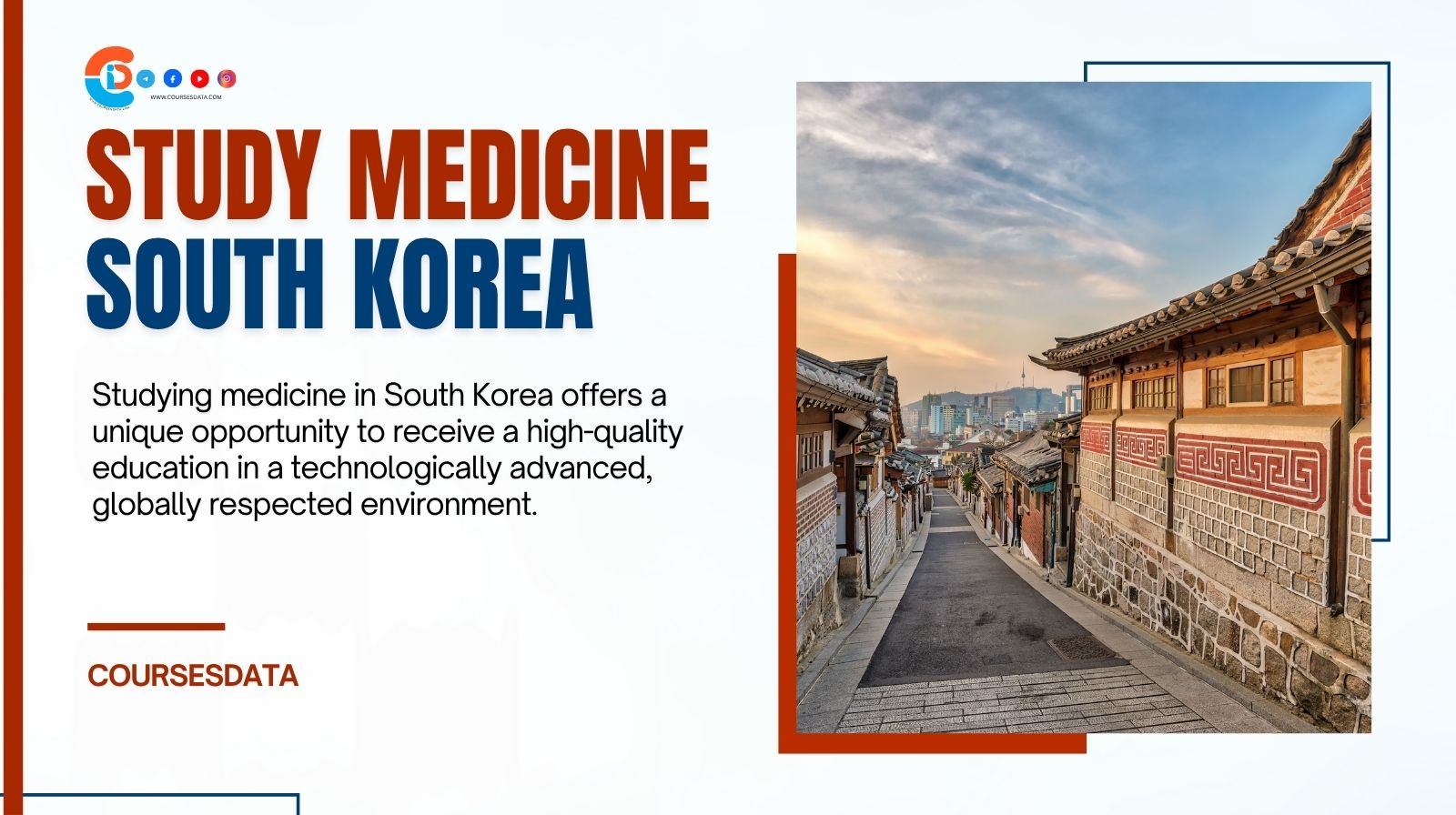
Studying medicine in South Korea can give international students access to research-focused universities, major teaching hospitals, advanced medical technology, and a structured medical education system.
However, students who want to Study Medicine in South Korea need to understand that admission is highly competitive, Korean-language ability can be essential, and international admission rules vary considerably between medical schools.
How Medical Education Works in South Korea
Medical education in South Korea is different from a standard four-year undergraduate degree.
The Korean higher-education system generally classifies medicine as a specialized field requiring six years of university education.
The structure may include pre-medical education followed by the professional medical curriculum.
Students gradually move from basic sciences into clinical subjects and hospital-based training.
A medical curriculum can include:
- Biology and chemistry
- Anatomy
- Physiology
- Biochemistry
- Microbiology
- Immunology
- Pharmacology
- Pathology
- Internal medicine
- Surgery
- Pediatrics
- Psychiatry
- Obstetrics and gynecology
- Clinical clerkships
The Korean government’s official Study in Korea portal explains the country’s higher-education system and provides information for international students about universities, admission, tuition, scholarships, visas, and living in Korea.
Medical education is academically demanding because students must develop both scientific knowledge and practical clinical skills.
During the later stages of the program, students increasingly work in teaching hospitals and interact with healthcare professionals and patients.
International students therefore need to consider more than university admission.
They must also prepare for Korean-language communication in a clinical environment.
Is Medicine Open to International Students?
International students can apply to certain medical schools in South Korea, but applicants should not assume that every university offering medicine accepts international applicants.
Universities may have separate international admission categories.
Eligibility can depend on factors such as:
- Applicant nationality
- Parents’ nationality
- Previous education
- Country where schooling was completed
- Academic performance
- Korean proficiency
- Medical-school-specific requirements
The general international admission route of a university does not automatically mean every department is available.
Medicine, dentistry, pharmacy, nursing, and other professional programs may have additional restrictions.
Before adding a university to your application list, confirm:
- Medicine is available under international admission
- Your educational qualification is accepted
- The required language certificate
- Whether an interview is required
- Whether additional science requirements apply
- Which admission intake accepts medicine
This verification should be completed before paying application or document-processing fees.
Admission Requirements to Study Medicine in South Korea
There is no single admission standard used by every Korean medical school.
Each university establishes its own requirements, and medicine normally has significantly stronger expectations than many other undergraduate programs.
International applicants will generally need a recognized secondary-school qualification.
Academic preparation is particularly important in:
- Biology
- Chemistry
- Mathematics
- Physics
- General science
- Academic language skills
Strong marks in science subjects can make an applicant more competitive.
Universities may examine the student’s entire secondary-school record rather than considering only the final examination result.
Applicants may also need to demonstrate that their education is equivalent to the schooling required for university admission in Korea.
A typical application may involve:
- High school diploma
- Complete academic transcripts
- Passport
- Proof of nationality
- Parents’ nationality documents
- Family relationship documents
- Korean-language certificate
- Personal statement
- Study plan
- Recommendation letters where requested
- Additional academic certificates
Some universities may conduct an interview after reviewing the submitted documents.
International Student Eligibility
International admission categories commonly distinguish students according to nationality and educational history.
For example, an international route may be available to:
- Students whose parents are both non-Korean nationals
- Students who completed their full primary and secondary education outside Korea
However, definitions differ between institutions.
Dual nationality, previous Korean nationality, parental nationality, or studying part of your education in Korea may affect the admission category available to you.
Applicants should therefore read the university’s international admission guide carefully rather than relying on general information from student forums.
Korean Language Requirements for Medical Students
Language preparation is one of the most important parts of planning to Study Medicine in South Korea.
Students should not assume that medical degrees are completely taught in English simply because a university offers other English-taught programs.
Medical students eventually need to communicate with:
- Patients
- Doctors
- Nurses
- Clinical instructors
- Hospital employees
- Other medical students
They may need Korean when taking medical histories, discussing symptoms, attending rounds, reading hospital information, communicating during examinations, and completing clinical training.
Universities can therefore require a much higher Korean level for medicine than for ordinary undergraduate programs.
Yonsei University provides a useful example.
According to the university’s official international admissions information, its College of Medicine is a Korean-language degree program.
Its admissions office has stated that international applicants to medicine must present TOPIK Level 5 or an accepted equivalent qualification and attend a face-to-face interview.
This illustrates why students should check the requirements of each medical school individually.
A practical Korean preparation plan should include:
- General Korean vocabulary
- Academic Korean
- Scientific terminology
- Medical terminology
- Listening comprehension
- Formal communication
- Patient communication
- Reading academic materials
- Speaking under pressure
- Medical interview practice
Students starting from beginner level should allow substantial time to build proficiency.
Reaching an examination level is only part of the challenge.
Students must eventually be able to understand patients speaking naturally in clinical environments.
Medical Universities to Research in South Korea
South Korea has many established medical schools associated with large university hospitals.
International students researching medical education may encounter institutions such as:
- Seoul National University
- Yonsei University
- Korea University
- Sungkyunkwan University
- University of Ulsan
- Hanyang University
- Kyung Hee University
- Ewha Womans University
- Pusan National University
- Kyungpook National University
These names should be treated as universities to research, not as a guaranteed list of international medicine options.
International admission availability can change by university, department, and admission cycle.
For every university, create a checklist containing:
- International medicine availability
- Academic requirements
- Korean requirement
- Accepted language certificates
- Required science subjects
- Interview requirement
- Tuition fees
- Scholarship availability
- Application documents
- Clinical training language
This is much more useful than simply selecting universities according to rankings.
How to Choose the Right Medical School
University reputation matters, but it should not be the only factor.
International students should examine whether the medical school actually fits their circumstances.
Compare:
- Admission eligibility
- Language requirements
- Curriculum structure
- Teaching hospital facilities
- Research opportunities
- Tuition costs
- Location
- Accommodation
- Scholarships
- Degree recognition
Location can also affect living expenses.
A university in Seoul may provide access to a very large metropolitan healthcare environment, while universities elsewhere in Korea may offer different costs and campus experiences.
The best university is one where the student meets the admission requirements and can realistically complete the entire medical program.
Documents Needed for a Medical School Application
Medical applications can involve extensive documentation.
International students should start collecting documents well before the university submission period.
Common documents can include:
- Completed application form
- Passport copy
- Passport photographs
- High school graduation certificate
- Academic transcripts
- Korean-language certificate
- Personal statement
- Study plan
- Recommendation letter
- Nationality documentation
- Family relationship documentation
Additional authentication may be required for foreign documents.
Depending on the country of issue and university rules, students may need:
- Apostille authentication
- Consular verification
- Certified translations
- Original documents
- Officially sealed transcripts
Never assume that uploading a scanned diploma is sufficient.
Universities can reject an otherwise strong application if the required authentication format has not been followed.
Personal Statement and Study Plan
The personal statement should explain the applicant’s academic motivation clearly.
Avoid generic statements such as wanting to become a doctor only because medicine is prestigious.
Instead, explain:
- Why you chose medicine
- Why you are academically prepared
- Why South Korea fits your study goals
- Why you selected the university
- How you prepared for Korean-language study
- Your long-term professional direction
Applicants should only describe activities and achievements they can document or discuss confidently.
An interview panel may ask detailed questions about information included in the application.
Tuition Fees and Living Costs
Medicine is generally more expensive than many other academic disciplines in South Korea.
The Korean government’s official Study in Korea cost guide reports average annual tuition for medicine at approximately KRW 9.84 million.
This is a national average rather than the tuition of every medical school.
Actual fees vary according to:
- University
- Public or private status
- Medical school
- Semester
- Additional university fees
Students must also budget for living expenses.
| Expense | What to Budget For |
|---|---|
| Tuition | Medical-school tuition charged by the university |
| Housing | Dormitory or private accommodation |
| Food | Groceries and university meals |
| Transportation | Subway, bus and local travel |
| Insurance | Required health insurance costs |
| Books | Medical textbooks and digital resources |
| Clinical items | Clothing and equipment required by the program |
| Language study | Korean courses and examination preparation |
| Documents | Authentication, translation and visa expenses |
| Personal expenses | Phone, clothing and daily needs |
The government’s international-student information estimates typical living expenses at around KRW 750,000 to KRW 1,000,000 per month.
Actual spending can be higher depending on location and lifestyle.
A student’s monthly budget may include:
- Dormitory fees
- Meals
- Transportation
- Mobile service
- Study supplies
- Health expenses
- Personal items
- Recreation
Students should calculate finances for several years rather than planning only for the first semester.
Medicine requires substantial study time, so depending heavily on part-time employment to finance the degree is not a strong financial strategy.
Scholarships for International Medical Students
Scholarships are available to international students in South Korea, but medical students need to check eligibility carefully.
A scholarship advertised for international undergraduate students may exclude regulated professional programs.
Possible funding sources include:
- University merit scholarships
- International student scholarships
- Tuition reductions
- Academic excellence awards
- Private foundations
- Departmental funding
- Need-based university support
Some scholarships may cover only part of tuition.
Others may have continuing requirements such as maintaining a minimum academic result.
Before adding scholarship funding to your budget, confirm:
- Medicine is an eligible major
- Your nationality is eligible
- The scholarship applies to international students
- Tuition coverage
- Living allowance, if any
- Duration of funding
- Academic renewal requirements
- Language conditions
Do not assume that admission automatically brings a scholarship.
Students should ideally prepare a financial plan that remains realistic even if they do not receive full funding.
What Medical School Life Is Like
The first phase of medical education is heavily academic.
Students build the scientific foundation necessary for later clinical subjects.
Typical early subjects may include:
- Anatomy
- Physiology
- Biochemistry
- Histology
- Genetics
- Microbiology
- Immunology
- Pharmacology
- Pathology
The curriculum then becomes increasingly clinical.
Students begin learning how diseases are identified, evaluated, managed, and discussed in healthcare settings.
Clinical areas may include:
- Internal medicine
- Surgery
- Pediatrics
- Psychiatry
- Neurology
- Emergency medicine
- Family medicine
- Obstetrics and gynecology
Clinical clerkships allow students to observe and participate in hospital-based education under supervision.
International students may find this stage particularly challenging because medical Korean involves much more than textbook vocabulary.
They need to understand:
- Formal medical terminology
- Everyday patient descriptions
- Clinical instructions
- Hospital communication
- Professional etiquette
Maintaining Korean proficiency throughout the program is therefore as important as meeting the initial admission requirement.
Medical Licensing After Graduation
Graduating from a medical school and receiving a diploma does not automatically allow a person to practise medicine independently.
Medical practice is regulated through professional licensing.
Students planning to remain in South Korea must understand the country’s physician licensing pathway and any required national examination.
Those intending to work in another country should investigate that country’s rules before starting the degree.
A graduate may need to complete:
- Degree recognition
- Credential verification
- Medical licensing examinations
- Language examinations
- Clinical training requirements
- Internship requirements
- Residency requirements
- Professional registration
Requirements differ considerably between countries.
For example, a student who wants to return to Germany, the United Kingdom, Canada, the United States, a Gulf country, or another jurisdiction must follow that country’s medical licensing authority.
A Korean medical degree should never be assumed to provide automatic professional recognition abroad.
Before enrolling, ask:
- Is this medical degree recognized in my destination country?
- Will I need additional examinations?
- Are internship requirements different?
- Is additional supervised training required?
- Are there language requirements?
- Can graduates enter residency directly?
Checking these questions before enrollment can prevent major problems after graduation.
Step-by-Step Plan to Apply for Medicine
A structured application strategy can make the process easier.
Step 1: Check Your Academic Background
Review your secondary-school qualification and science subjects.
Strong preparation in biology and chemistry is especially useful.
Your first checklist should include:
- Diploma eligibility
- Biology grades
- Chemistry grades
- Mathematics
- Physics
- Overall academic performance
Step 2: Start Korean Preparation
Language study should begin as early as possible.
Do not wait until after applying.
If a medical school requires advanced TOPIK proficiency, reaching the required level can take substantial preparation.
Step 3: Build a University Shortlist
Select several universities and check medicine separately.
Create a spreadsheet with:
- University
- Medicine availability
- Language requirement
- Admission route
- Interview
- Tuition
- Scholarships
- Required documents
Remove universities where your eligibility cannot be confirmed.
Step 4: Prepare Official Documents
Collect diplomas, transcripts, nationality records, and family documents.
Allow enough time for:
- Translation
- Certification
- Apostille
- Consular authentication
- International delivery
Step 5: Prepare for the Interview
If the university conducts an interview, practice discussing both academic and personal topics.
Useful areas include:
- Motivation for medicine
- Science knowledge
- Ethical situations
- Communication skills
- Reasons for studying in Korea
- Korean-language ability
- Long-term career plans
Step 6: Calculate the Full Cost
Estimate tuition and living costs for the entire course.
Your budget should include an emergency reserve and possible tuition increases.
Step 7: Check Degree Recognition
Contact the medical regulator in the country where you hope to practise.
Do this before accepting your university place.
Is Studying Medicine in South Korea Right for You?
South Korea can be a suitable destination for a student who has strong academic results, is prepared to learn Korean to an advanced level, and understands the demands of a long professional degree.
It may not be the best choice for someone who wants a simple English-only medical program.
A strong candidate should be prepared for:
- Competitive admission
- Advanced science study
- Korean-language learning
- A long academic program
- Intensive examinations
- Clinical training
- High tuition and living costs
- Professional licensing after graduation
Students should also be comfortable adapting to a new educational and cultural environment.
Studying medicine abroad is a major academic and financial commitment.
For this reason, admission, language, financing, and degree recognition should all be confirmed before enrollment rather than investigated separately after the student has already moved to Korea.
Conclusion
To Study Medicine in South Korea, international students need strong science preparation, excellent academic results, sufficient Korean-language ability, careful financial planning, and a clear understanding of medical licensing.
The most important step is to verify each medical school’s international admission requirements directly, because medicine can have stricter rules than ordinary university programs.
Students who research eligibility, language requirements, costs, and future degree recognition before applying can make a much more informed decision about whether South Korea is the right destination for their medical education.
Frequently Asked Questions
Can international students study medicine in South Korea?
Yes.
Certain Korean universities provide admission routes that can include international applicants to medicine.
However, international availability is not identical at every university, so applicants must check the specific medical school’s admissions rules.
Is medicine taught in English in South Korea?
Students should not expect medical education to be completely in English.
Korean can be especially important during clinical education because students interact with patients, doctors, nurses, and hospital staff.
Do I need TOPIK to study medicine in South Korea?
The requirement depends on the university.
Some medical schools require advanced Korean proficiency.
Yonsei University, for example, requires international applicants to medicine to provide TOPIK Level 5 or an accepted equivalent qualification.
How long does it take to study medicine in South Korea?
Medicine is generally structured as a six-year specialized university program.
The exact division between pre-medical, medical, and clinical education depends on the university.
Can I apply after high school?
International students may apply through undergraduate admission routes where medicine is available.
Applicants need an accepted secondary-school qualification and must satisfy the medical school’s academic, nationality, language, and document requirements.
What subjects should I study before applying?
Biology and chemistry are especially relevant preparation for medical education.
Physics and mathematics can also strengthen a student’s scientific foundation.
How much does medical school cost in South Korea?
Official Korean education information reports average annual tuition for medicine at approximately KRW 9.84 million.
Individual universities may charge more or less, and students must budget separately for housing, food, transportation, insurance, and personal expenses.
Are scholarships available for medicine?
Scholarships may be available through universities or other organizations, but eligibility must be checked carefully.
Some international scholarships exclude medicine or other professional healthcare degrees.
Can I practise medicine in my home country after graduating?
Possibly, but the Korean degree must meet the requirements of your country’s medical regulator.
Graduates may need credential recognition, examinations, supervised training, language tests, or additional registration before practising.
What should I do first if I want to study medicine in South Korea?
Start by identifying universities that actually accept international applicants into medicine.
Then compare their academic eligibility, Korean-language requirements, tuition, application documents, and degree-recognition implications before preparing an application.
This really resonates with me. I’m currently a medical student in South Africa, and the idea of affordable tuition paired with cutting-edge tech is incredibly tempting—our public hospitals here often struggle with outdated equipment. I’m curious, though: how common is it for international students to get clinical placements in those world-class hospitals, and do they offer enough English support during hands-on training? Your point about learning Korean is a big factor, too—I’ve heard the language barrier can be tough even with bilingual programs.
I’m actually a South African who went through this exact process, so I feel your pain about the equipment gap back home. Getting clinical placements is doable if you apply early, but the English support during hands-on training is patchy—lectures are fine, but bedside teaching with patients is almost entirely in Korean. I’d strongly recommend starting medical Korean classes before you even arrive, because even the bilingual programs expect you to pick up the language quickly on the ward.
Mate, Thandi’s got a solid point there—those clinical placements are the real deal. From what I’ve seen, a lot of the top unis like SNU or Yonsei do reserve spots for international students at their affiliated hospitals, but you’re right to wonder about the English support during hands-on training; it’s often better in lectures than on the ward. Honestly, I reckon picking up some Korean beforehand would be a smart move, even if it’s just medical terms—makes a huge difference when you’re dealing with real patients.
You’re spot on about the language gap between lectures and real patient care—I’ve heard the same from friends at SNU who said they felt totally prepared for exams but completely lost during bedside rounds. I’d add that even learning basic polite phrases like “어디가 아프세요?” made a huge difference for them in building trust with patients during their first rotations. It’s definitely one of those things where a little prep goes a long way before you step onto the ward.
Yeah, Thandi’s question about clinical placements is exactly what I’d be worried about too. I’ve done some digging, and it seems like the English support during rotations is patchy at best—lectures are fine, but real patient interactions lean heavily on Korean. If I were in your shoes, I’d budget time for a solid medical Korean course before even applying, just to avoid being that lost intern who can’t ask a patient where it hurts.
Oh, Thandi’s comment really hit home for me—I’ve been looking into SNU for a while now, and the whole clinical placement thing is my biggest worry too. From what I gathered talking to a current international student there, the English support is solid during lectures but pretty inconsistent on the ward, especially if you’re dealing with elderly patients who don’t speak a word of English. Did you come across any specific programs that offer a structured medical Korean course as part of the curriculum, or is it all on us to figure out beforehand?
Good question. A few universities, like Yonsei and Catholic University of Korea, offer medical Korean language courses integrated into their international programs, but they’re usually optional and not intensive enough for full clinical fluency. Most international students end up taking additional private lessons or enrolling in a standalone Korean language institute before starting rotations. Bottom line: don’t expect the curriculum to carry you—plan to put in serious work on the language side yourself.
Yeah, that lines up with what I’ve heard from a couple of friends who went through it. They all said the same thing—those optional language courses are a good start, but nowhere near enough to handle real patient conversations. If you’re serious about clinical work, you really have to treat Korean like a core subject from day one.
This is such a helpful discussion, and it’s making me rethink my own plans a bit. I had been assuming the English support would carry me through the clinical years, but hearing how much it drops off on the ward is a real wake-up call—especially since I’d be nervous enough without a language barrier. For those who’ve already gone through it, did you find that most hospitals or universities offer any kind of language buddy system or translator for international students during rotations, or are you truly on your own once you step into the patient room?
This whole thread hits close to home—I’m a South African too, and I’ve been looking at Yonsei for a while. The thing that snags me is the tuition: while it’s cheaper than the US or UK, factoring in living costs in Seoul plus private Korean lessons on top of the fees still feels steep for a tight budget. Has anyone here managed to land a decent scholarship or part-time gig that actually covers the language prep without burning through savings?