
Have you ever wondered what the DELE Spanish exam really measures and how it can boost your academic or professional career? The Spanish Language Proficiency Test (DELE) is a globally recognized certification proving your command of the Spanish language, essential for students, professionals, and anyone seeking opportunities in Spanish-speaking countries.
What Is the DELE Exam?
The DELE exam, short for Diplomas de Español como Lengua Extranjera, is an official accreditation of Spanish language proficiency issued by the Instituto Cervantes on behalf of Spain’s Ministry of Education. It certifies a candidate’s ability to understand and communicate effectively in Spanish within academic, professional, or social environments.
- Conducted by Instituto Cervantes centers worldwide
- Recognized in 100+ countries
- Available at six CEFR levels: A1, A2, B1, B2, C1, C2
- Accepted by universities and employers globally
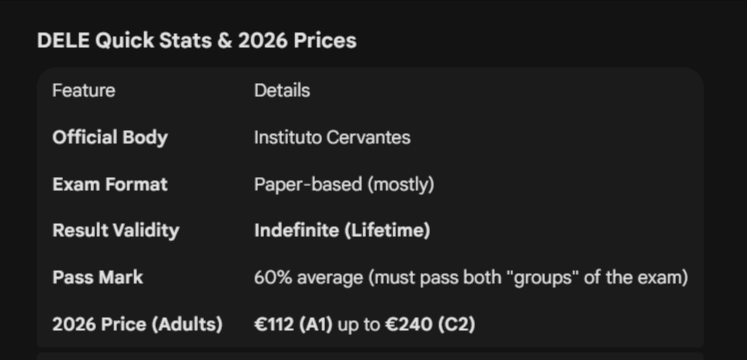
- Valid for life (no expiration)
- Covers reading, writing, listening, and speaking
- Open to all nationalities
- Offered several times a year
- Uses real-life language tasks
- Option to retake individual sections if needed
Why Take the DELE Spanish Test?
Earning a DELE diploma opens academic, professional, and personal doors. It proves your Spanish competency officially and objectively, enabling smoother integration into Spanish-speaking environments and global career opportunities.
- Enhances your academic CV
- Required by many Spanish universities
- Qualifies for Spanish citizenship or residency
- Recognized by multinational companies
- Helps secure bilingual job positions
- Boosts confidence in professional communication
- Strengthens global employability
- Offers a competitive edge in international markets
- Builds deeper cultural understanding
- Validates your true fluency
DELE Exam Structure and Levels
The DELE exam follows strict CEFR (Common European Framework of Reference for Languages) guidelines, ensuring every certificate reflects measurable skills at specific proficiency levels. Each level assesses progressively advanced communication skills.
| Level | Description | Target Candidates |
|---|---|---|
| A1 | Beginner command of everyday expressions | New learners |
| A2 | Basic understanding and simple conversation | Travelers, basic users |
| B1 | Independent speaker with basic comprehension | Students, employees abroad |
| B2 | Advanced independent communication | Professionals, exchange students |
| C1 | Effective operational proficiency | Academic or managerial roles |
| C2 | Mastery of language competence | Translators, educators, linguists |
- All levels contain four sections: reading, writing, listening, and speaking
- Scoring is divided equally among skills
- Passing grade: 60/100 overall
- Some levels include grammar and vocabulary tasks
- Each section scored independently
- Speaking tests often held separately
- Topics cover cultural and real-world contexts
- Tasks simulate authentic communication
- Vocabulary range increases with level
- Listening includes diverse Spanish accents
Registration and Exam Dates
DELE exams are administered worldwide through Instituto Cervantes branches and authorized centers on fixed global dates. Registration opens months in advance to allow preparation and documentation.
- Register online via the Instituto Cervantes website
- Choose your level carefully; no switching allowed mid-process
- Exams held typically in February, April, May, July, September, and November
- Early registration ensures seat availability
- Provide valid ID and passport photo
- Pay exam fees via authorized platform
- Fees vary by level and testing center
- Confirmation email includes test date and location
- Admission ticket required on exam day
- No refunds after registration closes
How to Prepare for the DELE Exam
Preparation strategies depend on your targeted level, but all candidates benefit from consistent immersion and structured study plans focusing on vocabulary, grammar, and comprehension.
- Study authentic Spanish materials
- Watch Spanish TV, films, and podcasts
- Practice sample DELE exams online
- Enroll in Instituto Cervantes preparation courses
- Build thematic vocabulary lists
- Join conversation groups or language exchanges
- Record yourself speaking for analysis
- Use official DELE preparation books
- Simulate exam conditions before test day
- Get feedback from native tutors
Tips for Passing the DELE Exam
Success in the DELE exam depends on balanced preparation—mastering both receptive (reading/listening) and productive (writing/speaking) skills. Attention to detail and time management are crucial.
- Understand the question format well
- Manage time between sections efficiently
- Read instructions carefully before answering
- Avoid leaving blank answers; guess intelligently
- Write clearly with correct grammar and coherence
- Structure written responses logically
- Practice pronunciation and fluency
- Listen to various Spanish accents
- Stay calm during speaking interviews
- Review errors after each mock test
Common Mistakes to Avoid
Many candidates fail sections of the DELE exam because of simple, avoidable errors. Recognizing these pitfalls helps improve performance and confidence.
- Memorizing phrases without understanding
- Ignoring listening practice
- Forgetting to answer all parts of a question
- Writing too briefly or too long
- Mismanaging time on reading section
- Overusing advanced words incorrectly
- Not practicing timed essays
- Speaking too fast or hesitating often
- Ignoring feedback from previous tests
- Neglecting grammar review altogether
How the DELE Is Graded
The DELE grading system ensures objectivity and fairness. Each skill (reading, writing, listening, speaking) carries equal weight, and candidates must achieve a minimum score in both sections to pass.
| Skill Group | Components | Weight |
|---|---|---|
| Group 1 | Reading & Writing | 50% |
| Group 2 | Listening & Speaking | 50% |
| Minimum Required | Each group | 30 points |
- Total score out of 100 points
- Results published within three months
- Certificates issued from Spain
- No expiry date – lifetime validity
- Numeric grade accompanied by qualitative feedback
- Advanced levels emphasize accuracy and nuance
- Evaluations standardized by CEFR criteria
- Oral exams recorded for quality review
- Appeals possible within official deadlines
- Results accessible via official online portal
DELE vs. SIELE: What’s the Difference?
While both DELE and SIELE certify Spanish proficiency, they differ significantly in structure, recognition, and flexibility. DELE remains the most traditional and formally recognized exam globally.
| Feature | DELE | SIELE |
|---|---|---|
| Type | Paper-based | Digital |
| Validity | Lifetime | Two years |
| Scheduling | Fixed dates | Flexible dates |
| Institution | Instituto Cervantes | Instituto Cervantes + partners |
| Assessment | Human evaluated | Automated + human mix |
| Levels | CEFR A1–C2 separate | Single adaptive test |
| Skills | All four tested | Modular structure |
| Use | Academic/professional | Fast proof of proficiency |
| Global Recognition | Very high | Growing rapidly |
| Ideal For | Long-term certification | Quick language check |
- DELE suits academic and official requirements
- SIELE benefits candidates needing rapid validation
- Both complement each other institutionally
- Preparation materials often overlap
- DELE preferred for residency applications
- SIELE ideal for online learners
- Certificates co-endorsed by major universities
- SIELE results arrive faster
- DELE verifies sustained learning
- Both measure true linguistic communication
Frequently Asked Questions
What is the passing score for the DELE exam?
You must obtain at least 30 points in both groups (Reading/Writing and Listening/Speaking) for a total of 60/100 to pass.
How long does the DELE certificate last?
The DELE diploma is permanent. Once earned, it never expires and remains valid worldwide.
Can I take the DELE test online?
Currently, all DELE exams must be taken in person at official test centers. However, registration and results checking occur online.
Is DELE required for Spanish citizenship?
Yes, applicants for Spanish nationality must usually demonstrate A2 DELE proficiency unless they come from a Spanish-speaking country.
How many times can I take the DELE exam?
There are no limits. You can retake the test as many times as needed to achieve your desired level.
When will I receive my results?
Scores are typically available two to three months after taking the test, depending on your testing center.
Can I skip levels?
Yes. Candidates can register for any level they feel competent in; lower-level exams are not prerequisites.
Is DELE recognized by universities?
Absolutely. DELE is accepted by all Spanish universities and many academic institutions worldwide for admission purposes.
Which is better—DELE or SIELE?
It depends on your goal. DELE is lifelong and official, while SIELE is quicker and digital. Both prove Spanish fluency effectively.
What happens if I fail one section?
You must retake the entire level. Partial results cannot be carried forward to the next test session.
Conclusion
The DELE exam remains the gold standard for proving Spanish proficiency worldwide. Whether for work, study, or immigration, this certification officially validates your language competence and connects you to a global Spanish-speaking community.