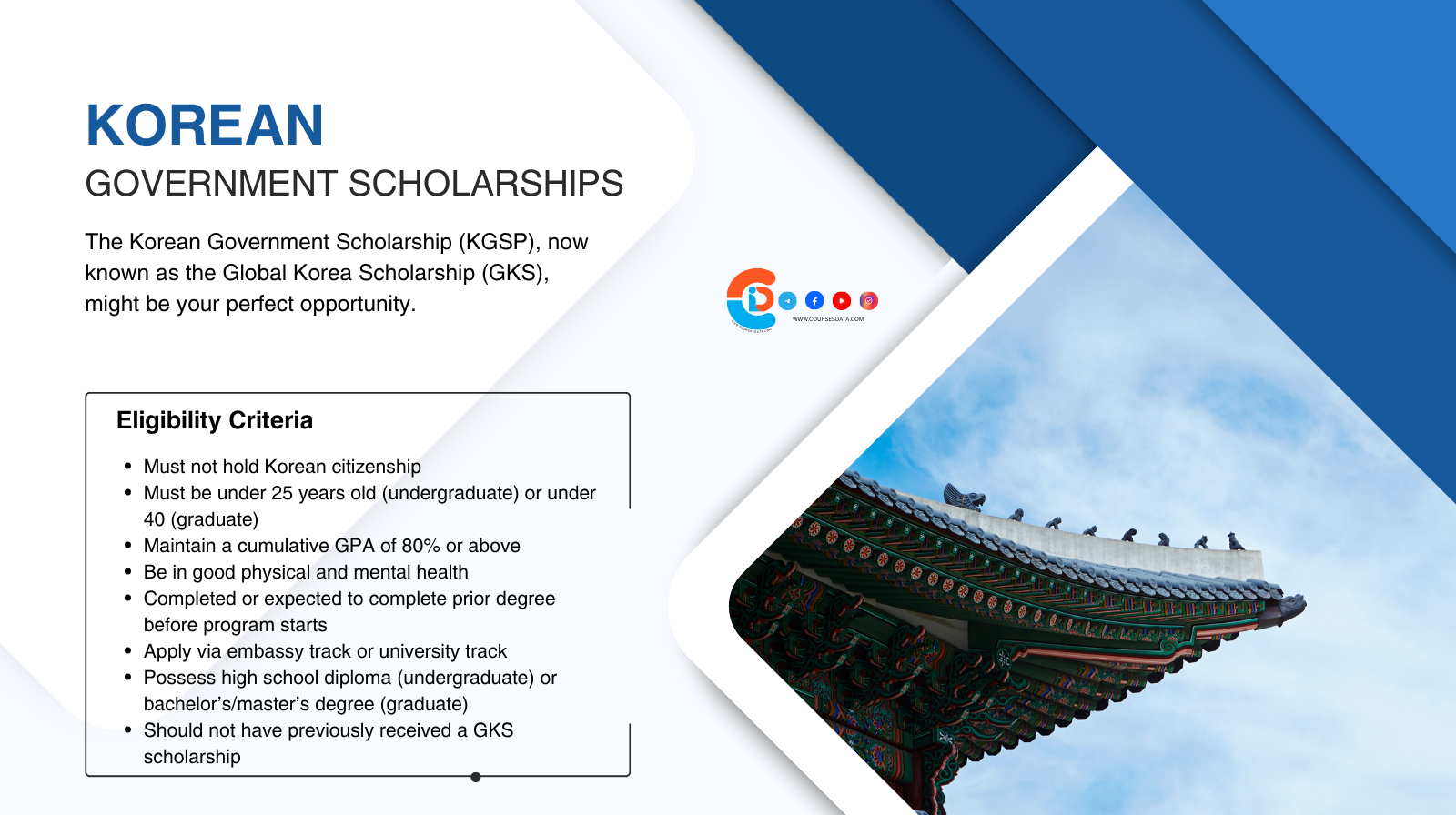
Are you dreaming of studying in South Korea for free while experiencing its vibrant culture and advanced education system? The Korean Government Scholarship (KGSP), now known as the Global Korea Scholarship (GKS), might be your perfect opportunity.
What is the Korean Government Scholarship (GKS)?
The Global Korea Scholarship (GKS) is a prestigious academic funding program sponsored by the South Korean government. It offers international students full financial support to pursue undergraduate or graduate degrees at Korean universities.
Key features of the Korean Government Scholarship:
- Fully funded by the South Korean Ministry of Education
- Covers undergraduate, master’s, and doctoral programs
- Includes full tuition fees and round-trip airfare
- Monthly living allowance for scholarship recipients
- Medical insurance coverage
- Free one-year Korean language training
- No requirement to pay back the scholarship
- Offers placement at top Korean universities
- Promotes cultural exchange and international cooperation
- Open to over 150 countries annually
Eligibility Criteria for GKS Applicants
To be eligible for the Korean Government Scholarship, you must meet specific academic and personal requirements set by the National Institute for International Education (NIIED).
Basic eligibility requirements:
- Must not hold Korean citizenship
- Must be under 25 years old (undergraduate) or under 40 (graduate)
- Maintain a cumulative GPA of 80% or above
- Be in good physical and mental health
- Completed or expected to complete prior degree before program starts
- Apply via embassy track or university track
- Possess high school diploma (undergraduate) or bachelor’s/master’s degree (graduate)
- Should not have previously received a GKS scholarship
- Demonstrate strong academic and leadership potential
- Show commitment to promoting international friendship
Application Process and Required Documents
The GKS application process can be competitive, so careful preparation is crucial. Applicants can apply through the Korean embassy in their country (embassy track) or directly to participating universities (university track).
Commonly required documents include:
- Completed application form
- Personal statement and study plan
- Letters of recommendation (usually 2)
- Official transcripts and diplomas (authenticated)
- Proof of nationality (passport or birth certificate)
- Medical assessment form
- Certificate of Korean or English language proficiency (TOPIK, TOEFL, IELTS)
- Awards or extracurricular achievements
- Research proposal (for graduate applicants)
- Consent form for academic verification
- Passport-size photographs
Benefits of the Korean Government Scholarship
The GKS provides extensive benefits to international students, making it one of the most generous scholarships globally.
GKS benefits include:
- Full tuition coverage (up to KRW 5 million per semester)
- One-time settlement allowance (KRW 200,000)
- Monthly living stipend (KRW 900,000+)
- Round-trip economy airfare
- Medical insurance (KRW 20,000/month)
- Free intensive Korean language course
- Research support for graduate students
- Degree completion grants (for excellent students)
- Opportunities for cultural immersion and travel
- Networking with global alumni and scholars
Participating Universities in South Korea
The Korean Government Scholarship is accepted at numerous public and private universities across South Korea. Universities are categorized by program level and application track.
Notable GKS partner universities:
- Seoul National University (SNU)
- Korea University
- Yonsei University
- KAIST (Korea Advanced Institute of Science and Technology)
- POSTECH (Pohang University of Science and Technology)
- Sungkyunkwan University (SKKU)
- Hanyang University
- Ewha Womans University
- Kyung Hee University
- University of Seoul
GKS Undergraduate vs. Graduate Scholarship
The GKS program offers two main streams: undergraduate and graduate. While both provide similar benefits, they differ in eligibility and duration.
| Criteria | Undergraduate GKS | Graduate GKS |
|---|---|---|
| Age Limit | Under 25 years | Under 40 years |
| Duration | 5 years (including language) | 3-4 years (including language) |
| Degree Levels | Bachelor’s only | Master’s and Doctoral |
| Application Tracks | Embassy, University | Embassy, University |
| Intake Period | September | March |
| Required Diploma | High School | Bachelor’s (Master’s for PhD) |
| Language Requirement | Not mandatory but preferred | Often required or recommended |
| Number of Slots | ~200 annually | ~1,200 annually |
Tips to Strengthen Your Application
With thousands of global applicants, standing out is essential. Here are practical ways to make your GKS application more competitive.
Application tips for success:
- Start early to gather and authenticate documents
- Tailor your personal statement to reflect career goals
- Emphasize leadership roles and community service
- Secure strong, personalized recommendation letters
- Highlight academic achievements and GPA
- Demonstrate passion for Korean culture or language
- Choose a study program aligned with your goals
- Research participating universities thoroughly
- Follow formatting and submission guidelines strictly
- Prepare for interviews if shortlisted
Life as a GKS Scholar in South Korea
Living in South Korea as a GKS scholar is a unique academic and cultural experience. Students enjoy world-class facilities, vibrant city life, and strong international communities.
What to expect as a GKS student:
- Immersive Korean language education
- Affordable, well-maintained university housing
- Access to cultural festivals and field trips
- Close-knit international student networks
- Excellent public transport and safety
- Diverse food culture and entertainment options
- Exposure to cutting-edge technology and innovation
- Academic support and mentorship from professors
- Opportunities for internships and part-time jobs
- Gateway to jobs in Korea after graduation
Frequently Asked Questions About Korean Government Scholarship
Q: Can I apply for the GKS without speaking Korean?
Yes, you can apply without knowing Korean, but basic proficiency or willingness to learn is highly valued.
Q: What are my chances of getting selected?
Selection is competitive. Strong academics, a compelling personal statement, and a well-prepared application improve your chances.
Q: Is it possible to work part-time as a GKS student?
Yes, students are allowed to work part-time with a permit during their studies.
Q: Can I bring my family with me under this scholarship?
GKS does not cover family expenses. Scholars may bring dependents at their own cost.
Q: Do I need to return to my home country after finishing the degree?
There is no mandatory return requirement, but many scholars return or stay based on career plans.
Q: What is the role of the Korean language year?
It prepares scholars for academic success and integration. A TOPIK level 3 or above is typically required to begin degree studies.
Q: Can I transfer universities once selected?
No, transfers are generally not allowed under GKS.
Q: What happens if I fail the language course?
Failing the Korean language program may result in disqualification from the degree course.
Q: Are there any restrictions on majors?
Most fields are supported, except for medicine, dentistry, pharmacy, and architecture (undergraduate).
Q: When does the application period usually begin?
Typically, the application period starts in February (graduate) and September (undergraduate), but this varies by country.
Conclusion
The Korean Government Scholarship opens doors to high-quality education and cultural exploration. With full financial support and global opportunities, it’s a life-changing pathway for ambitious international students.
Oh, this brings back memories—I actually applied for the KGSP back in 2018 and got as far as the interview stage before being waitlisted. That year-long Korean language training is no joke; it’s intense but honestly, it’s what makes the program so effective for actually surviving and thriving in classes later. One thing I’d add: make sure your chosen university has a strong track record of supporting GKS scholars, because the administrative process can get bumpy without a good international office behind you.
You’re so right about the language training—I finished mine in 2019 and it was brutal but absolutely necessary; by the end, I could follow lectures without relying on translations. And your point about the international office is spot on—I had a friend at a smaller university who spent months sorting out her visa extensions because the admin team was clueless about GKS protocols. Definitely worth checking if your school has a dedicated GKS coordinator before you commit.
It’s reassuring to hear you managed to follow lectures without translations by the end—I’ve always wondered if the language year was enough for that, or if it just helped with basic survival. That visa extension nightmare your friend went through is exactly the kind of hidden headache that can derail your whole experience, so I’m definitely adding “check for a dedicated GKS coordinator” to my pre-application checklist now.
Mate, that’s gold. I’ve heard the same horror stories about smaller schools fumbling GKS admin—it’s not worth the headache when bigger unis have it sorted. And props for nailing lectures without translations; that gives me hope the language year actually pays off.
That language year really does separate the serious applicants from the rest—I remember sitting in my interview thinking the same thing. And your warning about the international office hits hard; I had a friend at a mid-tier school who spent her first semester fighting with admin over a stipend delay because they had no clue how GKS payments worked. Definitely going to dig into a university’s track record before I submit my application.
Interesting that you mention the language training as intense but effective—I’ve heard the same from others, though it’s rarely highlighted in the official brochures. Did you find that the one-year course was enough to handle lecture-level Korean, or did most students still lean on English materials afterward? I’d also be curious if the administrative bumps you hint at are more common with certain university tiers or regions.
Reading through this takes me right back to my own GKS application cycle last year—I was honestly blindsided by how much weight the language training carries in the actual interview process. The panel seemed just as interested in my willingness to commit to that intense Korean year as they were in my academic background, which I hadn’t expected at all. For anyone currently prepping their application, did you find that mentioning specific Korean universities or labs in your study plan made a noticeable difference, or was it more about showing general enthusiasm for the program?
That point about the weight of the language training in the interview really resonates—when I applied, I focused almost entirely on my research proposal and barely mentioned the language year, and I’m certain that hurt my chances. Looking back, I think the panel wanted to see that I understood the full commitment, not just the academic side. For anyone prepping now, I’d strongly suggest framing the Korean language training as a core part of your readiness, not just a footnote.
I applied a few years back and got as far as the document review before my application mysteriously vanished into what I assume was a very polite Korean administrative abyss. Reading about the visa extension nightmare at smaller universities, I have to wonder if anyone’s compiled a rogue’s gallery of which international offices are secretly terrible, or is that information only shared in hushed tones over instant ramyeon? It might be helpful to treat the language year less as a bonus and more as the actual price of admission, because the interview panel seems to view anyone who underestimates it the same way a cat views a cucumber.
I went through the GKS application last year, and I’ll be honest—I nearly dropped out during the language training because the pace was relentless, but by month eight I could argue my thesis points in Korean, which felt like a superpower. One thing that caught me off guard was how much the interview panel pressed me on my specific university choice; they wanted to know exactly which labs or professors I’d contacted, not just a vague “I love Korea” pitch. For anyone still preparing, I’d say reach out to a current GKS scholar at your target school before applying—they’ll tell you if the international office is a dream or a nightmare, and that intel is worth more than any polished essay.