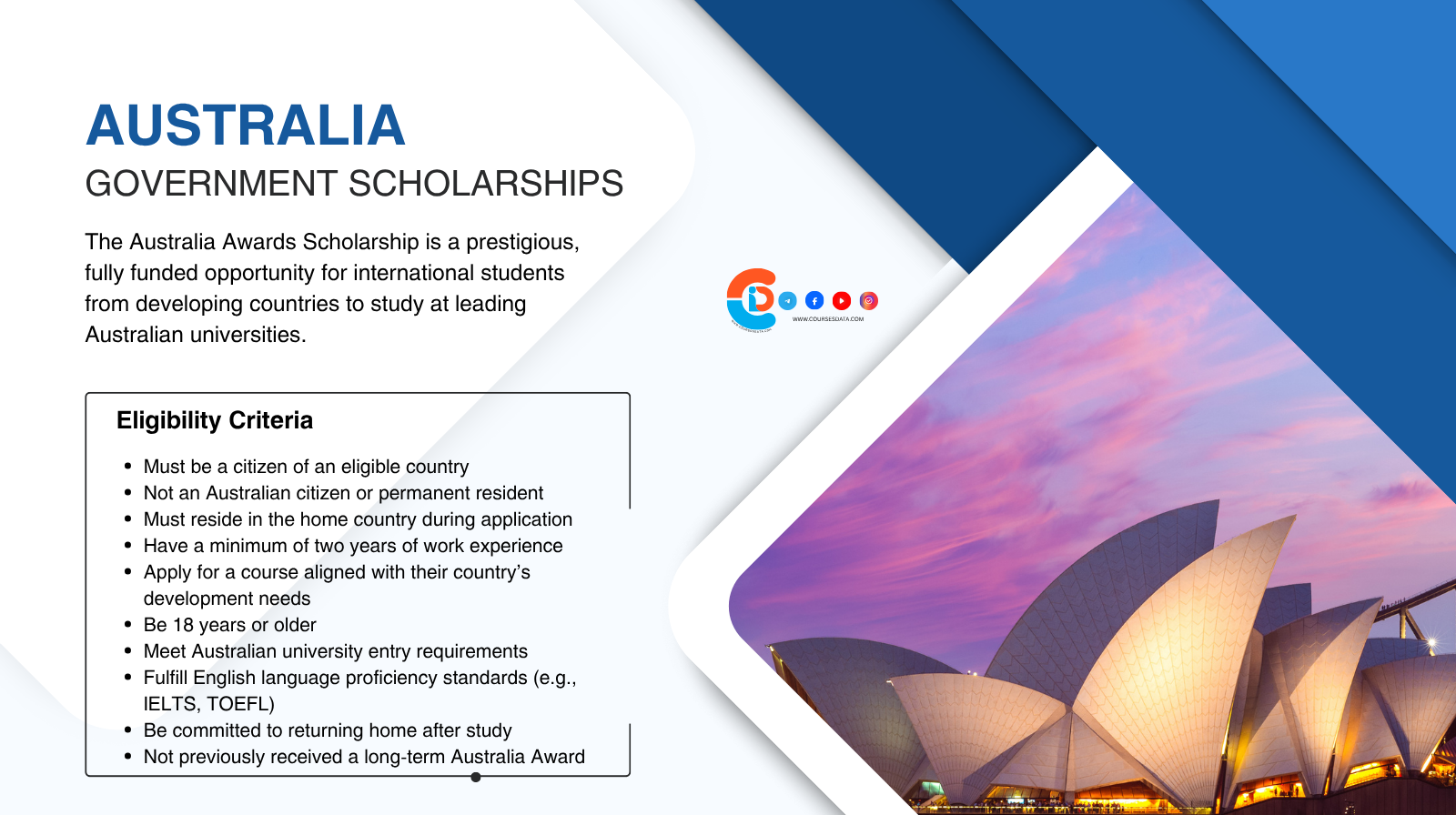
The Australia Awards Scholarship is an Australian Government scholarship for eligible citizens of participating countries who want to undertake full-time undergraduate or postgraduate study at participating Australian universities and TAFE institutions.
It is designed not only to support international study but also to help scholars develop skills that can contribute to development in their home countries after they return.
What Is the Australia Awards Scholarship?
The Australia Awards Scholarship is a long-term scholarship program administered by the Australian Government Department of Foreign Affairs and Trade (DFAT).
It provides study opportunities to citizens of participating developing countries, particularly within the Indo-Pacific region, through selected Australian higher education institutions.
The program is different from an ordinary university scholarship because eligibility and study options are determined partly by the applicant’s country.
Each participating country has its own profile that can identify eligible applicants, priority fields, approved courses, institutions, documents and other local requirements.
The scholarship is intended to support academic and professional development while creating a connection between the applicant’s studies and development priorities in the applicant’s home country.
Before preparing an application, applicants should understand these basic points:
- You must be a citizen of a participating country.
- You must meet the eligibility rules for your specific country program.
- The scholarship supports full-time study.
- Both undergraduate and postgraduate opportunities are available within the wider program.
- Available fields of study vary by country.
- Eligible institutions and courses are identified through the relevant country profile.
- Academic and professional background can be important during selection.
- Development impact is a major consideration.
- You must meet the Australian institution’s admission requirements.
- You must meet the conditions of the scholarship if selected.
Official source: Australia Awards Scholarships – Australian Government Department of Foreign Affairs and Trade
What Does the Australia Awards Scholarship Cover?
One of the main reasons students consider the Australia Awards Scholarship is its extensive financial support.
The standard benefits generally cover the major costs associated with completing an approved academic program in Australia.
The scholarship is normally offered for the minimum period needed to complete the approved academic program, including any required preparatory training.
The standard benefits generally include:
- Full tuition fees.
- Return economy-class air travel through the most direct route.
- A one-time establishment allowance.
- A Contribution to Living Expenses paid fortnightly.
- A compulsory Introductory Academic Program.
- Overseas Student Health Cover for the scholarship holder.
- Pre-course English support where considered necessary and approved.
- Supplementary academic support in applicable circumstances.
- Approved fieldwork support for eligible research students and relevant master’s programs with compulsory research components.
The establishment allowance can contribute toward expenses such as accommodation, textbooks and study materials when the scholar initially settles in Australia.
The Contribution to Living Expenses is intended to help with basic living costs during the scholarship.
However, applicants should not assume that every personal expense is automatically covered.
For example, a student may have to manage expenses outside the specific scholarship entitlements, so it is important to read the official scholarship conditions rather than relying on descriptions found on social media or third-party websites.
The scholarship also includes important conditions.
Successful applicants must sign an agreement with the Commonwealth of Australia, and scholars are required to leave Australia for a minimum period after completing the scholarship.
Failure to meet this requirement can result in a debt for the accrued cost of the scholarship.
Who Is Eligible for the Australia Awards Scholarship?
Eligibility for the Australia Awards Scholarship is not identical for every applicant.
DFAT clearly states that applicants should review the country profile for their country because local eligibility criteria, priority fields and documentation requirements can differ.
In general, applicants must satisfy the core program requirements as well as any additional conditions imposed by their country program.
Common requirements include:
- Being at least 18 years old at the relevant eligibility point.
- Being a citizen of a participating country.
- Applying according to the rules for the relevant country program.
- Not being an Australian citizen.
- Not holding Australian permanent residency.
- Not applying for permanent residency in Australia.
- Meeting applicable rules concerning certain Australian or New Zealand citizen or permanent-resident spouses or partners.
- Not being serving military personnel where the program rules exclude this.
- Meeting any country-specific professional or academic requirements.
- Meeting the admission requirements of the Australian institution.
- Meeting Australian visa requirements.
Meeting these general conditions does not automatically make an applicant eligible.
For example, a candidate may have an appropriate academic qualification but still be unable to apply if their intended field is not included in the priority areas for their country.
Similarly, professional experience may be mandatory in one country program while another program may use different criteria.
The official Participating Countries page should therefore be one of the first pages an applicant checks.
Official source: Australia Awards Participating Countries and Country Profiles
Which Countries Can Apply?
Australia Awards Scholarships are available only to citizens of participating countries.
DFAT divides the participating programs into regional groups including Africa, Asia and the Pacific, with individual country programs providing their own detailed requirements.
The official list includes countries such as:
- Algeria.
- Botswana.
- Côte d’Ivoire.
- Egypt.
- Ethiopia.
- Ghana.
- Kenya.
- Madagascar.
- Malawi.
- Mauritius.
- Morocco.
- Mozambique.
- Namibia.
- Nigeria.
- Rwanda.
- Sierra Leone.
- South Africa.
- Tanzania.
- Uganda.
- Zambia.
- Zimbabwe.
- Bangladesh.
- Bhutan.
- Brunei.
- Cambodia.
- Indonesia.
- Malaysia.
- Nepal.
- Pakistan.
- Philippines.
- Sri Lanka.
- Thailand.
- Vietnam.
- Fiji.
- Papua New Guinea.
- Samoa.
- Timor-Leste.
- Vanuatu.
This list should always be checked against the official country page because eligibility is tied to the current participating-country arrangements and individual country profiles.
An applicant should never select a course first and only later check whether their country is eligible for that subject.
A better approach is to start with the country profile and work backward from the eligible fields and institutions.
Applicants from a non-participating country cannot apply for the Australia Awards Scholarship.
However, they may investigate scholarships offered directly by Australian universities or other Australian Government programs.
What Can You Study With Australia Awards?
The Australia Awards Scholarship does not operate as a general scholarship for every academic discipline.
The fields available to applicants are linked to development priorities established for their country or regional program.
This means that the correct question is not simply, “Which degree do I want to study?” Instead, applicants should ask whether the intended degree is included in the approved study areas for their country.
Priority areas may include fields related to:
- Education.
- Public policy.
- Governance.
- Public administration.
- Health.
- Agriculture.
- Food security.
- Environmental sustainability.
- Climate-related development.
- Economics.
- Infrastructure.
- Digital development.
- Technology.
- Other country-specific development priorities.
These areas are examples rather than a universal list.
The actual eligible fields, courses and institutions are defined by the individual country profile.
There are also areas that are excluded from Australia Awards Scholarships.
DFAT states that the program does not support training related to aircraft flying, nuclear technology or military training.
Aviation Management is distinguished from flight training in the official guidance.
A useful course-checking process is:
- Find your participating-country profile.
- Identify the listed priority fields.
- Check the eligible course list.
- Check the participating institution.
- Review academic admission requirements.
- Check the English requirement.
- Compare your academic background with the course.
- Confirm that the study plan fits the development priorities.
- Prepare your application around the approved study area.
- Avoid applying for a course that is not listed as eligible.
Official source: Australia Awards Participating Countries and Course Information
What Are the English Language Requirements?
English proficiency is an important part of the Australia Awards Scholarship process because scholars must be able to meet the academic language requirements of their Australian institution.
The current scholarship handbook specifies that applicants can satisfy DFAT’s English requirements in certain circumstances through English-medium education.
Where that does not apply, an approved academic English test may be required.
Australian institutions can also impose their own, potentially higher, admission requirements.
The DFAT requirements listed in the current handbook include:
| English Test | Minimum DFAT Requirement |
|---|---|
| IELTS Academic | Overall 6.5, with no band below 6.0 |
| TOEFL iBT | Overall 84, with a minimum of 21 in each subtest |
| PTE Academic | Overall 58, with no communicative skill score below 50 |
These scores should not be interpreted as automatic university admission scores.
If the selected institution or course requires a higher English level, the applicant must meet the institution’s requirement as well.
The program may provide pre-course English training in certain circumstances where the applicant is close to the required standard.
Such support is subject to the applicable country program and scholarship conditions and should not be assumed to be available to every applicant.
Before submitting your application, check:
- Your country’s English-language rules.
- The approved test types.
- The minimum score.
- The selected university’s English requirement.
- The course-specific English requirement.
- Test-result validity requirements.
- Whether pre-course English support applies to your situation.
Official source: Australia Awards Scholarships Policy Handbook – Department of Foreign Affairs and Trade
How to Apply for the Australia Awards Scholarship
The application process begins with the official country profile rather than with a university application.
Applicants must check the specific instructions for their country, including the application method, documents, eligible courses and local requirements.
For many participating countries, applications are submitted through the Online Australia Awards Scholarships Information System (OASIS).
DFAT states that applicants from Indonesia and the Philippines use their country-specific application portals instead.
A practical application process is:
- Open the official participating-country page.
- Select your country profile.
- Confirm your eligibility.
- Review priority fields.
- Check eligible institutions and courses.
- Read the document requirements.
- Prepare your academic records.
- Prepare your CV.
- Prepare referee documents when required.
- Prepare your English evidence when required.
- Develop a clear study plan.
- Explain the development need your study addresses.
- Explain how you will use the skills after returning home.
- Complete the official application system.
- Review every answer and uploaded document.
- Submit the application through the required channel.
Applications are not assessed on a rolling basis.
DFAT states that applications are reviewed after the closing date and that submitting earlier does not itself change the assessment outcome.
However, applicants should avoid leaving the submission until the final moment because errors may become impossible to correct after the application closes.
Official application information: How to Apply for an Australia Awards Scholarship
How Are Australia Awards Applications Assessed?
Australia Awards selection looks beyond academic grades.
The official scholarship policy states that selection considers professional and personal qualities, academic competence and the applicant’s potential to contribute to development challenges in their home country.
Country programs may also apply additional selection criteria.
This means a strong application should create a clear connection between your background, your proposed study and your future contribution.
For example, an education professional could explain an existing challenge in access to quality education, identify the skills that postgraduate study would provide, and then describe how those skills could be applied after returning to work in the education sector.
An effective application can focus on:
- Your relevant academic background.
- Your professional experience.
- A clearly explained development challenge.
- The reason your selected course is relevant.
- Skills you expect to gain.
- How those skills connect to your career.
- Your plans after returning home.
- Potential implementation barriers.
- Practical ways to address those barriers.
- A realistic long-term contribution.
Shortlisted candidates may be contacted for interviews or additional assessment activities.
DFAT also emphasises the importance of authenticity in the application process.
Applicants should pay particular attention to the current rules on artificial intelligence.
The official guidance states that AI may be used for basic productivity tasks such as spelling, grammar and organising ideas, but it must not be used to write, improve or paraphrase application responses.
Application responses must remain the applicant’s own original work.
This is especially important for applicants who use AI tools during scholarship preparation.
Understanding the rules before submitting an application can prevent an avoidable integrity problem.
What Documents Do You Need?
The exact supporting documents required for an Australia Awards Scholarship application depend on your country program.
DFAT provides general guidance and also directs applicants to their country profile for additional documents and templates.
Depending on the country and scholarship category, applicants may be asked for:
- Academic certificates.
- Academic transcripts.
- Curriculum vitae.
- Identification documents.
- English-language evidence.
- Referee reports.
- Employment evidence.
- Professional documents.
- Research-related documents for relevant programs.
- Other country-specific supporting materials.
Applicants should not upload documents simply because another Australia Awards applicant was asked to provide them.
Your own country profile is the controlling source for the application requirements.
It is also useful to prepare your documents early:
- Check that names are consistent.
- Use clear scans.
- Confirm translation requirements.
- Check certification instructions.
- Keep complete academic records.
- Verify referee details.
- Keep employment evidence available.
- Save copies of submitted documents.
- Follow the required file format.
- Recheck every uploaded document before submission.
For applicants considering research degrees, additional requirements can apply.
The scholarship placement process may require evidence concerning research proposals and potential academic supervision, depending on the program and institution.
What Happens After Selection?
Being selected for the Australia Awards Scholarship is followed by a placement process.
Successful candidates still need to satisfy the admission requirements of the Australian institution and the conditions associated with their scholarship.
The process can include:
- Confirmation of the approved course.
- Review of institutional admission requirements.
- Submission of additional documents.
- Confirmation of English-language requirements.
- University or TAFE placement procedures.
- Scholarship agreement arrangements.
- Preparatory activities.
- Visa procedures.
- Pre-departure preparation.
- Travel arrangements.
- Arrival and enrolment in Australia.
The scholarship is connected to the approved academic program.
It is therefore important to follow the instructions from DFAT, the relevant country program and the Australian institution rather than assuming that a successful scholarship selection gives unrestricted freedom to change courses or institutions.
Australia Awards scholars must also respect the return requirement after completing their scholarship.
According to DFAT, scholars are required to leave Australia for a minimum period after completing the award.
The scholarship should therefore be viewed as an education and development program, not simply as a funding route for studying and remaining in Australia.
How to Prepare a Strong Australia Awards Application
A good application should be specific, evidence-based and connected to the priorities identified by the relevant country program.
Start by identifying a genuine professional or development issue that relates to your proposed field.
Then explain how the selected course can help you address that issue through knowledge, technical skills, professional training or research.
For example, a public-sector applicant interested in digital transformation could connect previous work experience with a specific administrative challenge, explain why the proposed degree is relevant, and describe realistic ways to apply the acquired skills after returning home.
Avoid making the application excessively general.
Statements about wanting to “help my country” are less informative than explaining what you have already done, what problem you have identified and what practical contribution you expect to make.
A final review should ask:
- Does my course match my country’s priority fields?
- Does my academic background support the proposed course?
- Have I clearly explained why this study matters?
- Have I demonstrated relevant experience?
- Are my career goals realistic?
- Have I explained how I will use my new skills?
- Have I considered practical barriers?
- Is my application based on my genuine experience?
- Have I followed the document instructions?
- Have I complied with the official AI-use rules?
The Australia Awards Scholarship is built around both academic development and development impact.
A well-prepared application should therefore show not only that you are capable of completing the proposed study, but also that the education has a credible connection to your future contribution at home.
The Australia Awards Scholarship can provide substantial financial support for eligible students from participating countries, including tuition fees, travel, living support, health insurance and other approved benefits.
However, eligibility is country-specific, available courses are limited by program priorities, and applicants must meet both scholarship and institutional requirements.
The most reliable way to prepare is to begin with the official country profile, identify the approved study options, organise your documents and build an application around your real academic and professional experience.
Most importantly, every application response should remain your own original work and should accurately reflect your goals and experience.
Australia Awards Scholarship FAQ
Is the Australia Awards Scholarship fully funded?
The scholarship generally covers full tuition fees, return air travel, an establishment allowance, a Contribution to Living Expenses, Overseas Student Health Cover and other approved support.
The exact benefits can vary according to the scholarship conditions and individual circumstances.
Who can apply for the Australia Awards Scholarship?
Citizens of participating countries may apply when they meet the general scholarship conditions and the additional eligibility requirements specified by their country program.
Applicants should always read their official country profile because eligibility is not identical across all countries.
Can I choose any subject I want?
No.
Eligible study fields are determined by the relevant country program and its development priorities.
Applicants should check the approved fields, courses and institutions in their country profile before selecting a study program.
Can I study for a master’s degree with Australia Awards?
Yes.
Australia Awards Scholarships provide opportunities for postgraduate study, including master’s-level study where the relevant country program offers eligible courses.
The actual fields and admission requirements depend on the country profile and institution.
Is IELTS always required?
Not necessarily.
DFAT provides English-language provisions that can apply in specific circumstances, while institutions can impose their own English requirements.
Where a recognised English test is required, the current handbook lists IELTS, TOEFL iBT and PTE Academic among the accepted tests.
Can I apply if I am already living in Australia?
Applicants must satisfy the residency and citizenship requirements of the scholarship program.
In particular, Australian citizens and permanent residents are not eligible under the general Australia Awards Scholarship rules.
Applicants should review the specific country profile for any additional restrictions.
Do I need to contact a university before applying?
Applicants should first follow the Australia Awards application instructions and country profile.
Course and institution placement is part of the scholarship process, although applicants can review university admission requirements when deciding whether a proposed study option is appropriate.
Can I apply for more than one course?
Applicants may be able to list study preferences through the application system, but the number of preferences and the eligible choices can depend on the country program.
The relevant country profile should be followed when selecting course preferences.
Can I use AI to write my application?
No.
DFAT’s current guidance allows limited AI use for tasks such as spelling, grammar and organising ideas, but AI must not be used to write, improve or paraphrase application responses.
The submitted responses must be the applicant’s own original work.
Do I have to return home after completing the scholarship?
Yes.
Australia Awards scholars are required to leave Australia for a minimum period after completing their scholarship.
The official scholarship conditions state that failure to meet this requirement can result in a debt for the accrued cost of the scholarship.
I actually applied for the Australia Awards Scholarship a few years back, so this post brought back memories. One thing I wish I’d known earlier is that your proposed course of study needs to be very clearly tied to a specific development need in your home country—my first draft was way too vague. For anyone considering it, I’d recommend reaching out to alumni in your region, because they can give you real insight into how to frame your application statement.
It’s funny you mention tying the course to a development need—I spent ages on my application too, and I think that’s the part most people underestimate. I ended up shifting my focus from a broad “help my country” idea to a very specific regional gap in renewable energy training, which made my statement much stronger. Did you find that mentioning local partnerships or government stakeholders in your home country made a difference in how they scored your proposal?
That’s a great question, Carla. I actually did mention a specific local NGO I’d already been volunteering with, and I think it helped show I wasn’t just theorizing—I already had a foot in the door with the people who’d need the skills. Without that concrete link, my proposal felt too much like a wish list rather than a realistic plan. It’s definitely worth digging into who you’d work with on the ground before you submit.
Oh, absolutely—mentioning local stakeholders made a huge difference for me. I specifically named a small community health initiative I’d already been coordinating with in my province, and I think that showed I wasn’t just guessing at a need; I had skin in the game. It felt like the difference between a hopeful wish and a grounded, actionable plan.
Oh, absolutely—mentioning local stakeholders made a huge difference for me. I specifically named a small community health initiative I’d already been coordinating with in my province, and I think that showed I wasn’t just guessing at a need; I had skin in the game. It felt like the difference between a hopeful wish and a grounded, actionable plan.
It’s really interesting to see how both of you zeroed in on tying the application to a specific need. I’m curious, though—when you shifted your focus, did you find it hard to prove that you’d actually be able to implement that knowledge back home, especially if the local job market or infrastructure isn’t fully ready for it? I’m looking into applying soon, and that follow-through part feels just as tricky as the initial statement.
I really appreciated how you all dug into the practical side of making the application concrete. When I applied, I found that linking my course to a specific government ministry’s targets—rather than just a general need—made a huge difference in how solid my plan felt on paper. For anyone worried about implementation, have you considered including a letter of support from a local employer or university to prove there’s a real place for those skills when you return?
It’s interesting how many of you hit on the same pain point—tying the study plan to a concrete local need. I’d add that it’s worth checking whether your proposed university has existing partnerships with organizations in your home region, because mentioning that in your application can subtly signal that there’s already a support system waiting for you when you return. Did anyone find that their chosen university’s research focus helped or hurt their chances of being shortlisted?
Right, so the takeaway here is that the “free study in Australia” part is the easy bit, and the real work is convincing them you’re not just going to wander off with their degree. I’m curious, though—does anyone know if they actually follow up with alumni to check if you’ve delivered on that grand development plan, or is it just a “trust me, bro” situation after you get the parchment? Seems like a lot of pressure to pre-sell a future you can’t guarantee.
This whole thread is spot-on about needing concrete local ties. When I applied, I leaned heavily on the fact that my proposed research aligned with a specific university research centre that already had projects running in my home province, and I made sure to mention that in my application. It felt like it showed the selection committee that there was already a built-in support system for me to plug into when I got back. Did anyone else find that their chosen university’s existing work in their home country made the proposal feel more credible to the reviewers?