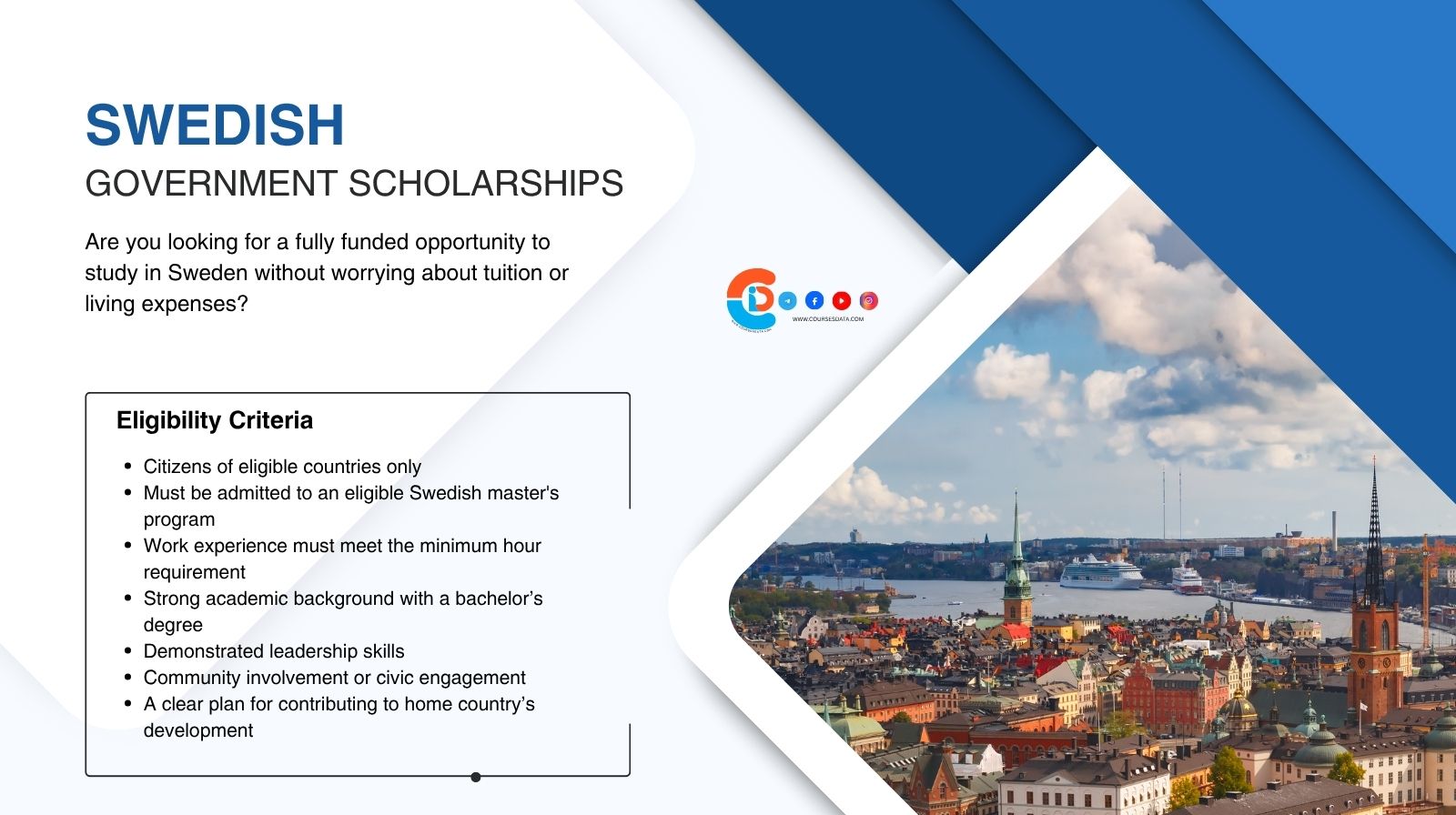
The Swedish Institute Scholarship for Global Professionals is a competitive scholarship for international professionals who want to pursue an eligible master’s degree in Sweden.
It can cover the full tuition fee, provide a monthly living allowance and travel grant, and give scholars access to professional networks, making it particularly relevant for applicants with documented work and leadership experience.
What Is the Swedish Institute Scholarship?
The Swedish Institute Scholarship for Global Professionals is a Swedish government-funded scholarship administered by the Swedish Institute.
It is designed for international professionals who want to study eligible English-taught master’s programmes at Swedish universities.
Unlike scholarships aimed primarily at academic performance, the SI Scholarship also places substantial emphasis on professional experience, leadership and the applicant’s ability to connect their studies with sustainable development.
The scholarship is available only for selected master’s programmes and eligible nationalities.
It is not a general scholarship that can be used for any programme or university in Sweden.
The official Swedish Institute scholarship portal allows applicants to search eligible programmes and build their scholarship application from programmes they have applied to through University Admissions.
Important points to understand:
- The scholarship is for master’s studies.
- It is intended for international professionals.
- Only eligible citizens can apply.
- Only selected master’s programmes qualify.
- Applicants must demonstrate work experience.
- Applicants must demonstrate leadership experience.
- The scholarship is separate from the university admission application.
- Applicants who must pay Swedish tuition fees are generally the target group.
- The scholarship is highly competitive.
- Meeting the minimum requirements does not guarantee an award.
What Does the Swedish Institute Scholarship Cover?
The SI Scholarship for Global Professionals provides several forms of financial support during the scholarship period.
The tuition component is paid directly to the Swedish university, while the living allowance is intended to help scholars cover everyday expenses during their studies.
The scholarship also provides a travel grant and access to professional networks connected with the Swedish Institute.
| Scholarship benefit | What it provides |
|---|---|
| Tuition fee | Full tuition fee coverage for the eligible programme |
| Living allowance | SEK 12,000 per month |
| Travel grant | SEK 15,000 in most cases, with a lower amount for certain eligible countries |
| Professional network | Membership in the SI Network for Global Professionals |
| Alumni network | Membership in the Sweden Alumni Network after the scholarship period |
The travel grant is normally a one-time payment.
It does not apply to scholars who are already living in Sweden, and the amount is lower for applicants from certain countries.
Applicants should also understand what the scholarship does not automatically mean.
For example, the University Admissions application fee is not waived simply because you apply for the SI Scholarship.
Applicants who are required to pay that fee must pay it for their admissions application to be processed.
Who Can Apply for the SI Scholarship?
Eligibility is based on several conditions rather than nationality alone.
For the current scholarship call, eligible applicants must generally be citizens of one of the countries specified by the Swedish Institute, apply for an eligible master’s programme, be liable to pay tuition fees in Sweden, and demonstrate professional and leadership experience.
The eligible-country list currently includes:
- Armenia
- Azerbaijan
- Bangladesh
- Belarus
- Bolivia
- Brazil
- Colombia
- Ecuador
- Egypt
- Ethiopia
- Georgia
- Guatemala
- Indonesia
- Iraq
- Jordan
- Kenya
- Liberia
- Malaysia
- Mexico
- Moldova
- Morocco
- Nigeria
- Peru
- Philippines
- Rwanda
- Senegal
- South Africa
- Tanzania
- Thailand
- Uganda
- Ukraine
- Uzbekistan
- Vietnam
- Zambia
Citizenship is important, but residence is a separate issue.
An eligible citizen does not necessarily have to be living in their country of citizenship when applying.
Applicants with dual citizenship should carefully follow the SI instructions rather than attempting to submit multiple applications using different eligible citizenships.
What Work Experience Is Required?
Work experience is one of the most important parts of the Swedish Institute Scholarship.
For many eligible countries, applicants need at least 3,000 hours of documented work experience.
The experience can come from different forms of professional activity, including employment, freelance work or entrepreneurship, provided that it meets the Swedish Institute’s documentation requirements.
The rules are not identical for every eligible nationality.
Some applicants from specific countries have different work-experience conditions, so candidates should always check the requirements associated with their citizenship in the official scholarship instructions.
Useful examples of professional experience may include:
- Full-time employment.
- Part-time employment.
- Professional freelance work.
- Self-employment.
- Entrepreneurship.
- Work in the private sector.
- Work in government institutions.
- Work with NGOs.
- Work with international organisations.
- Other qualifying professional activities accepted by SI.
For example, an applicant working as a project coordinator in an NGO could potentially use that experience if it is properly documented.
A freelance software developer may also have relevant experience if the activity can be documented according to the required format.
The important point is not simply to state that you have worked.
Your application should clearly document what you did, where you worked, how long you worked and what responsibilities you held.
Why Leadership Experience Matters
The SI Scholarship is aimed at professionals who can demonstrate leadership, not simply applicants with a strong academic transcript.
Leadership can come from professional employment or civil society engagement.
It does not necessarily mean that you must have held a formal executive position.
Examples may include:
- Managing a team.
- Coordinating a professional project.
- Supervising colleagues.
- Leading an organisational initiative.
- Managing volunteers.
- Organising a community programme.
- Taking responsibility for a major workplace project.
- Influencing decisions within an organisation.
- Developing or implementing a new initiative.
- Holding responsibility in a civil society organisation.
A useful application should show what you actually did rather than simply describing yourself as a “leader.”
For example, instead of writing that you have strong leadership skills, explain that you coordinated a project team, allocated responsibilities, solved operational problems and helped deliver a measurable result.
This distinction can make your experience much easier for the scholarship selection process to understand.
Which Master’s Programmes Are Eligible?
One of the most important steps is checking the official list of eligible master’s programmes before submitting your scholarship application.
The SI Scholarship does not cover every master’s programme available in Sweden.
The official scholarship portal contains the programmes that can be included in the scholarship application.
Eligible programmes can cover different academic areas.
Examples appearing in the SI programme database include areas such as:
- Data science.
- Computer science.
- Engineering.
- Sustainability.
- Business.
- Entrepreneurship.
- International development.
- Public health.
- Social sciences.
- Environmental studies.
- Innovation.
- Technology.
- Governance-related fields.
The exact list can change between scholarship calls, so applicants should not rely on an old list found on another website.
For example, a student interested in data science should not assume that every Swedish master’s programme containing the words “Data Science” is eligible.
The exact programme must be checked in the official SI database.
Search the official SI scholarship programme database
How to Apply for the Swedish Institute Scholarship
The application process has two connected but separate parts: applying for a Swedish master’s programme and applying for the SI Scholarship.
The first application is submitted through University Admissions in Sweden.
After submitting the university application, you receive an application number that is used when completing the SI scholarship application.
A practical application sequence is:
- Research eligible master’s programmes.
- Check that your citizenship is eligible.
- Check the programme’s academic entry requirements.
- Prepare your academic documents.
- Apply through University Admissions.
- Pay the required admissions application fee if applicable.
- Save your University Admissions application number.
- Prepare the SI scholarship documents.
- Submit the separate SI scholarship application.
- Monitor both admission and scholarship communications.
The SI portal specifically instructs applicants to add eligible master’s programmes that they have applied for through University Admissions.
Apply through University Admissions in Sweden
Apply through the official Swedish Institute Scholarship portal
Documents You Should Prepare
The SI application requires carefully prepared supporting information.
Applicants should follow the official templates and instructions rather than submitting documents in an unrelated format.
Common preparation items include:
- A valid passport or accepted identity document.
- Academic information.
- Details of your eligible master’s programme.
- Your University Admissions application number.
- A scholarship CV using the required format.
- Proof of professional experience.
- Evidence of leadership experience.
- Required reference letters.
- A motivation statement.
- Information about your professional background.
- Information explaining your future contribution.
Your documents should tell a consistent story.
For example, if your master’s programme focuses on sustainable energy, your professional experience, leadership examples and motivation should make it clear why this field is relevant to your background and future plans.
Avoid copying generic scholarship statements.
A strong application should explain your actual professional path, the problem you want to address and how the master’s degree relates to your future work.
How to Build a Strong SI Scholarship Application
The SI Scholarship is not simply an academic admission competition.
Your application should connect education, professional experience, leadership and future impact.
A useful way to structure your thinking is:
Professional background → leadership experience → master’s programme → development challenge → future contribution
For example, imagine an applicant who has worked in public health and coordinated community health projects.
If the applicant applies for an eligible master’s programme related to public health, the application can explain how advanced training would strengthen their ability to design, manage or evaluate health programmes.
Useful preparation steps include:
- Choose a programme that genuinely fits your professional background.
- Identify two or three important achievements from your career.
- Document your work experience carefully.
- Identify concrete examples of leadership.
- Research the master’s programme thoroughly.
- Understand the problems your field faces in your home country or region.
- Explain how the programme fills a professional knowledge gap.
- Connect your education to a realistic future contribution.
- Use specific examples rather than general claims.
- Check every document against the official instructions before submission.
The goal is not to make your application sound dramatic.
It is to make it clear, credible and consistent.
Common Mistakes to Avoid
Many applicants focus heavily on academic documents and underestimate the separate requirements of the scholarship.
The SI Scholarship application should be treated as its own competitive application rather than simply an extension of your university admission form.
Avoid these mistakes:
- Applying for a master’s programme that is not on the SI eligible list.
- Assuming that every Swedish university programme qualifies.
- Applying for the scholarship before completing the required university application.
- Forgetting the University Admissions application number.
- Ignoring the work-experience requirements.
- Providing unclear evidence of employment.
- Describing leadership without giving examples.
- Using inconsistent information across documents.
- Submitting documents outside the required templates.
- Waiting until the application period to begin collecting references.
- Assuming that admission to a university automatically means receiving the scholarship.
- Assuming that the scholarship covers every possible personal expense.
University Admissions also confirms that applicants who are required to pay the application fee must pay it even when they are applying for a scholarship.
Swedish Institute Scholarship vs University Scholarships
The SI Scholarship is not the only funding option for international students in Sweden.
Swedish universities may also offer their own scholarships, and their eligibility requirements can be different.
University scholarships may be based on academic qualifications, programme-specific criteria or other institutional requirements.
University Admissions confirms that scholarships can be offered both by the Swedish Institute and individual Swedish universities.
When comparing funding options, check:
- Whether tuition is fully covered.
- Whether living expenses are included.
- Whether a travel grant is available.
- Whether the scholarship is programme-specific.
- Whether work experience is required.
- Whether leadership experience is required.
- Whether your nationality is eligible.
- Whether you must pay an application fee.
- Whether the scholarship covers the complete programme duration.
- Whether separate applications are required.
This comparison is particularly important if you are eligible for both an SI scholarship and a university-specific scholarship.
Practical Checklist Before You Apply
Before submitting your application, use a final checklist rather than relying on memory.
Eligibility checklist
- My citizenship is on the current SI eligible-country list.
- My intended master’s programme is SI eligible.
- I meet the university’s academic requirements.
- I meet the applicable work-experience requirement.
- I can document my professional experience.
- I can demonstrate leadership experience.
- I understand the tuition-fee requirement.
- I have completed the University Admissions application.
- I have recorded my University Admissions application number.
- I have prepared the required SI documents.
- My references meet the official requirements.
- My motivation statement is specific to my background and programme.
- All information is consistent across my documents.
- I have checked the official SI instructions immediately before submission.
Is the Swedish Institute Scholarship Right for You?
The SI Scholarship is particularly relevant if you already have meaningful professional experience and can demonstrate leadership in your workplace or civil society activities.
It is less suitable for someone looking for undergraduate funding, because the scholarship is designed for eligible master’s studies rather than bachelor’s programmes.
University Admissions explicitly states that Swedish Institute scholarships are available for master’s applicants from specific countries and that there are no SI scholarships for bachelor’s studies or programmes beginning in the spring semester.
Before investing significant time in the application, verify three things first:
- Your citizenship is eligible.
- Your master’s programme is eligible.
- Your professional and leadership experience meets the applicable criteria.
If all three conditions are satisfied, you can then focus on building a coherent application that explains your professional background and future objectives.
The official Swedish Institute website should always be treated as the final authority because eligible programmes, country requirements and application instructions can change between scholarship calls.
Official Swedish Institute Scholarship information
Conclusion
The Swedish Institute Scholarship provides an opportunity for eligible international professionals to pursue selected master’s programmes in Sweden with substantial financial support.
Its distinctive focus on work experience, leadership and future contribution means that applicants need to prepare more than academic documents alone.
A successful application starts with choosing an eligible programme and confirming your nationality and professional eligibility.
From there, careful documentation, a clear motivation statement, credible leadership examples and accurate completion of both the university and scholarship applications are essential.
For the most reliable information, always verify the current programme list and application requirements through the official Swedish Institute scholarship portal and University Admissions before submitting an application.
Frequently Asked Questions About the Swedish Institute Scholarship
Is the Swedish Institute Scholarship fully funded?
The SI Scholarship for Global Professionals provides full tuition fee coverage, a monthly living allowance and a travel grant, together with access to the SI professional and alumni networks.
However, applicants should not interpret “fully funded” as meaning that every possible personal expense is automatically covered.
Can I apply for the SI Scholarship for a bachelor’s degree?
No.
The SI Scholarship for Global Professionals is designed for eligible master’s studies.
University Admissions states that Swedish Institute scholarships are not available for bachelor’s studies.
Do I need work experience to apply?
Yes.
Demonstrated work experience is one of the eligibility requirements for the SI Scholarship for Global Professionals.
For many eligible countries, the applicable requirement includes at least 3,000 hours of documented work experience, although country-specific rules should always be checked.
Is leadership experience required?
Yes.
Applicants need to demonstrate leadership experience from employment or civil society engagement.
Leadership can involve responsibilities such as coordinating projects, supervising people, managing initiatives or taking responsibility for organisational activities.
Can freelancers apply for the Swedish Institute Scholarship?
Professional experience does not necessarily have to come from traditional full-time employment.
Freelance and self-employed professional activity may qualify when it meets the applicable SI requirements and can be properly documented.
Can I apply before applying to a Swedish university?
The scholarship application depends on your application to an eligible master’s programme through the Swedish admissions process.
University Admissions states that you must submit your admissions application first and use the resulting application number for the SI scholarship application.
Do I have to pay the Swedish university application fee if I apply for the scholarship?
If you are required to pay the University Admissions application fee, applying for an SI scholarship does not remove that obligation.
University Admissions currently states that there is no general scholarship-related fee waiver for applicants who must pay the application fee.
Can I choose any master’s programme in Sweden?
No.
The SI Scholarship applies only to programmes included in the official list of eligible master’s programmes.
Applicants should search the SI scholarship portal and verify the exact programme rather than relying on the university name or subject area alone.
Does the scholarship include a monthly living allowance?
Yes.
The current SI Scholarship for Global Professionals provides a monthly living allowance of SEK 12,000 throughout the scholarship period.
Where should I check the latest Swedish Institute Scholarship requirements?
The Swedish Institute’s official scholarship website and application portal are the most appropriate sources for checking current eligibility, eligible programmes, documents and application instructions.
University Admissions should also be checked for the master’s admission requirements and application-fee rules.
Swedish Institute official website
I actually applied for this scholarship a couple of years ago and made it to the final round, so I can say that the leadership and work hour requirements are no joke—they really dig into your experience. One thing that surprised me was how specific they are about linking your past work to the UN Sustainable Development Goals in your motivation letter. If you’re thinking of applying, my advice is to start drafting your essays early, because connecting your 3,000 hours of work to a clear impact plan takes way more time than you’d expect. Also, has anyone here received the travel grant on top of the stipend? I’m curious how that process actually works once you’re accepted.
That work-hour requirement is no joke—I only have about 2,500 hours myself, so I’d need to pick up another six months of full-time work just to qualify. It’s refreshing to see a scholarship that actually prioritizes real-world experience over just good grades, but I do wonder how they verify those hours for people in informal or freelance roles. Kiri, when you applied, did they ask for a specific letter from an employer to prove the hours, or just a detailed CV?
Mate, that’s exactly the thing—they’re dead serious about the hours. When I applied, I had to upload signed letters from past employers confirming my roles and the actual timeframes, not just a CV. If you’re freelancing, you’d want to get contracts or client statements to back you up, because they’ll check. It’s a hassle, but honestly, it weeds out the time-wasters.
Honestly, the verification for informal work is the part that had me sweating too. I ended up having to track down old clients for signed statements and dig up bank statements showing payments, which was a pain, but they definitely want something official-looking, not just a CV. If you’re freelancing, I’d start collecting those documents now because it’s way more than just listing your hours on paper.
Reading through this, I’m honestly a bit intimidated by the 3,000-hour work requirement—I’ve been working part-time while studying for years, and I’m still nowhere near that number. It does make me wonder, though, if they consider volunteer hours or internships that aren’t strictly paid, or if they’re only counting formal employment. I’d love to hear from someone who got in with a non-traditional work background, because that “global professional” label seems to lean heavily on traditional career paths.
I actually applied for the SISGP last year and got through to the second round, so I can back up what Kiri said about the UN Sustainable Development Goals connection—they really want to see that you’ve already been working toward those goals, not just planning to. One thing that tripped me up was proving my 3,000 hours: I had a mix of part-time jobs and freelance projects, and the signed employer letters were a headache to gather for the informal gigs. For anyone in that boat, I’d suggest documenting every client contract and timesheet now, because they do verify. My question is, for those who got the travel grant, does it cover family members too, or just the student?
I’ve been looking into this scholarship for months, and the 3,000-hour work requirement honestly threw me off because I’ve been self-employed for years. It’s reassuring to hear from Maggie that they accept freelance documentation, but I’m still worried about proving irregular project hours without an official employer stamp. Has anyone here successfully used a portfolio with invoices and client emails to meet the proof requirement, or did you need something more formal?
Ah, the 3,000-hour hurdle. I had to scramble to prove my hours because I spent years working as a ski instructor across different resorts, which meant dozens of short-term contracts and no single HR department to stamp a letter. For anyone else in a seasonal or project-based field, I’d strongly recommend creating a master spreadsheet with employer names, dates, and total hours *before* you start the application—it saved me from a last-minute panic when they asked for detailed breakdowns. One thing that still bugs me, though: did they ever explain why they set the bar at exactly 3,000 hours and not, say, a simpler “three years of full-time work”? That specific number feels arbitrary when you’re trying to piece together part-time gigs.
Reading through all this, I’m actually relieved to hear that freelance and project-based work can count, because I’ve got about 3,800 hours from a mix of contract graphic design and NGO volunteer coordination, but none of it came with a neat employer letter. For anyone in a similar spot, I’d suggest getting a signed affidavit from the project leads or clients—something notarized if possible—because that’s what I had to do to make my hours look official. My question is, for those who’ve been through the final interview, did they ask you to pitch a concrete project tied to the SDGs, or was it more about your past impact?
I’ve been looking into this scholarship for a few weeks now, and the 3,000-hour work requirement is exactly what’s holding me back—I’ve got about 2,100 hours from a mix of full-time work and volunteer coordination, but I’m worried the volunteer hours won’t count unless I can get a signed letter from a nonprofit director who’s hard to track down. For those who made it through with a non-traditional background, did you find that the selection committee valued project-based or volunteer leadership just as much as formal employment, or did they seem to favor the corporate experience? I’d love to know if anyone’s heard of an exception for candidates who come close but don’t hit the exact hour threshold.