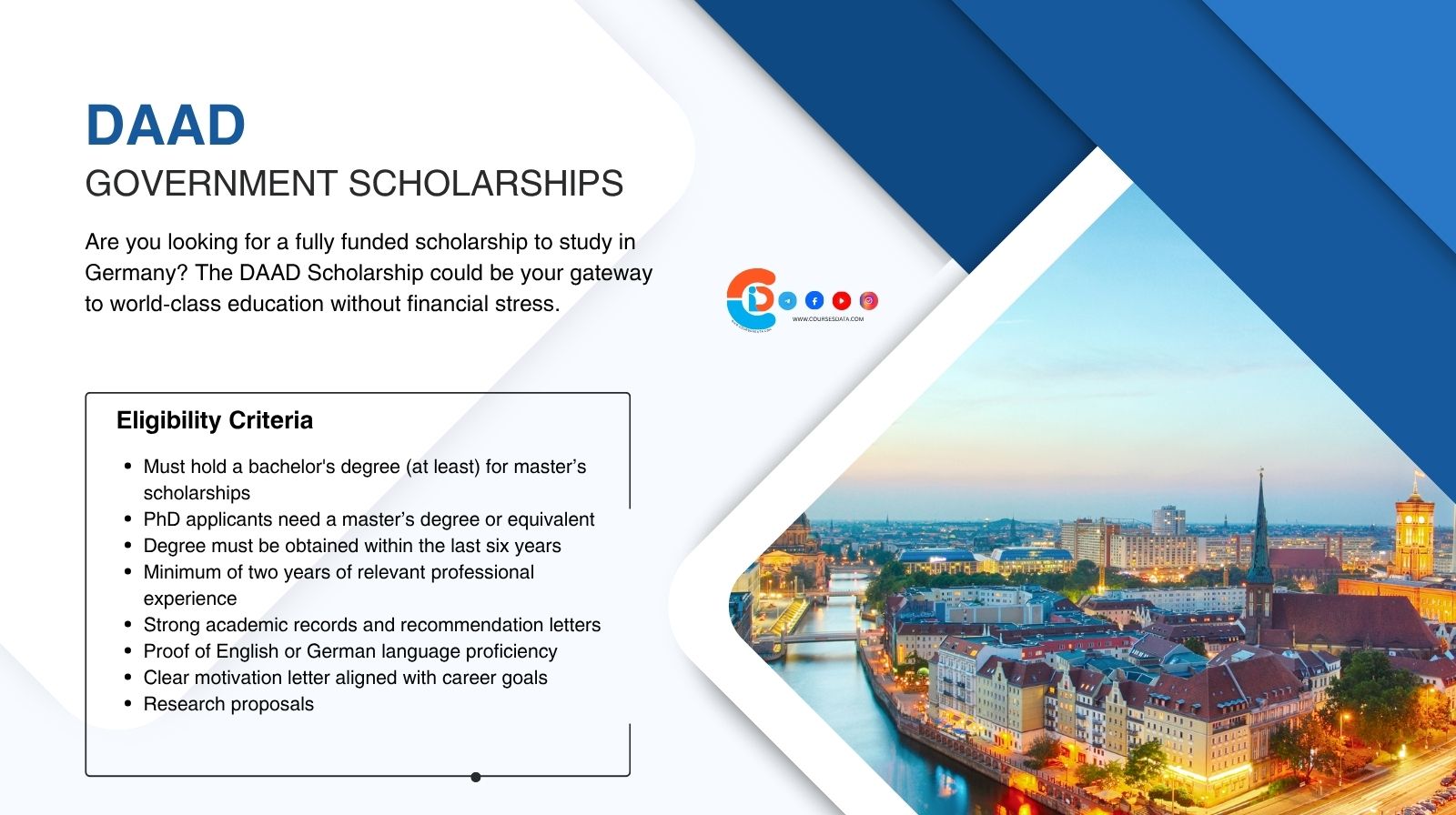
Are you looking for a fully funded scholarship to study in Germany? The DAAD Scholarship could be your gateway to world-class education without financial stress.
Overview of the DAAD Scholarship
The German Academic Exchange Service (DAAD) offers prestigious scholarships for international students to pursue higher education in Germany. These scholarships support graduate and postgraduate students across various disciplines.
- Available to international students from over 100 countries
- Covers master’s, doctoral, and short-term research programs
- Fully funded: tuition, living allowance, travel stipend
- Focused on academic merit and professional potential
- Funded by the German government and partner institutions
- Offers study programs in English and German
- Encourages intercultural exchange and academic collaboration
- Applications open once per year per program
- Available for a wide range of study fields
- Supports both individual and group research projects
Who is Eligible for the DAAD Scholarship?
The eligibility criteria are specific and vary slightly depending on the program. However, general requirements apply across most categories.
- Must hold a bachelor’s degree (at least) for master’s scholarships
- PhD applicants need a master’s degree or equivalent
- Degree must be obtained within the last six years
- Minimum of two years of relevant professional experience
- Strong academic records and recommendation letters
- Proof of English or German language proficiency
- Clear motivation letter aligned with career goals
- Research proposals (for PhD and research applicants)
- Age limit varies by program but generally under 45
- Must not be residing in Germany at the time of application
What Does the DAAD Scholarship Cover?
One of the biggest advantages of the DAAD Scholarship is its comprehensive financial support. It covers all key expenses to help students focus on their studies.
- Full tuition fees (if applicable)
- Monthly stipend:
- €934 for master’s students
- €1,200 for PhD candidates
- Health, accident, and personal liability insurance
- Travel allowance for international flights
- Study and research subsidies
- Monthly rent subsidy (if applicable)
- Family allowance for accompanying members
- Free preparatory German language courses
- Alumni networking and support opportunities
- Access to cultural integration events
How to Apply for the DAAD Scholarship
Applying for the DAAD Scholarship involves multiple steps, and attention to detail is crucial. Each program may have slightly different application procedures.
- Find a suitable program using the DAAD Scholarship Database
- Check individual program deadlines and requirements
- Prepare academic transcripts and certificates
- Write a convincing letter of motivation
- Obtain letters of recommendation from professors/employers
- Submit proof of language proficiency (TOEFL, IELTS, or TestDaF)
- Create a detailed CV using the Europass format
- Prepare a research proposal (if required)
- Apply online via the DAAD portal or university site
- Monitor application status and respond to follow-up communications
Top Courses Funded by DAAD Scholarship
DAAD offers funding for a wide range of academic fields. Here are the most popular courses supported under the scholarship.
- Engineering (Mechanical, Civil, Electrical)
- Computer Science and IT
- Environmental Sciences
- Public Policy and Governance
- Economics and Business Administration
- Renewable Energy and Sustainability
- Agricultural Sciences
- Medicine and Public Health
- Urban and Regional Planning
- Social Sciences and Education
Popular Universities Accepting DAAD Scholars
Germany is home to some of the world’s leading universities that welcome DAAD recipients. These institutions offer English-taught and research-intensive programs.
| University Name | Location | Known For |
|---|---|---|
| Technical University of Munich | Munich | Engineering, Computer Science |
| Heidelberg University | Heidelberg | Medicine, Life Sciences |
| Humboldt University of Berlin | Berlin | Social Sciences, History |
| RWTH Aachen University | Aachen | Mechanical Engineering |
| University of Freiburg | Freiburg | Environmental Studies, Renewable Energy |
| University of Mannheim | Mannheim | Business, Economics |
| LMU Munich | Munich | Humanities, Natural Sciences |
| University of Bonn | Bonn | Agriculture, Philosophy |
| University of Cologne | Cologne | Law, Management |
| University of Stuttgart | Stuttgart | Architecture, Engineering |
Benefits of Studying in Germany with a DAAD Scholarship
Choosing Germany as a study destination comes with countless academic and personal growth opportunities, especially with DAAD support.
- Tuition-free or low-cost education
- High-quality universities with global rankings
- Wide range of programs in English
- Exposure to cutting-edge research
- Opportunities to learn German language and culture
- Strong job market for international graduates
- Safe and diverse student-friendly cities
- Central location in Europe for travel
- Long-term stay and job-seeking visas available
- Access to global alumni networks
Timeline and Deadlines to Remember
DAAD application deadlines vary by program and university, but here’s a general timeline to guide your planning.
- April–June: Research programs and eligibility
- July–August: Prepare documents and draft essays
- September–October: Submit applications
- November–December: Interviews and document verification
- January–March: Notification of results
- April–August: Visa application and travel prep
- October: Semester begins in most universities
Common Mistakes to Avoid When Applying
Many qualified applicants miss out due to small errors. Avoid these common mistakes during your DAAD application process.
- Submitting incomplete applications
- Ignoring language proficiency requirements
- Failing to tailor motivation letter to specific program
- Using generic CV templates instead of Europass format
- Not verifying academic credentials with transcripts
- Missing deadlines for document uploads
- Applying to non-eligible programs
- Underestimating importance of recommendation letters
- Failing to demonstrate clear career goals
- Not following specific instructions on DAAD portal
Frequently Asked Questions
Is the DAAD Scholarship hard to get?
It is competitive, but achievable with strong academics, a clear motivation letter, and well-prepared documents.
Do I need to speak German to apply?
No, many programs are offered in English. However, learning German helps with integration and daily life.
Can I work while on the DAAD Scholarship?
Yes, but part-time work must comply with visa regulations and scholarship conditions.
Are there age restrictions for the DAAD Scholarship?
Most programs prefer applicants under 45, but exceptions exist based on career stage and qualifications.
Can I bring my family to Germany?
Yes, the DAAD offers family allowances and support for dependents.
How do I prove language proficiency?
You must submit valid TOEFL, IELTS, or TestDaF scores depending on your chosen language of instruction.
Is health insurance included in the scholarship?
Yes, comprehensive health and liability insurance are covered.
Can I apply for more than one program?
Yes, but you must tailor each application separately.
How long does the scholarship last?
Duration depends on your program—usually 12–24 months for master’s, up to 36 months for PhD.
Do I need a confirmed university admission before applying?
Some programs require prior admission, others allow simultaneous application.
Conclusion
The DAAD Scholarship opens doors to top-tier education, global exposure, and personal transformation. It’s your chance to study in Germany without financial burden.
That’s a solid overview of the DAAD, but I’d add one thing from my own experience: the application timeline can really sneak up on you. I remember scrambling for my recommendation letters because I thought the deadline was two weeks later than it actually was. If you’re considering this, make sure you double-check the exact dates for your specific program because some fields close earlier than others.
Oh, you’re so right about the timeline sneaking up—I almost missed my own DAAD deadline because I had the wrong date in my calendar for the recommendation letters. I ended up emailing my referees in a total panic at 11 p.m., and one of them was kind enough to submit it the next morning. Now I triple-check every date against the program’s official PDF, not just the main website. It’s a small step that saved me a huge headache.
Fair point about the timeline. I’d add that the language requirements can trip people up too—even if your program is in English, some universities still ask for basic German proficiency proof for the visa or daily life. Did you find it hard to balance the application with your current job or studies while gathering all those documents?
I learned this the hard way too—I actually missed the DAAD deadline for my first choice program because I assumed all applications closed on the same date. Turns out, some partner universities have earlier internal cutoffs, so I had to wait a whole year to reapply. Has anyone here found that the required “letter of motivation” really makes or breaks the application, even more than grades?
Oh, absolutely—the motivation letter is everything. I had decent grades, but my first rejection taught me that without a clear, personal reason for choosing that specific program and university, the committee just sees another generic applicant. Once I linked my past research project directly to a professor’s lab work in Berlin, I got the scholarship the next cycle. Grades open the door, but that letter walks you through it.
I actually learned that lesson about motivation letters the hard way. I spent weeks perfecting my grades and research proposal, but my first draft of the motivation letter was way too generic—just listing achievements instead of connecting them to why Germany and that specific program mattered to me. Once I rewrote it to show genuine curiosity about a professor’s ongoing project there, everything clicked. Did anyone else find that tailoring it to a specific research group or course module made a noticeable difference in the outcome?
Yes, absolutely—I had the same experience. I rewrote my motivation letter after finding a professor whose work on renewable energy grids matched a project I’d done back home, and I think that specific link is what got me through. It turned the application from a checklist into a real conversation about why I belonged there.
Oh, absolutely—finding that specific professor link is basically the secret handshake of the DAAD application. I did the same thing with a lecturer who studied water management in arid regions, and suddenly my generic “I like Germany” letter turned into something that actually sounded like I’d done my homework. It’s the difference between being a name on a list and someone they can picture in their seminar room.
Honestly, the bit about tailoring the motivation letter really hit home for me. I spent ages obsessing over my GPA and test scores, but my first application got rejected because I didn’t clearly explain why I chose that particular German university over others. It wasn’t until I dug into a specific professor’s research on sustainable urban planning and mentioned how it connected to my own volunteer work that I finally got accepted. For anyone applying now, that personal link is way more important than just listing your grades.
Reading all these comments about the motivation letter really makes me rethink my own approach. I’m currently gathering my documents for the DAAD, and I was so focused on my research proposal that I almost treated the letter as an afterthought. Thanks for the heads-up—I’m going to start digging into specific professors’ work now to find that personal connection before I hit submit.