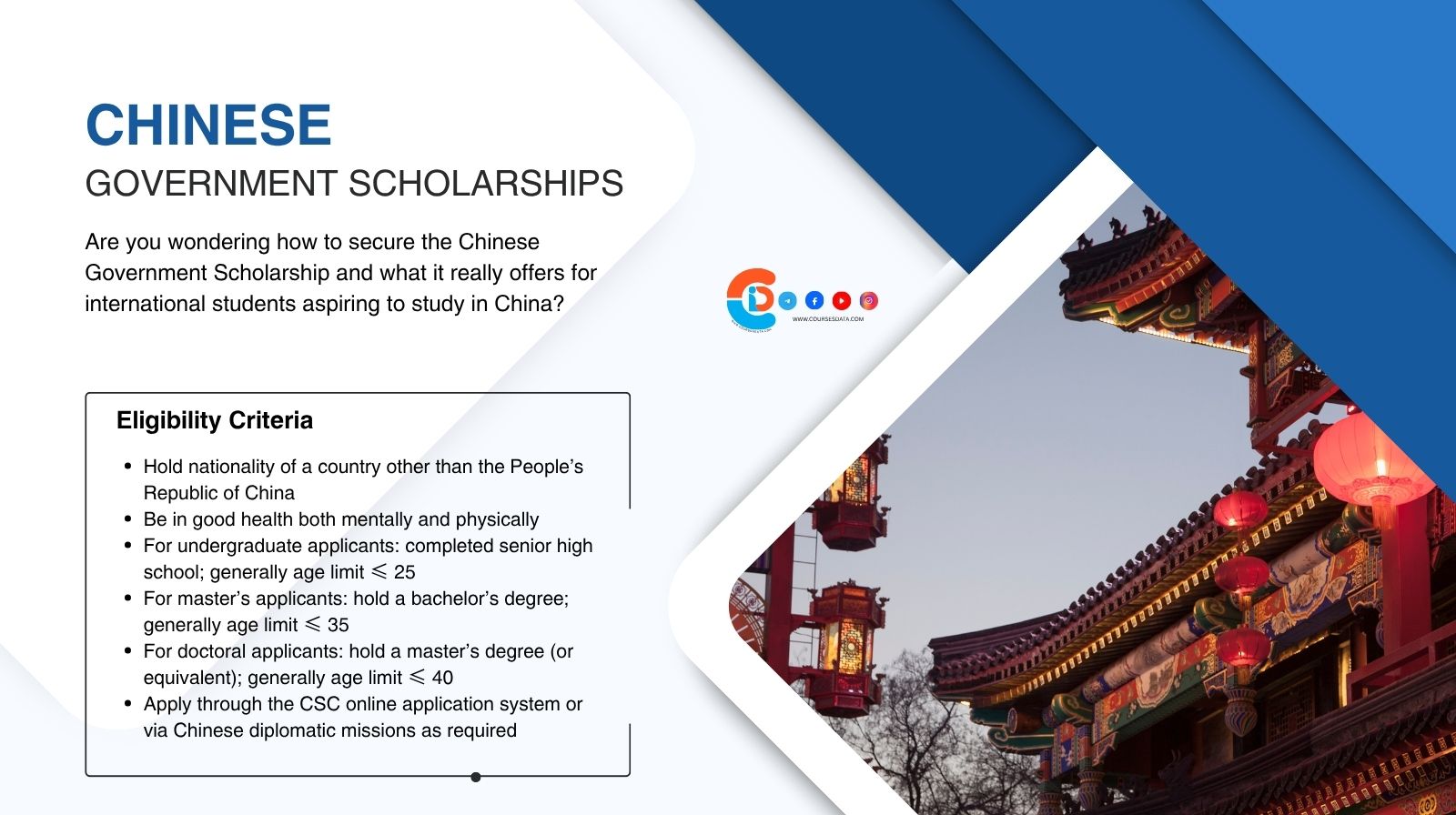
Are you wondering how to secure the Chinese Government Scholarship and what it really offers for international students aspiring to study in China? Here’s a comprehensive guide packed with real facts, eligibility criteria, benefits, application timelines, and tips for the Chinese Government Scholarship (CGS) program.
What is the Chinese Government Scholarship?
The Chinese Government Scholarship is a fully funded grant provided by the Chinese government through the China Scholarship Council (CSC) to support international students, scholars and researchers to study or conduct research in China. It covers a variety of degree levels and programs. The aim is to promote academic exchange and development of global talent.
Eligibility and Application Requirements
To apply for the Chinese Government Scholarship you must meet specific criteria and gather required documents. Below is a list of key requirements and steps:
- Hold nationality of a country other than the People’s Republic of China
- Be in good health both mentally and physically
- For undergraduate applicants: completed senior high school; generally age limit ≤ 25
- For master’s applicants: hold a bachelor’s degree; generally age limit ≤ 35
- For doctoral applicants: hold a master’s degree (or equivalent); generally age limit ≤ 40
- Apply through the CSC online application system or via Chinese diplomatic missions as required
- Submit supporting documents (transcripts, degree certificates, recommendation letters, health certificate, passport copy)
- Some programs require Chinese language proficiency (e.g., HSK test) or accept preparation year of Chinese language
- If applying to a Chinese university, you may need an Admission Notice (“Pre-Admission Document”) from a Chinese higher education institution
Table: Summary of Educational Level and Age Limits
| Study Level | Educational Requirement | Age Limit |
|---|---|---|
| Undergraduate | Senior high school | ~25 years |
| Master’s | Bachelor’s degree | ≤35 years |
| Doctorate | Master’s degree | ≤40 years |
Coverage and Benefits of the Scholarship
This scholarship is a full scholarship program under many categories, meaning major costs are covered. Here’s what typical recipients receive:
- Tuition fee waiver for required courses or full programme
- Accommodation (on-campus or university dormitory) or allowance for lodging
- Living stipend for the duration of the study (monthly allowance)
- Medical insurance for international students and basic learning materials costs
- One-time settlement subsidy and inter-city travel allowance (in some cases)
Supported Study Levels and Duration
The Chinese Government Scholarship supports degree-seeking programmes at different levels and also non-degree research or language studies. Here’s an outline.
Supported Study Categories
- Undergraduate study (Bachelor’s degree) in Chinese universities
- Master’s degree study in China
- Doctoral degree study in China
- Chinese language study or preparatory Chinese course before major study
- General scholars (non-degree) and senior scholars (researchers) categories for shorter research periods
Typical Duration
- Undergraduate programmes: 4 years (medicine or some majors: 5 years)
- Master’s programmes: usually 2-3 years
- Doctoral programmes: generally 3 years
- Language preparatory year: 1 year before major study
Application Timeline and Process
Understanding when and how to apply is critical for success in the scholarship application.
Timeline Highlights
- Application window: typically from January through April each year
- Online application deadlines vary by country and university, often early March
- Final results announced around July
- Students begin studies in China at the start of the academic year (typically September)
Process Steps
- Step 1: Choose the kind of scholarship category (undergraduate, master, doctoral, language, general scholar, senior scholar)
- Step 2: Check eligible universities and majors participating under the CSC/CGS scheme
- Step 3: Collect and upload all required documents (transcripts, certificates, health form, passport copy, study plan, recommendation letters)
- Step 4: Submit the online application via the CSC system or affiliated university portal
- Step 5: If required, obtain a Pre-Admission Notice from the Chinese university before or during the application process
- Step 6: Begin waiting for selection results, complete visa and travel preparations upon success
Eligible Universities, Majors & Language Requirements
This section covers the universities, fields of study and language requirements under the scholarship.
Universities and Majors
- Over 270 Chinese universities participate under the Chinese Government Scholarship scheme
- Majors range widely: engineering, sciences, business, arts, medicine, humanities
- Applicants may select any major offered by a participating Chinese university subject to availability and admission
Language Requirements
- If the programme is taught in Chinese, proficiency in Chinese may be required (e.g., HSK level 3 or 4)
- Some programmes are taught in English, which may waive the Chinese language requirement
- A preparatory Chinese language year may be included if the applicant lacks required Chinese proficiency
Selection Criteria and Tips for Competitive Application
To increase your chances of securing the scholarship, you must understand how applications are evaluated and how you can prepare yourself.
Key Selection Criteria
- Academic performance: strong grades, transcripts, achievements
- Age and educational qualifications fitting the requirement for the study level
- Language ability (Chinese or English) and readiness to study in China
- Submission of complete and correct documents before deadline
- Study plan and motivation: demonstration of why you choose China and how you will benefit
- Recommendation letters from professors or supervisors
- Good health and ability to adapt to studying abroad
Application Tips
- Start preparing early: gather transcripts, certificates, identify recommenders
- Research universities and majors carefully to ensure fit
- Tailor your study plan: explain how studying in China aligns with your goals
- Learn some basic Chinese: it may help with daily life
- Meet deadlines precisely and check for any additional documents
- Check local embassy or recommending agency for additional requirements
Common Terms and Variations You Should Know
When researching the scholarship you’ll encounter various related terms; here’s what they mean:
- CSC Scholarship – same as the Chinese Government Scholarship
- Full scholarship – covers tuition, accommodation, stipend, insurance
- Preparatory Chinese language – a year of Chinese language study before major programme
- Pre-Admission Notice – a letter from the university affirming admission
- Study in China / Study China – international student programmes in China
- One-Belt-One-Road (OBOR) programme – some scholarships target students from OBOR countries
Frequently Asked Questions
Q: Can I apply if I already have another scholarship?
A: Most CGS applicants must not already be receiving a full scholarship elsewhere.
Q: What is the application deadline?
A: Usually January to April, with exact dates varying by country and university.
Q: Do I need to know Chinese?
A: Not always. English-taught programmes may waive this; others may require HSK or offer a preparatory year.
Q: What costs are covered?
A: Tuition, accommodation, stipend, insurance, and sometimes travel. International airfare is often not included.
Q: Can I apply to any university?
A: Only participating universities listed under the CSC/CGS scheme.
Q: What happens after I receive the scholarship?
A: You get an admission notice, apply for a visa, and begin studies in China.
Q: Are there short-term options?
A: Yes. Categories exist for language study and short-term research.
Q: What are my odds of selection?
A: It depends on competition, your qualifications, and completeness of your application.
Q: Can I change my major or university later?
A: Changes require approval and are generally discouraged.
Q: Is the funding guaranteed for longer study?
A: Only standard duration is covered. Extensions are not guaranteed.
Challenges and Considerations for Applicants
While the scholarship offers excellent opportunities, be aware of the following:
- Adapting to Chinese culture and language takes time
- Visa and residency regulations must be followed
- Major availability differs across universities
- High competition requires thorough preparation
- Living costs vary by city; stipends may not fully cover expenses
- Some programmes require Chinese proficiency or a preparatory year
- Policy changes or new requirements may arise each year
Why Choose the Chinese Government Scholarship?
Choosing the Chinese Government Scholarship can provide significant advantages if you’re considering studying abroad.
- Receive full funding for your study journey
- Study in one of the world’s top education markets
- Gain global credentials and new perspectives
- Access diverse academic and research options
- Build international networks and career skills
Conclusion
The Chinese Government Scholarship offers a compelling pathway for international students seeking full support to study in China. With its comprehensive benefit package, global academic environment and diverse programmes, it stands out as an excellent opportunity for motivated applicants.
I applied for the Chinese Government Scholarship two years ago, and honestly, the timeline was the trickiest part—I almost missed the window because different universities have their own internal deadlines before the CSC cutoff. One thing I wish the post emphasized more is that the “fully funded” label really means everything: tuition, accommodation, a monthly stipend, and even comprehensive medical insurance, which saved me a huge headache when I got sick in Beijing. For anyone considering this, I’d suggest reaching out to your target university’s international office early—they often have tips on how to strengthen your application for the specific programs they prioritize.
That’s a solid point about the internal deadlines—most people fixate on the CSC cutoff and miss the real key date. The insurance part is underrated too; I had a friend who needed emergency dental work in Shanghai and the bill would’ve been brutal without it. Best advice is to email the international office before you even start the application, not after.
You’re absolutely right about the insurance—I remember a classmate who needed an emergency root canal in Nanjing, and she walked out with zero out-of-pocket costs thanks to that CSC coverage. And yes, contacting the international office early is a game-changer; they let me know they preferred applicants with research proposals aligned to their current faculty projects, which gave my application a real edge.
Lindiwe, your point about aligning research proposals with faculty projects really resonates—that’s exactly how I got my edge too. I spent two weeks combing through my target university’s website to find a professor whose work matched my background, and when I mentioned his name in my statement, the international office fast-tracked my file. That hospital story is wild, but it proves how the insurance is a silent game-changer for anyone nervous about health costs abroad.
Oh, brilliant—so the secret sauce to getting a government scholarship is just stalking faculty pages until you find a professor who’s willing to be name-dropped. Who knew academic stalking could be so lucrative? But honestly, that insurance bit is the real hero here; nothing says “fully funded” like walking out of a root canal without checking your bank account.
Ah, the “academic stalking” approach—hard to argue with results, even if it feels a bit like crafting a Tinder bio to impress someone you’ve never met. And you’re dead right about the insurance; nothing says “fully funded” like getting a cavity filled without wondering if you’ll have to sell a kidney to pay for it.
That bit about name-dropping a specific professor is clever—I did something similar, and it felt a bit like academic stalking until my application got flagged for priority review. The insurance really is the unsung hero of the whole package; nothing makes you appreciate “fully funded” quite like a trip to the hospital that costs you nothing but time.
That’s a great point about the internal deadlines—I’ve seen a few people miss out just because they assumed the CSC cutoff was the only date to watch. I’m curious, did you find that the monthly stipend actually covers living costs comfortably in a city like Beijing, or did you have to supplement it? Also, practical tip for anyone reading: get your documents notarized and translated well in advance, because last-minute rushing with the health check forms can throw off your whole application.
Honestly, the stipend in Beijing was tight but doable—I had to budget carefully for eating out and metro fares, but rent and utilities were covered, so I never went into my own savings. That tip about notarized documents is spot-on; I saw a guy in my orientation group get disqualified because his health check wasn’t stamped by the right hospital. Start gathering those papers at least two months before the internal deadline, not the CSC one.
Yeah, the stipend in Beijing was tight but manageable—I never had to dip into savings, but I definitely skipped pricier restaurants and stuck to the campus cafeterias most days. The real lifesaver was that accommodation and utilities were fully covered, so my monthly money went straight to food, transit, and a bit of fun. And I can’t second that document advice enough; I nearly lost my spot because my health form wasn’t stamped by the right hospital, so get that sorted way before the internal deadline.