Are you looking for fully funded scholarships in Organization of Islamic Cooperation (OIC) countries?
Many OIC member states offer generous scholarships for international students, especially those from other Muslim-majority countries. These scholarships cover tuition fees, living expenses, travel, and more, aiming to foster cooperation and academic exchange across the Islamic world.
What Are OIC Scholarships?
OIC scholarships are educational funding programs offered by member states of the Organization of Islamic Cooperation. These scholarships aim to promote academic collaboration, skill development, and cultural exchange among Muslim-majority countries.
Key Features of OIC Scholarships
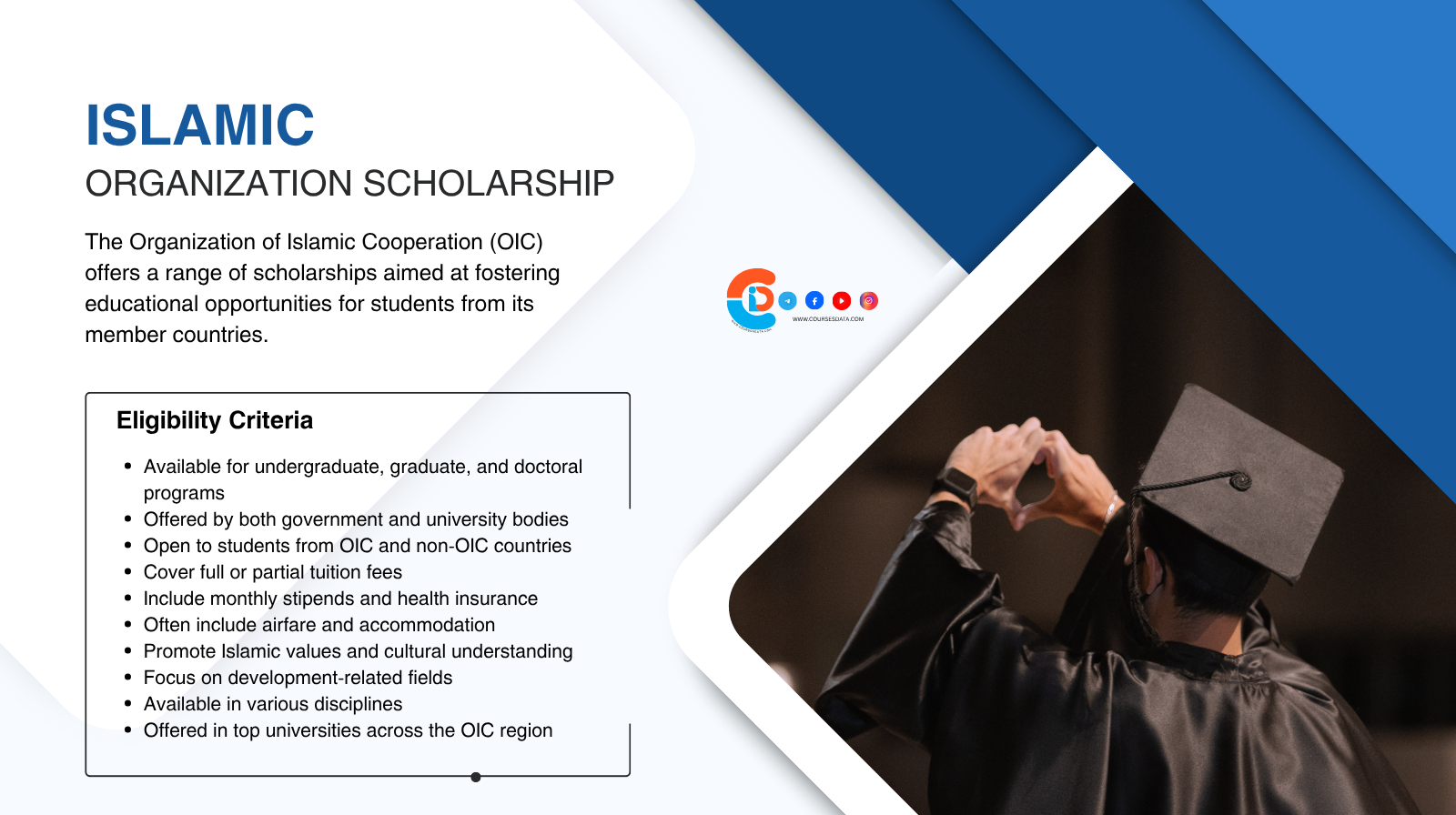
- Available for undergraduate, graduate, and doctoral programs
- Offered by both government and university bodies
- Open to students from OIC and non-OIC countries
- Cover full or partial tuition fees
- Include monthly stipends and health insurance
- Often include airfare and accommodation
- Promote Islamic values and cultural understanding
- Focus on development-related fields
- Available in various disciplines
- Offered in top universities across the OIC region
Top Countries Offering OIC Scholarships
Several OIC member countries offer competitive scholarships to international students. These programs are well-funded and academically recognized.
Leading OIC Scholarship Providers
- Turkey: Turkiye Burslari Scholarship Program
- Malaysia: MTCP Scholarships, IIUM Scholarships
- Saudi Arabia: King Abdullah, Islamic University of Madinah
- Pakistan: HEC and COMSATS scholarships for OIC nationals
- Indonesia: KNB Scholarship, Islamic University of Indonesia
- Iran: Al-Mustafa International University
- Egypt: Al-Azhar University grants
- Qatar: Qatar University Scholarships
- UAE: Khalifa University, UAEU Scholarships
- Morocco: Moroccan Agency of International Cooperation (AMCI)
Turkiye Burslari: Turkey’s Premier OIC Scholarship
The Turkiye Burslari program is one of the most sought-after scholarships among students from Muslim-majority countries.
Turkiye Burslari Benefits
- Fully funded programs from bachelor’s to PhD
- Monthly stipend (up to $500 for PhD students)
- Free Turkish language course for one year
- University placement provided by the state
- Round-trip airfare
- Full health insurance
- Accommodation provided
- Access to academic seminars and workshops
- Cultural immersion programs
- Open to students from 100+ countries
Malaysian Scholarships for OIC Students
Malaysia, as a major education hub, offers scholarships through its government and Islamic institutions.
Major Malaysian Scholarships
- MTCP Scholarship (for postgraduate studies)
- IIUM Scholarships (undergraduate and graduate)
- UTM and USM scholarships for international students
- Zakat aid for needy students
- ASEAN and Islamic scholarships
- Full tuition coverage
- Living allowance included
- Study at globally ranked universities
- English-medium instruction
- Strong academic support system
Saudi Arabia’s Academic Opportunities
Saudi Arabia offers prestigious scholarships that attract thousands of students annually from OIC countries.
Notable Saudi Scholarships
- Islamic University of Madinah (for Islamic studies)
- King Abdulaziz University Scholarships
- King Fahd University of Petroleum and Minerals
- KAUST Graduate Scholarships
- Monthly stipend and free housing
- Medical care included
- Travel allowance
- Strong focus on STEM and Islamic studies
- Welcomes students from across the Islamic world
- English and Arabic instruction
How to Apply for OIC Scholarships
Application procedures vary by country and institution but usually follow similar steps.
Common Application Requirements
- Valid passport or national ID
- Academic transcripts and certificates
- Statement of purpose or motivation letter
- Letters of recommendation
- Language proficiency test results (English/Arabic/Turkish)
- Medical report or health clearance
- Online application form
- Interview (in some cases)
- Specific forms per country
- Submission within the deadline period
Eligibility Criteria for OIC Scholarships
Most scholarships have standard eligibility conditions, although specifics may vary.
Typical Eligibility Requirements
- Citizenship of an OIC or eligible developing country
- Minimum academic achievement (e.g., 70%+ GPA)
- Age limits (usually under 25 for undergraduate)
- Good health and clean legal record
- Language proficiency
- Commitment to return and serve home country
- No simultaneous scholarships
- Strong academic and leadership background
- Interest in Islamic values and cooperation
- Field of study relevance to OIC goals
Popular Fields of Study in OIC Scholarships
OIC scholarships prioritize areas aligned with developmental needs and Islamic cooperation.
Common Disciplines Offered
- Islamic Studies and Shariah Law
- Medicine and Health Sciences
- Engineering and Technology
- Business and Economics
- Agriculture and Food Security
- Environmental Science
- Political Science and International Relations
- Education and Teacher Training
- Social Sciences
- Natural Sciences
Scholarships by the Islamic Development Bank (IsDB)
The Islamic Development Bank (IsDB) runs a well-known scholarship program targeting development-focused students.
Highlights of the IsDB Scholarship
- Undergraduate, Master’s, PhD, and Post-Doctoral support
- Fully funded including tuition, travel, living allowance
- Priority to STEM and development-related fields
- Partner institutions in OIC member states
- Return service obligation after graduation
- Focus on community development projects
- Offered in multiple languages
- Emphasis on leadership and entrepreneurship
- Annual call for applications
- Available to both men and women
Benefits of Studying in OIC Countries
Studying in an OIC country offers cultural familiarity and valuable academic networks.
Advantages for International Students
- Shared religious and cultural values
- Affordable cost of living
- High-quality education
- Multicultural academic environments
- Career opportunities in OIC economies
- Government-funded facilities and labs
- Strong alumni networks
- Internship and job placement support
- Safe and supportive societies
- Halal food and religious freedom
Frequently Asked Questions
What are OIC scholarships?
OIC scholarships are educational grants provided by member countries of the Organization of Islamic Cooperation to support students, especially from Muslim-majority nations.
Who can apply for OIC scholarships?
Applicants must typically be citizens of OIC countries or Muslim communities and meet academic, health, and language requirements.
Are OIC scholarships fully funded?
Yes, most are fully funded, covering tuition, living expenses, airfare, and more.
Can non-Muslim students apply for OIC scholarships?
Some programs are open to non-Muslim applicants, especially if they reside in OIC countries or support cooperation goals.
Is knowledge of Arabic or Turkish mandatory?
Language requirements vary. Many programs offer courses in English or provide a language preparatory year.
How competitive are these scholarships?
They are highly competitive, especially those from Turkey, Saudi Arabia, and IsDB, due to full funding and global recognition.
When do applications open for OIC scholarships?
Most programs open between December and April, with some variations depending on the country.
Do OIC scholarships require a service obligation?
Yes, particularly IsDB scholarships require students to return and contribute to development in their home country.
Can I work while studying on an OIC scholarship?
Work rights vary by country, but academic performance must be prioritized.
Where can I find more information?
Each scholarship has its own portal, usually through the education ministry or a national scholarship body.
Conclusion
OIC scholarships provide a gateway to quality education, cultural exchange, and impactful careers.
They are ideal for students committed to academic growth and Islamic cooperation.
Right, so I skimmed the part about these being open to non-OIC countries too—does that actually happen in practice, or is it mostly just on paper? I’ve seen a few of these schemes before, and the application process can be a right maze of deadlines and notarised copies. Still, if you’re from a Muslim-majority country and don’t mind a bit of paperwork, it’s probably worth digging into the specific offers from places like Saudi or Malaysia.
It’s not just on paper—non-OIC students do get accepted, but the funding often shrinks. I’ve seen programs where they cover full tuition for anyone, but the living stipend only kicks in if you’re from an OIC member state. The real catch is that you have to read the fine print on each country’s specific offer, because the broad “open to all” claim hides those tiered benefits. If you’re from outside the OIC, Malaysia’s scholarships tend to be more straightforward with fewer hidden conditions.
Oh, the “open to all” bit is about as reliable as a free buffet sign that turns out to be just bread and water. In practice, non-OIC students do squeeze through, but the funding often gets whittled down to just tuition while the living stipend mysteriously evaporates. If you’re from outside the club, Malaysia tends to be the most honest about it—fewer hidden traps, though you’ll still want a magnifying glass for the fine print.
Yeah, it’s real, but like everyone’s said, the fine print matters way more than the glossy brochure. I’m from a non-OIC country and got into a Malaysian program—tuition was covered, but my living stipend was half what a mate from an OIC nation got in the same batch. So if you’re not from a member state, don’t just look at the headline; check the exact breakdown for each country’s offer before you invest in all that notarising.
Oh, it’s real enough—I’ve seen non-OIC students get in, but the funding gets tiered faster than a London bus fare. You’ll land the tuition, sure, but that living stipend often shrinks to pocket money unless you’re from a member state. The paperwork is indeed a labyrinth, but if you’re from a Muslim-majority country, you’re already ahead of the game—just keep a magnifying glass handy for the fine print.
Yeah, that “tiered faster than a London bus fare” is spot on—I’ve seen the same thing with a mate who got into a Saudi program. He thought he was sorted until the living stipend turned out to be about a third of what a classmate from an OIC country got, even though both were in the same lab. The real trick is to find the actual funding breakdown PDF before you even start the paperwork, because the main page is always just the shiny headline.
Oh, I actually applied for one of these a few years back—the Saudi one for postgraduate studies. The paperwork was brutal, but what really caught me off guard was how specific they were about your home country needing to be an OIC member for certain benefits, even though the general guidelines said “open to all.” Did anyone else run into that weird fine print where some scholarships only cover full living expenses if you’re from a fellow OIC nation, while others just give you a partial stipend?
Oh, you’ve hit the nail on the head, Bronwyn. I went through the same shock with a Turkish OIC scholarship—they advertised it as “fully funded,” but my stipend was noticeably smaller than what a friend from an OIC country received, even though we were in the same program. It’s that hidden tier system that really gets you; you assume “open to all” means equal treatment, but the funding often breaks down along membership lines. I’d say it’s worth digging into each country’s specific offer sheet, because the general promises rarely tell the full story.
Saudi’s offer looks great on paper, but I learned the hard way that “fully funded” can mean different things depending on where you’re from. My application went smoothly until I realized the living allowance was clearly scaled back because my home country isn’t in the OIC. If you’re outside the bloc, don’t just skim the main page—hunt down the exact breakdown for tuition versus stipend before you spend hours on notarized copies.
Oh, Jean-Paul, you’ve summed up exactly what I stumbled into with my own application to a Turkish program last year. I was so relieved when the tuition was covered that I didn’t notice the living stipend was barely enough for groceries, while a classmate from an OIC country was comfortably housed. It’s like they bury the real numbers in a separate PDF, so now I always tell friends to compare the fine print side-by-side before they even open the notary folder.