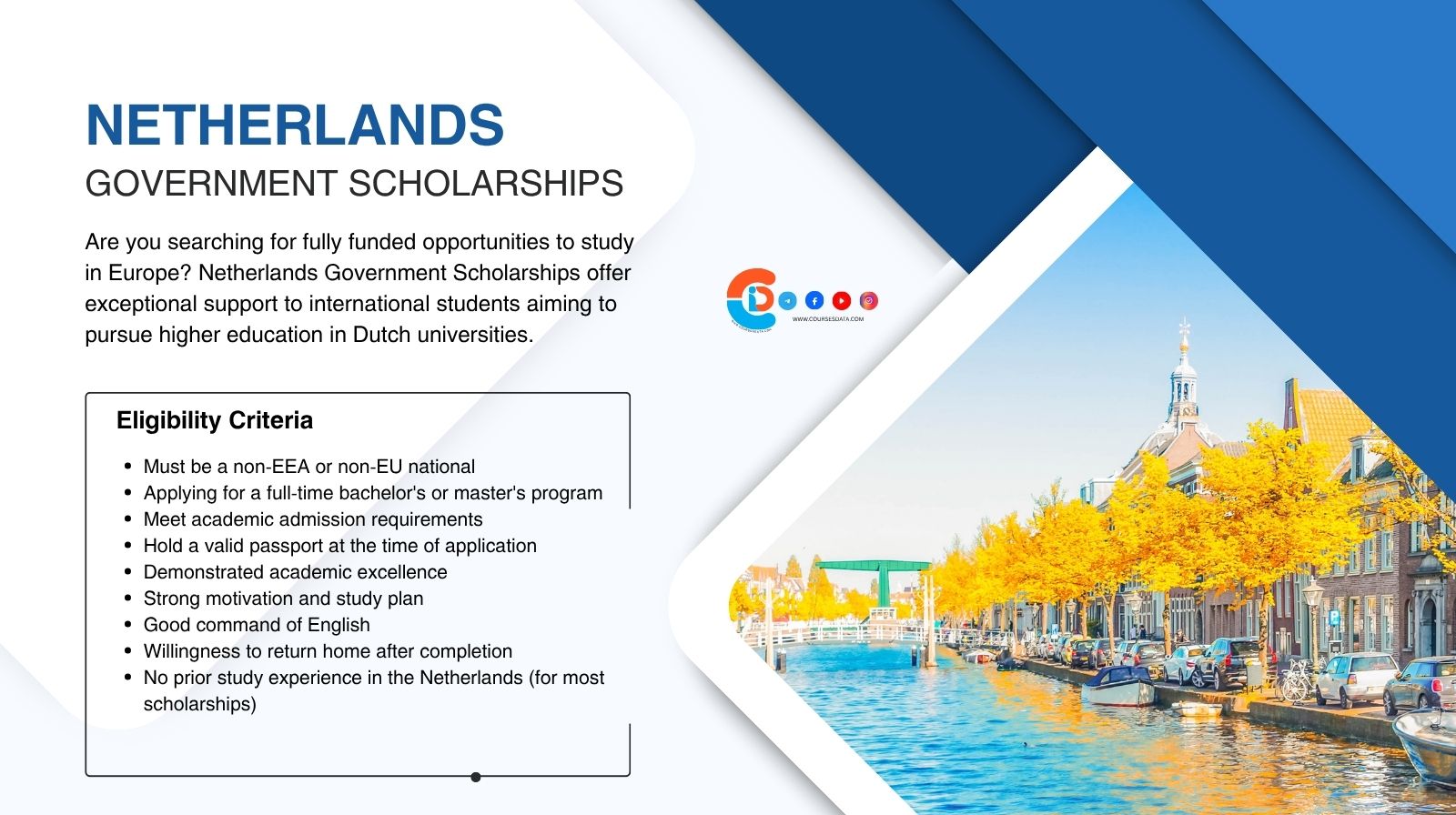
Netherlands Government Scholarships generally refers to the NL Scholarship, a national scholarship supported by the Dutch Ministry of Education, Culture and Science together with participating Dutch higher education institutions.
For eligible non-EEA students, it provides €5,000 during the first year, but it is not a full-tuition scholarship, so applicants should plan for the remaining tuition and living costs.
What Are Netherlands Government Scholarships?
The NL Scholarship is the main national scholarship programme commonly associated with Netherlands Government Scholarships for international students.
It is designed primarily to attract talented students from outside the European Economic Area to Dutch higher education.
A key point is that the scholarship is jointly financed by the Dutch Ministry of Education, Culture and Science and participating Dutch universities and universities of applied sciences.
The scholarship can be relevant to students planning either a bachelor’s or master’s degree at a participating institution.
- Intended mainly for non-EEA international students
- Available for selected bachelor’s and master’s programmes
- Award value: €5,000
- Scholarship is paid in the first year
- It does not cover the full tuition fee
The most important distinction is simple: the NL Scholarship offers financial support, but it should not be treated as a fully funded study package.
Who Can Apply for the NL Scholarship?

Eligibility is determined by both the general scholarship rules and the requirements of the Dutch institution where you are applying.
Applicants must normally be nationals of a country outside the EEA and apply for a full-time bachelor’s or master’s programme at a participating Dutch higher education institution.
You must also satisfy the admission requirements of the specific university or university of applied sciences.
Those requirements can differ according to the programme and institution.
- You must normally have non-EEA nationality
- You must apply to a participating institution
- Your programme must be a full-time bachelor’s or master’s programme
- You must meet the institution’s admission and scholarship criteria
- You must not already hold a degree from a Dutch educational institution
Nationality alone does not guarantee a scholarship.
A student can meet the general conditions but still fail to qualify because the chosen institution or programme has additional selection requirements.
What Does the Netherlands Scholarship Cover?
The NL Scholarship provides €5,000, which is awarded during the first year of study.
The official programme information states that this is not a full-tuition scholarship.
This means applicants should calculate the total cost of studying before submitting an application.
For non-EEA students, tuition fees can vary substantially depending on the programme.
Living expenses are separate and can include housing, food, transportation, insurance and study materials.
| Funding item | NL Scholarship |
|---|---|
| Scholarship value | €5,000 |
| Payment period | First year |
| Tuition fully covered? | No |
| Bachelor’s study | Available at participating institutions |
| Master’s study | Available at participating institutions |
| Living costs fully covered? | No |
| Application route | Through the participating institution |
The remaining budget may need to come from personal funds, family support, another scholarship, savings, or other permitted sources of financing.
Students should also budget for accommodation, food, insurance, transportation, study materials and residence-related expenses.
How to Find Participating Universities
The list of participating institutions is not identical across all application periods, and not every programme at a participating institution necessarily offers the scholarship.
Applicants should check the participating institution’s own website for the available fields of study, selection criteria and application requirements.
Examples of participating Dutch institutions can include research universities and universities of applied sciences such as:
- Eindhoven University of Technology
- Maastricht University
- University of Groningen
- University of Twente
- Radboud University
- Hanze University of Applied Sciences
- Saxion University of Applied Sciences
- NHL Stenden University of Applied Sciences
The safest approach is to start with the official NL Scholarship information and then move to the website of the institution offering your intended programme.
Do not assume that a university offering the NL Scholarship offers it for every degree.
How to Apply for Netherlands Government Scholarships

Applying for Netherlands Government Scholarships usually requires you to begin with the academic programme rather than treating the scholarship as a completely separate application.
A practical application process looks like this:
- Choose an eligible bachelor’s or master’s programme
- Check whether the institution participates in the NL Scholarship
- Review academic and language requirements
- Prepare the required admission documents
- Submit the programme application
- Complete the scholarship application requested by the institution
Depending on the institution, applicants may be asked for materials such as a motivation letter, English-language test results, academic records or other supporting documents.
Requirements are not identical across institutions, so applicants should always follow the instructions published by their chosen university.
Do not prepare the scholarship application in isolation. The programme admission requirements can determine whether you are eligible to continue with the scholarship process.
How to Strengthen Your Application
Because selection can involve institution-specific criteria, a strong application should connect your academic background with the programme you are applying for.
Your motivation letter should explain why the chosen programme fits your academic interests and future plans rather than simply stating that you need financial support.
Useful preparation includes:
- Presenting a clear academic record
- Matching your previous studies with the selected programme
- Writing a specific motivation letter
- Checking the required language evidence carefully
- Preparing supporting documents before the institutional deadline
Avoid using the same generic motivation letter for every university.
A more useful application explains the specific connection between your background, the programme and your academic objectives.
Costs You Still Need to Plan For
One of the biggest mistakes applicants make is seeing the €5,000 scholarship and assuming that most study expenses will disappear.
For non-EEA students, tuition alone can be substantial, and living expenses must be considered separately.
Some institutions may also charge an application or handling fee to certain non-EEA applicants.
Before applying, create a simple financial plan covering:
- Remaining tuition after the scholarship
- Accommodation and daily living expenses
- Health insurance and other required costs
- Travel and relocation expenses
- Application or handling fees where applicable
International students should also check immigration requirements.
Depending on nationality and circumstances, studying in the Netherlands can require a residence permit and, in some cases, an MVV.
Students should also check the rules governing work alongside study, because employment conditions can apply to international students.
Netherlands Government Scholarships: Practical Application Checklist
Before submitting an application, review the following points carefully.

- Confirm that your nationality meets the scholarship conditions
- Confirm that your institution and programme participate
- Read the university’s specific selection criteria
- Check the admission requirements separately
- Prepare financial proof and a realistic budget
- Submit every required document before the institutional deadline
Application deadlines are not necessarily the same from one institution or programme to another, so applicants should rely on the official university page for the final deadline.
A useful strategy is to maintain one application folder containing your passport information, academic transcripts, language certificate, CV, motivation letter and any programme-specific documents.
Conclusion
Netherlands Government Scholarships can provide financial assistance for eligible international students, but the NL Scholarship should not be presented as a fully funded scholarship.
The programme provides €5,000 in the first year, while students remain responsible for the rest of their tuition and other study-related costs.
The strongest starting point is to choose an eligible Dutch programme, verify participation in the NL Scholarship, complete the university admission process and then follow that institution’s scholarship instructions.
Frequently Asked Questions
Is the NL Scholarship a fully funded scholarship?
No.
The NL Scholarship provides €5,000 during the first year, but it does not cover all tuition and living costs.
Students therefore need additional financial resources for the remaining expenses.
Who is eligible for Netherlands Government Scholarships?
The NL Scholarship is primarily intended for international students from outside the EEA who want to study a full-time bachelor’s or master’s programme at a participating Dutch higher education institution.
Additional institutional requirements also apply.
Can I apply for the scholarship without applying to a university?
The scholarship is linked to participating Dutch higher education institutions, so applicants normally need to select an eligible programme and follow the institution’s admission and scholarship process.
Can bachelor’s students apply for the NL Scholarship?
Yes.
The NL Scholarship is available for eligible full-time bachelor’s programmes at participating institutions, subject to the institution’s programme and selection requirements.
Can master’s students apply for Netherlands Government Scholarships?
Yes.
Eligible international applicants can apply for participating full-time master’s programmes, provided they satisfy both the general scholarship criteria and the requirements of the institution and programme.
Does the scholarship cover accommodation?
The NL Scholarship provides €5,000 during the first year and is not designed as comprehensive accommodation funding.
Applicants should therefore prepare a separate budget for housing and daily living expenses.
Do I need IELTS for the NL Scholarship?
There is no single scholarship-wide IELTS requirement that applies to every applicant.
English-language requirements are normally determined by the individual institution and programme.
Do all Dutch universities offer this scholarship?
No.
The NL Scholarship is offered through participating higher education institutions, and available programmes can differ.
Applicants should verify participation directly with the relevant university or university of applied sciences.
Can I combine the NL Scholarship with other funding?
Whether the NL Scholarship can be combined with another source of funding depends on the rules of the specific scholarship, institution and funding provider.
Applicants should check the conditions before accepting multiple awards.
Where should I check the official application requirements?
Start with the official NL Scholarship information and then check the website of the Dutch institution offering your chosen programme.
The institution should be treated as the final source for programme-specific eligibility, documents and application instructions.
I actually applied for one of these last year and the application timeline was way tighter than I expected—make sure you double-check the specific university deadlines, because some close as early as February. One thing I wish I’d known is that the monthly allowance often doesn’t cover rent in cities like Amsterdam or Utrecht unless you find shared housing early. Did you have any luck getting clarity on whether the scholarship covers visa costs, or is that strictly on the student?
Oh, the shared housing tip is so real—I learned that the hard way too. For the visa costs, from my experience, the scholarship only covered the residence permit fee, and I had to pay the rest out of pocket for the entry visa and legalization. Definitely budget an extra few hundred euros for that part.
That’s a good point about the rent—I was looking at programs in Groningen, and even there the allowance felt tight when I ran the numbers. On the visa question, from what I’ve read the scholarship usually only covers the residence permit application fee, not the full visa process or any legalization costs, so you’re still out a few hundred euros upfront. Has anyone here actually gotten the monthly stipend adjusted for inflation, or is it the same flat rate they’ve used for years?
Oh, inflation adjustment—that’s cute you think the Dutch government keeps up with the cost of living like they’re running a charity. The stipend is the same flat rate they’ve been using since the last ice age, so unless you’re planning to live off instant noodles and pure spite, definitely budget for a part-time gig. And you’re spot on about the visa costs—they cover the permit fee, but that’s like getting a free appetizer when the main course costs your firstborn.
DeShawn, you’ve nailed it—the flat rate is practically a historical artifact at this point. I remember running the numbers for a friend in Rotterdam, and the stipend barely covered half her rent in a shared flat near the city center, let alone groceries or a train pass. The “free appetizer” analogy is spot-on too; that visa fee coverage feels like a cruel joke when you’re already scraping together your firstborn’s ransom for the rest.
DeShawn, you absolutely nailed it with that “instant noodles and pure spite” line—I’m still laughing, but also wincing because it’s so painfully true. When I applied, I remember thinking the stipend would be plenty until I actually looked at rental listings in Rotterdam and realized I’d be lucky to afford a broom closet. That “free appetizer” analogy is perfect too; the visa fee coverage feels like they’re handing you a coupon while the actual bill is due in full before you even board the plane.
It’s so helpful to hear about the real costs behind the scholarship—thanks for flagging the rent issue in Groningen, Mackenzie. I’m curious, has anyone here had success negotiating a part-time job on a student visa to supplement the allowance, or do most programs restrict that to a certain number of hours per week? Also, Megan, your tip about the February deadlines is gold—I’ve already started marking my calendar so I don’t miss the window.
Yeah, the flat rate thing is a bit of a joke when you’re looking at actual rent prices. I’d add that what they don’t tell you is most of these scholarships are tied to specific programs, so you can’t just apply to any random degree and hope for the best—check which faculties actually have the funding first. Also, on the job question, the standard is 16 hours a week during term and full-time in summer, but good luck finding a gig that fits around a Dutch uni schedule.
The shared housing tip is absolutely key—I’ve seen people assume the monthly stipend will cover a solo studio, and that’s just not realistic unless you’re in a smaller city. On the visa front, it’s frustrating that the entry visa and legalization costs aren’t included, because that can easily run you €300-€500 before you even land. Has anyone found a reliable way to get those costs reimbursed through the university, or is it always on the student?
Man, the rent thing really hit home for me—I was looking at Rotterdam and got excited about the scholarship amount until I actually checked what a basic room goes for there. On the visa side, I’d add that some universities will front the residence permit fee but then ask you to pay it back from your first stipend installment, which can really mess with your move-in cash flow. Has anyone had luck getting a clear breakdown of exactly what the “tuition fee waiver” part covers, or is it just a flat percentage they apply to the bill?