
Studying for an MBA in Belgium can be a practical option for professionals who already have several years of work experience and want to move into management, leadership, consulting, entrepreneurship, or international business.
For many MBA programmes, around two to three years of professional experience places applicants closer to the expected profile, although the exact requirement depends on the school and programme.
Why Work Experience Matters for an MBA in Belgium
An MBA is generally designed for professionals rather than students entering higher education directly after a bachelor’s degree.
Classroom discussions, case studies, group projects, and leadership exercises often rely on students bringing real workplace situations into the learning process.
For this reason, business schools may use professional experience as an admission requirement rather than treating it as an optional advantage.
- Work experience gives you practical examples to discuss in interviews and essays.
- Professional experience can help you understand finance, marketing, operations, strategy, and management concepts more easily.
- Your previous roles can influence which MBA specialisations and career paths make the most sense.
“The value of work experience is not only the number of months you have worked, but what you learned and achieved during that time.”
A candidate with two years of relevant responsibility may therefore have a stronger application than someone with more experience but limited progression or unclear career goals.
Is 2-3 Years of Experience Enough?

There is no single Belgian MBA rule requiring exactly two or three years of work experience.
The requirement is set by each institution and can also depend on whether you are applying for a full-time MBA, Executive MBA, or another management programme.
For example, Vlerick Business School currently requires at least three years of full-time, post-degree work experience for its Full-time MBA.
Its Executive MBA programmes require more professional experience.
Solvay Brussels School’s Executive MBA lists a minimum of three years of professional experience among its key admission criteria.
Antwerp Management School has a higher professional-experience threshold for its Executive MBA, requiring at least five years of work experience.
This means that the phrase “2-3 years work experience needed” should be understood as a useful target for certain MBA applicants, not as a universal admission rule for every MBA in Belgium.
- Around two years can be enough for some programmes, but you must check the individual admission criteria.
- Three years is a clearly stated minimum for some well-known Belgian MBA programmes.
- Executive MBA programmes may expect substantially more experience.
MBA Admission Requirements in Belgium
Work experience is only one part of the application.
Business schools normally assess your academic background, English ability, professional history, motivation, and readiness for graduate-level business study.
Vlerick, for example, requires a recognised university degree together with the stated professional-experience requirement for its Full-time MBA.
Applicants can use the school’s own admissions test or accepted GMAT/GRE routes, followed by an interview.
Solvay’s Executive MBA lists a higher-education diploma, professional experience, English proficiency, and an admissions assessment route among its criteria.
Before applying, prepare these core elements:
- University degree or recognised equivalent.
- CV showing your responsibilities and professional progression.
- Proof of English ability where required.
- Admissions test results or the school’s alternative assessment.
- Motivation statement and interview preparation.
The exact documents can differ, so applicants should always use the official admission page of the programme they are targeting.
Examples of MBA Options in Belgium

Belgium has several business schools offering MBA or Executive MBA programmes, but their target students are not identical.
| Business school | Programme example | Professional experience stated by school | Study format |
|---|---|---|---|
| Vlerick Business School | Full-time MBA | At least 3 years | Full-time |
| Vlerick Business School | Executive MBA | At least 4 years | Executive |
| Solvay Brussels School | Executive MBA | Minimum 3 years | Executive |
| Antwerp Management School | Executive MBA | At least 5 years | Part-time |
The table illustrates why checking the programme rather than searching only for “MBA in Belgium” is important.
Vlerick’s Full-time MBA specifically requires at least three years of full-time post-degree experience, while its Executive MBA and the programmes at the other schools listed have different thresholds.
Vlerick Business School
Vlerick’s Full-time MBA is aimed at candidates with at least three years of full-time post-degree work experience.
The school also states that the programme is intensive and requires on-campus study during normal working hours, so it is not designed to be completed alongside a full-time job.
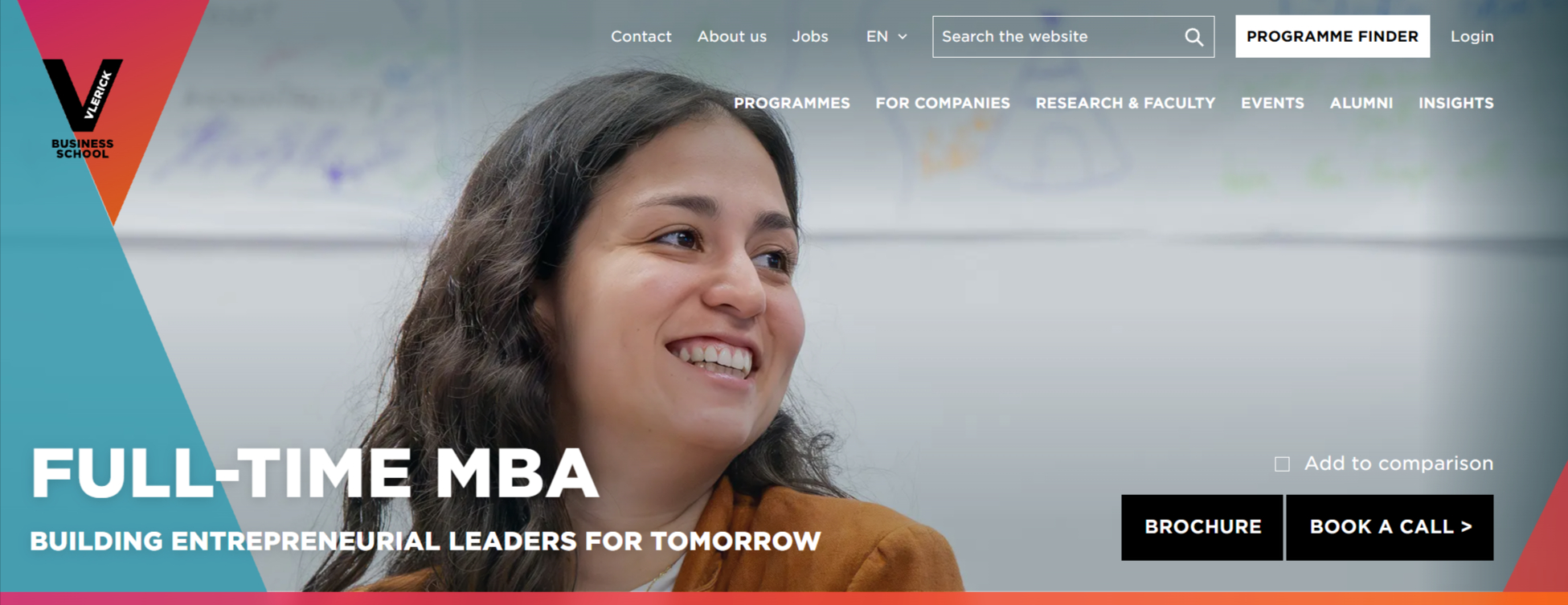
Official programme information: Vlerick Full-time MBA
Solvay Brussels School
Solvay’s Executive MBA is delivered in English and is designed for professionals who want to continue developing their careers while studying.
The school states a minimum of three years of professional experience, together with academic, English-language, and admissions-test requirements.
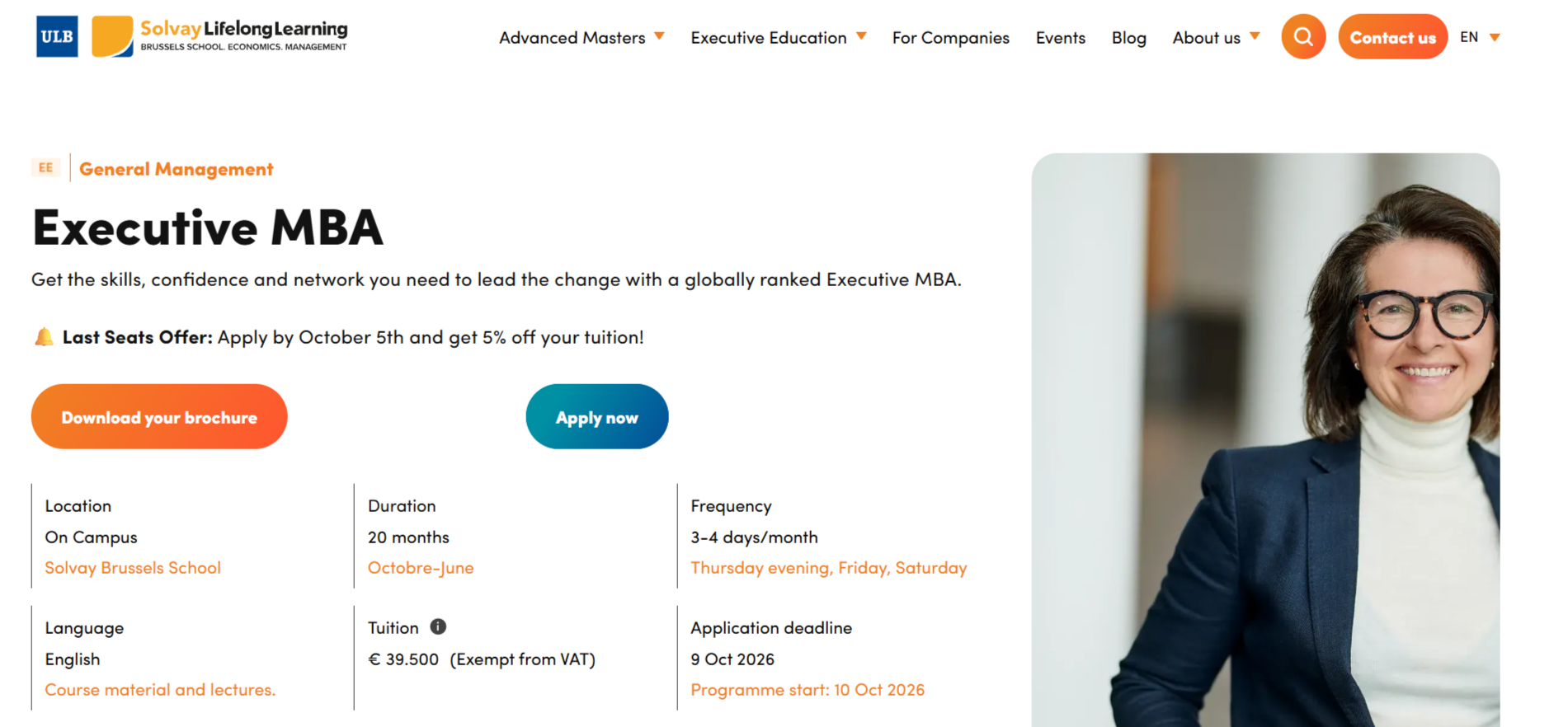
Official programme information: Solvay Executive MBA
Antwerp Management School
The Antwerp Management School Executive MBA requires at least five years of work experience and is structured for professionals who need to combine study with an existing career.
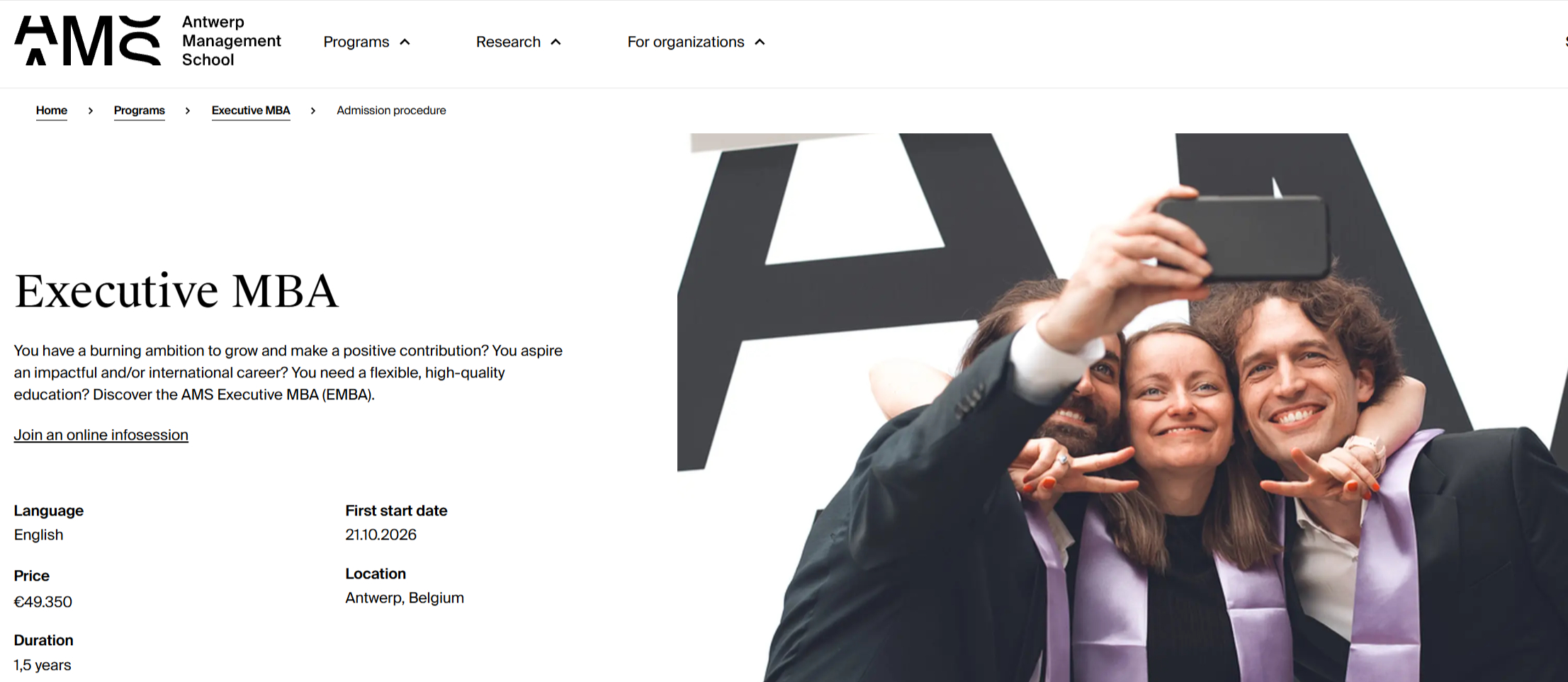
This makes it less suitable for someone who has only recently entered the workforce.
Official programme information: Antwerp Management School Executive MBA
How to Build a Strong MBA Application With 2-3 Years of Experience
Having the required number of years does not automatically make an application competitive.
What matters is how clearly you demonstrate what you have done during that period.
A strong professional profile should connect your experience to your future management goals.
Focus on:
- Responsibilities rather than only job titles.
- Measurable achievements where you can document them.
- Leadership, teamwork, project ownership, or decision-making experience.
- A clear reason for needing an MBA at this stage of your career.
For example, an applicant with three years in information technology could explain how they moved from technical responsibilities into project coordination, client communication, budgeting, or team leadership.
Another applicant with two years in finance could highlight responsibility for reporting, financial analysis, process improvement, or supporting business decisions.
“Your application should show why an MBA is the next logical step, not simply why you want another degree.”
Your CV should also make your professional progression easy to understand.
Admissions teams should be able to see what you did, what changed, and what you want to do next.
Tuition, Living Costs, and Financial Planning
MBA costs in Belgium vary significantly between institutions and are not necessarily comparable with standard public-university tuition.
The Wallonia-Brussels Campus notes that MBA and specialised master’s fees can differ from general higher-education registration fees, so applicants should check the exact tuition published by their chosen institution.
For international students, the total budget should include more than tuition.
Consider:
- Tuition and application-related costs.
- Accommodation and daily living expenses.
- Health insurance and transportation.
- Visa and residence-related expenses where applicable.
- Emergency funds for unexpected costs.
The official Belgian study guidance also explains that international students seeking a study visa must demonstrate sufficient financial means for their stay, with the required amount subject to official rules and indexation.
Do not calculate your budget using tuition alone.
An MBA can involve intensive study, relocation expenses, housing costs, and reduced working capacity depending on the programme format.
English, Student Visa, and Career Planning
Many MBA programmes in Belgium are taught in English, particularly programmes aimed at an international professional audience.
For example, Vlerick’s Full-time MBA and Solvay’s Executive MBA are delivered in English, with applicants expected to communicate effectively in a professional academic environment.
International applicants should also separate admission requirements from immigration requirements.
Being accepted by a business school does not itself replace the need to meet Belgian residence and financial conditions.
For students coming from outside the European Union, planning should cover:
- Admission and enrolment requirements.
- Proof of sufficient financial resources.
- Appropriate residence documentation.
- Accommodation arrangements.
- Health insurance and other practical requirements.
Post-study planning also matters.
Vlerick states that graduates from outside the EU, EEA, or Switzerland may be able to apply for a twelve-month orientation-year permit to seek employment or start a business in Belgium, subject to the applicable conditions.
Who Should Study an MBA in Belgium?
An MBA can make sense when your existing professional experience creates a clear reason to study business at a higher level.
You may be considering an MBA because you want to:
- Move from a technical or specialist role into management.
- Change industry or move toward consulting.
- Prepare for broader business responsibilities.
- Develop leadership and strategic decision-making skills.
- Build an international professional network.
Someone with only two years of experience should pay particular attention to programme eligibility.
A management master’s designed for recent graduates may be a better admissions fit at some institutions when an MBA requires more experience.
For example, Antwerp Management School describes its full-time Master in Management as being aimed at recent graduates with little or no work experience, illustrating the difference between graduate management programmes and experience-based MBA programmes.
Conclusion
The statement that you need two to three years of work experience to study an MBA in Belgium is useful as a general planning guideline, but it is not a universal rule.
- Some MBA programmes explicitly require at least three years of professional experience.
- Executive MBA programmes can require four or five years or more.
- Applicants with less experience may have alternative management master’s programmes available.
The most important step is to match your current professional profile with the exact admission requirements, programme format, tuition, and career objective before submitting an application.
Frequently Asked Questions
Do I need work experience to study an MBA in Belgium?
Many MBA programmes expect professional experience because the curriculum is designed for people who can relate business concepts to real workplace situations.
However, the exact minimum varies by institution and programme.
Is two years of work experience enough for an MBA in Belgium?
It can be enough for some programmes, but not for every MBA.
For example, Vlerick’s Full-time MBA currently states a minimum of three years of full-time post-degree work experience, so applicants with only two years would need to consider programmes with different criteria.
Is three years of work experience enough?
Three years meets the stated professional-experience requirement for some Belgian MBA programmes.
However, Executive MBA programmes may require more experience, so applicants should check the exact programme rather than relying on a general MBA requirement.
Can I apply for a Belgian MBA without a business degree?
A business degree is not necessarily required for every MBA.
Vlerick, for example, states that applicants need a bachelor’s or master’s degree from a recognised university rather than requiring a previous business degree specifically.
Do Belgian MBA programmes require GMAT or GRE?
The testing requirement depends on the school.
Vlerick allows applicants to use its internal admissions test or accepted GMAT/GRE routes, while other institutions may use different assessment methods.
Are MBA programmes in Belgium taught in English?
Several professional MBA programmes are taught in English.
Vlerick’s Full-time MBA and Solvay’s Executive MBA are examples of programmes delivered in English.
Can international students study an MBA in Belgium?
International students can apply to Belgian higher-education institutions when they meet the institution’s admission requirements and the applicable immigration conditions.
Visa applicants may also need to demonstrate sufficient financial resources for their study stay.
Can I work while studying an MBA in Belgium?
The answer depends on your residence status and the programme structure.
Some full-time MBA programmes are intensive and designed around daytime study, while executive programmes are structured for working professionals.
Always check both the programme schedule and the applicable rules for your residence status.
Which Belgian MBA is suitable for someone with three years of experience?
There is no single programme that fits every applicant.
With three years of experience, you can meet the stated professional-experience threshold for programmes such as Vlerick’s Full-time MBA and Solvay’s Executive MBA, while some Executive MBA options require more experience.
What should I do if I have less than two years of experience?
Do not assume that you must wait without checking alternatives.
Some management master’s programmes are specifically designed for recent graduates and applicants with little professional experience, which may provide a more appropriate route until you meet an MBA programme’s experience requirement.
I actually looked into this pretty seriously a couple years back, and one thing that surprised me was how much the cost of living in Brussels can sneak up on you. The tuition might look manageable compared to the US, but finding decent housing near the EU quarter was way more expensive than I budgeted for. Did you run into any hidden costs like that when you were researching programs?
You’re so right about the housing shock—I remember budgeting for tuition and completely underestimating what a decent studio near the EU quarter would cost. I ended up in Ixelles, which saved me a bit, but the tram ride became my daily reminder to plan for transport costs too. Did you find that the program’s career services helped offset those expenses with internship placements?
Oh, you’re absolutely right about the housing near the EU quarter—I was shocked when I saw studio prices there. I ended up living a bit further out in Ixelles, which was more affordable but still meant a 30-minute tram ride each morning. Did you find that the networking opportunities in the city center made up for the higher rent, or did it feel like a tough trade-off?
Honestly, the networking in the city center is hyped up, but I got way more value from the program’s organized events and my study group than from just being near the EU quarter. I lived out in Ixelles too, and that tram ride became my time to prep for class, so it never felt like a loss. The real connections happened during workshops and alumni meetups, not at random bars after hours.
You’ve put into words exactly what I experienced during my own MBA research—I was so fixated on being in the heart of Brussels that I nearly ignored how much the program’s structured networking could offer. I ended up in a quieter neighborhood too, and like you, those tram rides became my best prep time for case studies. It’s reassuring to hear that the real value came from workshops and alumni meetups, not just proximity to the EU quarter.
That point about housing near the EU quarter is spot on—I was looking at a program at Vlerick a while back and the rent for a basic studio near the campus was almost as much as my current place in Sydney. I ended up factoring in a longer commute to stay sane on costs, but the trade-off was missing out on those late-night networking drinks with EU officials. Is the career boost from that proximity really worth the budget squeeze, or do most people find their network through the program itself?
Man, the housing thing hits home—I was looking at Solvay and nearly choked when I saw what a shoebox near the EU quarter costs. I ended up going with a place in Etterbeek, which was way cheaper, but I definitely felt like I was missing out on the spontaneous networking at bars after class. For me, the career boost came more from the cohort itself than just being close to the EU buildings, so I’d say don’t break the bank just for the address.
You know, that housing reality check is so real—I remember looking at a studio near the EU quarter and realizing my entire living stipend would vanish on rent alone. I ended up going with a place in Woluwé-Saint-Lambert, which added a solid 40-minute commute, but the trade-off was that I actually got to know my classmates on the tram and during study sessions. Honestly, I think the real career boost comes from the program’s alumni network and internships, not just being a five-minute walk from the Berlaymont building.
Interesting to see so many people converging on the same housing shock. I noticed the article doesn’t mention that some programs offer subsidized housing blocks or partnerships with local co-living spaces, which can shave a couple hundred euros off the market rate. Did anyone here manage to get into one of those, or is it all just a lottery you win on the first day?
The housing cost shock is so real—I remember looking at a studio near the EU quarter and realising my entire budget for groceries and social stuff would be gone on rent alone. I ended up in Etterbeek too, and honestly, the longer commute gave me time to actually prep for classes, so it wasn’t all bad. But I’m curious—did anyone find that the program’s career services or alumni network really helped land internships that made the extra cost worthwhile?