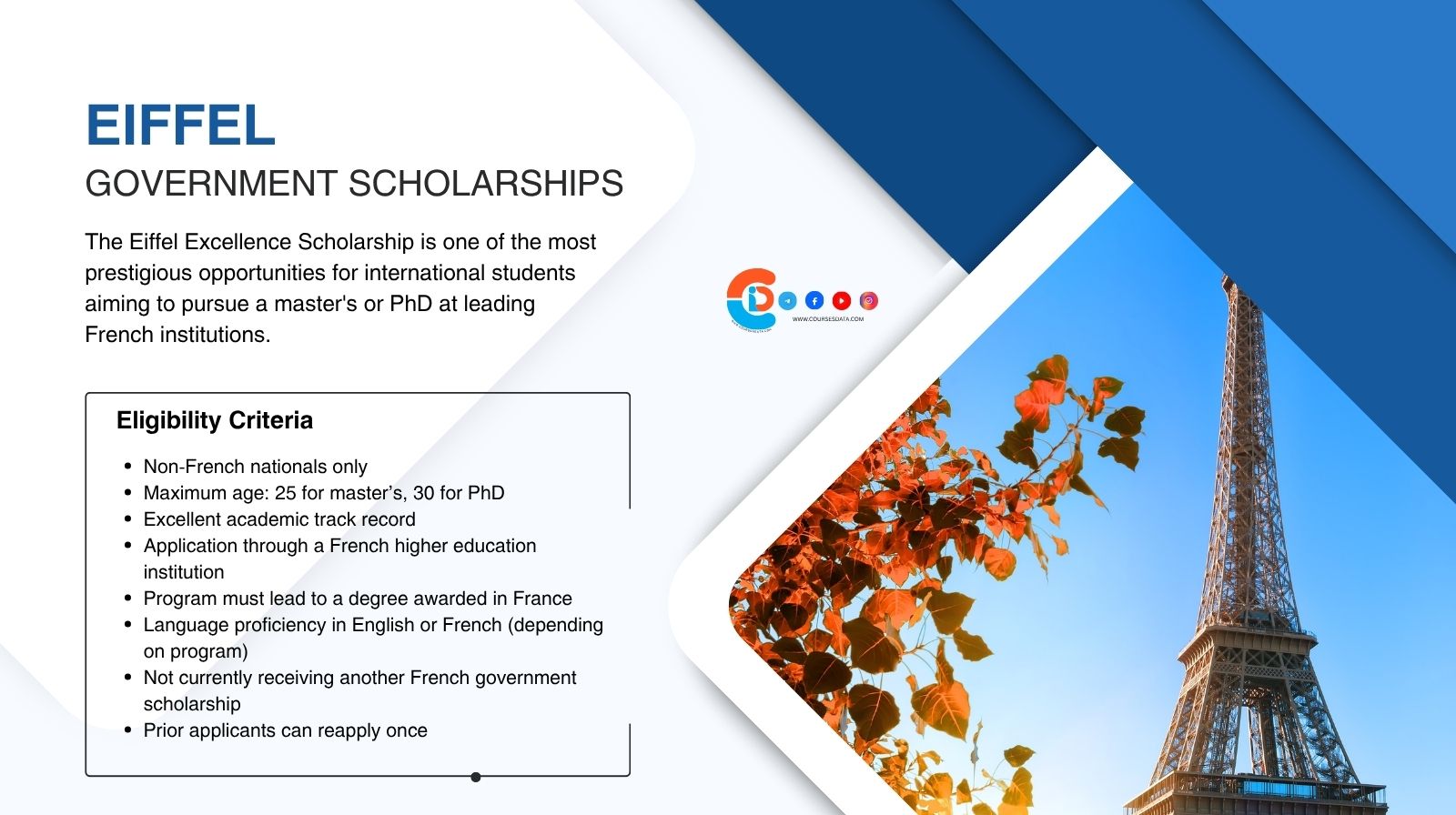
Looking to study in France with a fully funded scholarship?. The Eiffel Excellence Scholarship is one of the most prestigious opportunities for international students aiming to pursue a master’s or PhD at leading French institutions. Designed by the French Ministry for Europe and Foreign Affairs, this scholarship attracts top global talent.
What Is the Eiffel Excellence Scholarship?
The Eiffel Scholarship is a government-funded program aimed at supporting international students with outstanding academic records. It targets key priority areas that align with France’s global development strategy.
- Administered by Campus France
- Funded by the French Ministry for Europe and Foreign Affairs
- Available for master’s and doctoral programs
- Covers a wide range of academic disciplines
- Focuses on STEM, economics, law, and political science
- Prioritizes candidates under 25 for master’s, under 30 for PhD
- Not open to dual French nationality applicants
- Highly competitive with limited annual awards
- Students must apply through French institutions
- Promotes French higher education worldwide
Who Can Apply for the Eiffel Scholarship?
To be eligible, candidates must meet strict academic and age criteria. The application process is institution-based, requiring pre-selection from a French university.
- Non-French nationals only
- Maximum age: 25 for master’s, 30 for PhD
- Excellent academic track record
- Application through a French higher education institution
- Program must lead to a degree awarded in France
- Language proficiency in English or French (depending on program)
- Not currently receiving another French government scholarship
- Prior applicants can reapply once
- Priority given to students from emerging and developing countries
- Not eligible if applying outside French academic institutions
What Fields of Study Are Supported?
The Eiffel Scholarship focuses on disciplines essential to France’s global influence. Programs are divided into two broad categories: science & technology, and humanities & social sciences.
- Engineering
- Life sciences
- Mathematics
- Physics
- Chemistry
- Environmental sciences
- Law
- Economics
- Political science
- Management
Fields Table
| Category | Disciplines Included |
|---|---|
| Science & Technology | Engineering, Mathematics, Physics, Biology |
| Humanities & Social Sciences | Law, Economics, Political Science, Management |
What Does the Scholarship Cover?
The Eiffel Scholarship is known for its generous financial support. While it does not cover tuition fees, it provides a robust monthly allowance and other essential benefits.
- Monthly stipend: €1,181 for master’s, €1,700 for PhD
- International travel to and from France
- Health insurance coverage
- Cultural activities access
- Housing assistance
- Public transport card discounts
- Free or subsidized French language courses
- Assistance with finding accommodation
- One-time arrival allowance
- Support throughout the study period
How to Apply for the Eiffel Scholarship?
Students must apply through the French university offering their chosen program. Direct applications to Campus France are not accepted.
- Research eligible institutions and programs
- Contact university international office
- Submit application documents to the university
- University submits application to Campus France
- Institutions evaluate based on academic excellence
- Applications open around October
- Deadline typically mid-January
- Results announced in March
- Students begin studies in September or October
- Carefully follow the institution’s internal deadlines
When Is the Eiffel Scholarship Application Deadline?
The application cycle opens annually in the fall and concludes early in the year. It’s essential to prepare documents well in advance.
- Application launch: October
- Deadline for universities to submit: Mid-January
- Campus France evaluation: January to March
- Final results published: End of March
- Scholarship valid for the following academic year
- Internal university deadlines may vary
- Early contact with university is crucial
- Recommended preparation: 3–6 months in advance
- Document translation may be required
- All documents must be submitted in digital form
Tips to Strengthen Your Eiffel Scholarship Application
A strong application can significantly increase your chances of selection. Academic excellence, clarity of purpose, and alignment with French priorities are key.
- Tailor your motivation letter to French cultural and academic values
- Highlight leadership experience and future plans
- Obtain strong academic references
- Ensure academic coherence with your study goals
- Demonstrate your commitment to returning and contributing to your home country
- Prepare a well-structured CV
- Meet language requirements (DELF, DALF, or IELTS/TOEFL)
- Choose a program relevant to France’s global priorities
- Avoid generic or vague study plans
- Show genuine interest in French culture and research
Eiffel Excellence Scholarship: Success Rate and Competition
The Eiffel Scholarship is highly selective due to limited availability and high global demand. Understanding the competitive nature can help set realistic expectations.
- Acceptance rate: 10–15% on average
- Over 1,500 applications received yearly
- Approximately 500 scholarships awarded
- Top-ranked institutions favored
- Engineering and political science programs most competitive
- Applications from Asia and Africa highly represented
- Previous academic distinction is a must
- Shortlisted based on institutional merit
- Strong proposals receive higher funding priority
- PhD proposals must be research-driven and supervisor-approved
Frequently Asked Questions (FAQ)
Can I apply for multiple programs under the Eiffel Scholarship?
No. You can only apply through one French institution and for one program each year.
Does the Eiffel Scholarship cover tuition fees?
No. The scholarship does not cover tuition, but many public universities in France charge minimal or no fees for international students.
Is the scholarship renewable?
It depends. Master’s funding is typically for 12–24 months, PhD for up to 36 months. Renewal is based on academic performance.
Can I apply without knowing French?
Yes, if your program is taught in English. However, some universities may still require basic French proficiency.
What is the role of Campus France?
Campus France manages the selection and promotion of the scholarship, but applicants must go through a university.
Is work allowed during the scholarship?
Yes, international students in France are allowed to work part-time under certain legal conditions.
Can I reapply if I’m not selected?
Yes. Candidates can reapply one additional time, but not for the same academic level.
Are private universities eligible under this scholarship?
Yes, provided they are accredited and issue degrees recognized by the French government.
Do I need to submit language certificates?
Yes. Institutions usually require proof of language proficiency based on the program’s instruction language.
Can I defer the scholarship if accepted?
No. The scholarship must be used for the academic year immediately following selection.
Conclusion
The Eiffel Excellence Scholarship opens doors to top-tier education in France with substantial support and global recognition.
It’s a chance to study at world-class French institutions and build a strong international career foundation.
I actually looked into this scholarship a couple of years ago when I was applying for my master’s, and while the funding is fantastic, I’d warn anyone that the application process feels like a full-time job on top of your regular studies. The requirement to be nominated directly by a French university rather than applying on your own caught me off guard at first. Did you find the discipline restrictions limiting, or did your field line up pretty well with their priority areas?
Oh, I absolutely agree—the nomination requirement felt like discovering the fine print after you’ve already signed up. My field in public policy happened to overlap with their priority areas, so I dodged that bullet, but I can see how it would be a dealbreaker for someone in, say, fine arts. Honestly, the whole process made me wonder if they’re secretly testing your stamina for French bureaucracy before you even set foot there.
That’s a great point about the stamina test—I felt the exact same way when I was digging into the requirements. It makes me wonder if the whole nomination hurdle is really just a clever way to see who’s willing to navigate French administrative quirks before they even arrive. Do you think they’d ever streamline it, or is that bureaucratic gauntlet part of the charm?
It’s funny you mention the discipline restrictions—I was sweating over that myself. My background is in digital humanities, which isn’t exactly their bread and butter, so I had to really stretch my proposal to emphasize the data science angle. In the end, it worked, but I definitely felt like I was bending my research to fit their mold rather than the other way around.
Oh, you’ve hit on exactly what gave me the most grief too—I spent weeks trying to figure out if my background in political economy was “priority enough,” and I still felt like I was forcing a square peg into a round hole. The nomination step really does feel like you need a secret handshake, and I admire anyone who gets through it without tearing their hair out. Did you find that the professors were more understanding once you explained your research fit, or did you mostly get polite form letters back?
Oh, I remember the nomination hurdle too—it was such a curveball. I was lucky that my field in sustainable urban planning fit neatly into their priority areas, but even then, the paperwork felt endless. Did anyone else find that the language requirements or the need for a French university to sponsor you made the process feel more exclusive than they expected?
Absolutely. The exclusivity is by design—they want students who are already on the radar of top French institutions, not just anyone with good grades. That sponsorship requirement filters out a lot of people early on, so if you don’t have a strong connection with a professor or program in France before applying, you’re already on the back foot. It’s a selective process that rewards proactive networking as much as academic merit.
Honestly, the nomination requirement was what almost made me give up before I even started. I spent months emailing professors in France just to get a foot in the door, and even then, my field in international law was a borderline fit for their priority list. It felt less like a scholarship application and more like a test of how badly I wanted to deal with French administrative culture.
Oh, Brenda, you’ve absolutely nailed it—that “test of stamina” is exactly how I felt too. I spent weeks chasing down a professor in Lyon for my environmental policy research, and the whole nomination dance made me wonder if the real scholarship was just surviving the process itself. And you’re spot on about it being a borderline fit; I had to reframe half my proposal just to squeeze into their priority box.
Reading through everyone’s experiences with the nomination hurdle, I have to say it really does feel like you need a mentor inside the system before you even start. My own background is in environmental chemistry, which ticked the STEM box easily, but the real shock for me was how little guidance exists on *how* to approach a French professor cold. Did anyone else find that the professors were surprisingly receptive once you showed you understood their research, or did you mostly run into polite silence?