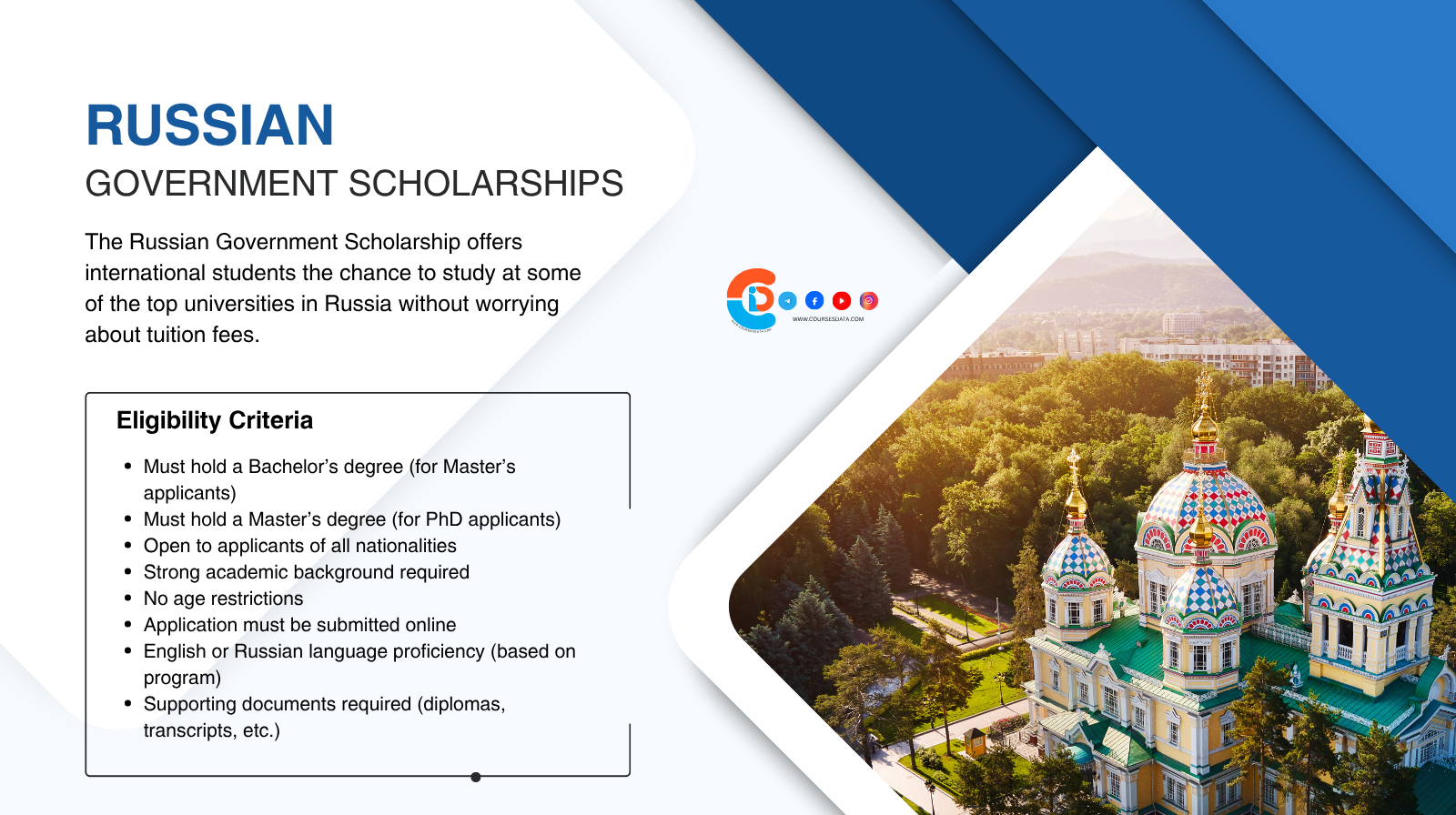
Are you looking for a fully funded opportunity to study in Russia for free?
The Russian Government Scholarship offers international students the chance to study at some of the top universities in Russia without worrying about tuition fees. With broad academic coverage and generous support, this scholarship is a gateway to world-class education and cultural experience.
What Is the Russian Government Scholarship?
This fully funded program is officially called the Open Doors Russian Scholarship Project. It’s backed by the Russian Ministry of Education and Science and managed by the Global Universities Association. The initiative aims to attract talented international students to pursue graduate-level education in Russia.
- Covers 100% of tuition fees
- Available for Master’s and PhD programs
- Open to citizens of any country
- Offered in a wide range of disciplines
- Selection based on academic competition
- No Russian language required (courses in English available)
- Opportunity to study at top Russian universities
- Includes visa support and documentation assistance
- Organized by the Association of Global Universities
- Conducted annually with multiple stages of selection
Eligibility Criteria for Applicants
To qualify for the Russian Government Scholarship, applicants must meet specific requirements that vary slightly based on the level of study. However, general eligibility standards are consistent across all disciplines.
- Must hold a Bachelor’s degree (for Master’s applicants)
- Must hold a Master’s degree (for PhD applicants)
- Open to applicants of all nationalities
- Strong academic background required
- No age restrictions
- Application must be submitted online
- English or Russian language proficiency (based on program)
- Supporting documents required (diplomas, transcripts, etc.)
- Some programs may require an entrance exam or portfolio
- Must apply within the deadline window each year
Fields of Study Covered by the Scholarship
The scholarship provides access to a broad range of disciplines, making it suitable for students from diverse academic backgrounds. Here are some of the primary fields of study available:
- Computer Science
- Physics
- Mathematics
- Chemistry
- Biology
- Engineering and Technology
- Political Science
- Linguistics
- Economics
- Psychology
How to Apply for the Russian Government Scholarship
The application process is entirely online and consists of multiple stages, including a portfolio review and competitive academic selection. Here’s how to proceed:
- Visit the official scholarship portal
- Register and create a personal account
- Select your desired field of study
- Upload your academic documents and certificates
- Submit a research proposal or portfolio (if required)
- Complete the online test (if applicable)
- Await evaluation and shortlisting
- Pass the final selection interview or competition
- Receive admission offer and scholarship confirmation
- Apply for a student visa and prepare for relocation
Benefits of the Russian Government Scholarship
This scholarship is not just about free education. It also includes a package of additional benefits designed to make the student experience as smooth and rewarding as possible.
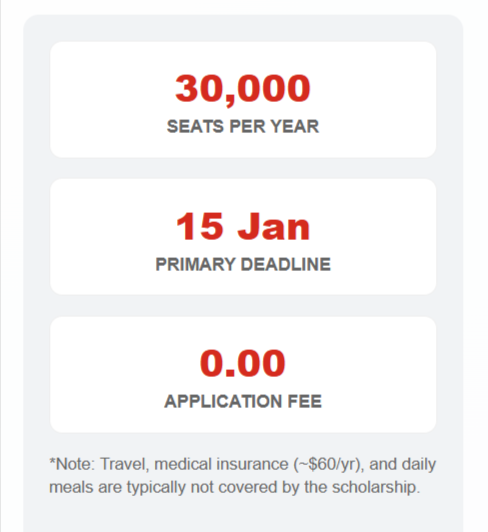
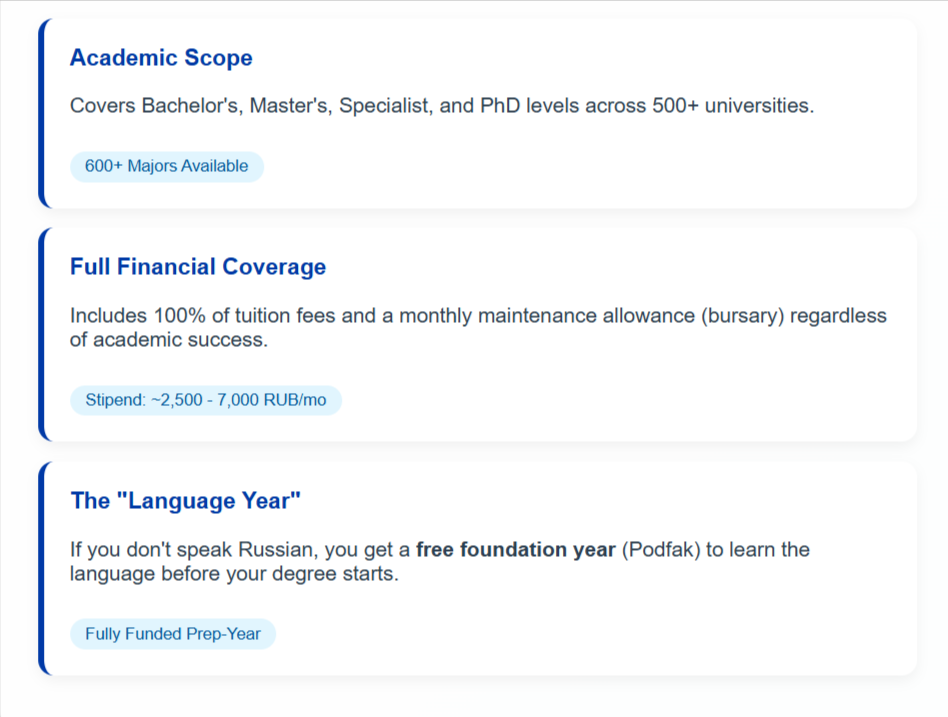
- 100% tuition fee coverage
- Study at top Russian universities
- Monthly stipend (amount varies by program)
- Free preparatory Russian language courses (optional)
- Support with accommodation in university dorms
- Visa support services
- Access to cutting-edge labs and research centers
- International networking opportunities
- Cultural integration programs
- Career support and internships
Timeline and Key Deadlines
The Russian Government Scholarship operates on a fixed timeline each year. Applicants should monitor deadlines closely to ensure they don’t miss out.
| Phase | Timeline (Typical Dates) |
|---|---|
| Application Opens | October |
| Document Submission | November–December |
| First Selection Round | January |
| Final Selection & Results | March–April |
| Visa Application & Admission | May–July |
| Arrival in Russia | September |
Top Universities Participating in the Program
The scholarship grants access to many of Russia’s most prestigious institutions, many of which are globally recognized for academic excellence.
- Lomonosov Moscow State University
- Saint Petersburg State University
- National Research Nuclear University MEPhI
- Higher School of Economics (HSE)
- Tomsk State University
- Novosibirsk State University
- Ural Federal University
- Kazan Federal University
- ITMO University
- Far Eastern Federal University
Living in Russia as a Scholarship Student
Living in Russia offers an exciting mix of academic challenges and cultural discoveries. Students can expect modern facilities, vibrant city life, and strong institutional support.
- Low cost of living in most cities
- Affordable public transport
- Student-friendly housing options
- Wide availability of English-language services
- Active international student communities
- Opportunities to learn Russian
- Rich cultural and historical landmarks
- Well-equipped university campuses
- Access to healthcare and insurance
- Safe and student-friendly environment
Frequently Asked Questions (FAQs)
Who can apply for the Russian Government Scholarship?
Anyone with a relevant degree from any country can apply, as long as they meet the academic and documentation requirements.
Is knowledge of the Russian language mandatory?
No. Many programs are available in English, and preparatory Russian language courses are offered if needed.
What expenses are covered by the scholarship?
The scholarship covers full tuition, visa assistance, and monthly stipends. Accommodation and language courses may also be included.
How competitive is the selection process?
It is moderately competitive. Success depends on your academic performance, research proposal, and preparation.
Can I apply for undergraduate studies?
This scholarship is currently available only for Master’s and PhD programs.
Is the scholarship renewable each year?
Yes, it continues throughout your program as long as you meet academic performance requirements.
How long does the application process take?
The full process, from application to arrival, can take 6 to 9 months.
Do I need to take any entrance exams?
Some programs require an online test or portfolio. It depends on the field and university.
Can I work during my studies?
Yes, international students are allowed to work part-time in Russia while studying.
How do I get a Russian student visa?
Once selected, you will receive official documentation to apply for a student visa through the Russian consulate in your country.
Conclusion
Studying through the Russian Government Scholarship is a life-changing opportunity for ambitious students seeking top-tier education and full financial support. Apply smartly, meet the deadlines, and prepare for a rewarding academic journey in Russia.
This sounds like an incredible opportunity, especially with the full tuition coverage. I’ve always been curious about the application process for the Open Doors project—is the competition extremely high for specific fields like engineering or medicine? From what I’ve read, the cultural immersion in Russia would be just as valuable as the degree itself.
Beatrice, I went through the Open Doors process for an engineering master’s last year, and the competition was definitely stiff. From what I saw, fields like computer science and medicine can have 10 to 15 applicants per slot, but it’s more manageable if you focus on regions like Tomsk or Kazan. The cultural immersion is no joke either—I spent weekends learning to cook pelmeni with my host family in Novosibirsk, and it made the whole experience unforgettable. Just make sure your academic profile and project proposal are rock solid, and you’ll have a real shot.
Graham, thanks for sharing that—it’s reassuring to hear that aiming for cities like Tomsk or Kazan can ease the competition a bit. I’ve been eyeing the Open Doors project for a PhD in environmental science, and your tip about the project proposal being rock solid hits home. I’m also curious if you found the language prep sufficient, or did you rely mostly on English in the lab?
Yves, I’m actually going through the Open Doors prep right now for a linguistics master’s, and I’ve been obsessing over the same language question. From what I’ve gathered from current students, the language prep is decent for basic survival phrases, but in the lab you’ll mostly lean on English, especially in STEM-heavy cities like Novosibirsk. That said, weekends in smaller towns can be rough if you don’t pick up at least conversational Russian—I’ve already started Duolingo drills just to feel less lost.
Yeah, I’ve been through this myself for a PhD in environmental science, and honestly, in the lab it was almost entirely English—most of the academic journals and supervisor meetings were in English too. The language prep they give you is fine for ordering coffee or asking for directions, but it won’t get you through a field excursion in the Urals where the local technician only speaks Russian. I’d say focus on conversational basics before you go, because those impromptu chats in the field are where you really learn.
Ah yes, the classic “we’ll teach you to say ‘please’ and ‘thank you’ in Russian, but good luck when the lab technician starts explaining why the permafrost sample is melting faster than expected.” I’d plan on your English carrying the academic load, but definitely brush up on the local vocabulary for fieldwork—nothing like watching a PhD candidate try to mime “tundra” while standing in a bog.
Man, that’s really helpful to hear from someone who’s actually been through the Open Doors process. I’ve been worried about the competition for engineering, but focusing on cities like Tomsk or Kazan makes a lot of sense. The bit about cooking pelmeni with a host family really sells the cultural side too—sounds like a good reminder to look beyond just the academics.
Honestly, the full tuition coverage is a game-changer, but I’d be keen to know how the language barrier plays out day-to-day in places outside of Moscow or St. Petersburg. For anyone heading over for a PhD, being able to navigate life in a smaller city like Tomsk or Novosibirsk would be a whole different challenge. Does the scholarship offer any Russian language prep courses before the program starts, or are you expected to just sink or swim with your English?
This really caught my eye because I’ve been looking into the Open Doors project for a Master’s in Public Health, but the idea of managing daily life in a smaller city like Tomsk honestly gives me pause. Sylvie’s point about weekends being rough without conversational Russian resonates—I’ve started wondering if the cultural experience outweighs the isolation for someone who isn’t in a STEM-heavy lab where English dominates. For anyone who has done this program in a humanities or social science field, how did you handle the academic reading and discussions in Russian when your program was supposedly in English?
That bit about cooking pelmeni with a host family in Novosibirsk really got to me—I think the cultural exchange is honestly half the value of a scholarship like this. I’m looking at a Master’s in history, so I’m curious if anyone in the humanities found their Russian improved faster since they couldn’t hide in an English-speaking lab all day. It sounds like going in with at least basic conversational skills is non-negotiable if you want to actually connect with people outside the university bubble.