The Dalhousie University Scholarship route for new undergraduates includes General Entrance Awards for eligible domestic and international applicants. One award application can put a student forward for several scholarships and bursaries, but admission alone does not complete that application.
Funding depends on the individual award: some offers are one-time, while others are renewable. This guide covers undergraduate entrance funding, not graduate research scholarships or a guaranteed full-cost package.
Brief description
- Institution: Dalhousie University.
- Location: Nova Scotia, Canada.
- Funding route: General Entrance Award application.
- Level: eligible undergraduate entry.
- Domestic and international students can qualify.
- The main route is for students entering from secondary school.
- Academic achievement is important for scholarship selection.
- Some awards also consider financial need, leadership or identity criteria.
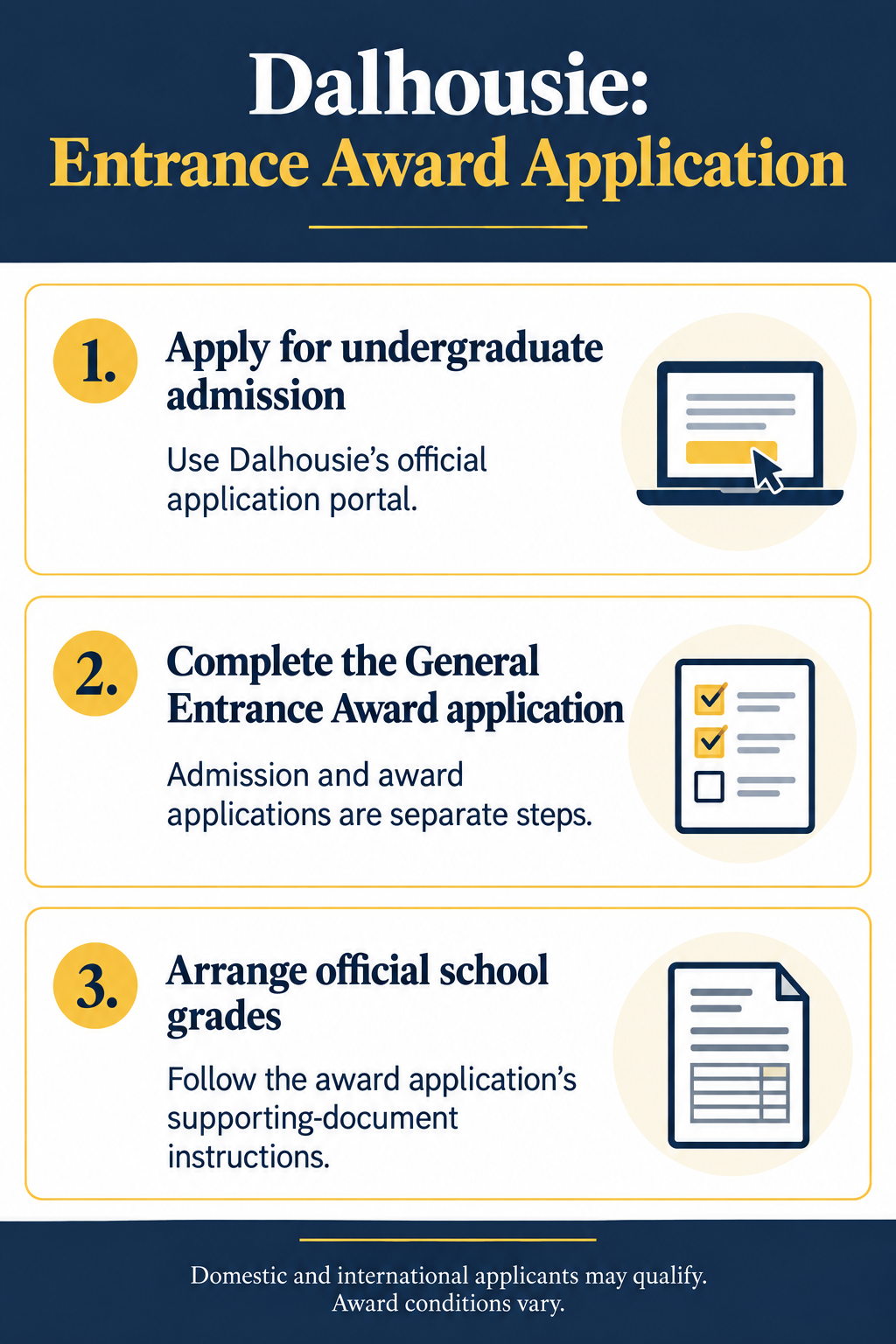
- Admission and entrance-award applications are separate submissions.
- The offer letter determines the amount and continuation conditions.
About the university
Dalhousie is a Canadian university with study locations in Halifax and Truro. Applicants should identify where their intended program is taught before planning accommodation.
Its undergraduate teaching spans arts, science, engineering, computing, management, agriculture and other professional fields. These programs have different subject prerequisites and selection processes.
University admission, scholarship selection and permission to study in Canada are separate matters. Choosing an appropriate academic program should come before estimating how an award might support it.
About Dalhousie University Scholarship
- General Entrance Awards combine multiple award opportunities in one application.
- Not every named scholarship uses the general application; some have separate instructions.
- The application can be submitted before an admission decision arrives.
- School-provided academic results are needed for award assessment.
- Self-reported admission grades alone do not complete the scholarship file.
- Award selection can consider community involvement and initiative as well as marks.
- An early entrance offer and a later general entrance offer are not automatically added together; the higher applicable offer is retained.
- Award acceptance is linked to accepting the relevant admission offer and paying the required deposit.
Fields of study
Dalhousie’s award-management rules identify eligible undergraduate programs within the following faculties. A particular donor-funded award may impose a narrower field restriction:
- Agriculture.
- Architecture and Planning.
- Arts and Social Sciences.
- Computer Science.
- Engineering.
- Health.
- Management.
- Science.
This is the university’s published faculty-level eligibility scope, not a promise that every major or professional program qualifies for every award. Confirm the specific degree against the award conditions. Some health programs also restrict admission by residency; international students must check their program individually. University of King’s College enrollment does not itself qualify a student for Dalhousie scholarships.
Target group
- Eligible students entering directly from secondary school.
- Gap-year applicants who have not undertaken transferable post-secondary study.
- Mature applicants without transferable post-secondary study, under the entrance-award rules.
- Canadian and international applicants who meet the applicable award conditions.
Transfer students generally fall outside the general entrance route, with specified exceptions for eligible Indigenous and Black students under Dalhousie’s targeted award arrangements. Some named awards additionally restrict nationality, ancestry, financial need or degree; general eligibility is not eligibility for every award.
Scholarship benefits
There is no universal eight-part benefits package. Confirmed forms of support within the entrance-award system include:
- Merit-based scholarship funding.
- Need-based bursary funding for qualifying applicants.
- Awards combining academic achievement with other selection criteria.
- Multi-year financial support where a renewable award is offered.
These are different award categories, not four payments promised to each recipient. Award values and permitted combinations vary. Payments are normally credited to the student account in two installments; airfare, accommodation and language-course funding are not standard benefits established by the general scheme.
Scholarship duration
- Bachelor’s programs: awards may be one-time or renewable for up to four years, according to the offer.
- Standard Dalhousie Entrance Renewable Scholarship: continuation into years two, three and four requires 30 credit hours over two academic terms and a scholarship GPA of at least 3.7.
- Nursing version of that renewable scholarship: continuation into years two and three requires 45 credit hours over three terms and a scholarship GPA of at least 3.7.
- Renewable bursaries follow different requirements; the standard entrance renewable bursary uses 18 credit hours over two terms and a scholarship GPA of at least 2.0.
- Master’s and doctoral study: outside this undergraduate entrance-award route.
Use your offer and the official renewal-criteria document to identify the correct award category. Scholarship GPA and cumulative GPA are not interchangeable.
Scholarship requirements
The general academic threshold is normally an 80% average across the five courses required for the degree, or 26 predicted IB points. Specified targeted awards have different academic eligibility arrangements.
- Apply to an eligible undergraduate program.
- Complete the separate General Entrance Award application.
- Arrange official school results for award assessment.
- Provide requested evidence for need-based or other restricted awards.
- Meet the admission conditions for the chosen degree.
- For payment, maintain the applicable full-time registration: normally nine credit hours per term in a degree or six in a technology program.
- For renewal, meet the higher workload and grade conditions attached to the particular award.
Admission requirements by degree
Bachelor’s degrees
- Complete the secondary-school qualification accepted for your education system.
- Meet the five-course requirement and the program’s subject prerequisites.
- Satisfy any supplementary selection requirements.
- Meet English proficiency requirements or an approved exemption.
The degree-specific admission requirements differ: engineering requires English, pre-calculus, chemistry and physics plus another academic subject, while arts has a different subject pattern. Meeting a published minimum does not guarantee a place.
For applicants needing an English test, the English-language requirements include IELTS Academic 6.5 overall with no band below 6.0. Approved alternatives and exemptions are listed separately.
Application instructions
Step 1: Check the academic and award route
- Choose a degree and confirm its prerequisites and applicant restrictions.
- Read the official entrance-award page to identify general and separate named-award applications.
Step 2: Apply for admission
- Create or access the official undergraduate application account.
- Complete your education history and program choices, and pay the stated application fee.
- Retain your account details and application reference.
Step 3: Complete the award application
- Follow the General Entrance Award instructions in the applicant portal.
- Submit the award application yourself; do not assume a representative has completed it.
- Answer requested activity, background and financial questions accurately.
Step 4: Arrange supporting evidence
- Ask your school to send the required official first-semester results; follow the alternative instructions for non-semestered schools.
- Upload financial or other evidence only where requested.
- For international financial-need assessment, provide accepted official income evidence and required translations.
Step 5: Review and accept the offer
- Read each award offer for its value, duration and restrictions.
- Follow the admission acceptance and deposit process to accept the applicable entrance award.
- Arrange enrollment and Canadian study-permit documentation separately.
Required documents
- Undergraduate admission application.
- General Entrance Award application.
- Official secondary-school academic results.
- Final qualification records, when required.
- English proficiency evidence, unless exempt.
- Program-specific supplementary materials, where required.
- Financial-need supporting documents, where requested.
- Required document translations.
The general entrance-award process does not require unsolicited CVs or reference letters. Separate named scholarships and admission programs can set different requirements.
Important tips
These recommendations are application advice, not additional official eligibility rules.
- Choose the degree before comparing award values.
- Keep admission and award checklists separate.
- Ask your school who sends official results.
- Keep a submission confirmation.
- Describe activities with specific responsibilities and outcomes.
- Report family finances consistently.
- Check whether a named award matches your nationality or background.
- Budget expenses beyond the confirmed award.
- Plan course loads around your exact renewal category.
- Ask for written clarification before changing programs or deferring study.
Dalhousie entrance funding can make an undergraduate plan more affordable when the application, academic fit and remaining budget align. Treat the award letter as the basis for financial planning and keep its continuation conditions accessible throughout your studies.
Frequently asked questions
Is the scholarship automatically awarded with admission?
The General Entrance Award route requires its own application. Admission is not a substitute for submitting it.
Can international applicants receive an award?
Yes, eligible international entrants can be considered, although individual awards can impose additional conditions.
Does every award last four years?
No. Some awards are one-time; renewable awards continue only when their stated conditions are met.
Does an English score have to accompany the scholarship application?
English evidence is an admission requirement when applicable, not a separate standard document for the General Entrance Award application itself.