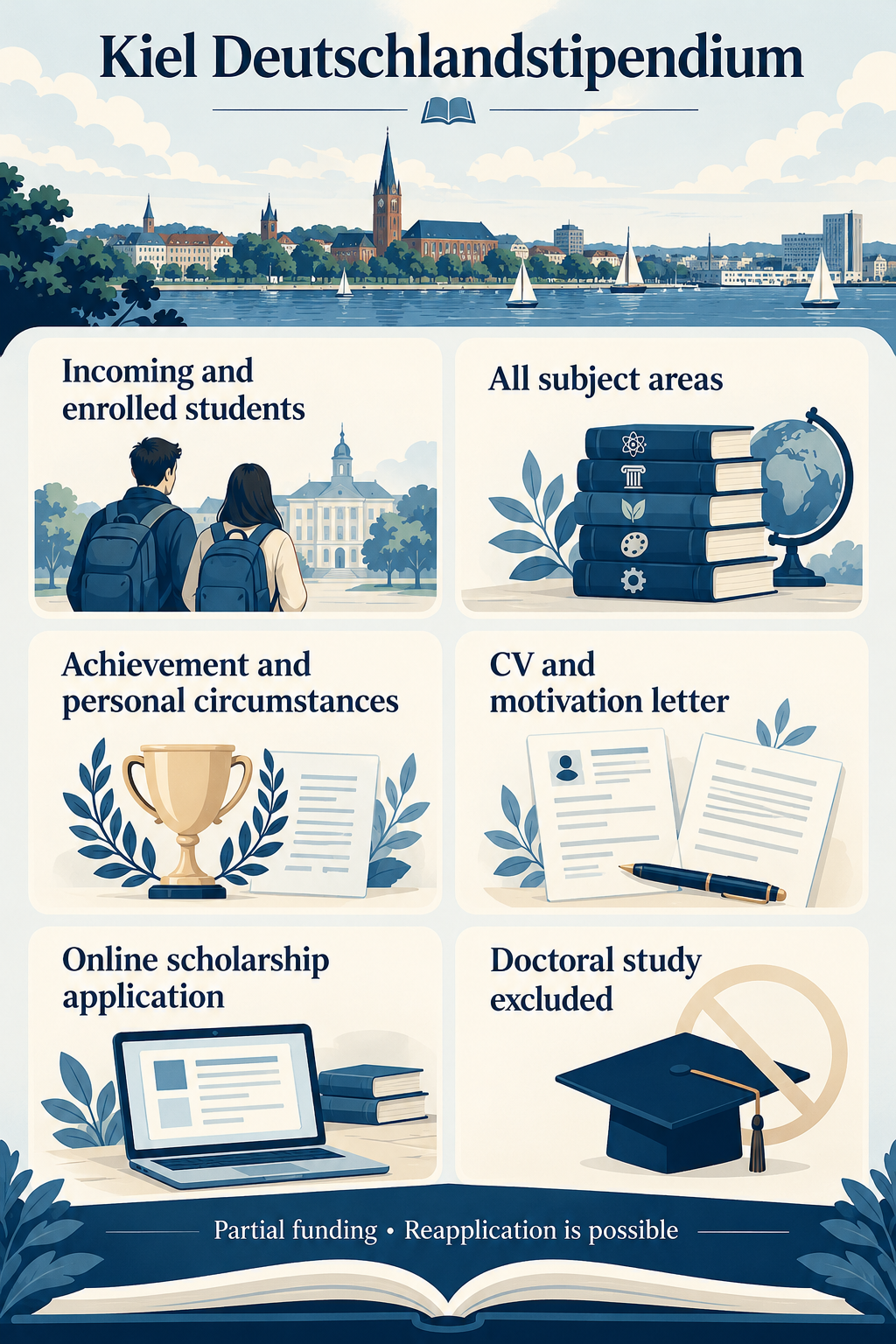
A University of Kiel Scholarship through the Deutschlandstipendium supports talented students with a monthly grant. The programme considers academic achievement alongside engagement and relevant personal circumstances.
This guide explains the Deutschlandstipendium at Christian-Albrechts-Universität zu Kiel, also known as CAU. The scholarship is partial funding, and its application is separate from admission to a degree.
Key Facts
- Host: Kiel University, Germany.
- Award: Deutschlandstipendium.
- Published payment: €300 monthly.
- Award period: one year, or two semesters.
- Entry stage: prospective and enrolled students.
- Subjects: all subject areas.
- Master’s study: eligible in principle.
- Doctoral study: excluded.
- Normal maximum: the programme’s standard study period.
- Further funding: reapplication is possible.
University Overview
Kiel University was founded in 1665 and is based in Schleswig-Holstein, northern Germany. Its Baltic Sea location is an important setting for its research.
The university combines research-based teaching with work across eight faculties. Its academic organisation spans theology, law, medicine, humanities, agricultural and nutritional sciences, mathematics and natural sciences, business and social sciences, and engineering.
Its research profile includes marine science, life science, societal and environmental change, and nanoscience. Students should compare course content and academic prerequisites when choosing a degree, rather than treating scholarship availability as an admission decision.
Scholarship Overview
- Private donors and federal funding jointly finance the programme.
- The award is based on performance and additional selection criteria.
- School or previous degree results provide academic evidence.
- Relevant achievements can affect assessment.
- Engagement outside the curriculum is considered.
- Caring responsibilities can be relevant.
- Some sponsorships are allocated to defined subjects.
- Awards depend on the funding available.
Eligible Majors
The current programme page invites students of all subjects, including prospective students. Bachelor’s, eligible state-examination and master’s routes can fall within the scheme; individual sponsorships may have subject allocations.
Choose the degree in which you will actually study. Fields represented at CAU include engineering, natural sciences, humanities, law, medicine, business, agriculture and nutrition; the broad scholarship invitation does not remove each course’s admission conditions.
Target Groups
The scheme covers eligible students already enrolled and people about to start at Kiel. Applicants with recognised foreign entrance qualifications can apply, and second or complementary degrees are eligible in principle.
Doctoral candidates are excluded. Applicants must meet the degree’s entrance conditions and normally remain within its standard study period.
Benefits
- €300 per month during the approved award period.
- Opportunities to connect with scholarship sponsors.
- Access to programme networking events.
The grant provides a contribution towards study costs. The published package does not promise separate payments for rent, travel, health insurance or research expenses.
Duration and Renewal by Degree
Bachelor’s and state examination: an award covers two semesters. The normal maximum funding period follows the standard length of the particular degree.
Master’s: the one-year award framework also applies to eligible master’s study. A student may apply again, but further support is not guaranteed.
Doctorate: not funded through this scheme. Check the written decision when changing degree stage, programme or university, because changes can affect the award.
Scholarship Requirements
The current Kiel award guidelines use the school-leaving grade or, where a degree has already been completed, its final grade. Additional assessment covers achievements, voluntary service, engagement, caring duties, illness or disability and first-generation university background.
Supporting evidence is necessary for claimed circumstances. The published checklist refers to recent awards and qualifying service, including a minimum two-month duration for the specified service categories.
Applicants must disclose other funding so the university can check the programme’s double-funding restriction. Original documents may be requested after selection.
Admission Requirements by Degree
Bachelor’s requirements
International applicants need a higher-education entrance qualification recognised in Germany. The university’s bachelor’s information sheet directs applicants with foreign qualifications to uni-assist; restricted programmes can also require registration details from Hochschulstart.
The published German-language standard is C1, with accepted evidence including DSH-2, TestDaF 4 in each part, telc C1 Hochschule and other listed equivalents. Use the official instructions for the chosen subject and qualification.
State-examination requirements
Admission routes for medicine, dentistry and pharmacy depend on the applicant’s category. The university’s international study guidance directs EU/EEA applicants in these subjects to Hochschulstart.
Scholarship selection does not supply a study place or waive subject-specific selection and language requirements.
Master’s requirements
Master’s admission requires an academically suitable bachelor’s qualification assessed by the relevant department. The international information sheet also describes applications where no more than 30 ECTS or one semester remain, subject to the stated conditions.
German-taught routes use the listed C1-level evidence, including DSH-2 or TestDaF 4444. English-language routes set their own English requirements and application route; consult the official master’s admission information.
Application Steps
1. Confirm your study route
Establish degree eligibility and admission arrangements through Kiel’s international application guidance.
2. Read the scholarship call
Check application availability and the current checklist on the official scholarship applicant page. The latest published application round has ended. Check the official page for a new call before attempting submission.
3. Prepare the evidence
Compile your qualification records, CV, motivation letter and documents for relevant achievements or responsibilities.
4. Register in the scholarship portal
Use the portal linked from the official programme page, set a password and complete email confirmation.
5. Complete and submit the form
Enter the requested information and upload the evidence. The portal permits saving progress, but a saved application must still be submitted.
6. Review the award decision
Read the conditions and any requests for originals. The programme page expects attendance at its award ceremony and encourages participation in networking where possible.
Required Documents
- Higher-education entrance qualification certificate
- Recognition and converted-grade evidence for foreign qualifications, where required
- Previous degree certificates, where available
- Curriculum vitae
- Motivation letter
- Achievement and award evidence, where applicable
- Internship or voluntary-service evidence, where applicable
- Engagement evidence, where applicable
- Personal, family or caring-responsibility evidence, where applicable
- Software-Challenge certificate and designated recommendation, where applicable
Practical Tips
These are preparation suggestions, separate from the official scholarship rules.
- Use the exact degree name from your application or enrolment record.
- Keep scholarship and admission portal credentials distinct.
- Explain your study interests concretely in the motivation letter.
- Describe responsibilities without overstating their impact.
- Use evidence identifying both the activity and its duration.
- Scan complete certificates, including relevant reverse pages.
- Check the readability of small print before uploading.
- Keep a copy of every submitted attachment.
- Retain the portal confirmation after submission.
- Plan how to finance costs beyond the grant.
Conclusion
The University of Kiel Scholarship through Deutschlandstipendium offers defined financial support and programme connections. A carefully documented application and a realistic study budget help applicants approach the competition with clear expectations.
FAQ
Are foreign qualifications accepted?
Yes, if recognised for study at Kiel. The scholarship guidelines require the relevant recognition evidence.
Does a master’s qualify?
Yes. The programme expressly includes master’s study in principle.
Does everyone need a recommendation letter?
No. The current checklist specifies one for the relevant Software-Challenge applicants; it is not a universal document requirement.
Does saving the portal form submit it?
No. Complete the final submission step after checking the saved information.
Can I receive the award for my whole degree automatically?
No. Each award covers one year, and repeat applications remain subject to selection.