The University of Oldenburg Scholarship covered in this guide is the university’s Deutschlandstipendium. It provides monthly support to high-performing students while also recognising social contribution and significant personal or family circumstances.
The scholarship is open across subjects and nationalities, but applicants must be enrolled and within their programme’s standard study period. Degree admission remains a separate process with its own academic and language requirements.
Key Facts
- Scholarship name: Deutschlandstipendium at the University of Oldenburg.
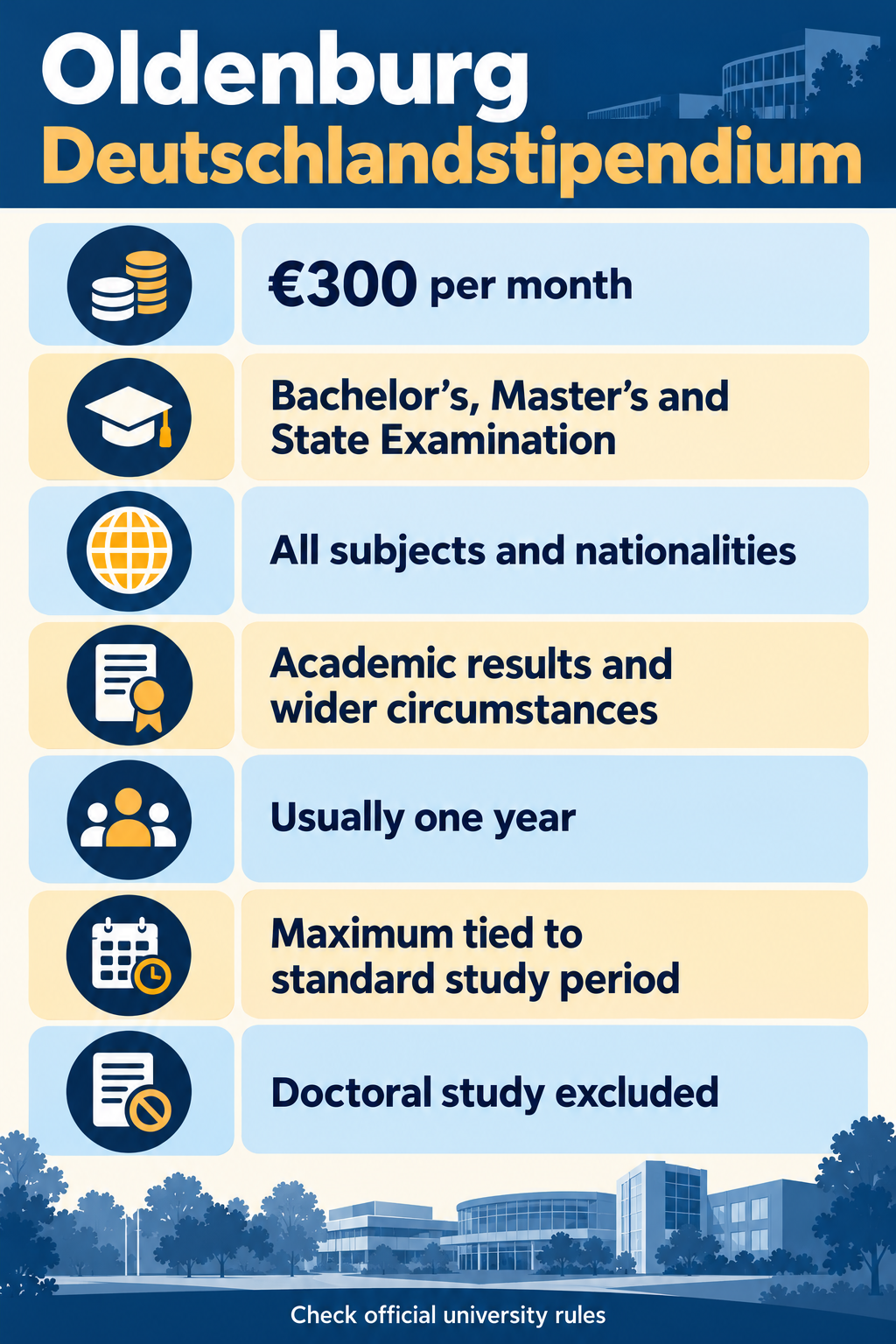
- Award value: €300 per month.
- Funding type: non-repayable, income-independent grant.
- Usual duration: one year.
- Eligible study levels: bachelor’s, master’s and state examination.
- Excluded level: doctoral study.
- Eligible subjects: all subjects at the university.
- Eligible nationalities and ages: no restriction stated by the current call.
- Core selection factors: academic results, social contribution and special personal or family circumstances.
- Application route: Stud.IP for enrolled students or the external form for incoming students without access.
University Overview
Carl von Ossietzky University of Oldenburg is a public university in Lower Saxony. Its academic structure covers six schools, including education and social sciences, computing and business, linguistics and cultural studies, humanities, mathematics and natural sciences, and medicine and health sciences.
The university combines interdisciplinary teaching with research strengths that include environment, sustainability, energy, hearing and health. Its degree portfolio includes bachelor’s, master’s, state-examination and doctoral programmes, although the scholarship in this guide does not fund doctoral study.
Applicants can explore the university’s official schools and departments before choosing a programme. Admission to the degree and award of the University of Oldenburg Scholarship are assessed separately.
Scholarship Overview
- The Deutschlandstipendium is financed jointly by private sponsors and the federal government.
- Recipients receive €300 each month.
- The payment is a grant and does not have to be repaid.
- The award does not depend on the applicant’s income.
- The university states that it can be combined with BAföG without a deduction.
- First-semester applicants are assessed mainly on their university entrance qualification.
- From the second semester, university achievements are the main academic measure.
- The official Oldenburg call page provides the controlling application rules and form routes.
Eligible Majors
The award is open to every subject at the University of Oldenburg. This includes programmes within educational and social sciences; computing, business, economics and law; linguistics and cultural studies; humanities and social sciences; mathematics and natural sciences; and medicine and health sciences.
Applicants must apply through the subject in which they are enrolled. Scholarship eligibility does not remove subject-specific admission, aptitude, language or selection requirements.
Target Groups
- Enrolled bachelor’s students within the standard study period.
- Enrolled master’s students within the standard study period.
- Students in state-examination programmes within the standard study period.
- Incoming first-semester students who will be enrolled when funding begins.
- German and international students.
- Applicants with outstanding school or university performance.
- Students with meaningful voluntary, social, cultural, religious or comparable engagement.
- Applicants with documented family responsibilities, illness, disability, migration experience or other significant circumstances.
Benefits
- €300 per month.
- A non-repayable grant.
- Income-independent assessment of the payment.
- Compatibility with BAföG without a reduction under the university’s stated rules.
- Support usually provided for one year.
- Access to the university’s scholarship network.
- Contact with participating private sponsors.
- Potential support through the standard period of study, subject to the rules and further selection.
Duration and Renewal by Degree
Bachelor’s Degree
The usual award lasts one year. Any later period of support remains subject to the scholarship rules, continued eligibility and selection, and the overall maximum follows the bachelor’s standard period of study.
Master’s Degree
Master’s students normally receive the same one-year award. The maximum funding period is tied to the standard duration of the master’s programme, with support beyond it allowed only in exceptional cases supported by a written request.
State Examination
Eligible state-examination students are assessed under the same core scholarship framework. Their funding limit follows the standard period assigned to the enrolled programme.
Doctoral Degree
Doctoral study is outside this Deutschlandstipendium call. The university lists separate foundations and doctoral funding routes for eligible researchers.
Scholarship Requirements
- Be enrolled at the University of Oldenburg when the funding period begins.
- Apply within the standard period of study for the subject used in the application.
- Provide the required academic evidence for your study stage.
- List social contribution and special circumstances truthfully.
- Use Stud.IP if you already have university access.
- Use the external form only if you are an incoming student without Stud.IP access.
- Upload all mandatory documents with the application.
- Remain enrolled and report circumstances relevant to continued funding.
The university awards the scholarship competitively and applicants have no legal entitlement to it. Academic performance is central, but the selection process also considers contributions to society and documented personal or family circumstances.
Admission Requirements by Degree
Bachelor’s and State-Examination Admission
Applicants need a recognised university entrance qualification and must satisfy the requirements of the chosen programme. International school qualifications are generally evaluated through uni-assist, and applicants from some countries must also provide the required APS certificate.
For German-taught study, the university generally accepts DSH-2, TestDaF level 4 in all four sections and specified equivalents. Check the official Oldenburg language requirements for the full list.
Master’s Admission
Applicants need a relevant bachelor’s degree or equivalent qualification and must meet the subject-specific academic criteria. International degree holders generally apply through uni-assist, while language evidence depends on the chosen master’s programme.
English-taught programmes may not require German, but each programme sets its own English standard. The official international master’s application guide explains the route and programme-level review.
Scholarship and Admission Relationship
A scholarship application does not serve as a degree application. Incoming applicants must complete admission and enrolment requirements so they are eligible when scholarship funding begins.
Application Steps
Step 1: Confirm Your Status
Verify that you will be enrolled, remain within the standard study period and are applying under the correct subject and degree level.
Step 2: Select the Correct Form
Use the scholarship form in Stud.IP if you already have access. Incoming students without Stud.IP access should use the external form linked by the university.
Step 3: Assemble the Documents
Prepare the required academic, enrolment and identity-related records, together with evidence for any personal circumstances or engagement you want assessed.
Step 4: Complete the Application
Enter grades, credit points and personal information exactly as shown in the official records. Explain relevant circumstances factually and upload clear files.
Step 5: Check and Submit
Review the whole application for missing fields and attachments, then submit it through the designated online form. Keep a copy of the final submission.
Required Documents
- Tabular curriculum vitae with photograph
- Enrolment certificate
- Grade transcript from the Examinations Office
- Verifiable Stud.IP grade transcript
- University entrance qualification certificate
- Undergraduate degree certificate for master’s applicants
- Master’s admission and selection evidence
- Evidence of special personal or family circumstances
- Evidence of voluntary or social engagement
Practical Tips
- Advice: Use the application route that matches your current system access.
- Advice: Make sure the grade record shows both the average and credit points.
- Advice: Explain engagement with concrete roles and responsibilities.
- Advice: Upload evidence only for circumstances you ask the committee to consider.
- Advice: Use consistent names across the form and certificates.
- Advice: Check that scans are complete, upright and readable.
- Advice: Keep the curriculum vitae concise and chronological.
- Advice: Separate scholarship documents from degree-admission documents.
- Advice: Save a copy of each uploaded file and the completed application.
- Advice: Consult the Scholarship Service Centre for an unusual eligibility case.
Conclusion
The University of Oldenburg Scholarship through the Deutschlandstipendium offers €300 per month to eligible students across all subjects. It rewards strong academic performance while recognising engagement and significant personal or family circumstances.
Applicants should use the correct online form, submit the full document set and keep admission requirements separate from scholarship selection. The live official call remains the final source for individual cases.
FAQ
Can international students apply for the University of Oldenburg Scholarship?
Yes. The current call states that nationality and age do not restrict applicants who meet the enrolment and study-period requirements.
Which degree levels are eligible?
Bachelor’s, master’s and state-examination students may apply. Doctoral candidates are excluded from this specific scholarship call.
How much is the award?
The Deutschlandstipendium pays €300 per month as a non-repayable grant.
What matters for first-semester applicants?
The university primarily assesses the university entrance qualification, while also considering engagement and documented personal or family circumstances.
Does the scholarship replace admission?
No. Applicants must separately qualify for, be admitted to and enrol in their degree programme.