A University of Cologne Scholarship through the Deutschlandstipendium provides partial financial support for students with strong academic potential. The scheme combines public and private funding and considers achievement alongside the circumstances in which it was earned.
This guide covers Cologne’s Deutschlandstipendium, rather than treating every university scholarship as one award. Applicants submit a separate scholarship application and must satisfy the university’s enrolment and selection conditions.
Key Facts
- Host: University of Cologne, Germany.
- Named scheme: Deutschlandstipendium.
- Published payment: €300 per month.
- Normal award period: two semesters.
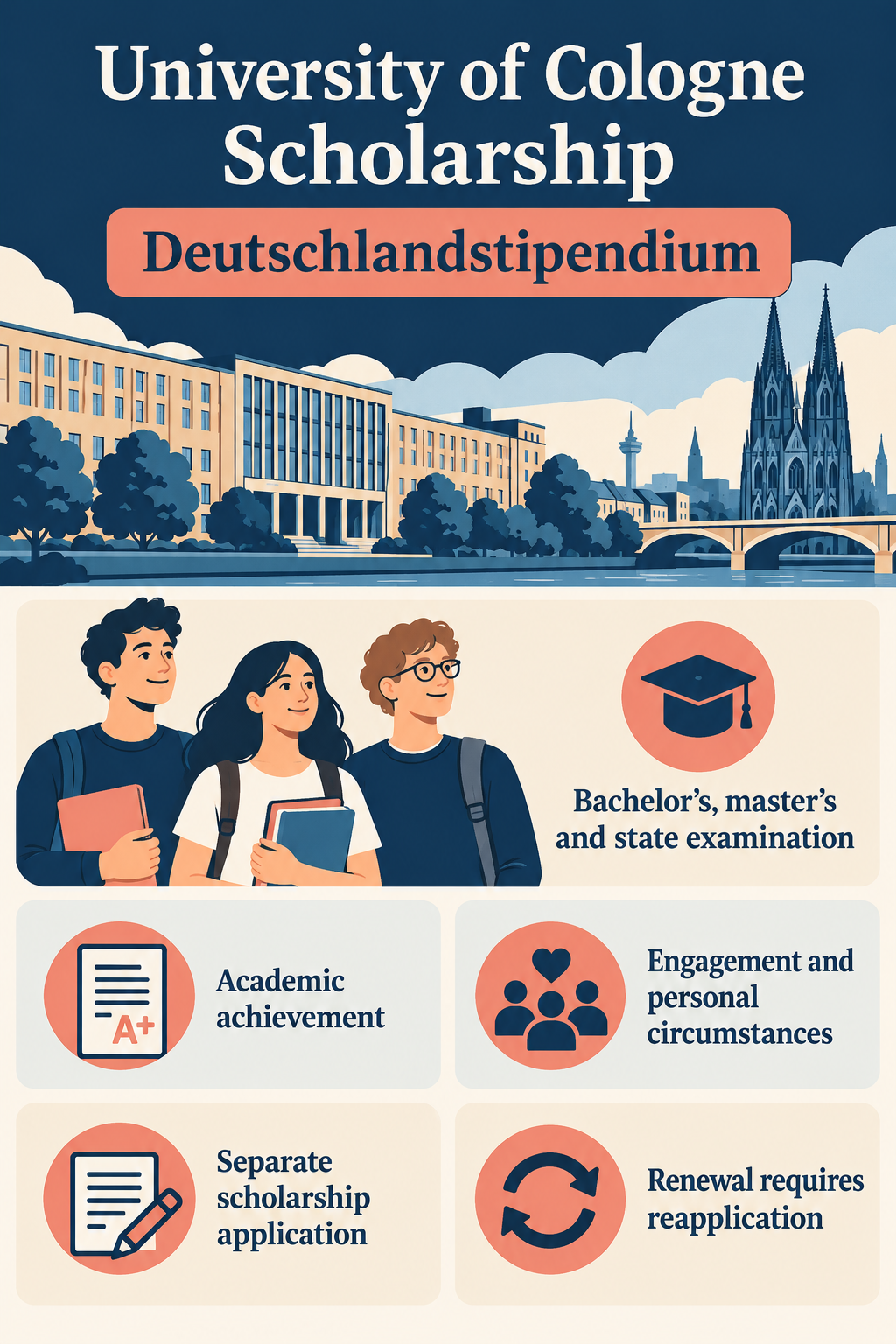
- Eligible stages: bachelor’s, master’s and state-examination study.
- Entry point: first-year or continuing study.
- Nationality: German and international students may apply.
- Academic focus: strong school or university performance.
- Funding model: federal support matched by private sponsors.
- Selection: competitive university assessment.
University Overview
The University of Cologne was established in 1388 and re-established in 1919. Its present profile combines research, teaching and the transfer of knowledge into society.
Its six faculties cover Management, Economics and Social Sciences; Law; Medicine; Arts and Humanities; Mathematics and Natural Sciences; and Human Sciences. Teacher education draws on expertise across the university.
International admission routes differ by qualification, nationality and degree level. Applicants should establish their admission pathway before assuming that a scholarship application can provide a place on a course.
Scholarship Overview
- School achievement is particularly relevant for students beginning their studies.
- University results become central for students in later semesters.
- Special achievements and awards can strengthen the overall assessment.
- Voluntary and civic engagement are considered.
- Personal and family circumstances can provide context for performance.
- Some sponsorships may be tied to a subject or programme.
- The number of awards depends on available funding.
- Admission alone does not constitute a scholarship application.
Eligible Majors
The scheme permits students across all faculties, subject to any restrictions attached to individual sponsorships. This includes eligible study in the humanities, sciences, business-related fields, law, medicine and education.
Choose the actual degree and faculty in the application. A broad subject label does not override admission prerequisites or a sponsor’s permitted subject allocation.
Target Groups
Eligible candidates include new entrants, students in higher semesters and master’s students. They must normally be studying within the standard period and be enrolled at Cologne during funding.
The scholarship programme excludes doctoral, guest and exchange students and students in preparatory programmes. An admission notice can initially support a new entrant’s application, but receiving funding depends on enrolment.
Benefits
- Monthly financial support under the award decision.
- Payment during lecture-free periods under the university’s Deutschlandstipendium guideline.
- An opportunity to meet the scholarship sponsor.
The award is income-independent. It does not establish a separate guarantee of tuition reimbursement, accommodation, insurance, airfare or research expenses; consult the official Cologne scholarship guidelines.
Duration and Renewal by Degree
Bachelor’s and state examination: awards normally cover two semesters. Further support requires a new assessment and should not be assumed for the whole degree.
Master’s: eligible students may apply under the master’s category, including when moving from a Cologne bachelor’s programme. The master’s stage begins again with its first subject semester.
Doctorate: excluded from this programme. Existing holders must reapply for continued consideration and compete with new applicants; the award is not automatically renewed.
Scholarship Requirements
Applicants need evidence supporting the information they submit. Strong results, relevant achievements, engagement and significant personal circumstances are assessed together; the university does not publish a single universal award guarantee based on a GPA.
Disclose other scholarship funding. Combinations must be checked against the programme’s parallel-funding rules and the other provider’s conditions.
Admission Requirements by Degree
Bachelor’s and state-examination admission
A recognised higher-education entrance qualification and the relevant subject requirements are necessary. International routes distinguish EU/EEA applicants and equivalent candidates from other non-EU applicants.
The published standard non-EU route uses a valid TestAS certificate and an online application through uni-assist, with programme-specific exceptions. Applicants with indirect university access must follow the applicable preparatory route instead of assuming direct entry.
Bachelor’s and state-examination teaching is in German. Accepted language evidence includes DSH-2, TestDaF TDN 4 in every examination part and listed equivalents; consult the specific admission route for any exception.
Master’s admission and language requirements
A foreign bachelor’s must be recognised and meet the intended master’s subject requirements. For foreign-degree applicants, the university describes a two-stage process: obtain a uni-assist VPD, then apply through KLIPS 2.0; obtaining the VPD alone is not a university application.
For German-taught master’s study, accepted proof includes DSH-2, TestDaF TDN 4 in every part or other listed equivalents. English-only master’s programmes have no formal German requirement, while their English rules remain programme-specific; use the official master’s admission guidance.
Doctoral admission
Doctoral admission follows separate faculty procedures and is outside this Deutschlandstipendium route. The scholarship’s undergraduate and master’s criteria must not be used as doctoral entry rules.
Application Steps
1. Confirm your study route
Check the official international admission routes and your programme prerequisites.
2. Read the scholarship instructions
Use the current call, guidelines and portal instructions. Application access follows the announced selection round.
3. Prepare the evidence
Compile academic results, a concise CV, motivation and documents supporting relevant achievements or circumstances.
4. Submit through the scholarship portal
Follow the university’s portal link, complete the form and upload the required documents in the prescribed order as one PDF, within the published 20 MB limit.
5. Complete any outstanding admission evidence
Where a new entrant’s admission or enrolment evidence is still outstanding, follow the university’s instructions for supplying it.
6. Review the decision
The university sends the outcome by email. If selected, read the award conditions and confirm the actions required to receive support.
Required Documents
- Tabular curriculum vitae
- Motivation letter
- Higher-education entrance qualification certificate
- Current transcript of records, where required
- Bachelor’s certificate, where applicable
- Uni-assist VPD, where applicable
- Admission notice or enrolment evidence, where applicable
- Vocational qualification or work-experience evidence, where applicable
- BAföG decision, where applicable
- Evidence of engagement, achievements or relevant personal circumstances
Practical Tips
These are preparation suggestions, not extra selection requirements.
- Keep admission and scholarship tasks on separate checklists.
- Use the precise degree title from your university records.
- Make scans clear enough to read without magnification.
- Explain the purpose and outcomes of genuine activities.
- Describe responsibilities with concrete examples.
- Keep the motivation letter focused on your study goals.
- Check that every claimed activity has appropriate evidence.
- Test the combined PDF before submitting it.
- Retain confirmation messages and the submitted file.
- Budget for expenses beyond the scholarship payment.
Conclusion
The University of Cologne Scholarship through Deutschlandstipendium rewards achievement in context. A complete, well-supported application and a realistic budget are essential, because the award supplements study costs rather than replacing an entire funding plan.
FAQ
Is scholarship consideration automatic?
No. You must make a separate application through the university’s scholarship process.
Can international students apply?
Yes, provided they meet the same programme and enrolment conditions applicable to their circumstances.
Is there a scholarship interview?
Cologne’s published FAQ says the selection process takes place through its application portal, without a personal presentation.
Does an award continue into the next year automatically?
No. Current recipients must apply again and are assessed alongside other candidates.
Does a scholarship remove language requirements?
No. Admission and language requirements still come from the intended degree programme.