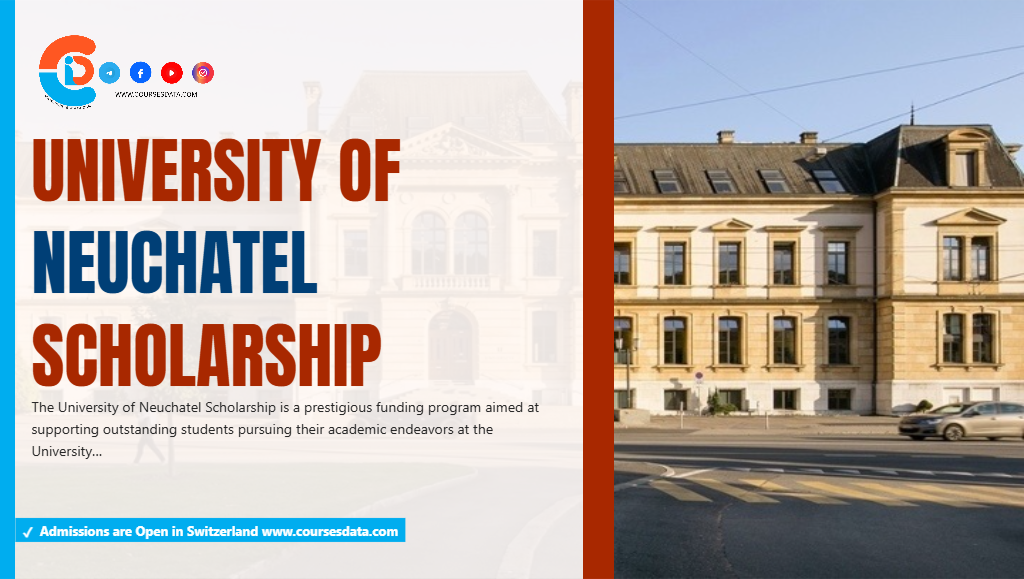
The University of Neuchatel Scholarship offers international students a funded opportunity to pursue bachelor’s, master’s, and doctoral degrees in Switzerland. This guide breaks down eligibility, available grants, the application timeline, and practical tips to strengthen your submission. Whether you are aiming for research-based study or a professional degree, you will find clear steps and honest advice to navigate the process successfully.
Overview of the University of Neuchatel Scholarship
The University of Neuchatel, located in the French-speaking part of Switzerland, provides several scholarship options for outstanding students. These awards are designed to reduce financial barriers and attract talented individuals from around the world. Most funding comes from the Swiss government, the university itself, or partner foundations.
Scholarships are not automatic. You must apply separately, and competition is strong. However, with a clear academic record and a well-prepared dossier, your chances improve significantly.
Types of Funding Available
- Swiss Government Excellence Scholarships: For postgraduate researchers and artists, covering monthly stipends, tuition fees, and health insurance.
- University Merit Scholarships: Awarded to high-achieving students based on academic performance, usually for master’s programs.
- Faculty-Specific Grants: Offered by individual faculties, such as science, law, or humanities, for research projects or thesis work.
- Need-Based Aid: For students who demonstrate financial hardship, often in the form of partial tuition waivers.
Eligibility Criteria for the University of Neuchatel Scholarship
Eligibility varies depending on the scholarship type, but some common requirements apply. You must hold an offer of admission or be currently enrolled at the University of Neuchatel. International students from non-EU/EEA countries are typically prioritized for government-funded awards.
Academic excellence is a baseline. Most scholarships require a minimum GPA equivalent to a Swiss grade of 5.0 out of 6.0. Language proficiency in French or English is also mandatory, depending on your program of study.
Additional Requirements by Study Level
- Bachelor’s: High school diploma with strong grades, proof of language skills, and a motivation letter.
- Master’s: Relevant bachelor’s degree, research proposal (for thesis-based programs), and two recommendation letters.
- Doctoral: Master’s degree, detailed research proposal, supervisor agreement, and publication record (if available).
How to Apply for the University of Neuchatel Scholarship
Start by checking the official university website for the specific scholarship page. Deadlines are strict, and late submissions are not accepted. Prepare your documents well in advance, as some require official translation or notarization.
Your application package should include academic transcripts, a valid passport copy, a curriculum vitae, and a statement of purpose. For research-based programs, a clear and feasible research proposal is essential.
Step-by-Step Application Process
- Choose your program and confirm you meet academic requirements.
- Apply for admission to the University of Neuchatel first.
- Identify which scholarship you are eligible for.
- Gather all required documents, including reference letters.
- Submit the online scholarship application before the deadline.
- Wait for the selection committee’s decision, which may take several weeks.
Key Deadlines and Timeline
Most scholarship applications open in autumn and close in early winter. For government-funded awards, the deadline is often around November or December. University-specific grants may have later deadlines, sometimes in spring.
It is wise to begin preparing your documents at least three months before the deadline. This gives you time to request transcripts, contact referees, and refine your research proposal.
| Scholarship Type | Typical Deadline | Application Mode |
|---|---|---|
| Swiss Government Excellence | November | Online via official portal |
| University Merit Scholarship | February | Directly to the university |
| Faculty-Specific Grant | Varies by faculty | Email or online form |
| Need-Based Aid | Rolling | Financial aid office |
Financial Coverage and Benefits
The University of Neuchatel Scholarship provides different levels of support. Government scholarships cover monthly living expenses, typically around 1,920 Swiss francs for graduate students and 2,000 Swiss francs for doctoral candidates. Tuition fees are often waived or reimbursed.
University merit scholarships may cover full or partial tuition, which is approximately 1,000 Swiss francs per semester for international students. Some grants also include a travel allowance for your initial move to Switzerland.
“Scholarships are not just about money; they are about access. Receiving this grant allowed me to focus entirely on my research without worrying about rent or groceries.” — Former scholarship recipient
Tips for a Strong Application
Your application should tell a coherent story about your academic journey and future goals. Avoid generic statements. Instead, explain why you specifically want to study at Neuchatel and how the program aligns with your career plans.
Choose referees who know you well and can speak to your abilities in detail. A vague recommendation letter can weaken an otherwise solid application.
What to Avoid
- Submitting incomplete documents or missing signatures.
- Using a copied or generic motivation letter.
- Underestimating the importance of language proficiency tests.
- Ignoring the specific requirements of your chosen faculty.
Living in Neuchatel as a Scholarship Student
Neuchatel is a small, safe city with a welcoming student community. The cost of living is moderate compared to Zurich or Geneva, but still higher than many other countries. A single student typically spends between 1,500 and 2,000 Swiss francs per month on rent, food, and transportation.
Scholarship recipients often live in student residences or shared apartments. The university’s housing office can help you find accommodation, but it is advisable to apply early due to limited availability.
“The best part of studying in Neuchatel is the balance between academic rigor and quality of life. You can hike in the Jura mountains in the morning and attend a seminar in the afternoon.” — Current international student
Common Mistakes and How to Overcome Them
Many applicants miss out because they underestimate the importance of the research proposal. This document should be specific, realistic, and aligned with the expertise of faculty members at Neuchatel. Contact potential supervisors before applying to discuss your ideas.
Another common issue is submitting generic recommendation letters. Ask your referees to highlight concrete examples of your skills, such as a challenging project you completed or a paper you presented.
Conclusion
The University of Neuchatel Scholarship is a realistic pathway for motivated students seeking quality education in Switzerland. While the process requires effort and attention to detail, the financial and academic rewards are substantial. Start early, follow the guidelines carefully, and tailor every part of your application to your specific goals. With persistence and a strong dossier, you can turn this opportunity into your next academic chapter.
Frequently Asked Questions
Do I need to be admitted to the university before applying for the scholarship?
Yes, in most cases you must have a conditional or unconditional offer of admission. Some scholarships allow you to apply simultaneously, but the university admission is a prerequisite for final award confirmation.
Is the scholarship open to all nationalities?
Most scholarships are open to international students from any country. However, Swiss government scholarships give priority to students from specific regions or partner countries. Check the eligibility list on the official website.
Can I work while holding the scholarship?
Yes, but with restrictions. Students with a Swiss study visa can work up to 15 hours per week during the semester. Scholarship conditions may also limit your working hours, so verify with the scholarship office.
Are family members allowed to accompany me?
If you receive a Swiss Government Excellence Scholarship, your family may join you under certain conditions. However, the scholarship does not provide additional financial support for dependents, and you must prove sufficient funds for their stay.
What language do I need to speak?
It depends on your program. French-taught programs require B2 or C1 level French. English-taught programs accept TOEFL or IELTS scores. Some scholarships require both languages for certain research roles.
How competitive is the University of Neuchatel Scholarship?
Competition is high, especially for fully funded awards. The university receives hundreds of applications each cycle, and only a small percentage are successful. A strong academic record and a well-aligned research proposal are essential.
Can I reapply if my first application is rejected?
Yes, you may reapply in a future cycle. Use the feedback from the selection committee, if provided, to strengthen your application. Many successful recipients applied more than once.
Is there an age limit for applicants?
No official age limit exists for most scholarships. However, some government grants target early-career researchers, so check specific program guidelines to ensure your profile fits.
Do scholarships cover health insurance?
Swiss Government Excellence Scholarships include health insurance coverage. University merit scholarships may not, so you will need to purchase mandatory Swiss health insurance separately.
When will I receive the scholarship decision?
Decisions are typically announced a few months after the application deadline. For example, if you apply in November, you may receive a decision by March or April. Always monitor your email and the application portal for updates.