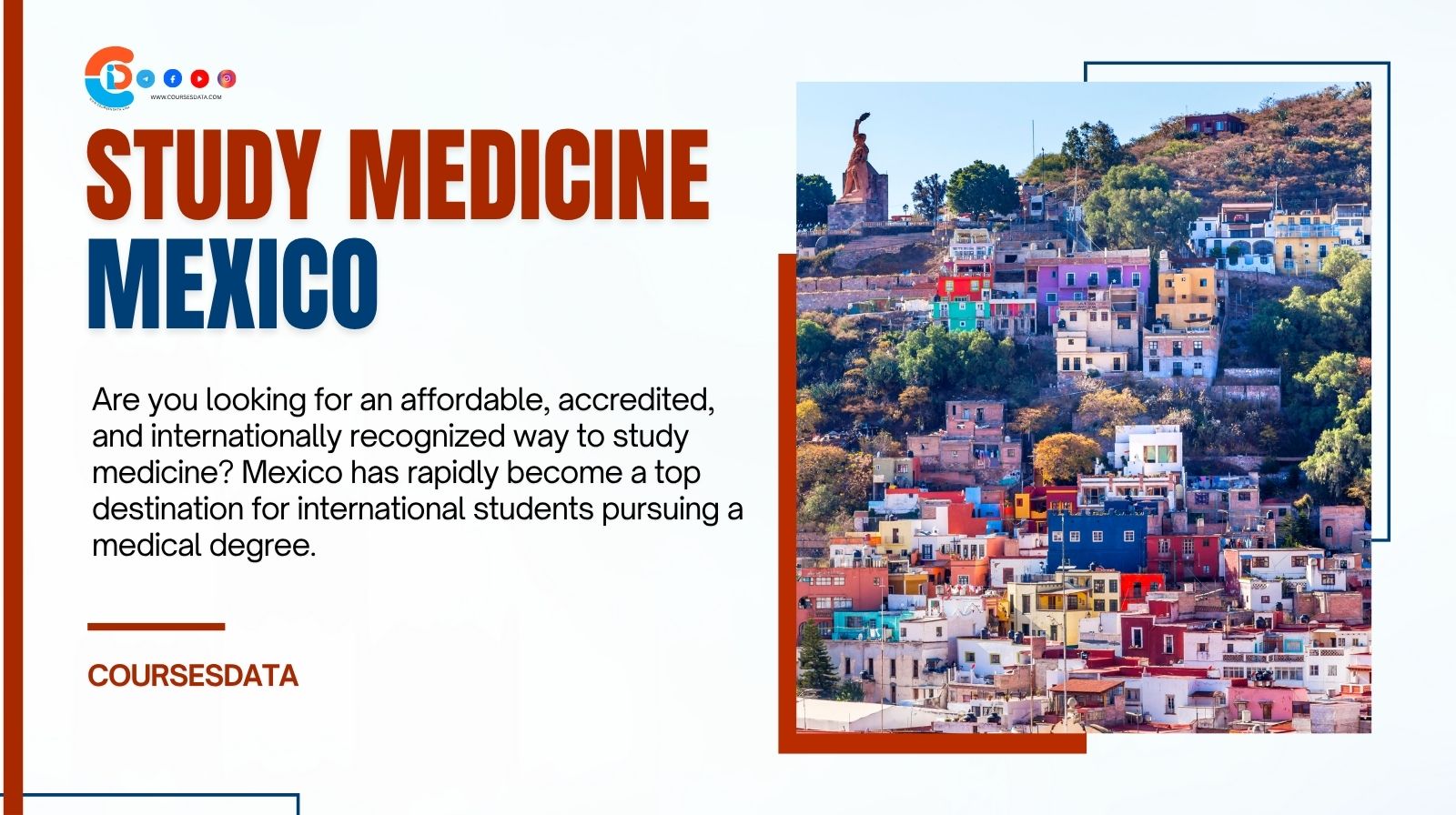
Are you looking for an affordable, accredited, and internationally recognized way to study medicine? Mexico has rapidly become a top destination for international students pursuing a medical degree.
Why Study Medicine in Mexico?
Mexico offers a compelling mix of affordable tuition, globally recognized programs, and cultural immersion. Medical schools here follow a rigorous curriculum aligned with international standards.
- Affordable tuition compared to U.S. and European schools
- Programs taught in English and Spanish
- Recognized degrees by WHO and ECFMG
- Pathway to U.S. residency via USMLE
- No MCAT required for many universities
- Modern teaching hospitals and clinical exposure
- Shorter program duration (6-7 years)
- Rich cultural and language immersion
- High acceptance rates for international students
- Growing expat and international student communities
Top Medical Schools in Mexico for International Students
Mexico is home to several well-respected universities offering quality medical education.
- Universidad Autónoma de Guadalajara (UAG)
- Universidad Nacional Autónoma de México (UNAM)
- Universidad de Monterrey (UDEM)
- Universidad Anáhuac
- Universidad Panamericana
- Instituto Tecnológico y de Estudios Superiores de Monterrey (ITESM)
- Universidad La Salle
- Universidad del Valle de México (UVM)
- Universidad Michoacana de San Nicolás de Hidalgo
- Universidad Veracruzana
Admission Requirements to Mexican Medical Schools
Getting into a medical school in Mexico is generally more accessible than in many countries.
- High school diploma or equivalent
- Science prerequisites (biology, chemistry, physics)
- Transcripts and GPA (minimum varies by school)
- Language proficiency (TOEFL/IELTS for English programs)
- Entrance exam (varies; some schools don’t require MCAT)
- Application form and fee
- Copy of passport and visa documents
- Medical certificate and vaccinations
- Personal interview (online or in-person)
- Letters of recommendation
How Long Does It Take to Study Medicine in Mexico?
Medical education in Mexico typically lasts 6-7 years, combining academic and clinical training.
Medical Program Breakdown:
| Year | Stage | Description |
|---|---|---|
| 1-2 | Basic Sciences | Classroom-based theory and lab work |
| 3-4 | Clinical Sciences | Hospital rotations and case studies |
| 5 | Social Service (Internado) | Supervised hospital work (mandatory) |
| 6 | Rural Service (Servicio Social) | Public healthcare service in rural areas |
- Total program duration: 6 to 7 years
- Some programs offer accelerated formats
- Pre-med not required for most schools
- Internship and service years are compulsory
- USMLE/ECFMG alignment allows U.S. residency eligibility
Cost of Studying Medicine in Mexico
Studying medicine in Mexico is significantly more affordable than in many countries.
- Annual tuition: $5,000 to $15,000 USD
- Living expenses: $400 to $800/month
- Books and materials: $300 to $500/year
- Student insurance: $150 to $300/year
- Dormitory or apartment options available
- Transportation and food are low-cost
- Scholarships available for international students
- Work opportunities are limited for foreign students
- Budget varies by city (Mexico City vs. Guadalajara)
- Currency exchange is favorable for many countries
Can International Students Practice in the U.S. After Studying in Mexico?
Yes, many Mexican medical schools align with U.S. licensing standards and are recognized by ECFMG.
- Take USMLE Step 1, 2 CK, and 2 CS
- Graduate from an ECFMG-certified school
- Complete U.S. residency via NRMP Match
- Obtain U.S. medical license after residency
- Some schools offer USMLE prep as part of curriculum
- Bilingual training is a major advantage
- Clinical electives in U.S. may be available
- Visa support offered by schools with U.S. pathways
- Alumni networks active in the U.S.
- Over 15,000 U.S. doctors trained in Mexico
Is It Safe to Study Medicine in Mexico?
Safety varies by city and region, but most student areas are secure and welcoming.
- Major cities like Guadalajara and Monterrey are safe
- Campuses have private security and health services
- Student housing often includes gated communities
- Medical schools guide on local laws and customs
- Emergency response systems in place
- Cultural orientation included during onboarding
- Travel advisories should be checked regularly
- Students encouraged to stay in groups when exploring
- Nighttime travel should be limited in some areas
- Awareness and respect for local customs enhance safety
Student Life and Cultural Experience in Mexico
Studying in Mexico offers a vibrant lifestyle and rich cultural immersion.
- Friendly and welcoming local communities
- Affordable travel within the country
- Traditional cuisine, music, and festivals
- Bilingual advantage in Spanish-speaking countries
- Opportunities for volunteer and public health work
- Modern cities with strong infrastructure
- Tropical and temperate climates depending on region
- Campus clubs, sports, and events for students
- Access to beaches, mountains, and historical sites
- Cultural exchange fosters global understanding
Frequently Asked Questions
Can I study medicine in English in Mexico?
Yes, many private universities offer English-taught medical programs designed for international students.
Do I need to speak Spanish to study medicine in Mexico?
Basic Spanish helps with daily life and clinical rotations. Some programs include Spanish language training.
Is a Mexican medical degree recognized internationally?
Yes, especially from schools approved by the WHO and ECFMG. Graduates can pursue licensing exams in the U.S., Canada, and other countries.
How competitive is medical school admission in Mexico?
Admission is less competitive than in the U.S. or Europe. High school performance and a strong application are key.
What documents do I need to apply?
You need your high school diploma, transcripts, passport, application form, letters of recommendation, and health documents.
How much does it cost to live in Mexico as a student?
Most students spend between $400 and $800 per month on housing, food, transportation, and other needs.
Can I work while studying medicine in Mexico?
International students have limited work options due to visa restrictions, but some on-campus opportunities may be available.
Is health insurance required?
Yes, all students must have health insurance. Many schools offer affordable plans or require proof of coverage.
Can I transfer from a U.S. or other foreign medical school to Mexico?
Some schools accept transfer students, but evaluations and credits vary. It’s best to contact the university directly.
What are the living conditions like for medical students in Mexico?
Students typically live in apartments, student housing, or with host families. Conditions are generally comfortable and affordable.
Conclusion
Studying medicine in Mexico offers international students a smart, affordable, and globally recognized pathway to a medical career.
Explore your future in healthcare by choosing a medical education in Mexico.
That bit about skipping the MCAT is a game-changer honestly. I’ve been looking into this for a while, and the fact you can get clinical exposure starting in the first few years instead of waiting until rotations is way more hands-on than what I’ve seen in the States. Quick question though—for the programs taught in English, how much Spanish do you realistically need for patient interactions during the clinical years? I’d hate to get through the bookwork and then hit a wall at the hospital.
Honestly, the no-MCAT thing is what sealed it for me too—it took so much pressure off the application process. On the Spanish front, I’d say get comfortable with at least basic conversational Spanish by your third year, because even in English-taught programs, you’ll meet patients who only speak Spanish during clinical rotations. I started with a medical Spanish course in my second year, and it saved me from so many awkward moments in the hospital—just practice a little every day, and you’ll be fine.
The no-MCAT angle is what finally got me to stop doom-scrolling application requirements, so I feel you there. On the Spanish bit—I’d add that even a daily 10-minute Duolingo habit from day one beats banking on a panic-crammed elective, because your third-year self will be too tired to conjugate verbs properly. Just don’t be like me and assume “pollo” means “patient” during your first clinical history.
That’s exactly what pulled me in too—the hands-on clinical exposure from year one is so different from the U.S. model. As for Spanish, I’d say you need at least conversational fluency by your third year, because even in English-taught programs, patients often speak only Spanish and you’ll be expected to take histories directly. I actually took a medical Spanish elective in my second year, and it made a world of difference during rotations. Don’t let it scare you off, but do start practicing early—your future patients will thank you.
Kendra, you just validated every late-night worry I had about the language barrier when I was weighing this exact decision. The medical Spanish elective tip is gold—I ended up doing the same in my third year, and let me tell you, fumbling through a patient’s history in broken Spanish is a humbling experience no textbook prepares you for. You’re spot-on about conversational fluency being the real gatekeeper, not the coursework. Start with the basics early, or you’ll be that person miming appendicitis to a very confused abuela.
The “miming appendicitis to a very confused abuela” image is going to haunt me, but you’re absolutely right—it’s the conversational fluency that catches you, not the biochem. I made the mistake of thinking my English-taught lectures meant I could coast on Spanish, and my first rotation disabused me of that notion real fast. A little daily practice from year one beats a panic-crammed medical Spanish elective in year three, trust me.
Hana, you just described my exact first rotation—I thought I was slick with my English lectures and then spent a solid week nodding along to a nurse’s rapid-fire Spanish before realizing she was asking about my patient’s bowel habits. That daily practice tip is the real deal; I started doing 15 minutes of Duolingo plus listening to a medical Spanish podcast on my commute, and it made the hospital feel way less like a foreign planet by year three. Don’t wait for the panic-cram, your future patients will be way less terrifying than that abuela.
That point about conversational Spanish being the real hurdle hit home for me—I’m currently weighing programs down there, and it’s easy to get blinded by the affordable tuition and skip the reality of day-to-day hospital life. For anyone already enrolled, did you find that the English-taught programs still weave in enough local medical terminology early on, or is it pretty much sink-or-swim once you hit rotations? I’m trying to figure out if I should front-load a Spanish course before I even apply, just to avoid that panicked miming phase.
The point about conversational Spanish being the real gatekeeper is spot on, but I’d flip the question back to the program structure itself. For those already in an English-taught track, how much do the universities actually embed local terminology into the first two years of coursework, or is it fully on you to self-teach alongside the heavy basic science load? If it’s the latter, that’s a serious time-management consideration on top of an already demanding schedule.
You know, reading this thread takes me right back to my own first clinical rotation—I was so confident in my English-taught coursework that I completely underestimated how much of my day would be spent fumbling through Spanish, especially when a patient’s family member started rapid-firing questions at me about discharge instructions. What finally saved me wasn’t a formal class but a habit of shadowing a bilingual nurse during my second year, who basically drilled me on the top 50 phrases you actually use in a hospital, like “¿Cuándo fue su última evacuación?”—trust me, you don’t want to learn that one on the fly. For anyone still weighing the decision, I’d say don’t just ask about the curriculum; ask the school if they offer early clinical shadowing in community clinics, because that’s where you’ll get the real language immersion before the pressure of graded rotations hits. And if you’re worried about time management, just remember that a 10-minute daily podcast habit is way easier to stick with than cramming a whole elective when you’re already exhausted by year three.