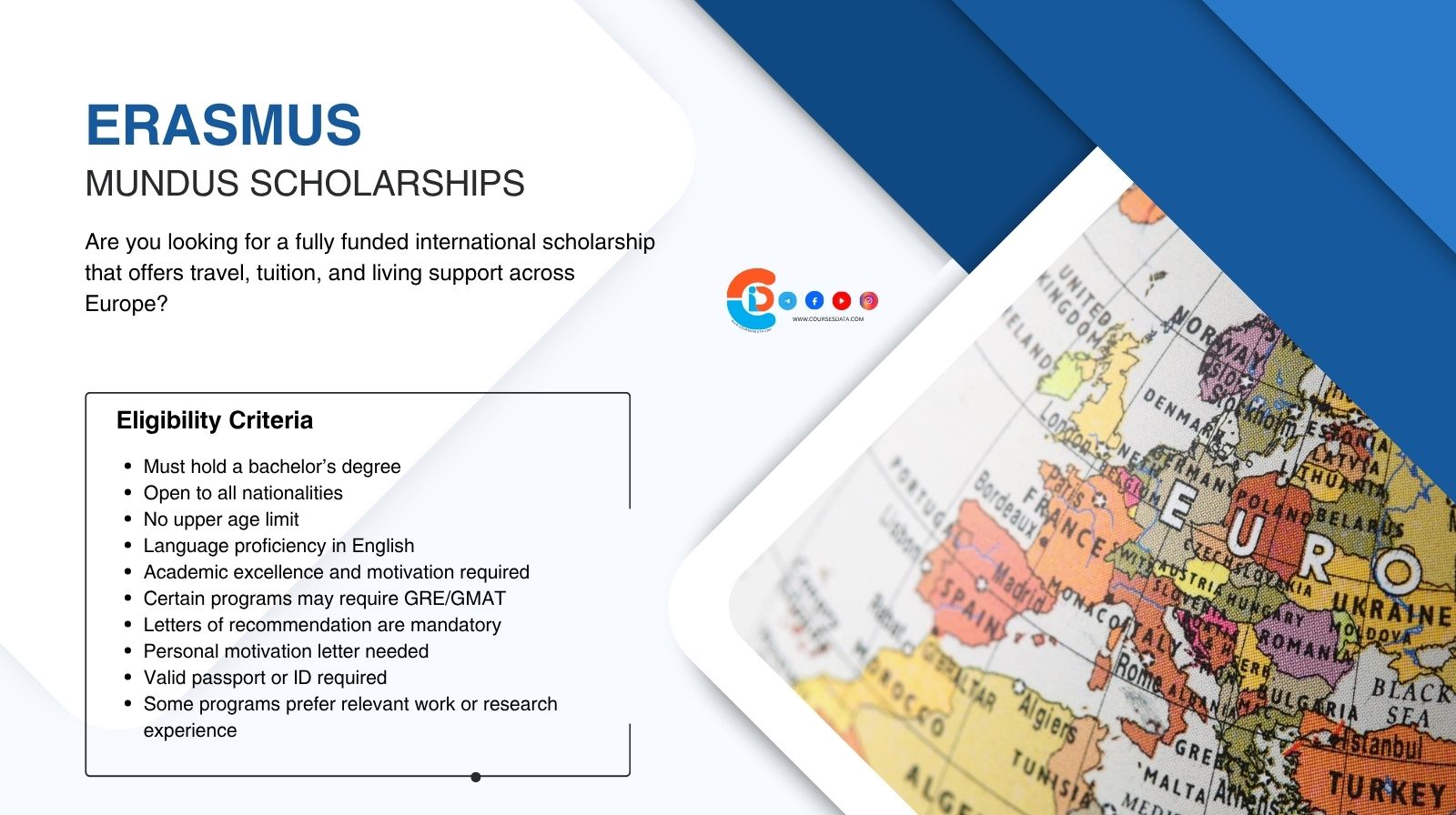
Are you looking for a fully funded international scholarship that offers travel, tuition, and living support across Europe?
What Is the Erasmus Mundus Scholarship?
The Erasmus Mundus Scholarship is a prestigious and fully funded program funded by the European Union, designed for students worldwide to pursue joint master’s degrees across multiple European universities. The program enhances global cooperation and academic mobility.
- Fully funded by the European Commission
- Covers tuition, travel, and living costs
- Targets master’s degree programs only
- Involves studying in at least two different countries
- Programs span two years
- Includes internship or research components
- Welcomes applicants from all nationalities
- No age restrictions
- Over 100 programs available annually
- Joint degrees from multiple institutions
Eligibility Criteria for Erasmus Mundus
To apply, you must meet specific academic and language requirements, along with documentation as outlined by each program.
- Must hold a bachelor’s degree (or be in final year)
- Open to all nationalities
- No upper age limit
- Language proficiency in English or other specified languages
- Academic excellence and motivation required
- Certain programs may require GRE/GMAT
- Letters of recommendation are mandatory
- Personal motivation letter needed
- Valid passport or ID required
- Some programs prefer relevant work or research experience
How to Apply for Erasmus Mundus Scholarship
Applications are made directly through the Erasmus Mundus Joint Master Degrees (EMJMD) program portals, usually between October and January.
- Choose up to 3 programs from EMJMD catalogue
- Review specific requirements of each program
- Prepare academic transcripts and certificates
- Write a compelling motivation letter
- Collect 2–3 academic or professional references
- Provide proof of language proficiency
- Submit online application through program websites
- No application fee required
- Await interview or further documentation request
- Final results announced between March and June
Benefits of the Erasmus Mundus Scholarship
The scholarship offers extensive support that covers nearly every aspect of a student’s academic journey in Europe.
- Full tuition coverage for two years
- Monthly stipend (1,000–1,200 EUR)
- Travel allowance (2,000–3,000 EUR)
- Installation support upon arrival
- Health insurance provided
- Access to top-ranked European universities
- Opportunity to live in at least two European countries
- Joint or multiple diplomas on graduation
- Language and cultural immersion
- Professional networking and alumni connections
List of Popular Erasmus Mundus Programs
Each year, dozens of interdisciplinary master’s programs open up under Erasmus Mundus across engineering, social sciences, humanities, and more.
| Program Name | Field of Study | Participating Countries |
|---|---|---|
| GEMMA | Gender Studies | Spain, UK, Poland |
| MUNDUS MAPP | Public Policy | Hungary, UK, Netherlands |
| EUROPHOTONICS | Photonics | France, Germany, Spain |
| IMRD | Rural Development | Belgium, Italy, Germany |
| EGEI | Global Economy | Belgium, France, China |
| EMLE | Law & Economics | Germany, Italy, Netherlands |
| MEDfOR | Forestry | Portugal, Spain, Italy |
| SE4GD | Smart Cities | Sweden, Italy, Portugal |
| CLE | Literature | France, Greece, Italy |
| MediaAC | Media Arts | Austria, Denmark, Poland |
Required Documents for Erasmus Mundus
Applicants must gather a strong portfolio of academic and professional documents to compete effectively.
- Academic transcripts
- Degree certificates
- Valid passport copy
- IELTS/TOEFL certificate or equivalent
- Motivation letter
- Curriculum Vitae (CV)
- Two or three recommendation letters
- Portfolio (if applicable)
- Proof of residence
- Application form per program guidelines
Key Deadlines and Timeline
Timing is crucial. Most Erasmus Mundus applications follow a structured schedule.
- Applications open: October–December
- Submission deadline: December–January
- Preselection period: February–March
- Interviews (if required): March–April
- Final results: April–June
- Visa processing: June–August
- Program start: September
Selection Criteria and Evaluation
The Erasmus Mundus selection process is competitive. Each application is scored based on predefined academic and motivational factors.
- Academic performance
- Relevance of previous studies
- Language proficiency
- Motivation and goals
- Letters of recommendation
- Clarity and structure of documents
- Research or professional experience
- Interview performance (if applicable)
- Portfolio (for design/media programs)
- Regional diversity considerations
Living and Studying in Europe as an Erasmus Scholar
The Erasmus Mundus experience is immersive, offering more than just education.
- Multicultural academic environments
- Language learning opportunities
- Access to university resources and libraries
- Student housing or housing support
- Social activities and events
- Peer support networks
- Affordable transport within Europe
- Discounts with Erasmus student card
- Career counseling and job fairs
- Cultural integration and local travel
Career Prospects After Erasmus Mundus
Graduates enjoy high employability and global career mobility thanks to the international scope of the program.
- Recognized joint/master’s degrees
- High employment rate within 6 months
- Strong alumni network worldwide
- Opportunities in international organizations
- PhD and research pathways
- Government and NGO careers
- Access to EU Blue Card residency
- Internships and job placements during studies
- Multilingual and multicultural skills
- Competitive edge in global job market
Frequently Asked Questions
Is the Erasmus Mundus scholarship fully funded?
Yes, it covers tuition, travel, insurance, and provides a monthly stipend.
Can I apply without IELTS?
Some programs accept alternatives like TOEFL or proof of previous English instruction.
How many programs can I apply to?
You can apply to up to three Erasmus Mundus Joint Master Degree programs per cycle.
Is work experience required?
Not mandatory, but relevant experience can strengthen your application.
What’s the acceptance rate for Erasmus Mundus?
Varies by program but typically ranges between 2% and 10%.
Can I stay in Europe after graduation?
Yes, many countries offer post-study work visas or pathways to residency.
Do I need a visa for each country?
You’ll typically get a student visa for your first destination, then register as required in others.
Are programs only in English?
Most are in English, but some offer courses in other European languages.
Can I bring my family with me?
Possible, but the scholarship does not cover dependents.
When will I receive scholarship payments?
Usually monthly, starting from your arrival in the program country.
Conclusion
Erasmus Mundus offers an unmatched opportunity to study, travel, and grow across Europe with full financial support. Choose Erasmus Mundus to turn your academic dreams into an international journey.
I applied for an Erasmus Mundus scholarship a few years back, and honestly, the most eye-opening part was understanding how different each program’s selection criteria can be—some really value work experience over pure grades. If you’re thinking of applying, my tip is to spend serious time tailoring your motivation letter to how your background connects to studying in two specific countries, not just listing achievements. Did you find any particular program’s focus—like sustainability or public health—that made you want to go for it?
Oh, absolutely—I remember being so surprised that some programs cared more about my volunteer work in community health than my GPA. For me, the pull toward public health was huge, especially when I found a track that let me study disease prevention in Sweden and then health policy in Portugal. It felt less like choosing a degree and more like building a story around real-world problems I wanted to help solve. Did you find your experience abroad shifted how you saw your own career path afterward?
Chantal, your point about building a story around real-world problems really hit home for me. I did a track on sustainable food systems, moving from an agroecology lab in Italy to a policy institute in Finland, and it completely rewired how I see my career—I went from wanting a generic research job to chasing roles that sit right between farming communities and EU regulations. The experience doesn’t just give you a degree; it forces you to figure out what kind of problem-solver you actually want to be.
Oh, absolutely—your point about tailoring the motivation letter to two specific countries really resonated with me. When I applied, I chose a program focused on coastal sustainability because I had volunteer experience in marine biology in Portugal and wanted to connect it to coastal management policies in the Netherlands. It wasn’t just about listing my GPA, but showing how my work in one country naturally flowed into the research I’d do in the other.
That’s exactly the kind of connection that makes an application stand out—showing how your hands-on work in one place directly fuels the academic question you want to tackle in another. I think a lot of people underestimate how powerful it is to frame your experience as a bridge between countries, not just a list of achievements. Your coastal sustainability track sounds like it was built for that kind of storytelling.
Oh, so the real challenge isn’t just getting in—it’s figuring out which program wants a gritty fieldworker versus a textbook hero. That bit about tailoring the motivation letter to two specific countries hits home; I always assumed it was about showing off grades, not explaining why you’d drag your suitcase from, say, a wind farm in Denmark to a policy lab in Portugal. Did you find that some programs practically ghost you if your background doesn’t scream “interdisciplinary mutt,” or was it more about nailing the language in their application portal?
You’re dead right—some programs want that interdisciplinary mutt more than a straight-A student, and they’ll ghost you fast if your CV looks like one-note textbook material. I’ve seen folks get dinged not because their grades were weak, but because they couldn’t show how their background actually fits two different countries’ approaches. Nailing the portal language is part of it, sure, but the real test is proving you can stitch together fieldwork in one place with policy work in another without it sounding forced.
Ah, so the real trick isn’t just having good grades—it’s convincing a panel that you’re the exact weird mix of field experience and academic curiosity they’re after. I’m curious, though: once you’re hopping between countries, how much does the actual bureaucratic side of things—like visas or finding housing in a new country every semester—wreck the romantic idea of studying abroad? Because that part always sounds less like a glossy brochure and more like a frantic spreadsheet nightmare.
You’re spot on—the glossy brochure dies fast when you’re chasing down a visa appointment in a language you barely speak. Honestly, the bureaucratic grind is real, but it’s manageable if you treat it like a project: start early, keep a spreadsheet, and lean on your program’s coordinator because they’ve seen it all before. The payoff—actually living and studying in those countries—makes the frantic spreadsheet nightmare worth it.
Oh, the spreadsheet—my old frenemy. I became oddly attached to color-coding visa deadlines and rental deposits in a language I was still butchering in conversation. But you’re right, leaning on the coordinator is the real pro tip; mine once walked me through registering for health insurance via a series of increasingly desperate emoji. And yes, the payoff absolutely makes up for it—there’s nothing like standing in a new city, knowing you survived the paper trail to get there.