

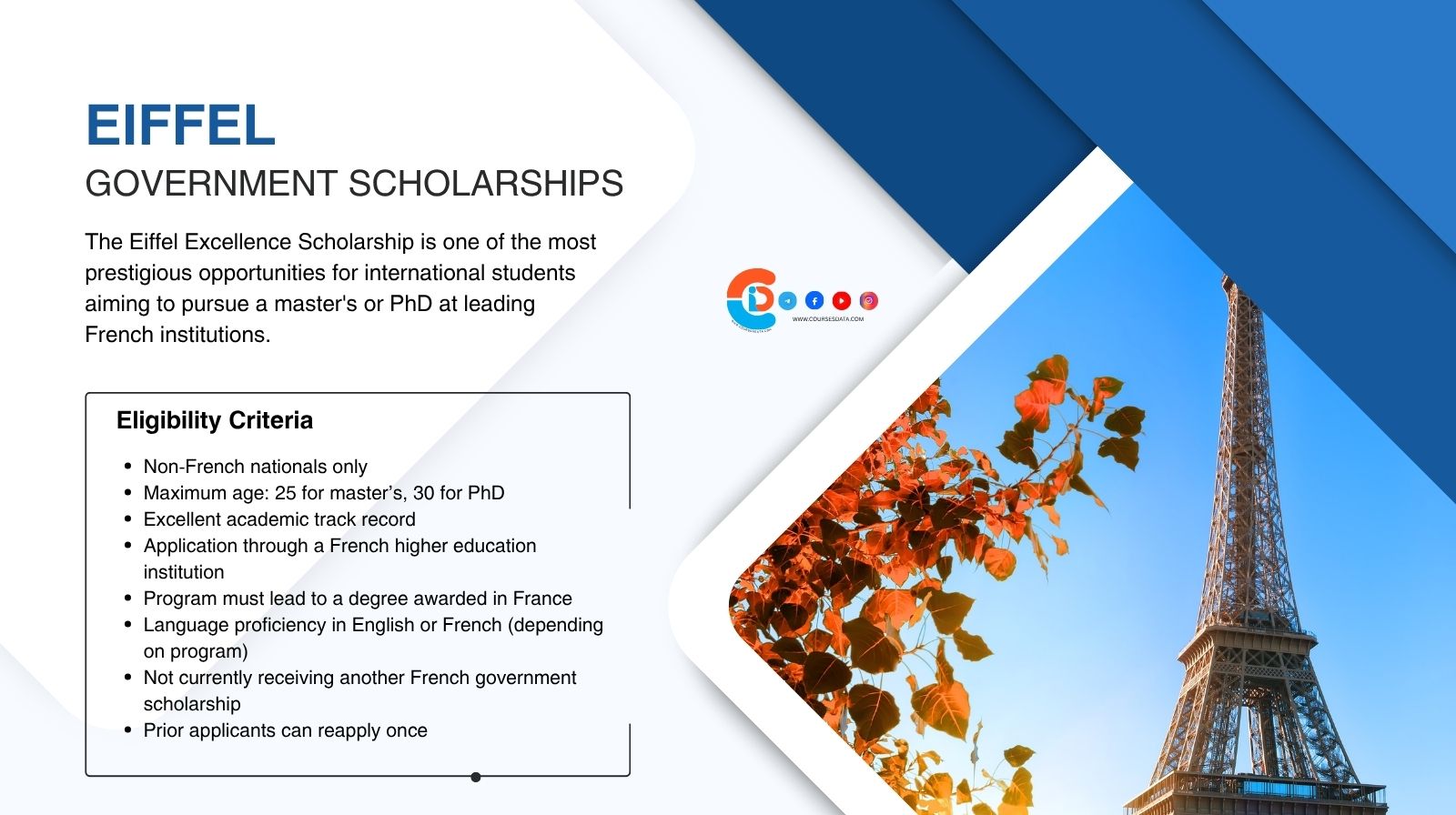
The Eiffel Excellence Scholarship is a French government-funded programme that enables international students to pursue a master’s degree or a doctoral programme in France. It is administered by Campus France on behalf of the French Ministry for Europe and Foreign Affairs and exists to attract high-achieving students from around the world to French higher education institutions. If you are researching this scholarship, the single most important fact to understand up front is that students cannot apply directly: French institutions nominate candidates, and final selection is made centrally. This guide explains who the scholarship is for, what it covers, how the nomination and application process works, and what you can realistically do to strengthen a candidacy.
What the Eiffel Excellence Scholarship Actually Is
The Eiffel programme is a merit-based scholarship created to support France’s international academic influence. It targets two distinct groups: students seeking a master’s-level qualification and students pursuing a doctorate. Campus France manages the programme, and its official information pages are the authoritative source for rules, deadlines, and eligible fields.
One detail that surprises many applicants is that the scholarship is awarded to the institution’s nominated candidate, not to a self-registering applicant. Universities and other eligible French higher education institutions select their strongest international candidates and submit nominations to Campus France within the annual campaign window. This structure shapes everything about how you should approach the process, from the first email you send to a department to the way you frame your project statement.
- The scholarship is funded by the French Ministry for Europe and Foreign Affairs.
- Campus France administers the programme and publishes the official rules.
- French host institutions nominate candidates; students do not apply directly.
- It supports both master’s-level study and doctoral research.
- Awards are merit-based and competitive, with limited places each campaign.
Who the Scholarship Is Designed For
The Eiffel programme is aimed at international students who demonstrate strong academic records and clear professional or research ambitions. It is not a general funding scheme for anyone who wishes to study in France; it is a targeted instrument for attracting talent in specific fields and at specific study levels. That distinction matters, because it determines whether pursuing the scholarship is a realistic use of your time at all.
Master’s-Level Candidates
For the master’s component, the scholarship is intended for students applying to eligible master’s programmes at French institutions. Candidates are typically expected to be under a certain age at the time of the campaign, and the exact age limit is set in the official programme rules for each call. Because these rules are updated periodically, check the current official eligibility criteria on the Campus France Eiffel pages rather than relying on older summaries.
Doctoral Candidates
The doctoral component supports students pursuing a PhD in France, usually through a doctoral school attached to a French institution. Age limits and conditions for the doctoral strand differ from the master’s strand, and the nomination is generally made by the doctoral school or the host institution. The official programme documentation is the only reliable place to confirm the current conditions.
- Non-French nationals are the intended beneficiaries of the programme.
- Applicants must be applying to, or enrolled in, an eligible French programme.
- Strong academic results and a coherent project are central selection criteria.
- Age and nationality conditions are defined in the official call each year.
- Both master’s and doctoral candidates are supported, under separate rules.
What the Scholarship Covers
The Eiffel scholarship is a monthly allowance rather than a full package that pays every cost. It also includes additional benefits such as travel support and insurance, the details of which are set out in the official programme documentation. The exact monthly amount, the treatment of travel costs, and the scope of cover can be adjusted by the ministry, so treat any figure you see on a blog as indicative only and confirm it on the official page.
What the scholarship generally does not do is cover tuition fees in full. French institutions set their own tuition, and some programmes charge different rates for international students. The scholarship is intended to reduce the financial burden of living in France, not to eliminate every expense. Budget for tuition, accommodation deposits, and initial settling-in costs separately, and do so before you accept a place.
- A monthly living allowance paid for the duration defined in the programme rules.
- Additional support that may include travel and insurance components.
- Tuition fees are generally not fully covered and vary by institution.
- Payments are administered through the host institution and Campus France processes.
- Exact amounts and conditions are published in the official call documents.
Eligible Fields of Study
The Eiffel programme is not open to every subject. It concentrates on priority fields that align with French international education strategy, and the list of eligible disciplines is published in the official call. Broadly, the programme has historically emphasised areas such as engineering, science, economics and management, law, and political science, but the precise list and any sub-field restrictions must be checked each campaign.
If your intended programme sits outside the eligible fields, no amount of strong grades will make a nomination possible. Confirm eligibility before you invest time in building a candidacy, and ask the institution’s international office directly if a specific programme qualifies. A short email at the start can save months of wasted preparation.
How the Application Process Works
The process is institution-driven, and understanding the sequence is the single most useful thing you can do. The timeline below reflects the general structure of the campaign; the specific dates change each year and are published by Campus France and by individual institutions.
| Stage | Who Acts | What Happens |
|---|---|---|
| 1. Programme selection | Applicant | Identify an eligible master’s or doctoral programme at a French institution. |
| 2. Institutional contact | Applicant and institution | Express interest in Eiffel nomination and follow the institution’s internal instructions. |
| 3. Internal selection | French institution | The institution ranks candidates and decides whom to nominate. |
| 4. Nomination submission | French institution | The institution submits nominations to Campus France within the campaign window. |
| 5. Central review | Campus France and ministry | Nominations are assessed and final awards are decided. |
| 6. Results and enrolment | Campus France and institution | Results are communicated and scholarship arrangements are confirmed. |
Because the institution controls the nomination, your practical task is to become the candidate that institution wants to put forward. That means engaging early, following internal deadlines precisely, and presenting a project that fits both the programme and the scholarship’s objectives.
Documents You Will Typically Need
Institutions set their own internal document requirements, but most nomination files draw on the same core materials. Preparing these in advance saves time and reduces the risk of missing an internal deadline that falls well before the central campaign closes.
- A completed academic CV covering degrees, grades, and relevant experience.
- Academic transcripts and proof of the highest qualification obtained.
- A statement of purpose or motivation letter tailored to the programme.
- A research proposal, for doctoral candidates in particular.
- Letters of recommendation from academic referees.
- Proof of identity and nationality.
- Language proficiency evidence, where the programme requires it.
- Any institutional forms required by the nominating university.
How Candidates Are Assessed
Selection looks at academic excellence first, but the assessment is broader than grades alone. Reviewers consider the quality and coherence of the candidate’s project, the fit between the candidate and the host programme, and the potential for the candidate to contribute to academic and professional links between France and their home country.
Letters of recommendation carry real weight because they provide independent evidence of your abilities and potential. A generic letter from a professor who barely knows you is far less useful than a specific one that describes your work and explains why you are suited to the proposed programme. The same principle applies to your own statement: specificity is what separates a memorable file from a forgettable one.
- Academic record and standing within your cohort.
- Clarity and ambition of the study or research project.
- Alignment between your goals and the host programme.
- Strength and specificity of recommendation letters.
- Potential for future impact and international connection.
Practical Steps to Strengthen Your Candidacy
Start with the institution, not the scholarship. Identify programmes in eligible fields that genuinely match your background, then contact the relevant department or international office to ask about their Eiffel nomination process. Some institutions publish internal guidance and deadlines on their own websites, and following that guidance is essential.
Give your referees enough time and information to write strong letters. Provide them with your CV, your project outline, and a reminder of the specific work you did with them. A referee who understands what the Eiffel programme values will write a more persuasive letter.
Finally, treat the project statement as the centrepiece of your file. Explain what you intend to study or research, why this particular programme and institution are the right setting for it, and how it connects to your longer-term goals. Reviewers should be able to see, from your statement alone, why you and this programme belong together.
- Confirm the programme’s eligibility before doing anything else.
- Ask the institution about its internal nomination deadline early.
- Write a focused project statement rather than a general motivation letter.
- Choose referees who know your academic work in detail.
- Prepare documents in the required format and language.
- Keep copies of everything you submit to the institution.
Common Mistakes to Avoid
The most common mistake is assuming you can apply directly to Campus France for the scholarship. Students who wait for a public application form often miss the institutional nomination window entirely. The second most common mistake is applying to a programme outside the eligible fields, which makes nomination impossible regardless of merit.
Another frequent problem is a weak or generic project statement. Reviewers read many applications, and a statement that could have been written for any university in any country does not stand out. Be specific about the programme, the research or coursework you want to pursue, and how it connects to your longer-term plans.
- Waiting for a direct student application route that does not exist.
- Ignoring the institution’s internal deadline.
- Choosing a programme outside the eligible disciplines.
- Submitting generic recommendation letters.
- Assuming the scholarship covers all tuition and living costs.
- Missing language or document requirements set by the programme.
How the Scholarship Fits With Your Overall Funding Plan
Treat the Eiffel award as one component of a funding plan rather than the whole plan. Even if you are nominated and selected, you should understand how tuition, accommodation, and day-to-day costs will be covered. Many students combine scholarships with institutional fee waivers, part-time work where permitted, or family support.
French student visa rules and work permissions are governed by official immigration guidance, and the conditions depend on your nationality and status. Check the official student visa requirements on the relevant French government portal before making financial assumptions about working while studying.
- Confirm tuition rates for your specific programme and nationality category.
- Budget for accommodation deposits and initial living costs.
- Check whether the host institution offers additional fee reductions.
- Review the official student visa requirements for your situation.
- Plan for the gap between arrival and the first scholarship payment.
Where to Verify Official Information
Rules, eligible fields, age conditions, and campaign dates are updated regularly, so always verify details on the official scholarship page maintained by Campus France. Individual institutions also publish their own nomination guidance, and those pages often contain the practical instructions you actually need.
For the broader application and enrolment side, the Campus France platform used for student procedures in your country of residence is the correct starting point. If you are unsure which procedure applies to you, the local Campus France office can confirm it.
- Use the official Campus France Eiffel programme pages for rules and eligibility.
- Check your target institution’s international office pages for nomination details.
- Use the official Campus France country procedure for your application route.
- Confirm visa and immigration conditions through official government portals.
- Avoid relying on third-party summaries for deadlines or amounts.
Conclusion
The Eiffel Excellence Scholarship rewards strong academic candidates who are nominated by a French institution, so the practical path runs through the university rather than a public application form. Confirm that your programme is in an eligible field, engage the institution early, and prepare specific, well-evidenced documents. Verify amounts, age limits, and deadlines on the official Campus France pages each campaign, and build a funding plan that accounts for costs the scholarship does not cover.
Frequently Asked Questions
Can I apply for the Eiffel Excellence Scholarship directly?
No. Students do not submit applications directly to Campus France for this scholarship. French higher education institutions select and nominate candidates, and Campus France then assesses those nominations. Your route is to contact the institution offering your chosen programme and follow its internal nomination process.
Is the Eiffel scholarship available for bachelor’s degrees?
The programme supports master’s-level study and doctoral research, not undergraduate degrees. If you are seeking funding for a bachelor’s programme in France, you will need to look at other scholarship schemes offered by the French government, your host institution, or external funders.
Does the scholarship cover tuition fees?
Generally, no. The Eiffel award is primarily a monthly living allowance with additional benefits defined in the official programme rules, and it does not automatically cover full tuition. Tuition varies by institution and programme, so confirm the rates for your specific course and plan how any remaining fees will be paid.
What fields of study are eligible?
Eligibility is limited to priority disciplines listed in the official call, which has historically included areas such as engineering, science, economics, law, and political science. The precise list and any restrictions change between campaigns, so check the current official eligibility criteria before committing to a programme.
Is there an age limit for applicants?
Age conditions apply and differ between the master’s and doctoral strands. The exact limits are set in the official programme rules for each campaign and are subject to change. Confirm the current conditions on the Campus France Eiffel pages rather than relying on older secondary sources.
How competitive is the scholarship?
It is a competitive, merit-based award with a limited number of places, and institutions nominate only a small number of candidates from their applicant pools. Strong grades alone are rarely enough; a coherent project, good programme fit, and convincing references all matter.
Can I apply if I am already studying in France?
Conditions depend on your situation and the strand you are applying for, and the official rules define who is eligible. Some candidates already enrolled in a French programme may be nominated by their institution, but you should confirm your specific case with the institution’s international office and the official programme documentation.
What happens if my institution does not nominate me?
Without a nomination, your candidacy cannot proceed for that campaign. You can still pursue your programme with other funding, and in a later campaign you may be considered again if you meet the conditions and the institution chooses to nominate you.
Do I need to speak French to receive the scholarship?
The scholarship itself does not impose a single language rule, but the programme you apply to will have its own language requirements. Many master’s and doctoral programmes are taught in French, while others are delivered in English. Check the specific programme’s admission requirements before applying.
When are results announced?
Results follow the central review stage after institutions submit their nominations, and the timing is set within each annual campaign. Because the schedule changes, consult the official Campus France programme page and your nominating institution for the current timeline rather than relying on previous years’ dates.

I actually looked into this scholarship a couple of years ago when I was applying for my master’s, and while the funding is fantastic, I’d warn anyone that the application process feels like a full-time job on top of your regular studies. The requirement to be nominated directly by a French university rather than applying on your own caught me off guard at first. Did you find the discipline restrictions limiting, or did your field line up pretty well with their priority areas?
Oh, I absolutely agree—the nomination requirement felt like discovering the fine print after you’ve already signed up. My field in public policy happened to overlap with their priority areas, so I dodged that bullet, but I can see how it would be a dealbreaker for someone in, say, fine arts. Honestly, the whole process made me wonder if they’re secretly testing your stamina for French bureaucracy before you even set foot there.
That’s a great point about the stamina test—I felt the exact same way when I was digging into the requirements. It makes me wonder if the whole nomination hurdle is really just a clever way to see who’s willing to navigate French administrative quirks before they even arrive. Do you think they’d ever streamline it, or is that bureaucratic gauntlet part of the charm?
It’s funny you mention the discipline restrictions—I was sweating over that myself. My background is in digital humanities, which isn’t exactly their bread and butter, so I had to really stretch my proposal to emphasize the data science angle. In the end, it worked, but I definitely felt like I was bending my research to fit their mold rather than the other way around.
Oh, you’ve hit on exactly what gave me the most grief too—I spent weeks trying to figure out if my background in political economy was “priority enough,” and I still felt like I was forcing a square peg into a round hole. The nomination step really does feel like you need a secret handshake, and I admire anyone who gets through it without tearing their hair out. Did you find that the professors were more understanding once you explained your research fit, or did you mostly get polite form letters back?
Oh, I remember the nomination hurdle too—it was such a curveball. I was lucky that my field in sustainable urban planning fit neatly into their priority areas, but even then, the paperwork felt endless. Did anyone else find that the language requirements or the need for a French university to sponsor you made the process feel more exclusive than they expected?
Absolutely. The exclusivity is by design—they want students who are already on the radar of top French institutions, not just anyone with good grades. That sponsorship requirement filters out a lot of people early on, so if you don’t have a strong connection with a professor or program in France before applying, you’re already on the back foot. It’s a selective process that rewards proactive networking as much as academic merit.
Honestly, the nomination requirement was what almost made me give up before I even started. I spent months emailing professors in France just to get a foot in the door, and even then, my field in international law was a borderline fit for their priority list. It felt less like a scholarship application and more like a test of how badly I wanted to deal with French administrative culture.
Oh, Brenda, you’ve absolutely nailed it—that “test of stamina” is exactly how I felt too. I spent weeks chasing down a professor in Lyon for my environmental policy research, and the whole nomination dance made me wonder if the real scholarship was just surviving the process itself. And you’re spot on about it being a borderline fit; I had to reframe half my proposal just to squeeze into their priority box.
Reading through everyone’s experiences with the nomination hurdle, I have to say it really does feel like you need a mentor inside the system before you even start. My own background is in environmental chemistry, which ticked the STEM box easily, but the real shock for me was how little guidance exists on *how* to approach a French professor cold. Did anyone else find that the professors were surprisingly receptive once you showed you understood their research, or did you mostly run into polite silence?