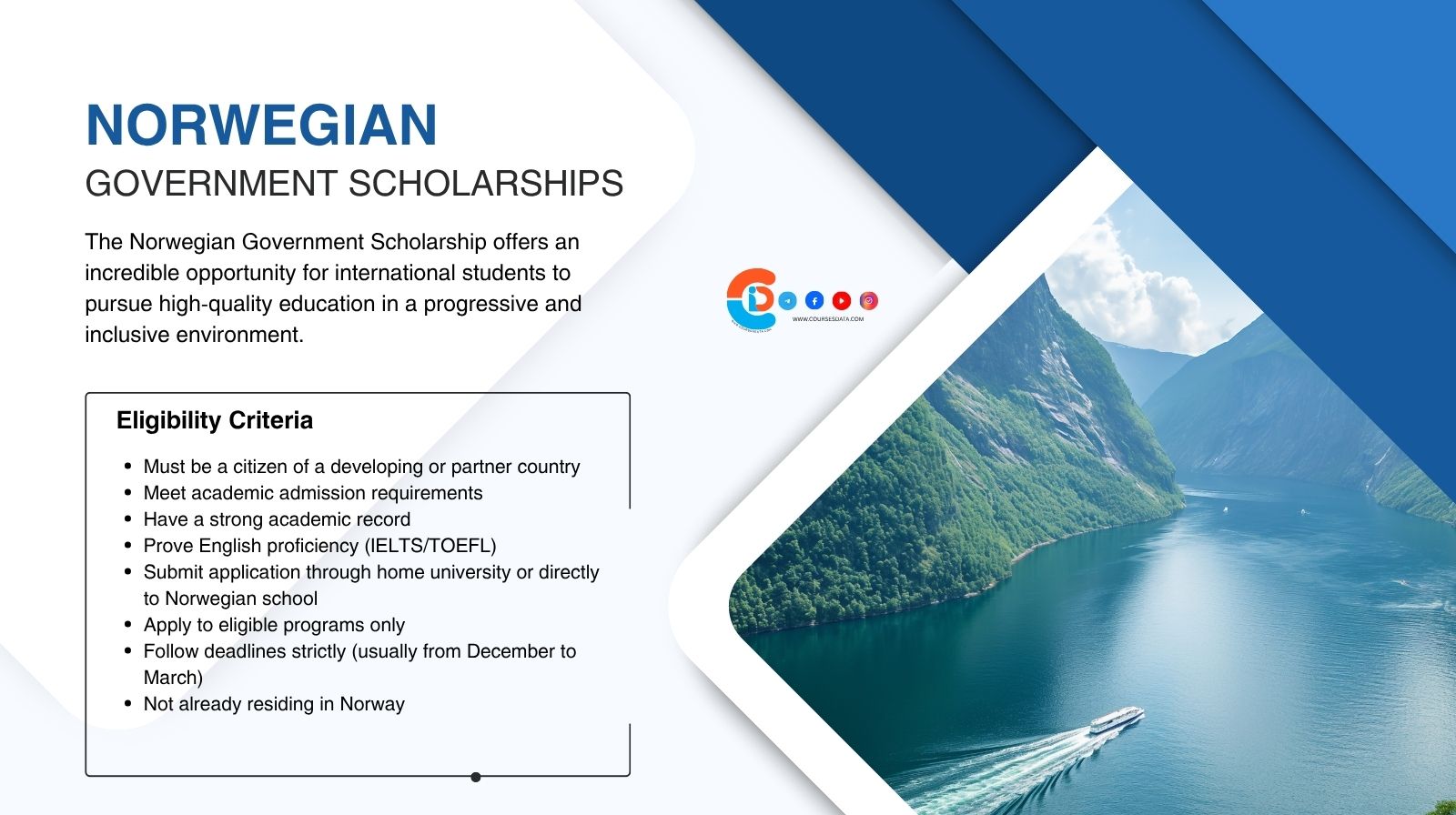
The Norwegian Government Scholarship is commonly searched by international students hoping to study in Norway with financial support.
However, Norway does not operate one general government scholarship that every international student can apply for.
Instead, funding is available through specific scholarship programmes, exchange schemes, institutional opportunities, research positions, and international partnerships.
What Is the Norwegian Government Scholarship?
The term Norwegian Government Scholarship is often used online as a general label for scholarships connected with studying in Norway.
It should not be understood as the name of one universal scholarship programme.
According to Norway’s official Study in Norway information, the Norwegian government does not provide an individual scholarship that is open to all international students.
Students therefore need to identify funding routes that match their degree level, nationality, university, academic field, or exchange status.
The main possibilities include:
- Erasmus Mundus Joint Master programmes involving Norwegian universities.
- Erasmus+ mobility grants for eligible exchange students.
- Nordplus grants for students at participating institutions.
- University-specific scholarships or funding arrangements.
- Research and doctoral positions.
- International cooperation programmes.
- Scholarships from external foundations.
- Nationality-specific funding schemes.
- Institutional exchange agreements.
- Tuition exemptions available to certain categories of students.
This distinction is important because applicants searching for a single application portal for a “Norwegian Government Scholarship” may otherwise spend time looking for a programme that does not exist in that form.
Who Can Receive Funding to Study in Norway?
Eligibility depends entirely on the funding route.
There is no single nationality list, academic requirement, age requirement, or financial package covering every international applicant.
Students who may find relevant opportunities include:
- International master’s applicants.
- Students applying to Erasmus Mundus programmes.
- Exchange students from partner universities.
- Students participating in Erasmus+.
- Students covered by Nordplus cooperation.
- Doctoral applicants.
- Researchers applying for funded positions.
- Students covered by international agreements.
- Applicants eligible for private or external foundations.
- Students receiving scholarships from their home countries.
Degree applicants should therefore separate admission eligibility from scholarship eligibility.
Being eligible for admission to a Norwegian university does not automatically mean that financial support is available.
Norwegian Government Scholarship Options at a Glance
The following table explains some of the most important funding routes students may encounter when researching scholarships in Norway.
| Funding route | Typical applicants | Possible support | Where to apply |
|---|---|---|---|
| Erasmus Mundus Joint Masters | International master’s students | Scholarship support may include participation costs and living support | Through the individual Erasmus Mundus programme |
| Erasmus+ | Eligible exchange students | Contribution toward travel and living costs | Through the home institution |
| Nordplus | Students at participating Nordic/Baltic institutions | Mobility funding | Through the participating institution |
| University funding | Depends on university and programme | Varies by institution | Directly through the university |
| PhD positions | Qualified doctoral candidates | Usually employment-based funding | Directly through the institution |
| External foundations | Depends on nationality and eligibility | Varies considerably | Through the funding organisation |
| Exchange agreements | Students from partner universities | May include tuition arrangements or grants | Through the home university |
Applicants should always read the conditions of the individual programme rather than assuming that every scholarship provides the same benefits.
Erasmus Mundus Scholarships in Norway
For international master’s applicants, Erasmus Mundus Joint Masters can be one of the most important scholarship routes connected with Norwegian higher education.
These programmes are delivered jointly by universities in several countries.
Some include Norwegian higher education institutions as members of the academic consortium.
The official Norwegian scholarship guidance confirms that Norwegian institutions participate in Erasmus Mundus Joint Master programmes and that applicants from around the world may apply to participating programmes.
Depending on the specific programme, scholarship funding can potentially contribute toward:
- Programme participation costs.
- Monthly living expenses.
- Travel.
- Relocation expenses.
- Visa-related expenses.
- Insurance.
- Academic activities.
- Study periods at participating universities.
- Research or thesis activities.
- Other eligible programme costs.
Applicants do not submit one general application to the Norwegian government.
Instead, they choose an eligible Erasmus Mundus programme and follow that programme’s admission and scholarship procedure.
For example, a student interested in engineering could search for a joint master’s programme involving a Norwegian university and then check whether Erasmus Mundus scholarships are offered for that specific intake.
Exchange Scholarships and Mobility Funding
Students who are already enrolled at a university outside Norway may have more funding possibilities than students applying independently for an entire degree.
Exchange schemes can provide financial assistance when a student’s home university has the appropriate agreement.
Common possibilities include:
- Erasmus+ mobility.
- Nordplus.
- University exchange agreements.
- Bilateral institutional partnerships.
- Subject-specific mobility programmes.
- Research exchanges.
- Short academic stays.
- Joint university projects.
- International cooperation programmes.
- Funding provided by the student’s home institution.
Erasmus+ funding normally contributes toward costs rather than guaranteeing that every expense will be paid.
Students generally apply through the international or Erasmus office of their current university rather than directly to Norwegian authorities.
Nordplus works in a similar institutional framework.
Students normally need to belong to a university or programme participating in the relevant Nordplus network.
For this reason, contacting your university’s international office can be particularly useful if you are considering an exchange semester in Norway.
Tuition Fees and Who May Be Exempt
One of the most important changes international applicants need to understand is that studying at a Norwegian public university is not automatically tuition-free for everyone.
Degree-seeking students from outside the EU, EEA, and Switzerland generally have to pay tuition fees unless they fall within an exemption.
The amount depends on the university and programme.
Students from Norway, Switzerland, and EU/EEA countries are generally exempt from tuition fees at public higher education institutions.
Other exemption categories can also apply.
Examples of groups that may qualify for tuition exemptions include:
- Students from EU/EEA countries.
- Swiss students.
- Doctoral candidates.
- Certain exchange students.
- Students covered by qualifying international agreements.
- Participants in specific cooperation programmes.
- Certain students entitled to equal treatment with Norwegian citizens.
- Students meeting particular statutory conditions.
- Participants in qualifying institutional exchange programmes.
- Students covered by specific Norwegian academic cooperation schemes.
A tuition exemption is not the same as receiving a scholarship.
A student can be exempt from tuition fees while still needing to pay for accommodation, food, transportation, insurance, books, and other personal expenses.
Similarly, receiving admission does not automatically provide a tuition exemption.
Admission Requirements for Norwegian Universities
Scholarship preparation should begin only after determining whether you are academically eligible for the intended programme.
Norwegian universities establish programme-specific requirements, but several general academic principles apply.
For bachelor’s applicants, Norway uses the Higher Education Entrance Qualification framework.
Requirements depend on the country where the applicant completed secondary education.
Master’s applicants generally need an accredited bachelor’s degree that is comparable to a Norwegian bachelor’s degree.
The official Norwegian guidance on entry requirements for bachelor’s and master’s programmes explains the academic framework international applicants should review before applying.
Applicants should normally prepare for requirements such as:
- Recognized previous qualifications.
- Required academic subjects.
- Programme-specific prerequisite courses.
- Sufficient academic performance.
- English-language documentation.
- Norwegian-language ability for Norwegian-taught programmes.
- Academic transcripts.
- Degree certificates.
- Identification documents.
- Programme-specific supporting documents.
For master’s programmes, the bachelor’s degree normally needs to include sufficient coursework relevant to the intended master’s subject.
Some programmes also set minimum grade requirements.
English Language Requirements
Many international students focus on English-taught master’s programmes because most bachelor’s programmes in Norway are taught in Norwegian.
Students applying to an English-taught programme generally need to demonstrate that they satisfy the institution’s English-language requirements.
Accepted documentation differs between institutions and programmes.
Possible forms of documentation can include:
- IELTS.
- TOEFL.
- Previous qualifying education in English where accepted.
- Other university-approved English tests.
- Qualifications specifically recognized by the institution.
Do not assume that studying previously in English automatically creates an exemption.
Applicants should use the requirements published for their exact programme.
Documents Commonly Needed for Scholarship Applications
Because there is no universal Norwegian Government Scholarship application, required documentation differs among funding schemes.
However, students can prepare a core set of documents in advance.
Common documents include:
- Passport or national identification.
- Academic transcripts.
- Graduation certificates.
- Bachelor’s degree certificate for master’s applicants.
- Proof of English proficiency.
- Curriculum vitae.
- Motivation letter.
- Recommendation letters.
- Course descriptions where requested.
- Research proposal for certain academic programmes.
- Portfolio for relevant creative programmes.
- Documentation required by the particular scholarship.
Scholarship committees may request additional information beyond the documents required for university admission.
For instance, an Erasmus Mundus programme may evaluate motivation, academic background, professional experience, international experience, or subject-specific qualifications.
A doctoral application may require a research proposal, academic publications, or documentation showing relevant research experience.
How to Apply for Funding to Study in Norway
Because funding is decentralized, applicants should approach the process systematically.
A practical application process looks like this:
- Decide whether you want a bachelor’s, master’s, exchange, or doctoral programme.
- Search for suitable study programmes in Norway.
- Check the programme’s academic admission criteria.
- Determine whether tuition fees apply to you.
- Look for scholarships connected specifically with the programme.
- Check Erasmus Mundus opportunities for master’s study.
- Contact your university about Erasmus+ if you are an exchange student.
- Investigate Nordplus if your institution participates.
- Review university and faculty funding pages.
- Prepare academic and language documents early.
- Apply through the official programme or university system.
- Submit separate scholarship applications where required.
Do not send a generic scholarship application to the Norwegian government expecting to be matched with a university.
That is not how Norway’s current system works.
A more effective strategy is to work from the programme toward the funding.
For example, instead of searching only for “Norwegian Government Scholarship,” search for an eligible master’s programme first.
Then determine which scholarships, exemptions, Erasmus arrangements, or external funding options apply specifically to that programme.
PhD Funding in Norway
Doctoral study is particularly important because PhD opportunities in Norway often operate differently from ordinary student scholarships.
PhD candidates are frequently recruited into paid academic positions.
In these cases, you are applying for a job or research position rather than a traditional scholarship.
Typical doctoral vacancies may require:
- A relevant master’s degree.
- Strong academic results.
- Research competence.
- A project proposal where applicable.
- Academic references.
- Relevant methodological skills.
- English proficiency.
- Subject-specific experience.
- A curriculum vitae.
- Previous academic or research work.
Funding conditions depend on the specific vacancy.
Applicants should therefore search Norwegian university vacancy pages and academic recruitment platforms rather than limiting themselves to scholarship databases.
For academically qualified students, this can be one of the clearest ways to undertake funded advanced study in Norway.
Living Costs and Financial Planning
Scholarship applicants should not focus only on tuition.
Norway has substantial living expenses, and students need to plan for costs beyond university fees.
Typical expenses include:
- Student accommodation.
- Food and groceries.
- Local transportation.
- Electricity where not included in rent.
- Mobile and internet services.
- Study materials.
- Insurance.
- Clothing.
- Personal expenses.
- Travel.
- Student welfare fees.
Non-EU/EEA students applying for a study permit normally need to demonstrate that they have sufficient funds to support themselves.
That requirement is separate from university admission.
A partial scholarship may therefore be helpful without necessarily covering everything required for studying and living in Norway.
Before accepting an offer, calculate the value of the scholarship against tuition fees and realistic living expenses.
Common Mistakes When Searching for the Norwegian Government Scholarship
Many unsuccessful scholarship searches begin with incorrect assumptions about Norway’s funding system.
Avoid these common mistakes:
- Assuming one national scholarship application exists for everyone.
- Believing all public universities are tuition-free for international students.
- Treating tuition exemptions as full scholarships.
- Assuming admission automatically includes funding.
- Applying without checking nationality restrictions.
- Ignoring programme-specific scholarship rules.
- Confusing exchange funding with full-degree scholarships.
- Using unofficial scholarship websites as the primary source.
- Applying for a scholarship without meeting university admission requirements.
- Forgetting to budget for living expenses.
Another common mistake is searching only for scholarships carrying the word “Norway.”
International funding programmes such as Erasmus Mundus may fund study at a Norwegian institution even though the scholarship itself is not called the Norwegian Government Scholarship.
Applicants should therefore search by university, programme, degree level, nationality, and mobility scheme.
Practical Strategy for International Students
A strong scholarship search should begin with the academic programme rather than the scholarship name.
First, shortlist several programmes that match your qualifications.
Then create a simple funding checklist for each one.
You can compare:
- Programme tuition fee.
- Your tuition exemption status.
- Available scholarship schemes.
- Erasmus Mundus participation.
- Exchange possibilities.
- University funding.
- External scholarships.
- Living expenses.
- Study permit financial requirements.
- Application deadlines.
For example, an international student seeking a master’s degree in environmental science could identify Norwegian programmes taught in English, check whether any participate in Erasmus Mundus, compare tuition fees, and then review relevant external funding.
An exchange student should instead begin with the international office at their current university.
A doctoral applicant should prioritize funded research vacancies.
These applicants may all want to study in Norway, but their funding strategies are very different.
Conclusion
The Norwegian Government Scholarship should not be treated as one universal fully funded scholarship for international students.
Norway’s official guidance confirms that there is no individual government scholarship available to every international degree applicant.
Funding opportunities still exist, particularly through Erasmus Mundus, Erasmus+, Nordplus, institutional agreements, university opportunities, external foundations, and funded doctoral positions.
The most effective approach is to choose the right study programme first, confirm your tuition status, and then identify the specific funding route connected with your degree level and circumstances.
Frequently Asked Questions
Is there a Norwegian Government Scholarship for international students?
There is no single individual Norwegian government scholarship open to all international degree students.
Funding is provided through specific programmes, institutional arrangements, mobility schemes, research positions, and external scholarship organisations.
Is the Norwegian Government Scholarship fully funded?
There is no universal scholarship with one standard funding package.
Some opportunities, such as certain Erasmus Mundus scholarships, can provide substantial funding, while other grants cover only part of a student’s expenses.
Can international students study in Norway for free?
Not automatically.
Degree-seeking students from outside the EU/EEA and Switzerland generally pay tuition fees at Norwegian institutions unless they qualify for an exemption.
Students from eligible tuition-exempt groups should still budget for living expenses.
Are there scholarships for master’s students in Norway?
Yes.
One important route is Erasmus Mundus Joint Masters involving Norwegian institutions.
Students can also investigate university-specific, external, and home-country funding opportunities.
Can bachelor’s students receive scholarships in Norway?
Scholarship availability for full bachelor’s programmes is more limited and depends on the university, applicant’s nationality, outside funding sources, or specific cooperation programmes.
Applicants should check funding connected with their intended bachelor’s programme rather than expecting a general government scholarship.
Is IELTS required for studying in Norway?
English-taught programmes require applicants to document sufficient English proficiency, but accepted tests and exemptions depend on the individual university and programme.
Students should check the language requirements of the exact degree they intend to apply for.
Does a Norwegian scholarship cover accommodation?
Not necessarily.
Scholarship benefits vary considerably.
Some programmes provide living allowances that students can use toward accommodation, while others may cover only certain academic or mobility expenses.
Can I apply for a Norwegian scholarship before university admission?
It depends on the scheme.
Some scholarship applications are integrated into programme admission, while others require an admission offer or are handled separately.
Applicants should follow the instructions of the specific scholarship rather than using one general procedure.
Are PhD programmes funded in Norway?
Many Norwegian PhD opportunities are advertised as paid research or academic positions rather than conventional student scholarships.
Applicants normally apply directly for an advertised vacancy and must satisfy the academic and research requirements stated in the position announcement.
Where should I search for Norwegian scholarships?
Start with Norway’s official Study in Norway portal and the official website of the university offering your chosen programme.
For master’s funding, also investigate Erasmus Mundus programmes connected with Norwegian institutions.
The safest approach is to verify every scholarship through the institution or organisation responsible for awarding it before submitting documents or paying any application-related fee.
I actually applied for the Norwegian Government Scholarship a few years back, and while the tuition-free aspect is amazing, the real challenge was getting admitted to a program first—you need that acceptance letter before you can even apply for the funding. One thing that caught me off guard was how competitive it is for master’s programs, especially in engineering and social sciences, so I’d recommend having a strong research proposal or work experience ready. Did anyone else find the country prioritization list a bit restrictive, or was it just me?
God, yes—the country priority list felt like a cruel joke when I realized my home country wasn’t even on it, so I had to scramble to see if I qualified through any other bilateral agreements. And you’re absolutely right about the admission letter being the real gatekeeper; I spent months perfecting my motivation letter just to get that first foot in the door. The competition for social sciences was brutal in my year too, so I ended up leaning heavily on my previous NGO fieldwork to stand out—definitely worth highlighting any practical experience you have.
Yes, the country prioritization list definitely felt restrictive to me too—I remember checking it obsessively just to make sure my home country was still eligible that year. And you’re so right about the admission letter being the real hurdle; I spent months emailing professors and tweaking my research proposal before I even felt ready to apply. What helped me was focusing on a niche program where I had direct field experience, which seemed to balance out the competition a bit.
That’s a smart angle with the niche program—I’ve seen locals here in Cork get tripped up by trying to apply to broad degrees that flood with applicants, while something like Arctic engineering or Sami studies barely fills its slots. Did you find your field experience actually shifted the conversation with professors, or was it more about fitting their published research? I’m always skeptical of advice that sounds too neat, but if it worked for you, I’d say it’s worth a shot.
Yeah, you hit the nail on the head with the admission letter catch—that step took me way longer than I expected. I also remember being surprised that the living grant only covers the basics if you’re in Oslo, where rent is brutal, so definitely budget extra. Did you ever feel like the priority list made it harder to plan around backup options, or did you just commit fully to the Norwegian route?
Oh, the Oslo rent thing is so real—I remember looking at housing prices and wondering if I’d have to live on instant noodles for two years just to make ends meet. As for the priority list, I actually committed fully to the Norwegian route, but only because my country was listed that year; I can see how it’d make planning backup options feel nearly impossible if you’re not sure you’ll qualify. It’s a gamble that forces you to put all your eggs in one basket, and that part definitely kept me up at night.
The part about the country priority list and the admission letter being the real gatekeeper really resonates with me. I spent nearly six months just getting my documentation and research proposal polished enough to even be considered for a master’s spot, and even then, the competition felt overwhelming. For anyone thinking of applying, I’d highly recommend reaching out to a professor in your field at the Norwegian university before you submit anything—having that informal support can make a huge difference when the selection committee reviews your file. Did anyone else find that building a connection with a faculty member ahead of time helped with the scholarship odds?
That’s solid advice—I actually emailed a professor before applying and it made a big difference in shaping my research proposal to fit their department’s focus. The informal support didn’t guarantee the scholarship, but it definitely helped my application stand out when the committee reviewed it. If you’re serious about this, don’t skip that step.
The admission letter hurdle really is the make-or-break moment—I spent a full year just getting my documents together for a master’s in public health, only to realize my country wasn’t on the priority list the following cycle. That constant uncertainty made it hard to commit fully, especially when the living grant barely covers rent in Oslo unless you’re willing to share a tiny flat. For anyone starting now, I’d suggest applying to a few Norwegian programs early and having a backup plan in another country, just so you’re not left scrambling if the list changes.
It’s wild to me how much the country priority list dictates everything—I spent a solid six months getting my application together for a master’s in environmental policy, only to find my home country had been dropped the cycle I was ready to apply. That constant shift made me wonder if it’s even worth banking on the scholarship alone, or if it’s smarter to treat Norway as a long-shot option while locking in a more predictable backup. Did anyone else find that the list changed between the time you started preparing and when you actually submitted?