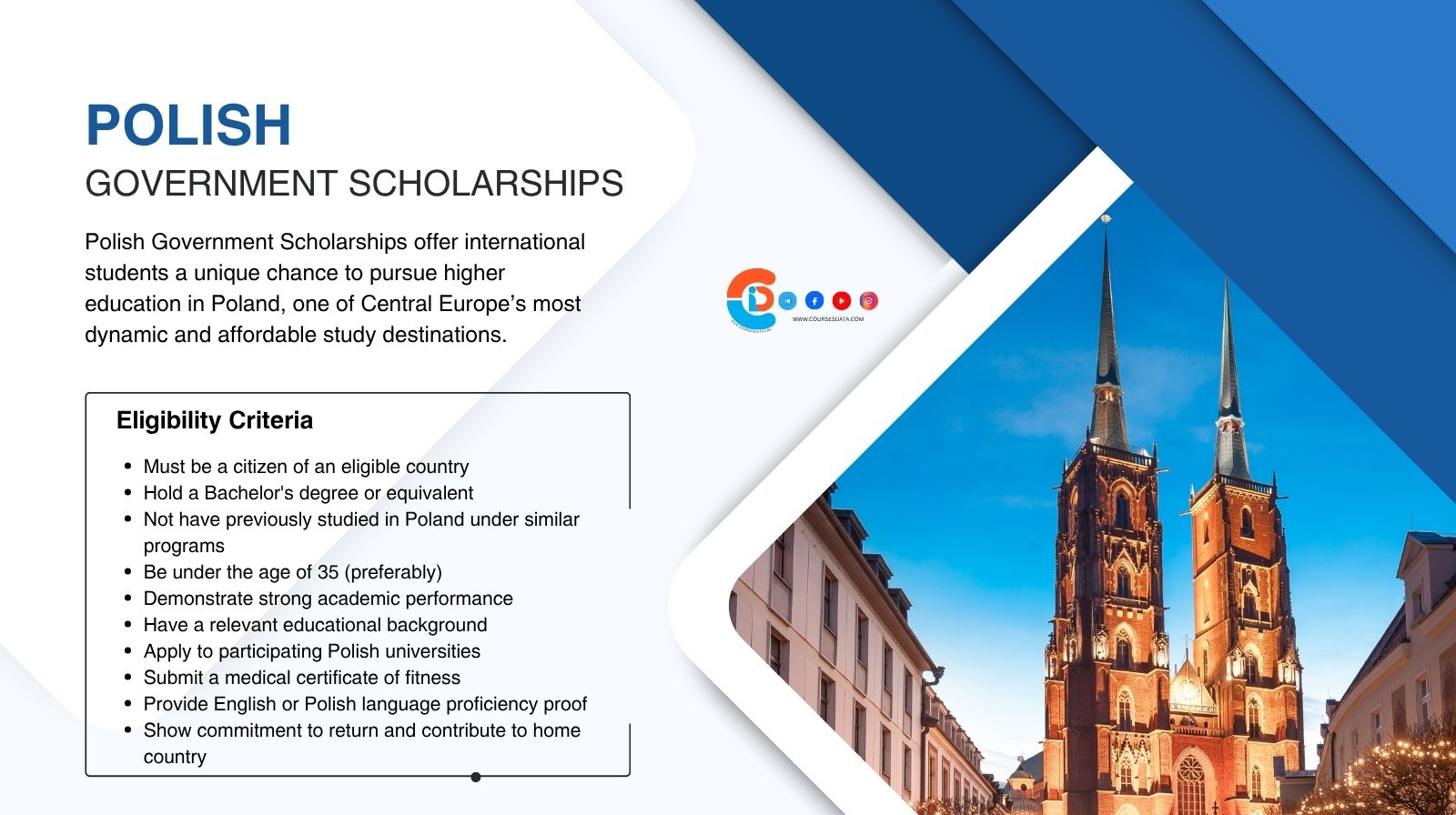
The Polish Government Scholarship is not a single scholarship for every international student.
Poland offers several government-funded routes through the Polish National Agency for Academic Exchange (NAWA), with eligibility depending on nationality, degree level, Polish origin, language of study, and the specific programme.
For many international applicants, the most relevant options are the Banach NAWA Programme and Poland My First Choice NAWA.
What Is the Polish Government Scholarship?
The term Polish Government Scholarship generally refers to scholarship programmes financed or supported by Polish public institutions and administered primarily through NAWA.
These programmes are designed for different groups of international students.
Some target applicants from developing countries, while others target students from particular countries or people of Polish origin.
The main scholarship routes for international students include:
- Banach NAWA Programme
- Poland My First Choice NAWA
- General Anders Scholarship Programme
- Polonista NAWA
- Programmes based on bilateral agreements
- Selected academic mobility programmes
For students looking for a complete master’s degree in Poland, the Banach and Poland My First Choice programmes are particularly important.
NAWA maintains information about the available programmes for foreign students through its official foreign-student scholarship portal.
Applicants should therefore avoid assuming that one set of requirements applies to every Polish Government Scholarship.
Main Polish Government Scholarship Programmes
The scholarship that fits you depends mainly on your nationality, academic background, degree level, and intended language of study.
Here is a simplified comparison.
| Scholarship route | Main target group | Typical study level | Language |
|---|---|---|---|
| Banach NAWA | Citizens of designated eligible countries | Master’s | Polish or English |
| Poland My First Choice NAWA | Citizens of designated developed countries and territories | Master’s | Polish or other approved language |
| General Anders Programme | Polish diaspora and eligible people of Polish origin | Bachelor’s, master’s and long-cycle studies | Mainly Polish |
| Polonista NAWA | Students and researchers connected with Polish studies | Studies or research | Primarily Polish-related fields |
The programmes are separate.
Being ineligible for one programme does not automatically mean you cannot qualify for another form of financial support in Poland.
A practical approach is to check:
- Your citizenship
- Your previous degree
- When you obtained the degree
- Your intended study level
- Your preferred language
- Whether your chosen university participates
- Whether your intended programme is eligible
The exact call regulations should always take priority over general scholarship descriptions.
Banach NAWA Scholarship Programme
The Banach NAWA Programme is one of the main Polish Government Scholarship opportunities available to students from designated countries.
It supports eligible international students who want to undertake full-time second-cycle, or master’s-level, studies in Poland.
The programme is jointly connected with Poland’s development cooperation objectives and is aimed at improving the education and professional qualifications of students from eligible countries.
According to the official Banach NAWA Programme information, recipients can study in either Polish or English, depending on their chosen pathway and programme.
The scholarship currently provides benefits including:
- A monthly NAWA scholarship
- Tuition exemption at eligible public universities
- A funded preparatory course where applicable
- A travel allowance
- Access to Polish- or English-taught studies
- Polish language and culture instruction for relevant participants
The current monthly scholarship under this programme is PLN 2,500.
A travel allowance of PLN 2,500 is also included under the current programme conditions.
These amounts should not be treated as permanent because NAWA can change scholarship conditions in future calls.
Countries eligible for Banach NAWA
Eligibility is restricted to specific nationalities rather than being available worldwide.
The current programme covers applicants from countries including:
- Albania
- Angola
- Argentina
- Armenia
- Azerbaijan
- Belarus
- Bosnia and Herzegovina
- Brazil
- Georgia
- India
- Indonesia
- Iraq
- Iran
- Jordan
- Kazakhstan
- Kenya
- Kosovo
- Lebanon
- Mexico
- Moldova
- Mongolia
- Montenegro
- Nigeria
- North Macedonia
- Palestine
- Papua New Guinea
- Peru
- Philippines
- Rwanda
- Senegal
- Serbia
- Tanzania
- Tunisia
- Ukraine
- Uzbekistan
- Vietnam
Nationality is only one condition.
Applicants must also satisfy the academic, degree, language, and other formal requirements stated in the relevant call.
Basic Banach eligibility requirements
Candidates generally need to meet conditions such as:
- Hold citizenship of an eligible country
- Not hold Polish citizenship
- Qualify academically for second-cycle studies
- Hold an eligible first-cycle degree or equivalent qualification
- Not already hold a master’s-level qualification where prohibited by the call
- Meet the required language standard
- Submit the application through NAWA
- Provide all compulsory documents
The programme may also establish rules concerning when the applicant obtained the previous degree.
This detail is important because possessing a bachelor’s degree alone does not necessarily make every graduate eligible.
Poland My First Choice NAWA
Another important Polish Government Scholarship route is Poland My First Choice NAWA.
Unlike Banach NAWA, this programme targets applicants from a different group of eligible countries and territories.
It supports full-time second-cycle studies at participating Polish academic higher education institutions.
The current programme provides:
- A monthly scholarship of PLN 2,000
- Tuition-fee exemption at public universities
- A one-time travel allowance
- Access to eligible full-time master’s programmes
- Study opportunities at participating academic universities
Applicants choose their university and study programme themselves.
NAWA does not automatically admit scholarship applicants to a university.
Receiving or applying for a scholarship and gaining university admission are separate processes.
The official Poland My First Choice NAWA programme page explains this distinction clearly.
Applicants should therefore normally complete two processes:
- Apply for the NAWA scholarship
- Apply separately to the selected university
This is one of the most important practical points for candidates to understand.
Missing a university admission requirement can prevent a student from beginning studies even if the scholarship application itself is strong.
What Does the Polish Government Scholarship Cover?
Benefits vary substantially between programmes.
A scholarship described as government-funded should not automatically be interpreted as covering every possible expense.
Depending on the programme, funding can include:
- Monthly living allowance
- Tuition-fee exemption
- Travel support
- Preparatory language studies
- Polish-language instruction
- Cultural orientation
- Financial support during the normal study period
For example, under Banach NAWA, tuition fees at participating public universities are waived for scholarship holders under the programme conditions.
However, students should still budget for costs that may not be fully covered, such as:
- Accommodation
- Food
- Local transportation
- Residence documentation
- Personal expenses
- Study materials
- Insurance where independently required
- Initial relocation costs
The monthly scholarship is financial support for living expenses rather than a promise that every personal expense will be paid directly by the government.
Students choosing more expensive accommodation or living in a major city may need additional personal funds.
Study Levels and Available Fields
One common misunderstanding is that every Polish Government Scholarship supports bachelor’s, master’s, and doctoral studies.
That is not the case.
Banach NAWA primarily supports full-time second-cycle studies, meaning master’s-level education.
Poland My First Choice also focuses on eligible full-time second-cycle programmes.
Other NAWA programmes serve different groups and degree levels.
Depending on the specific scholarship, study opportunities can include fields such as:
- Engineering
- Information technology
- Economics
- Business
- Agriculture
- Natural sciences
- Social sciences
- Environmental studies
- Mathematics
- Humanities
- Other eligible academic disciplines
The Banach Programme is not restricted to one single academic discipline.
Nevertheless, the chosen course must satisfy programme regulations and university requirements.
Applicants should select a programme that makes academic sense in relation to their previous studies rather than choosing solely because it appears easier to enter.
For example, a graduate in computer engineering may consider master’s programmes in:
- Computer science
- Artificial intelligence
- Data science
- Cybersecurity
- Software engineering
- Related technology disciplines
The university ultimately determines whether the previous qualification is academically suitable for admission.
Language Requirements: English or Polish
International students do not necessarily need to know Polish before applying for every Polish Government Scholarship.
Under Banach NAWA, eligible students may pursue master’s studies in English or Polish.
For an English-taught route, applicants normally need to demonstrate at least a B2 level of English using evidence accepted under the programme rules.
For Polish-language studies, the required level depends on the chosen route.
Typical language pathways include:
- English-taught master’s programme
- Polish-taught master’s programme
- Preparatory Polish-language course before degree studies
Applicants choosing the preparatory-course pathway may be permitted to enter with a lower initial Polish-language level than candidates beginning degree studies directly in Polish.
Proof of language ability is important because scholarship eligibility and university admission requirements can overlap but are not necessarily identical.
A university may have its own acceptable certificates or language verification process.
Before submitting documents, compare:
- NAWA language requirements
- University language requirements
- Programme language of instruction
- Accepted certificates
- Any exemptions allowed
Do not assume that an English-medium bachelor’s degree automatically replaces every required language document unless the programme rules explicitly permit it.
Documents Required for the Application
The exact documents depend on the scholarship call, but applicants to major NAWA programmes should prepare their academic records carefully.
For the Banach NAWA route, required application materials can include:
- Passport identification page
- Bachelor’s diploma
- Academic transcript
- University certificate for applicants awaiting graduation where permitted
- Language proficiency documentation
- Evidence related to the intended Polish university
- Scholarship application information
- Required declarations
- A short self-presentation or motivation video
The current Banach application process includes a short video in which applicants explain their motivation in Polish or English.
This means candidates should prepare more than a traditional motivation letter.
A useful presentation should briefly explain:
- Your academic background
- Why you chose the field
- Why you want to study in Poland
- Your professional goals
- How the degree connects to those goals
- How your education may contribute to your future career or community
Avoid simply repeating information already visible on your transcript.
The strongest presentation usually establishes a clear relationship between previous education, the proposed master’s programme, and a realistic professional plan.
How to Apply for the Polish Government Scholarship
Most NAWA scholarship applications are completed electronically through the official NAWA application system.
The precise procedure varies between programmes, but a practical workflow looks like this:
- Identify the correct NAWA scholarship.
- Confirm that your nationality is eligible.
- Check the required study level.
- Review previous-degree requirements.
- Select an eligible Polish university.
- Find an appropriate academic programme.
- Check its language requirements.
- Prepare the scholarship documents.
- Complete the NAWA application.
- Complete the university admission process where required.
Do not treat university admission and NAWA scholarship selection as the same process.
For programmes such as Poland My First Choice, applicants independently participate in university recruitment.
A useful application strategy is to create three separate checklists:
- Scholarship eligibility
- NAWA application documents
- University admission documents
This reduces the risk of completing one application while forgetting the requirements of the other.
Example application plan
Suppose an eligible student has a bachelor’s degree in civil engineering and wants to complete a master’s degree in Poland.
The student could:
- Verify nationality eligibility for Banach NAWA
- Search participating Polish universities
- Identify an English-taught civil engineering master’s programme
- Check whether the bachelor’s qualification satisfies admission rules
- Confirm English-language requirements
- Apply through the NAWA system
- Follow the university’s separate admission procedure
- Provide proof of admission when required
This is more effective than submitting a scholarship application before investigating suitable universities.
How Applications Are Evaluated
NAWA applications normally go through formal and substantive assessment according to the rules of the relevant programme.
The formal stage checks whether the application complies with programme requirements.
Problems at this stage may include:
- Ineligible nationality
- Wrong degree level
- Missing documents
- Incorrect document format
- Failure to satisfy degree requirements
- Missing language evidence
- Incomplete application
- Submission outside programme rules
Applications that satisfy formal requirements may then undergo substantive evaluation.
Depending on the programme, assessment can consider academic performance and other elements specified in the official call.
For Banach NAWA, academic achievement and the applicant’s self-presentation are relevant parts of the selection process.
Candidates should therefore focus on providing a coherent academic profile rather than trying to make the application sound impressive through vague claims.
A strong application should show:
- Good academic preparation
- A logical choice of degree
- Clear educational objectives
- Evidence of language readiness
- Accurate documentation
- A realistic professional plan
Every statement should be supported where documentation is required.
Important Mistakes to Avoid
Many scholarship applications fail because of procedural issues rather than a lack of ambition.
One major mistake is applying simply because the programme is described online as a “Polish Government Scholarship.”
Always identify the exact scholarship first.
Other mistakes to avoid include:
- Applying from a country not covered by the programme
- Assuming all degree levels are funded
- Ignoring the age or graduation-related rules in a call
- Choosing an ineligible institution
- Missing university admission requirements
- Uploading incomplete transcripts
- Using unacceptable language evidence
- Providing inconsistent information
- Treating scholarship approval as university admission
- Waiting until the application deadline to prepare documents
Another mistake is relying on old blog posts or social media announcements.
Scholarship amounts, eligible countries, academic requirements, participating universities, and application procedures can change between calls.
Use the official NAWA call as the final authority.
Is the Polish Government Scholarship Fully Funded?
The answer depends on what you mean by “fully funded.”
Some Polish government scholarship programmes provide substantial financial support, including tuition exemption and a monthly allowance.
Banach NAWA, for example, currently combines:
- Tuition-fee exemption at public universities
- Monthly scholarship support
- Travel allowance
- Preparatory-course funding where applicable
However, students should not interpret this as unlimited coverage of every cost.
Housing, food, personal travel, residence formalities, and other expenses still need to be planned carefully.
Before accepting an award, prepare a realistic monthly budget covering:
- Rent or dormitory fees
- Groceries
- Public transportation
- Phone and internet
- Study materials
- Personal expenses
- Emergency funds
Scholarship recipients should also read the rules governing continued payment, academic obligations, and circumstances that may lead to suspension or loss of funding.
Conclusion
The Polish Government Scholarship can provide international students with a practical route to master’s studies in Poland, but applicants must choose the correct programme rather than treating it as one universal scholarship.
Banach NAWA is particularly relevant for students from designated developing countries, while Poland My First Choice covers another group of eligible international applicants.
Before applying, confirm your nationality, degree eligibility, language level, selected university, and admission requirements.
Use the official NAWA regulations as the final reference, prepare both the scholarship and university applications carefully, and make sure your chosen degree follows logically from your academic background and future plans.
Frequently Asked Questions
1. What is the Polish Government Scholarship?
The term generally describes scholarships funded or supported by Polish public institutions for international students.
Many major programmes are administered by NAWA, including Banach NAWA and Poland My First Choice.
There is no single programme that accepts every international student under identical conditions.
2. Is the Polish Government Scholarship fully funded?
Some programmes provide extensive funding, including a monthly stipend and exemption from tuition fees at public universities.
Certain programmes also offer travel support or funded preparatory language courses.
Students may still need personal funds for accommodation and other living expenses.
3. Can international students apply for the Polish Government Scholarship?
Yes, but nationality requirements vary by programme.
Banach NAWA, for example, accepts applicants only from countries included in its official eligibility list.
Other scholarship routes have different target groups.
4. Can I study in English with a Polish Government Scholarship?
Yes.
Programmes such as Banach NAWA allow eligible students to undertake full-time master’s studies in English.
Applicants must satisfy the language requirements of both the scholarship and their chosen university.
5. Do I need IELTS to apply?
Not necessarily in every case.
Applicants must provide acceptable evidence of the required language proficiency, but the exact documents recognized depend on the NAWA programme and university.
Check the official list of accepted language certificates before applying.
6. Can I apply without knowing Polish?
Yes, when applying for an eligible English-taught programme and meeting its English-language requirements.
Applicants taking the Polish-language route must satisfy the applicable Polish-language conditions or qualify for an available preparatory pathway.
7. Does the scholarship cover bachelor’s degrees?
Some Polish government-funded programmes can support undergraduate education, but the major Banach and Poland My First Choice programmes focus on second-cycle studies.
Applicants seeking bachelor’s funding should check other NAWA programmes, including those designed for eligible people of Polish origin.
8. Can I apply directly to NAWA without applying to a university?
You can submit the scholarship application according to the procedure of the relevant programme, but this does not eliminate university admission requirements.
For programmes where university admission is handled separately, applicants must independently secure admission to an eligible institution.
9. Which Polish universities can I choose?
The available institutions depend on the particular scholarship programme.
NAWA publishes programme-specific information and participating-institution lists.
Applicants should confirm that their selected university and programme satisfy the scholarship requirements before applying.
10. How can I improve my chances of receiving the scholarship?
Begin by meeting every formal requirement exactly.
A strong academic record is valuable, but documentation, programme fit, language ability, and a coherent study plan are also important.
Choose a degree that logically connects your previous education with clear professional goals, prepare required documents early, and make your motivation or self-presentation specific rather than generic.
I actually looked into this scholarship last year when I was applying for my Master’s. The monthly stipend they mention is decent for Poland’s cost of living, but I found out the hard way that the list of eligible countries is pretty narrow and often changes each year. One thing that caught me off guard was that some programs require you to already have an acceptance letter from a Polish university before you even apply for the scholarship. If you don’t mind me asking, have you already checked whether your home country is on their current list?
Oh, I learned that the hard way too—spent a whole weekend gathering documents only to realize I needed the university acceptance first. It really threw off my timeline. As for the country list, I checked mine (I’m from Kenya) and it was included, but I’ve heard from friends in other regions that it can be unpredictable from year to year. Have you had any luck finding a workaround for the acceptance letter step?
Ah, the acceptance letter catch-22—nothing like a little bureaucratic hoop-jumping to keep things interesting. I haven’t checked my country’s status yet, but I’m starting to wonder if the real scholarship is the patience we develop along the way. Any tips for getting that university acceptance before the portal even opens, or is it all just a waiting game?
You’re right to flag the acceptance letter requirement—that caught me off guard too when I applied two years ago. I spent weeks perfecting my scholarship application only to realise I needed a separate admission offer first, which really slowed everything down. Have you found that the eligible country list shifts much from year to year, or is it fairly stable for certain regions?
Honestly, the acceptance letter thing threw me off too. As for the country list, I’m from South Africa and it’s been included for a few years now, but I’ve seen it change for others—seems like some regions are more stable than others. I’d suggest double-checking the NAWA website right when applications open each year, just to be safe.
You’re so right about that acceptance letter—I wasted weeks on my scholarship application too before realizing I needed the university offer first, and it totally threw off my whole timeline. As for the country list, I’m from Zimbabwe and it’s been steady for a few years, but I’ve noticed some friends from other African countries got dropped one year and reinstated the next, so I’d definitely check the NAWA site as soon as it updates.
This whole conversation about the acceptance letter is really making me rethink my timeline. I was getting excited about the application, but now I’m worried I’ll waste time gathering documents for the scholarship only to get stuck waiting on a separate university offer. For those of you who managed to get the acceptance first, how long did it typically take for the university to get back to you after you applied to them directly?
Honestly, that timing thing is tricky. When I applied, I heard back from the university in about six weeks, but I started the application process a full three months before the scholarship deadline just to be safe. My advice is to check each Polish university’s own admission calendar on their website—some departments are much faster than others, and you don’t want to end up with the acceptance letter arriving after the scholarship portal closes.
Hey Niamh, I totally get the frustration—it’s a real catch-22. When I applied, I heard back from the university in about five weeks, but I made sure to start the whole process at least three months ahead of the scholarship deadline. My advice is to check each university’s own admission calendar because some departments are way faster than others, and you don’t want that acceptance letter showing up after the scholarship portal shuts.
The acceptance letter requirement is the real bottleneck here. What worked for me was applying to two or three Polish universities at once—some process applications faster than others, and it gives you a backup if one program’s timeline doesn’t line up with the scholarship deadline. Have you checked if any of the universities you’re interested in have rolling admissions? That can cut down the wait significantly.