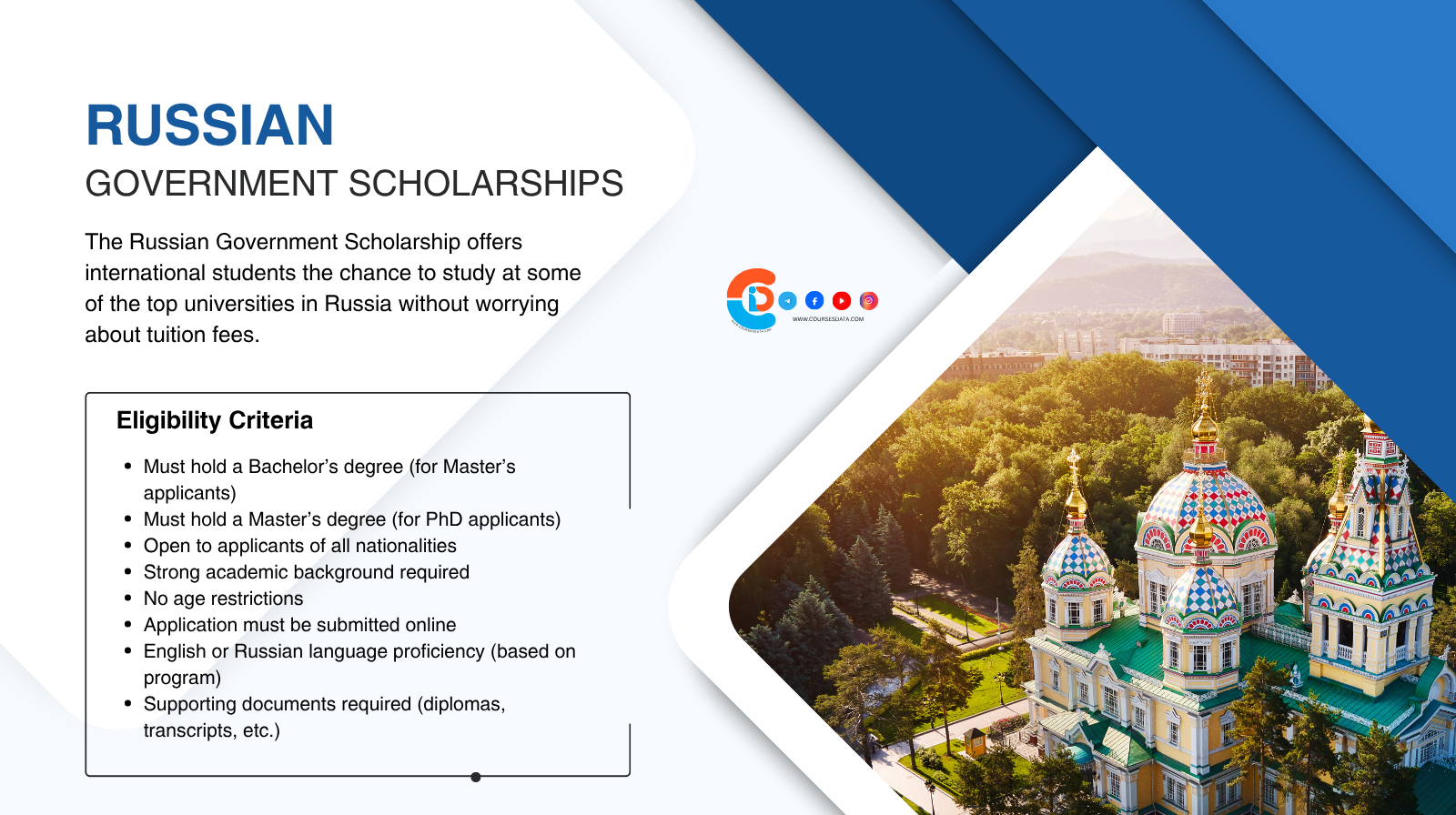
The Russian Government Scholarship is a state-funded route that allows international students to study at Russian universities without paying tuition fees.
It is awarded competitively through the government quota system and can be used for undergraduate, specialist, master’s, postgraduate, and certain other recognized programs, with successful applicants also eligible for a state academic stipend and university dormitory accommodation.
What Is the Russian Government Scholarship?
The Russian Government Scholarship is commonly used to describe admission under the Government of the Russian Federation quota for foreign citizens and stateless persons.
Instead of applying only as a regular fee-paying international student, applicants compete for places financed from the federal budget.
Selection is normally coordinated through Rossotrudnichestvo, Russian diplomatic missions, designated organizations in the applicant’s country, and participating Russian universities.
The scholarship route generally offers:
- Tuition-free study at the assigned Russian university.
- Access to recognized degree programs.
- A state academic scholarship during the study period.
- Eligibility for university dormitory accommodation.
- Access to undergraduate programs.
- Access to specialist degree programs.
- Access to master’s programs.
- Access to postgraduate education where available.
- Possible preparatory Russian-language study when required.
- Study at participating state-recognized Russian institutions.
Applications for the quota are normally initiated through the official Education in Russia application portal.
The number of available places is limited, which means registration does not automatically result in a scholarship offer.
What Does the Russian Government Scholarship Cover?
One of the main advantages of the scholarship is that the applicant does not have to pay the normal tuition fee for the program to which they are admitted under the government quota.
Students admitted within the quota are also entitled to a state academic scholarship during their studies according to the applicable regulations.
Official Russian guidance states that quota students receive this scholarship throughout their study period regardless of their academic performance.
The main benefits include:
- Full tuition funding for the assigned program.
- State-funded university education.
- A regular state academic scholarship.
- A guaranteed opportunity for a dormitory place.
- Access to university libraries and academic resources.
- Free standard textbooks and teaching materials at state-funded institutions.
- Possible Russian-language preparatory education.
- Access to student services available at the university.
A dormitory place should not automatically be interpreted as completely free accommodation.
Universities establish their own accommodation procedures and charges, so students should confirm the dormitory fee directly with the university before traveling.
The government scholarship should also not be treated as an all-expenses-paid travel package.
Applicants should prepare separately for expenses that are not explicitly included in their individual award.
These can include:
- International airfare.
- Local transportation.
- Visa-related expenses.
- Document translation.
- Document legalization or recognition.
- Medical examinations.
- Health insurance.
- Food and daily expenses.
- Personal purchases.
- Dormitory charges where applicable.
The state scholarship can help with student expenses, but applicants should not assume that it will cover their complete monthly cost of living.
Who Can Apply for the Russian Government Scholarship?
The government quota is specifically designed to provide educational opportunities to foreign citizens and stateless persons.
Applicants must also possess the previous academic qualification required for the level of study they are seeking.
For example:
- Secondary-school graduates may seek undergraduate or specialist study.
- Bachelor’s graduates may apply for appropriate master’s programs.
- Master’s or specialist graduates may pursue postgraduate programs.
- Applicants to medical specialties must satisfy relevant academic requirements.
- Applicants to research programs may need evidence of research experience.
- Some fields may require additional examinations or interviews.
Nationality-specific procedures can differ because the initial selection is often organized in the applicant’s country of residence.
Applicants should therefore check the instructions shown in their Education in Russia account and the information issued by the local Russian House, Russian embassy, or other authorized selection body.
A competitive applicant will normally need to demonstrate:
- Appropriate previous education.
- Strong academic performance.
- A suitable academic background.
- Complete and accurate documentation.
- Compliance with the program requirements.
- Satisfactory performance during selection.
- Appropriate language preparation where required.
- Genuine interest in the selected field.
- Relevant achievements when they strengthen the application.
- Eligibility under the rules applied in the applicant’s country.
There is no single admission formula that applies identically to every applicant, university, country, and degree level.
Available Degree Levels and Fields of Study
The Russian Government Scholarship is not restricted to one narrow group of academic disciplines.
Participating institutions collectively offer programs across science, engineering, healthcare, economics, humanities, agriculture, technology, arts, and many other fields.
Common study areas include:
- Medicine.
- Dentistry.
- Pharmacy.
- Computer science.
- Artificial intelligence.
- Engineering.
- Architecture.
- Economics.
- Business and management.
- International relations.
- Political science.
- Mathematics.
- Physics.
- Chemistry.
- Biology.
- Agriculture.
- Languages.
- Education.
- Humanities.
- Arts and creative disciplines.
Applicants should still verify that their preferred university actually provides the chosen specialization under the quota.
Degree possibilities can include:
| Study level | Typical previous qualification | General purpose |
|---|---|---|
| Bachelor’s | Secondary education | First university degree |
| Specialist | Secondary education | Extended professional degree |
| Master’s | Bachelor’s or equivalent | Advanced specialization |
| Postgraduate | Master’s or specialist degree | Research and academic training |
| Medical postgraduate training | Relevant medical qualification | Advanced clinical specialization |
| Preparatory program | Depends on intended degree | Russian language and subject preparation |
Program availability depends on the institution and field.
The official Study in Russia education portal provides information about Russian degree structures, universities, admission routes, and government-funded study.
Russian Language and Preparatory Study
A major issue for international applicants is the language of instruction.
Most programs at Russian universities are taught in Russian, although English-taught programs are available at some institutions and in selected fields.
Applicants should therefore check the teaching language of the exact program rather than assuming that every international course is available in English.
Students who do not have sufficient Russian may be able to complete a preparatory program before beginning their main degree.
A preparatory course can include:
- Russian language.
- Academic terminology.
- Mathematics.
- Physics.
- Chemistry.
- Biology.
- Other subjects related to the future degree.
For example, a future medical student may study Russian together with chemistry and biology, while an engineering applicant may need Russian, mathematics, and physics.
Official guidance confirms that quota applicants may have the opportunity to complete qualifying preparatory education without paying tuition.
Students should pay close attention to the language listed for each program because language preparation directly affects their ability to attend lectures, complete examinations, communicate during practical training, and manage daily life.
Documents Required for the Russian Government Scholarship
Document requirements can differ by country, study level, university, and stage of the application.
However, applicants should generally expect to prepare documents relating to their identity and previous education.
Common documents include:
- Passport or another accepted identity document.
- Passport-style photograph.
- School certificate or university diploma.
- Academic transcript.
- Application form.
- Consent to personal data processing.
- Russian translations where required.
- Medical documents where requested.
- Proof of academic achievements when relevant.
- Research documents for certain postgraduate applicants.
For postgraduate applicants, additional materials may include:
- Research proposal.
- List of scientific publications.
- Academic CV.
- Motivation statement.
- Research achievements.
- Conference participation certificates.
- Recommendation documents.
Foreign-issued documents may require notarized Russian translations.
Some educational documents can also require:
- Legalization.
- Apostille certification.
- Formal recognition in Russia.
- Verification of academic equivalency.
Whether these steps are necessary depends on the country that issued the document, applicable agreements, and university requirements.
Students should avoid arranging expensive legalization procedures solely on the basis of advice from unofficial agents.
The requirements displayed by the scholarship system and the assigned institution should be followed.
How to Apply for the Russian Government Scholarship
The application begins through the official scholarship system and normally continues through several stages rather than through a single university application.
A practical application sequence is:
- Create an account on Education in Russia.
- Complete your personal information.
- Choose the intended education level.
- Select the preferred academic field.
- Search available universities and programs.
- Arrange universities in your preferred order.
- Upload the required documents.
- Submit the scholarship application.
- Participate in required selection procedures.
- Follow your application status.
- Provide additional documents if requested.
- Complete university enrollment after final placement.
Applicants can normally list several universities in order of preference.
Current university guidance describes applications in which candidates indicate up to six institutions when applying through the quota process.
Your university choices should therefore be deliberate.
Instead of choosing institutions only because their names are familiar, compare:
- Availability of your specialization.
- Teaching language.
- Academic curriculum.
- City and living environment.
- Dormitory arrangements.
- Research facilities.
- Entry requirements.
- Preparatory-language options.
- Professional recognition requirements.
- Career relevance of the degree.
Selecting several appropriate universities can give the selection system more realistic options when allocating a successful candidate.
How the Selection Process Works
Admission through the government quota is competitive.
Current university admission guidance describes a process involving initial selection in the applicant’s country followed by review and placement involving Russian educational institutions.
Depending on the country and study level, assessment may consider:
- Academic grades.
- Relevant subjects.
- Entrance examinations.
- Interviews.
- Academic achievements.
- Olympiad participation.
- Research experience.
- Publications.
- Motivation.
- Portfolio or creative work.
- Professional achievements.
Applicants who pass the initial competition are not simply free to enroll anywhere they choose.
Their documents proceed through the government quota system and participating universities evaluate candidate files.
Universities may examine whether:
- The applicant has the appropriate previous qualification.
- Documents meet formal requirements.
- The academic background matches the program.
- Required translations are available.
- Recognition requirements have been satisfied.
- The candidate meets program-specific conditions.
After the appropriate approvals and placement procedures, successful applicants receive information necessary to proceed with enrollment and, where applicable, visa arrangements.
The network responsible for educational and cultural cooperation abroad is coordinated through Rossotrudnichestvo, including Russian Houses operating in numerous countries.
How to Improve Your Scholarship Application
There is no legitimate method that can guarantee selection, but a carefully prepared application can avoid preventable weaknesses.
The first priority should be academic relevance.
If you are applying for a master’s program in computer science, for example, your degree, transcript, technical experience, projects, and supporting achievements should show a logical connection to advanced computer science study.
Useful ways to strengthen an application include:
- Choose a field connected to your academic background.
- Upload clear and readable scans.
- Check names and passport details carefully.
- Provide complete transcripts.
- Include relevant academic certificates.
- Add research work when applicable.
- Mention competitions or Olympiads when relevant.
- Include publications for research-level applications.
- Prepare seriously for interviews or examinations.
- Rank universities realistically.
- Follow official instructions precisely.
Avoid submitting unrelated certificates simply to make the application appear larger.
Three relevant academic achievements can be more useful than dozens of documents with no connection to your intended program.
Postgraduate applicants should pay particular attention to research alignment.
A candidate applying for doctoral-level study should be able to explain the intended research area, previous academic work, and why the proposed Russian institution is suitable for that research.
Important Costs and Practical Issues Before Accepting the Scholarship
Winning the Russian Government Scholarship significantly reduces the cost of university study, but students still need a personal financial plan.
Before accepting an offer, estimate the expenses that remain your responsibility.
Prepare a budget for:
- Flight tickets.
- Visa processing.
- Insurance.
- Medical examinations.
- Document translation.
- Legalization if necessary.
- Dormitory payments.
- Food.
- Transportation.
- Clothing.
- Telephone and internet.
- Personal expenses.
- Emergency funds.
Living expenses differ substantially between cities.
A student in Moscow or Saint Petersburg may face different expenses from a student studying in a smaller regional city.
Applicants considering regulated professions such as medicine, dentistry, pharmacy, teaching, or certain engineering fields should also investigate recognition requirements in the country where they eventually intend to work.
Receiving a scholarship and graduating from a university does not automatically guarantee professional licensing in another country.
Common Mistakes Applicants Should Avoid
Many scholarship problems are caused by application mistakes rather than a lack of academic ability.
Avoid the following:
- Applying through unofficial websites.
- Paying an agent for a supposedly guaranteed scholarship.
- Uploading incomplete academic records.
- Choosing an incorrect degree level.
- Selecting programs without checking the teaching language.
- Ignoring translation requirements.
- Entering information that differs from the passport.
- Choosing universities without checking the intended major.
- Missing selection instructions.
- Ignoring messages in the application account.
- Assuming every expense is covered.
- Waiting until the final stage to investigate document recognition.
Be particularly cautious with people advertising a “guaranteed Russian Government Scholarship.”
The official quota is competitive.
No private consultant can legitimately guarantee selection by the government or admission by a university.
Is the Russian Government Scholarship Worth Applying For?
For students who want to study in Russia and are comfortable with the academic, language, and practical requirements, the Russian Government Scholarship can provide a substantial financial advantage because the government funds the tuition cost.
The program is particularly relevant to applicants who:
- Need tuition-free university education.
- Are interested in Russian universities.
- Are willing to study in Russian where necessary.
- Have a competitive academic record.
- Can complete the required documentation.
- Are prepared for international relocation.
- Can cover remaining personal expenses.
- Have researched their intended profession carefully.
Applicants should view the scholarship as an educational funding route rather than as a promise that every cost associated with studying abroad will be paid.
Careful university selection, accurate documents, suitable academic preparation, and close attention to official instructions remain essential throughout the application.
Conclusion
The Russian Government Scholarship provides international students with a competitive route to tuition-free education at Russian universities, together with a state academic scholarship and access to university accommodation.
Applicants can pursue multiple levels and fields of study, while students who need Russian-language preparation may also have access to preparatory education within the quota system.
The most effective approach is to apply directly through the official system, choose universities that genuinely offer the intended program, prepare documents carefully, and budget for expenses that are not covered by the scholarship.
Applicants should rely on the Education in Russia platform, official Russian education information, and authorized Russian representatives rather than unofficial offers promising guaranteed admission.
Frequently Asked Questions About the Russian Government Scholarship
Is the Russian Government Scholarship fully funded?
It covers tuition for students admitted under the government quota and provides a state academic scholarship.
Quota students are also entitled to a dormitory place, but applicants should not assume that airfare, food, insurance, visa expenses, document processing, and all personal costs are covered.
Can international students apply?
Yes.
The government quota is specifically available to foreign citizens and stateless persons, although the selection procedure and available quota places can vary by country.
Do I need to speak Russian before applying?
Not necessarily.
Applicants who need Russian-language preparation may have access to a preparatory program before starting their degree.
However, the exact arrangement depends on the assigned course and scholarship decision.
Can I study in English under the scholarship?
Some Russian universities provide programs in English, but most university programs are taught in Russian.
Applicants should check the language of the exact program before placing a university on their preference list.
Does the scholarship cover accommodation?
Students admitted under the government quota are guaranteed access to a dormitory place.
This does not necessarily mean the room is completely free, because accommodation charges and procedures are determined by individual universities.
Can I apply for medicine through the Russian Government Scholarship?
Yes, medical programs can be available through government-funded admission.
Applicants must satisfy the academic, selection, language, medical, and university-specific requirements associated with the program.
Can I apply for a master’s degree?
Yes.
Applicants with a suitable bachelor’s degree or equivalent qualification can compete for eligible master’s programs offered within the government quota.
Can I apply for a postgraduate or doctoral program?
Yes, postgraduate study can be available through the quota.
Research applicants may need additional documents such as publications, research information, academic achievements, or a motivation statement.
How many universities can I choose?
The government quota application system allows applicants to indicate multiple university preferences, and current institutional guidance describes the option of listing up to six universities.
Applicants should place them in a carefully considered order of preference.
Where should I submit my application?
Applications for the government quota should be initiated through the official Education in Russia platform and completed according to the instructions provided for the applicant’s country.
Selection may also involve the local Russian House, Russian diplomatic mission, authorized national organization, and the universities reviewing the candidate’s application.
This sounds like an incredible opportunity, especially with the full tuition coverage. I’ve always been curious about the application process for the Open Doors project—is the competition extremely high for specific fields like engineering or medicine? From what I’ve read, the cultural immersion in Russia would be just as valuable as the degree itself.
Beatrice, I went through the Open Doors process for an engineering master’s last year, and the competition was definitely stiff. From what I saw, fields like computer science and medicine can have 10 to 15 applicants per slot, but it’s more manageable if you focus on regions like Tomsk or Kazan. The cultural immersion is no joke either—I spent weekends learning to cook pelmeni with my host family in Novosibirsk, and it made the whole experience unforgettable. Just make sure your academic profile and project proposal are rock solid, and you’ll have a real shot.
Graham, thanks for sharing that—it’s reassuring to hear that aiming for cities like Tomsk or Kazan can ease the competition a bit. I’ve been eyeing the Open Doors project for a PhD in environmental science, and your tip about the project proposal being rock solid hits home. I’m also curious if you found the language prep sufficient, or did you rely mostly on English in the lab?
Yves, I’m actually going through the Open Doors prep right now for a linguistics master’s, and I’ve been obsessing over the same language question. From what I’ve gathered from current students, the language prep is decent for basic survival phrases, but in the lab you’ll mostly lean on English, especially in STEM-heavy cities like Novosibirsk. That said, weekends in smaller towns can be rough if you don’t pick up at least conversational Russian—I’ve already started Duolingo drills just to feel less lost.
Yeah, I’ve been through this myself for a PhD in environmental science, and honestly, in the lab it was almost entirely English—most of the academic journals and supervisor meetings were in English too. The language prep they give you is fine for ordering coffee or asking for directions, but it won’t get you through a field excursion in the Urals where the local technician only speaks Russian. I’d say focus on conversational basics before you go, because those impromptu chats in the field are where you really learn.
Ah yes, the classic “we’ll teach you to say ‘please’ and ‘thank you’ in Russian, but good luck when the lab technician starts explaining why the permafrost sample is melting faster than expected.” I’d plan on your English carrying the academic load, but definitely brush up on the local vocabulary for fieldwork—nothing like watching a PhD candidate try to mime “tundra” while standing in a bog.
Man, that’s really helpful to hear from someone who’s actually been through the Open Doors process. I’ve been worried about the competition for engineering, but focusing on cities like Tomsk or Kazan makes a lot of sense. The bit about cooking pelmeni with a host family really sells the cultural side too—sounds like a good reminder to look beyond just the academics.
Honestly, the full tuition coverage is a game-changer, but I’d be keen to know how the language barrier plays out day-to-day in places outside of Moscow or St. Petersburg. For anyone heading over for a PhD, being able to navigate life in a smaller city like Tomsk or Novosibirsk would be a whole different challenge. Does the scholarship offer any Russian language prep courses before the program starts, or are you expected to just sink or swim with your English?
This really caught my eye because I’ve been looking into the Open Doors project for a Master’s in Public Health, but the idea of managing daily life in a smaller city like Tomsk honestly gives me pause. Sylvie’s point about weekends being rough without conversational Russian resonates—I’ve started wondering if the cultural experience outweighs the isolation for someone who isn’t in a STEM-heavy lab where English dominates. For anyone who has done this program in a humanities or social science field, how did you handle the academic reading and discussions in Russian when your program was supposedly in English?
That bit about cooking pelmeni with a host family in Novosibirsk really got to me—I think the cultural exchange is honestly half the value of a scholarship like this. I’m looking at a Master’s in history, so I’m curious if anyone in the humanities found their Russian improved faster since they couldn’t hide in an English-speaking lab all day. It sounds like going in with at least basic conversational skills is non-negotiable if you want to actually connect with people outside the university bubble.