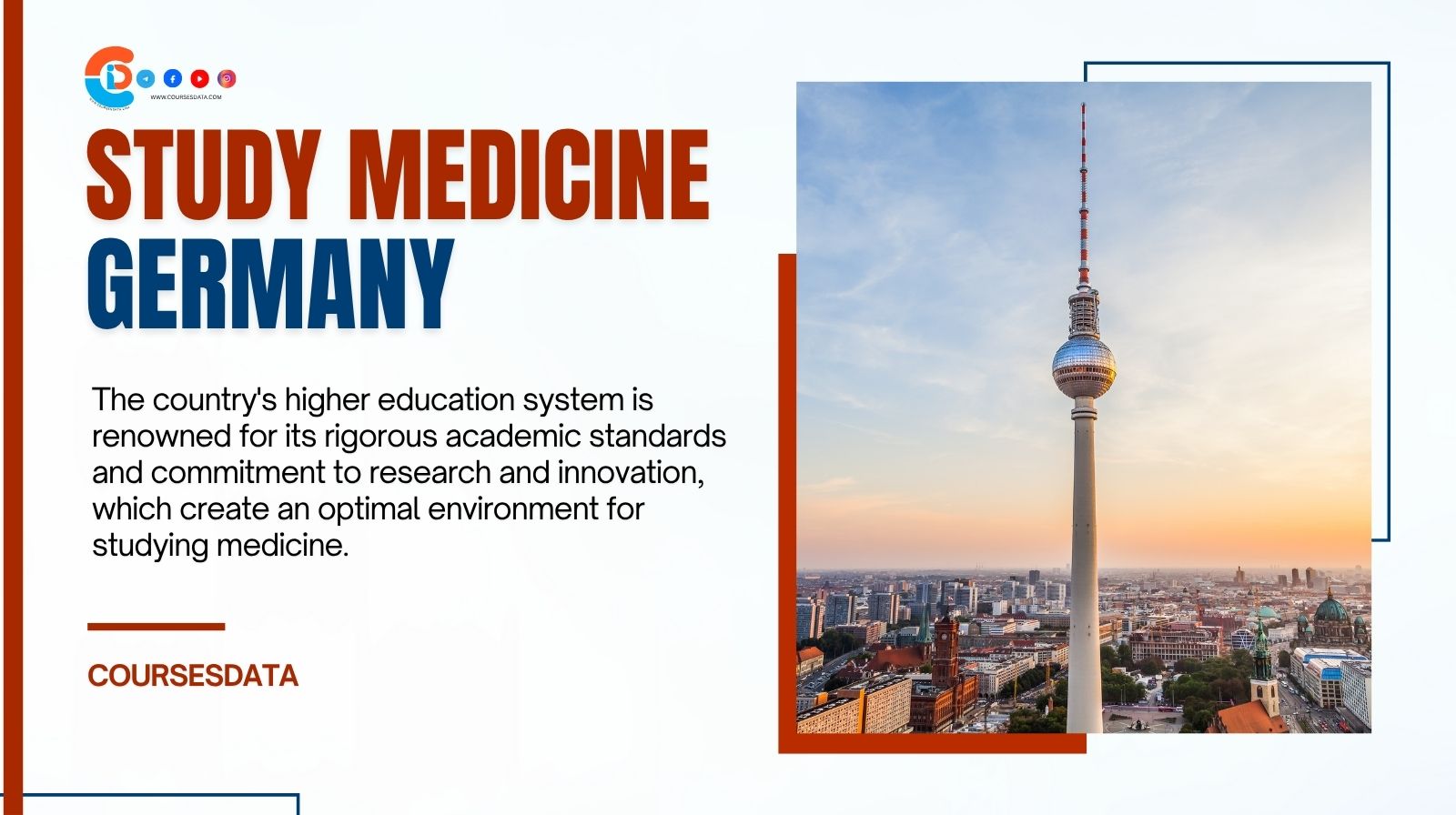
Are you planning to study medicine in Germany and wondering what steps to take?
Germany is one of the top destinations for international students pursuing a medical degree. It offers high-quality education, affordable tuition, and globally recognized qualifications. Here’s everything you need to know about how to study medicine in Germany and what makes it a smart choice.
Why Study Medicine in Germany?
Germany is renowned for its rigorous academic system and world-class healthcare infrastructure. Medical universities here are research-oriented and provide hands-on clinical experience, ensuring graduates are well-prepared for global practice.
- Tuition-free education at public universities
- Globally respected medical degrees
- Access to modern hospitals and labs
- Strong focus on research and practical training
- Courses aligned with EU medical standards
- High demand for medical professionals in Germany
- Extensive post-graduate opportunities
- Student-friendly visa and residence policies
- Central location in Europe for travel and networking
- Excellent public health and safety systems
Entry Requirements for Studying Medicine in Germany
To study medicine in Germany, international students must meet specific academic and language requirements. These ensure students are prepared for the demanding curriculum and patient interactions.
- Secondary school certificate equivalent to Abitur
- Proof of academic excellence (high GPA or grades)
- German language proficiency (TestDaF or DSH certificate)
- Passing the “Feststellungsprüfung” if required
- Pre-medical or foundation year for non-EU qualifications
- High scores in biology, chemistry, and physics
- Motivation letter and CV
- Valid student visa
- Health insurance coverage
- Financial proof for living costs (~€11,208 per year)
Top Medical Universities in Germany
Choosing the right university is key to a successful medical career. Germany is home to many prestigious institutions that offer medical programs in German, with some offering English-taught preclinical courses.
- Heidelberg University
- Charité – Universitätsmedizin Berlin
- LMU Munich (Ludwig Maximilian University)
- RWTH Aachen University
- University of Freiburg
- University of Tübingen
- University of Würzburg
- University of Hamburg
- Goethe University Frankfurt
- University of Leipzig
Structure of Medical Studies in Germany
Medical education in Germany follows a structured path combining theory, laboratory work, and clinical experience. It usually takes six years and three months to complete.
| Phase | Duration | Focus Areas |
|---|---|---|
| Pre-clinical Phase | 2 years | Basics in anatomy, physiology |
| First Medical Exam | After 2 years | State examination (“Physikum”) |
| Clinical Phase | 3 years | Disease study, diagnosis, therapy |
| Practical Year | 1 year | Hospital internships |
| Final Medical Exam | End of year 6 | Second state examination |
- Curriculum includes theoretical and clinical training
- Strong emphasis on scientific research
- Mandatory hospital rotations
- Taught in German (language proficiency essential)
- Followed by optional specialization (residency)
- Regulated by the German Medical Licensing Act
- Includes exams after each phase
- Integrated emergency medicine training
- Internship involves direct patient interaction
- Licensure granted after final exam and approval
Costs of Studying Medicine in Germany
Studying medicine in Germany is financially accessible, especially at public universities. However, students still need to budget for living expenses, books, and administrative fees.
- Tuition: Free at public universities
- Semester contribution: €250 to €350
- Health insurance: ~€110/month
- Rent and utilities: €300 to €600/month
- Food: €150 to €250/month
- Transport: Semester ticket usually included
- Books and supplies: ~€50/month
- Leisure/personal expenses: €100 to €150/month
- Total estimated monthly cost: €850 to €1,100
- Annual financial proof required: €11,208
How to Apply to Medical Universities in Germany
Applying to a German medical university involves several steps. It’s important to start early and ensure all documents are properly translated and certified.
- Choose your universities (based on ranking and location)
- Check specific university requirements
- Use Uni-Assist for application submission
- Submit high school diploma and transcripts
- Provide German language certificates
- Include motivation letter and CV
- Apply for APS certificate (for some countries)
- Await admission confirmation (“Zulassungsbescheid”)
- Apply for a student visa
- Arrange accommodation and health insurance
Is Medicine in Germany Taught in English?
Medical degrees in Germany are primarily taught in German. However, some universities offer English-taught pre-med or preparatory courses.
- Pre-med programs available in English
- Medical degree itself taught in German
- TestDaF or DSH required for admission
- Clinical training involves German-speaking patients
- Some private universities may offer bilingual courses
- German proficiency crucial for licensure
- English-only programs limited in scope
- Language learning supported by universities
- Free German courses often available
- Early language preparation highly recommended
Residency and Specialization After Graduation
After obtaining the medical license (Approbation), graduates can apply for residency (“Facharztausbildung”) in their chosen field. Residency is paid and leads to specialist certification.
- No centralized application system
- Apply directly to hospitals or clinics
- Duration: 5 to 6 years depending on specialty
- Fully salaried positions (~€4,500/month average)
- Covers specialties like surgery, internal medicine, etc.
- Ends with a board examination
- Recognized across EU countries
- Opportunities to stay and work in Germany
- German language required throughout
- Attractive for long-term career building
Frequently Asked Questions
Can international students study medicine in Germany for free?
Yes, most public universities in Germany offer tuition-free medical education to both EU and non-EU students. However, living expenses must be covered.
What GPA is required to study medicine in Germany?
A high GPA, especially in science subjects, is necessary. German universities use a highly competitive system, and top grades increase your chances of admission.
Do I need to speak German to study medicine in Germany?
Yes. Medical programs are conducted in German, and clinical work requires communication with patients in German.
How long does it take to become a doctor in Germany?
It typically takes 6 years and 3 months of academic and clinical training, plus residency for specialization.
Is Germany a good place to study medicine?
Absolutely. Germany offers world-class education, extensive practical training, and globally recognized degrees, making it an ideal place to study medicine.
Are medical degrees from Germany recognized internationally?
Yes. German medical degrees are well-respected and recognized throughout the EU and many countries worldwide.
Can I work while studying medicine in Germany?
Yes, students can work part-time (up to 20 hours/week), but medical studies are demanding, so balancing both can be challenging.
What is the Numerus Clausus (NC)?
NC is the minimum GPA requirement for admission to competitive programs like medicine. Each university sets its own NC.
How do I prepare for medical school in Germany?
Focus on science subjects, learn German early, and consider enrolling in a Studienkolleg (foundation course) if needed.
Can I stay in Germany after graduation?
Yes. Graduates can apply for a residence permit to stay and work in Germany after completing their studies.
Conclusion
Studying medicine in Germany is a smart investment in a global medical career. It offers high-quality education, clinical excellence, and a solid path to specialization.
This is exactly the kind of breakdown I wish I’d had before I started applying. The part about tuition-free education sounds amazing, but I’ve heard the real challenge is the language barrier—most programs require near-native German, even if they’re listed as “English-friendly.” Did you find it difficult to meet the language proof requirements, or was there a specific prep course that helped you get through the TestDaF?
You’re spot on about the language barrier—it’s the real gatekeeper, not the tuition. I honestly struggled more with the TestDaF than I did with my first anatomy exam, and I ended up doing an intensive 8-week *Vorbereitungskurs* at the Goethe-Institut that finally clicked for me. The key was practicing mock *mündlicher Ausdruck* sessions with a native tutor who drilled me on medical scenarios, which made the actual test feel a lot less intimidating.
Ah yes, “tuition-free” — the siren call that lures you in before the German language rises up like a bureaucratic kraken. I spent a solid six months convincing myself that “eine Tablette” meant “a tablet computer” and nearly ended up asking a pharmacist for an iPad. The TestDaF prep course helped, but what really stuck was forcing myself to watch German medical dramas where the dialogue was 70% panic and 30% anatomical terms I still can’t pronounce. Does anyone else feel like the C1 requirement is really just a secret test of how much suffering you’re willing to endure before setting foot in a lecture hall?
Oh, Jasper, your “bureaucratic kraken” line had me laughing out loud—and wincing in solidarity! I totally get that feeling of staring at a word like *Krankenversicherung* and wondering if you’ve accidentally signed up for a medieval torture system instead of health insurance. Honestly, I tackled the C1 monster by labeling everything in my apartment with sticky notes and narrating my entire morning routine in German, from *Kaffee kochen* to a dramatic recounting of stubbing my toe. It felt ridiculous, but by exam day, I could argue about my phantom iPad prescription and conjugate *verschreiben* in my sleep!
Your “bureaucratic kraken” is the most accurate description of German paperwork I’ve ever encountered—I’m still convinced my application to the *Studienkolleg* required a blood sample and a signed oath in triplicate. And yes, the C1 requirement feels less like a language test and more like an endurance trial for how many compound nouns you can survive before they let you near a cadaver lab. The medical dramas are a brilliant tactic, though; I found that yelling *”Notaufnahme!”* at my TV during *Charité* somehow made the vocabulary stick better than any flashcard ever did.
Eleanor, I’m still convinced my *Studienkolleg* application needed a lock of hair and a blood type confirmation, so I feel that. The screaming-at-*Charité* method is exactly how I finally learned *Krankenwagen* without freezing up—turns out pure panic is the best language teacher.
Jasper, you’ve nailed it—the C1 requirement is basically a hazing ritual for future doctors. I spent three months watching *Charité* on repeat and learned that *Blutvergiftung* sounds way scarier than “blood poisoning,” but at least the medical dramas stick better than textbooks. The secret is treating the language prep like a pre-med boot camp: suffer through it now, or suffer in a German lecture hall later.
You’ve absolutely nailed it with the boot camp mindset—I wish I’d thought of it that way before I started. I spent a month trying to memorize *Geburtshilfe* by repeating it while making tea, and all I got was a burnt kettle. Watching *Charité* with subtitles off was what finally made the compound words stick, even if I still panic at *Krankenhaus* when it’s shouted in an emergency scene.
The sticky note idea is genius—I covered my entire kitchen in *der Kühlschrank* and *die Spülmaschine* labels, only to realize I’d been calling my fridge “the cool cupboard” in my head for weeks. One thing I haven’t seen mentioned yet is how the *Numerus Clausus* (NC) cutoff can vary wildly by university, so applying broadly to less competitive schools might save you a year of waiting. Did anyone else find that their high school grades mattered less than nailing the *Hochschulzugangsberechtigung* recognition process?
Right, so I’m sitting here with a sticky note that says *der Kühlschrank* stuck to my forehead, and I’m starting to think the real NC cutoff is how many compound nouns you can survive without questioning your life choices. That bit about applying to less competitive schools is a lifesaver, though—did anyone else find that the *Hochschulzugangsberechtigung* process was basically a black box where you just mail documents and hope a German bureaucrat doesn’t demand a signed blood oath in triplicate? I’m half-convinced the C1 requirement is just a clever way to weed out anyone who isn’t stubborn enough to conjugate *verschreiben* while crying over a burnt kettle.