The Soongsil University Scholarship helps international students reduce tuition costs in Seoul, South Korea. Undergraduate entrance awards depend on Korean-language qualifications, while graduate tuition support follows a separate scheme.
A qualifying undergraduate with TOPIK Level 6 can receive a full first-semester tuition waiver. Plan your application around the degree, language route, and renewal conditions that apply to you.
Brief Description
- Host institution: Soongsil University.
- Location: Dongjak-gu, Seoul, South Korea.
- Scholarship type: institutional tuition support.
- Study levels: undergraduate, master’s, and doctoral.
- Applicant category: qualifying international degree students.
- Undergraduate routes: new admission and eligible transfer admission.
- Main entrance-award criterion: recognized Korean-language proficiency.
- Continuing undergraduate assessment: academic results, credits, and TOPIK.
- Graduate administration: the General Graduate School and relevant department.
- Application route: the university’s official degree-admission system.
About Soongsil University
Soongsil is a private university founded in 1897. Its Seoul campus brings together humanities, social sciences, business, natural sciences, engineering, computing, and artificial intelligence.
International undergraduates receive academic Korean and writing support, tutoring, and learning coaching. TOPIK study groups help students strengthen the language skills needed for university study.
The university also offers mentoring, multilingual counseling, and employment preparation. Compare the actual curriculum and teaching language of your department when deciding whether Soongsil fits your goals.
About the Soongsil University Scholarship
- Entrance and continuing undergraduate awards are assessed under different rules.
- The entrance award applies immediately after admission for one semester.
- Only one entrance scholarship category is awarded.
- Completing Soongsil’s Korean-language course can provide an alternative entrance-award route.
- A passing university Korean test and an excellent test score serve different purposes: admission and scholarship assessment.
- Continuing undergraduate merit awards are assessed automatically, but TOPIK evidence must reach International Affairs.
- Graduate tuition assistance requires continued academic eligibility.
- Institutional degree scholarships are separate from exchange-student funding and government scholarships.
Fields of Study
The undergraduate international admissions guide lists the following departments and majors. Transfer restrictions apply to Film Arts, Architecture, Electronic Engineering, and AI Software; use the admissions guide to choose the permitted entry route.
- Christian Studies
- Korean Language and Literature
- English Language and Literature
- German Language and Literature
- French Language and Literature
- Chinese Language and Literature
- Japanese Language and Literature
- Philosophy
- History
- Film Arts
- Sports
- Law
- International Legal Affairs
- Social Welfare
- Public Administration
- Political Science and Diplomacy
- Information Sociology
- Mass Communication
- Lifelong Education
- Economics
- Global Commerce
- Business Administration
- Accounting
- Entrepreneurship and Small Business
- Finance
- Mathematics
- Physics
- Chemistry
- Statistics and Actuarial Science
- Medical-biosystematics
- Chemical Engineering
- Materials Science and Engineering
- Electrical Engineering
- Mechanical Engineering
- Industrial and Information Systems Engineering
- Architectural Design and Architectural Engineering
- Computer Science and Engineering
- Electronic Engineering
- Global Media
- AI Software
Graduate programs have their own department and degree-availability tables. The official graduate admissions information provides the department list and the route to the governing admission guide. Select your exact master’s or doctoral program from that guide; undergraduate availability does not establish graduate eligibility.
Graduate study fields in the current guide are grouped below. Degree availability and special restrictions differ by department, so confirm the master’s or doctoral column before applying.
- Humanities and social sciences: Korean Language and Literature; English Language and Literature; German Language and Literature; French Language and Literature; Chinese Language and Literature; Philosophy; History; Lifelong Education; Sports for All; Creative Writing; Christian Studies; Law; Social Welfare; Public Administration; Political Science and International Relations; Mass Communication; Information Sociology; Business Administration; Economics; International Trade; Accounting; Venture and Entrepreneurship; Finance; Global Law.
- Natural sciences: Mathematics; Physics; Chemistry; Statistics and Actuarial Science; Bioinformatics and Life Science.
- Engineering and computing: Chemical Engineering; Materials Science and Engineering; Electronic Engineering; Electrical Engineering; Mechanical Engineering; Industrial and Information Systems Engineering; Architecture and Architectural Engineering; Information and Telecommunication Engineering; Interior Design; Computer Science and Engineering; Digital Media; Software; AI Convergence.
- Interdisciplinary study: IT Policy and Management; Metaverse and Culture Contents; Financial Technology Convergence; IT Logistics and Distribution; Disaster and Safety Management; Christian Leaders for National Unification; Smart Wearables Engineering; Security and Public Weal Management; Safety and Health Convergence Engineering; Green Chemistry and Materials Engineering; Intelligent Semiconductors; Energy Policy and Technology Convergence; Future Education Management.
- Restricted specialist route: AI-Techno Convergence has employment-related eligibility and a separate funding framework. Project Management does not accept international applicants in the current guide.
Target Group
- Foreign-national applicants whose parents both hold foreign nationality.
- School graduates seeking a first university degree.
- College or university students who meet an eligible undergraduate transfer route.
- Bachelor’s graduates applying for a master’s degree.
- Master’s graduates applying for a doctoral degree.
- Enrolled international undergraduates seeking continuing merit support.
- International graduate students maintaining the required academic standing.
Korean dual nationality does not qualify for the international admission category. Applicants with a history of Korean nationality must provide the evidence required by their admission guide.
Scholarship Benefits
The university’s international undergraduate scholarship rules distinguish the following benefits. Each applicant receives the award matching the applicable category.
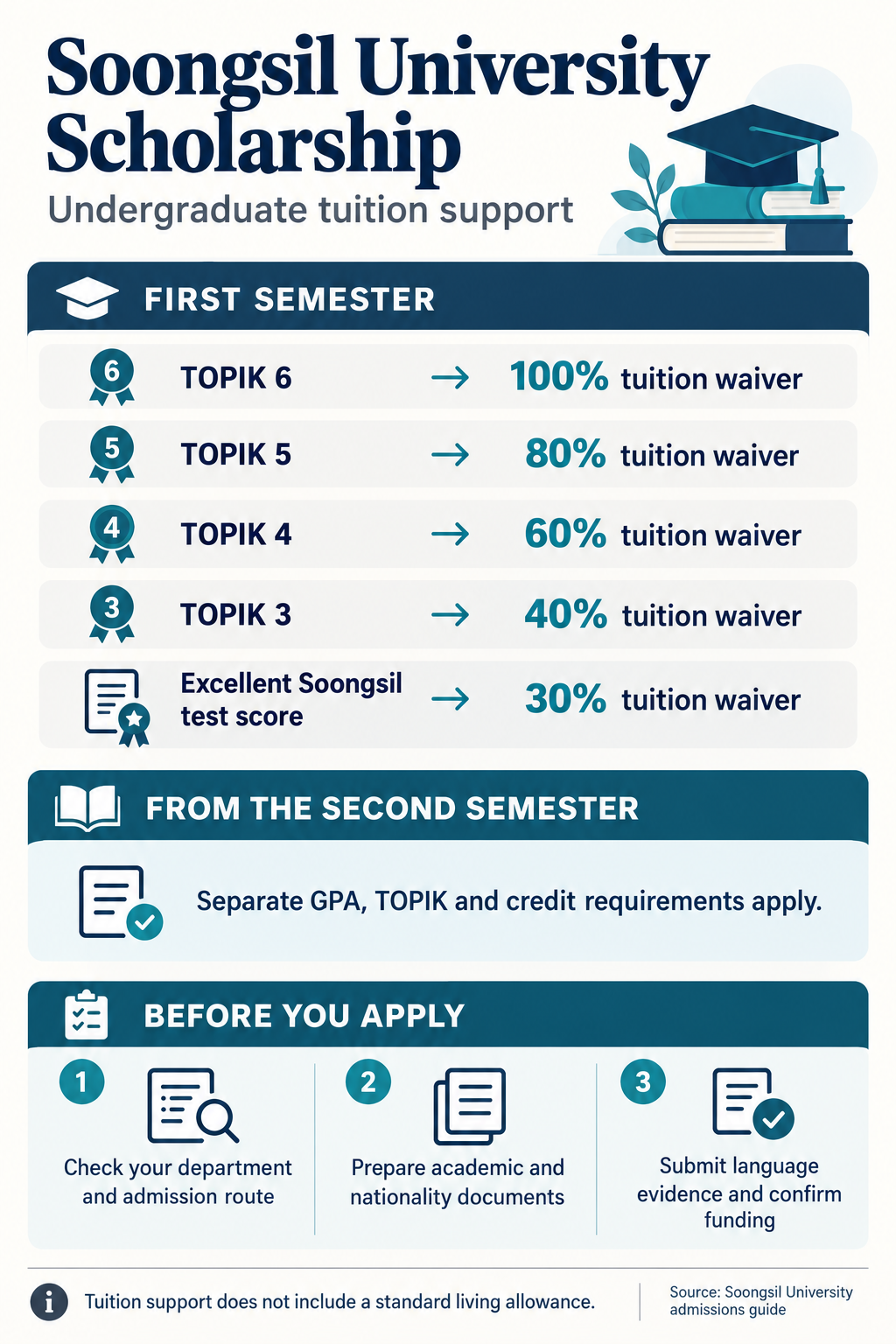
- TOPIK Level 6: 100% undergraduate entrance tuition waiver.
- TOPIK Level 5: 80% undergraduate entrance tuition waiver.
- TOPIK Level 4: 60% undergraduate entrance tuition waiver.
- TOPIK Level 3: 40% undergraduate entrance tuition waiver.
- Excellent Soongsil Korean test result: 30% undergraduate entrance tuition waiver.
- Qualifying completion of Soongsil Korean Level 4 or higher: 40% undergraduate entrance tuition waiver.
- Continuing undergraduate merit: tuition reductions linked to university grades and language results.
- Undergraduate TOPIK achievement: a one-time KRW 200,000 award for eligible students who newly meet the published conditions.
- Graduate humanities and social sciences: 50% tuition support under the international-student scholarship.
- Graduate natural sciences and engineering: 60% tuition support under the international-student scholarship.
- Graduate language achievement: the current admission guide lists a one-time KRW 300,000 additional award for TOPIK Level 5 or above.
Budget separately for housing, meals, travel, insurance, and fees outside the tuition award. These institutional awards do not provide a standard living allowance.
Soongsil University Scholarship Duration
- Bachelor’s: most undergraduate programs require eight semesters, normally four years; Architectural Design follows a five-year curriculum. New-entry scholarship eligibility is capped at eight semesters.
- Sophomore transfer: undergraduate scholarship eligibility is capped at six semesters.
- Junior transfer: undergraduate scholarship eligibility is capped at four semesters.
- Master’s: plan around the regular two-year, four-semester course; the standard international graduate scholarship is listed for a maximum of four semesters.
- Doctoral: regular coursework normally spans four semesters, with dissertation work and degree completion depending on research progress. Confirm the scholarship end point separately from your expected graduation.
Soongsil University Scholarship Requirements
Admission eligibility comes first. Prepare evidence of your nationality, academic history, language proficiency, and finances, then check the conditions attached to your particular tuition award.
- Use the international admission category appropriate to your nationality history.
- Hold the previous qualification required for your degree.
- Submit complete records from recognized educational institutions.
- Provide valid language evidence accepted for your program.
- Meet department-specific evaluation and supporting-document requirements.
- Authenticate overseas academic documents in the required form.
- Provide certified Korean or English translations when required.
- Supply financial evidence for admission certification and the student-visa process.
- Complete enrollment even when the tuition payable is zero.
- For graduate scholarship continuation, maintain a GPA of at least 3.0 under the published international-student scheme.
For current new-entry undergraduate merit rules, the highest continuing waiver requires GPA 4.3 or above, TOPIK 6, and the qualifying credit load. The highest tier normally requires 15 previous-semester credits, with 12 accepted for the specified penultimate-semester exception. Lower tiers require TOPIK 4 or above and at least 12 credits: 50% for GPA 3.8 or above, 40% for GPA 3.5 to below 3.8, and 20% for GPA 3.0 to below 3.5. The university’s current table governs the assessment.
Admission Requirements by Degree
Bachelor’s and Undergraduate Transfer
- New entrants must complete recognized elementary and secondary education or its equivalent.
- For most majors, satisfy one accepted Korean route: TOPIK 3 or above, qualifying Soongsil Korean Level 3 completion, King Sejong Institute Intermediate 1 completion, or at least 60/100 on the Soongsil Korean proficiency test.
- Film Arts requires TOPIK 4 or above and its additional evaluation materials.
- Sophomore transfer requires qualifying college graduation or at least one university year with the specified credits.
- Junior transfer requires qualifying college graduation or at least two university years with the specified credits.
- Check institution recognition and restrictions on online, alternative, and equivalency education in the undergraduate guide.
Master’s Degree
- Hold or expect to obtain a four-year bachelor’s degree or an accepted equivalent.
- Submit Korean or English proficiency evidence accepted by the Graduate School.
- The general language routes include TOPIK 3 or above or IELTS 5.5 or above; departmental requirements can be higher.
- Prepare a study plan and academic records for document review and interview.
- Use a language-certificate exemption or departmental confirmation only when the official guide permits it.
Doctoral Degree
- Hold or expect to obtain a master’s degree.
- Meet the graduate language requirement and any stricter departmental condition.
- Submit records for all previous degree courses.
- Provide the prescribed professor recommendation.
- Explain your research interests and academic preparation during evaluation.
- Confirm subject-specific restrictions, including prior-degree requirements for Christian Studies.
Application Instructions
Step 1: Choose the Correct Admission Route
- Open the official international undergraduate admissions guide for bachelor’s and transfer applications.
- For master’s or doctoral study, open the General Graduate School admissions page and its current guide.
- Check that the department accepts your degree and entry category.
Step 2: Check Language and Funding Eligibility
- Match your language certificate to the admission requirement.
- For an undergraduate entrance award, identify the scholarship category supported by your result.
- Prepare a budget showing the tuition balance and your living costs.
Step 3: Register in the Official Application System
- Follow the online application link supplied by the relevant admissions office.
- Create the required account and enter your name exactly as it appears in your passport.
- Select the department, degree, and entry route carefully.
Step 4: Complete the Form and Application Payment
- Enter your education, citizenship, language, and contact details.
- Pay the application fee using the method specified for your route.
- Print the admission ticket or application summary and sign forms that require a signature.
Step 5: Submit the Supporting Documents
- Prepare authenticated certificates and translations before assembling the final package.
- Submit originals or certified copies through the channel specified in the guide.
- Graduate applicants must complete the document submission in addition to online registration.
- Keep copies and proof of delivery, then check the recorded submission status.
Step 6: Complete Evaluation and Enrollment
- Attend the required interview or departmental evaluation; follow the instructions for overseas applicants.
- Check results through the official application system.
- Read the award and tuition bill before accepting your place.
- Complete registration, financial verification, student-visa arrangements, and any required final-degree submission.
Documents Required for Registration
- Online admission ticket or application summary
- Signed application forms
- High-school graduation certificate and transcripts for undergraduate entry
- College or university enrollment, completion, or graduation evidence for transfer
- Transfer academic transcripts and credit information
- Bachelor’s degree certificate and transcripts for graduate entry
- Master’s degree certificate and transcripts for doctoral entry
- Graduate study plan
- Graduate Release of Information Form
- Doctoral recommendation letter
- Applicant’s passport copy
- Applicant’s and parents’ identification documents
- Government-issued family relationship evidence
- Nationality-history certificates where applicable
- Alien Registration Card where applicable
- Accepted Korean or English language certificate
- Korean-language institute records where applicable
- Bank balance certificate
- Apostille, consular authentication, or other prescribed academic verification
- Certified translations where required
- Film Arts self-introduction video link where applicable
- Additional department-specific documents
Important Application Tips
- Choose the department for its curriculum and your goals.
- Prepare Korean for academic study as well as testing.
- Check certificate validity before submitting.
- Keep passport-name spelling consistent.
- Ask your previous institution about authentication early.
- Write a specific, evidence-based study plan.
- Discuss graduate research fit with the department.
- Track document delivery and application status.
- Reserve funds for costs beyond tuition.
- Keep scholarship renewal conditions beside your study plan.
The Soongsil University Scholarship can make a Seoul degree more affordable when your language preparation and academic record match the award rules. Choose the correct admission route, submit a complete application, and plan funding for the full degree rather than relying only on the entrance award.
Frequently Asked Questions
Does the scholarship cover all living costs?
The institutional scholarships described here mainly reduce tuition. Arrange separate funding for accommodation, food, transport, travel, and other personal expenses.
Can I apply with an English certificate for a bachelor’s degree?
The standard undergraduate international route requires one of the accepted Korean-language qualifications. An English certificate alone does not replace that requirement.
Does completing Korean Level 3 qualify me for the language-course entrance award?
Soongsil Korean Level 3 can meet the general admission language route for most majors. The language-course entrance scholarship requires qualifying completion of Level 4 or higher.
Can I combine two undergraduate entrance scholarships?
No. The undergraduate guide awards only one entrance scholarship category.
Will the entrance scholarship remain unchanged until graduation?
No. Subsequent semesters use the continuing-student rules, so your grades, earned credits, and TOPIK result determine later support.
Is there a separate scholarship application for continuing undergraduate merit support?
The merit tuition reduction is assessed automatically. You must still submit TOPIK evidence to International Affairs as instructed; the TOPIK achievement cash award has its own application procedure.
Can I transfer into any undergraduate department?
No. Some listed departments do not accept transfers. Confirm the restriction for your exact major before selecting an entry year.
Do graduate applicants need a recommendation letter?
The international graduate document checklist specifically requires the prescribed professor recommendation for doctoral applicants. Follow additional departmental instructions for your chosen program.
Can an expected graduate apply?
Expected graduates can apply when the relevant guide permits it. Admission remains conditional on obtaining the required qualification and submitting the final evidence.
Is a zero tuition bill enough to complete enrollment?
No. Full tuition scholarship recipients must complete the university’s registration procedure, including the zero-payment process when applicable.